To avoid these ads, REGISTER NOW!

Faced batt insulation and plastic vapor barrier?

walrus

Well-known member
Joined
Nov 12, 2008
Messages
11,679
Location
Maine
Does anyone know if I have to seal the cracks where the 2x4's meet the sheathing?

Do i need to use caulk/ foam, or does it not make a difference and i can skip it? Looking to start today.

Only going to heat the garage 3 days a month in the winter...

Thanks!

I would seal the holes where the wire goes thru top plate.
 
To avoid these ads, REGISTER NOW!

CombatNinja

Well-known member
Joined
Aug 24, 2013
Messages
1,456
Seal up every single hole and air gap that you can, period. Never once have I built something and had the comment later that it is sealed up "too well" and somebody wishes it were draftier or more expensive to climate control. At that price difference, I would use rock wool over the fiberglass.
 

rerod

Well-known member
Joined
Jan 30, 2015
Messages
376
Location
North English Iowa
Seal up every single hole and air gap that you can, period. Never once have I built something and had the comment later that it is sealed up "too well" and somebody wishes it were draftier or more expensive to climate control. At that price difference, I would use rock wool over the fiberglass.

Bingo! Adding more insulation for energy efficiency past R13 is worthless without a tight building. Air changes per hour.. Or less than 1 ACH

Poly is evil imo. What happens when you install tyvek on the outside and then condensation due to temperature differences, cant escape the cavity? Id tape and seal off plywood seams and gaps, use faced fiberglass, and then seal the drywall with caulk before hanging, but never paint with oil base. That's how all the fema trailers failed by using unpermeable wall paper and AC in humid area's rotted them out.
 

DFB

Well-known member
Joined
Sep 7, 2016
Messages
5,765
Location
Southern VT/Western Mass
I recently seen an older YouTube video (done like 4 years ago) of the This Old House that crew going over and explaining the various insulation materials and costs on the market at the time. They showed using a clear vapor retarder over unfaced insulation like rock wool though wasn't an impermeable poly but was breathable enough not to trap in moisture.

I'm not at all familiar with it... does any else know what it is or a maybe a name
 

rayra

Well-known member
Joined
Dec 1, 2014
Messages
4,724
Location
Escaped from Los Angeles
skip This Old House and go directly to teh building science institute or to Matt Risinger's Youtube channel and get all the REAL info about vapor barrier use and where and when NOT to.

too, those 'FEMA trailers' were brand new. The 8A assholes that got them complained about the 'new car' stink and nobody could satisfy the recipients and then the bigger morons in the media started squawking about 'formaldehyde' - in the glue for carpet and plywood, it's why new carpet stinks etc - and THEN all the headlines were 'Bush FEMA trying to poison our community!'

The reason those trailers are rotted is they were left, abandoned, everythign wide open trying to air them out. Left to rot.
There was NOTHING wrong with them. Our govt spent top dollar to get them there and morons rejected them. And then our government left them to rot.
 
Last edited:

rerod

Well-known member
Joined
Jan 30, 2015
Messages
376
Location
North English Iowa
skip This Old House and go directly to teh building science institute Our govt spent top dollar to get them there and morons rejected them. And then our government left them to rot.

Interesting you mentioned building science institute, because it was Joe Lstiburek the founder of Building Science Corporation who wrote about the fema trailers and other examples of trapping moisture inside the wall cavitys he inspected. I have no idea or even care about the politics. Only the real life example and results or what not to do.

Joe said.. "Let’s move on to FEMA and New Orleans and Katrina. It is hard to believe this if you have not seen this with your own eyes. Trailer after trailer after trailer (Photograph 5). Where is New Orleans on the map? It is smack dab in the ASHRAE hot-humid climate region. Most of us intuitively know that this means it is pretty much hot and humid outside almost all the time in New Orleans. Here is the tricky part—we air condition the inside in New Orleans. Yes, it is true. We make the inside colder and drier than the outside in New Orleans. So, work with me on this…the outside is hot and humid and the inside is cold and dry. It is that pesky Second Law again. What direction is the vapor drive? We can actually use a pyschrometric chart for this example and not have to go to the steam tables—so it is not as hard as NASA’s problem. With a dominant inward vapor drive (there is not much of a winter in New Orleans) what is the last thing you would want to see on the inside of an assembly in New Orleans? Yes, that is right, a vapor barrier. You absolutely positively would not ever want to see a vapor barrier on the inside of an air-conditioned assembly in New Orleans. Yes, you guessed it. All FEMA trailers have an interior vapor barrier (Photograph 6). The FEMA trailers are lined with gypsum board wrapped with vinyl facings. And they are turning the trailers into moldy stinky messes. And it is not like FEMA wasn’t warned. They and HUD and the mobile home/manufactured home industry all blindly continue to believe that this is not a problem. But hey, it is poor people in these trailers, who is going to notice?

https://www.buildingscience.com/documents/insights/bsi-021-thermodynamics-its-not-rocket-science

I recently seen an older YouTube video They showed using a clear vapor retarder over unfaced insulation like rock wool though wasn't an impermeable poly but was breathable enough not to trap in moisture.
I'm not at all familiar with it... does any else know what it is or a maybe a name

Ive never heard of clear plastic poly that was permeable. Polyethylene is a vapor barrier not retarder.

Main thing is to allow any condensation that forms on super hot and cold days to escape, so using any vapor retarder on both sides of the wall is a bad approach. Next to each other would be ok I guess.

Matt Risinger learned allot of what he knows from Martin Holladay so I spend time at Greenbuildingadvisor.com
 
Last edited:
To avoid these ads, REGISTER NOW!
OP
1

191185

Active member
Joined
Mar 27, 2018
Messages
30
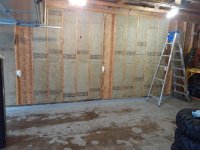
Hey guys, just an update, I got about half my garage done with the rockwool, Holy cow is that easy to work with..

Anyway, I'm still on the fence about using Sheetrock or Plywood.

IF, I did go with plywood, is the nicer stuff worth the extra cost ? should i go 1/2 inch, 3/8th ?
 

Attachments

  • 20191225_140316.jpg
    20191225_140316.jpg
    150.7 KB · Views: 72

rerod

Well-known member
Joined
Jan 30, 2015
Messages
376
Location
North English Iowa

yeldogt

Well-known member
Joined
Jan 2, 2012
Messages
18,184
If you look at TOH or Matt Risinger -- over time things change. Matt is IMO way too commercial now.

I did think it was interesting how Matt has walked back the way he installed windows years ago ... no pans.

Early TOH had a house where they used typically fiberglass w/ craft -- cut the kraft and did polly over it .... I would like to see how that worked out. Norm has long ago said that was a mistake ... as was polly alone.

One must keep in mind that fiberglass batts is really at the bottom of the list of insulation products. It works when there is no air movement -- since modern fiberglass allows air movement ..and leak will compromise the product. It's cheap ... that;s the selling point.

Old style fiberglass -- glass wool ...was very dense. Same with the old blow in stuff -- it would stop air movement. When you stop air movement in many climates the VB need drops ... or can be eliminated.

If you read various papers on the best way to install kraft faced fiberglass -- you will see people giving reason for both the tab over the stud and on the side. The side people usually want a continuous bead of construction adhesive on the studs so the drywall is an air sealing barrier.

IMO it's always a good practice to seal the top and bottom plate and the stud holding the sheathing joint --
 
To avoid these ads, REGISTER NOW!
Top Bottom