At least he showed up, right?


At least he showed up, right?
I had an electrical final inspection today (all EMT so no nail plates) but I asked. Rural area, inspection service works in many jurisdictions. NYS (amended 2017 NEC) says 1 1/4", and it applies where I live. Some jurisdictions require nail plates on all holes regardless of depth. Local jurisdictions can be more restrictive than state code but not less.My experience is the inspector wants nail plates on all pipes and conduit, regardless of depth.
I had an electrical final inspection today (all EMT so no nail plates) but I asked. Rural area, inspection service works in many jurisdictions. NYS (amended 2017 NEC) says 1 1/4", and it applies where I live. Some jurisdictions require nail plates on all holes regardless of depth. Local jurisdictions can be more restrictive than state code but not less.
Air exchangers have been required in Minnesota since 2000. The outgoing air conditions the incoming air. There is always going to be some loss, but I assume it is less than letting the building breath on its own.You know what the ironic part is? All this sealing creates tight buildings, the air goes stale, and you have to add forced ventilation to maintain air quality.
Is that so the propane burner can always get combustion air.We don't have a whole house air ventilation system but the heat pump does. The heat pump has propane backup heat so there is a 3" pvc pipe to the inlet side that runs to the outside of the house. I was told this was a code requirement and wasn't needed if we had electric backup heat.
Could be. The heat pump inside unit is a big aluminum box that I have not had a need to get inside of so I am not exactly sure where the pvc pipe goes. After we moved in I thought it might be a good idea to label all the pipes, hoses etc that feed the heat/AC and the water heater which is about 2ft away. So I followed all of them to determine where they went and remembered that comment from the builder.Is that so the propane burner can always get combustion air.
Yes, but outside air for two reasons. One is if it pulled from inside the house would depressurize and pull in cold air to replace what was sent up the exhaust flue.Is that so the propane burner can always get combustion air.
We have the same reasons and very similar building regulations in the UK, since houses have been made much more air tight actual ventilation has to be calculated and added to all for air changes.Yes, but outside air for two reasons. One is if it pulled from inside the house would depressurize and pull in cold air to replace what was sent up the exhaust flue.
The other is safety. Say you have another appliances like a traditional gas water heater with a NA flue.
If you pulled air from inside, it could try to bring air from outside down the chimney and cause carbon monoxide to be pulled down with it.
I think this may be the reason since the propane water heater is right next to the heat/ac inside unit. The water heater has a squirrel cage fan for it's exhaust but it has a small inlet on it also.Yes, but outside air for two reasons. One is if it pulled from inside the house would depressurize and pull in cold air to replace what was sent up the exhaust flue.
The other is safety. Say you have another appliances like a traditional gas water heater with a NA flue.
If you pulled air from inside, it could try to bring air from outside down the chimney and cause carbon monoxide to be pulled down with it.

Does anyone know if you can sit your HVAC on a drainage easement? The addition we built is about three foot from a drainage easement (think a swell in the yard for water to flow to the street from the back). Mind you this is due to a 10 foot easement on both sides of the bottom of that ditch. I'll have to pour the HVAC slab about three foot into that. I'm thinking this may be a good example of asking forgiveness not permission, but I am curious if an HVAC counts as something installed that is immovable, which is what our codes office said is the no-no on anything put in a drainage easement.
Rather than a pad on the ground, can you bolt brackets to the house and elevate it off the ground?Does anyone know if you can sit your HVAC on a drainage easement? The addition we built is about three foot from a drainage easement (think a swell in the yard for water to flow to the street from the back). Mind you this is due to a 10 foot easement on both sides of the bottom of that ditch. I'll have to pour the HVAC slab about three foot into that. I'm thinking this may be a good example of asking forgiveness not permission, but I am curious if an HVAC counts as something installed that is immovable, which is what our codes office said is the no-no on anything put in a drainage easement.

Its a honkin' 4 ton. We have a 2.5 very crudely installed to just work for now, but I closed in my garage last year for the kids playroom. It added 483sqft and now the addition which will add another 486 sqft. Those bumped our house up from 1400 sqft to just over 2300 sq ft. The garage has a mini-split I installed but with all of this work and the fact that the new unit had to be bought anyway, I opted to have the HVAC guy (aka, my neighbor giving me a deal) install 10 new needed floor registers in the additions and one inlet in the main house. Also, we had to "settle" for a HEIL unit. 4 and 5 ton Rheems are on an insane backorder.When you say HVAC are you meaning a heat pump or something similar? If so and it's not a huge unit I'd look into mounting it on your external wall instead of on a small slab.
I would, but that 4 ton is very large and heavy. I'm going to just do the slab and hope the inspector doesn't look at the plat info again. He really has no reason I wouldn't think given the foundation inspection has already been done.Rather than a pad on the ground, can you bolt brackets to the house and elevate it off the ground?
We did a townhouse project and the end units of adjacent buildings butted a drainage easement. We bracket mounted the outdoor units in an elevated manner so would not be in the way should earthwork be needed to maintain the drainage. Not sure if what we did was legit or not but 6 years later nothing has come of it even though they had to dig up the drainage pipe for unknown reasons.
I would, but that 4 ton is very large and heavy. I'm going to just do the slab and hope the inspector doesn't look at the plat info again. He really has no reason I wouldn't think given the foundation inspection has already been done.
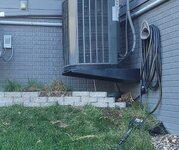
Mine is a all-in-one heat pump ducted into the crawlspace. If I was to go your route, I don't trust the bracket sitting right below a void in the wall for the ducts.My Trane 6 ton unit is mounted to the foundation with a metal frame
It was replaced 6 or 7 years ago before we bought so not sure if its been on that mount since it was built but it's rock solid and no issues
Makes sense, getting enough blocking and support in there with wood framing be more challengingMine is a all-in-one heat pump ducted into the crawlspace. If I was to go your route, I don't trust the bracket sitting right below a void in the wall for the ducts.
Probably. Unless in seismic zones C, or D2, D2, or D3, very little rebar is actually required by the IRC. A lot of builders will add it - "cheap insurance" - but the experts that write the code say it's not necessary. None in footings and none in shorter walls unless there is unbalanced fill and no dowels connecting footings and stem walls.You know, this is very late to the game, but in looking at pictures my wife (who is fairly ignorant to how homes are built) took of the addition build as a whole, I just realized that the concrete foundation was poured, but there is no rebar installed that ties it to the block wall above. This was all done in two days while I was at work. I sent a text to the concrete GC and he said that because it is not a retainage wall, it doesn't require rebar installed or tying it to the concrete underneath. Does this sound right for a mid-TN foundation?
Well, I guess that's good to know that they didn't eff up that part. Lord knows they had to come back and fix many issues.Probably. Unless in seismic zones C, or D2, D2, or D3, very little rebar is actually required by the IRC. A lot of builders will add it - "cheap insurance" - but the experts that write the code say it's not necessary. None in footings and none in shorter walls unless there is unbalanced fill and no dowels connecting footings and stem walls.
I think in TN absolutely.Is a vapor barrier in the crawlspace necessary? My HVAC guy came and ran the ductwork while I was on vacation this weekend unannounced. I'm sure he was trying to be helpful, but my crawlspace floor is so close to the joists that with his ductwork that runs the length of the crawlspace and is amost touching the gravel floor, I can't get around it to install poly. Its about six inches of gravel packed on the floor. Is the poly necessary?
I would use fireproof foam (orange).There is a 1/4 gap between the original subfloor and the additions subflooring due to working around a few wires I couldn't get removed when they stared building the addition. The wires are removed now but I need to seal it up. Its a run of about 1/4" x 27'. Would you use caulk or spray foam insulation?
Meh. It's there for drainage. I'd put an HVAC on it, as they are not perm structures. That'd be my call.Who's easement is it?