To avoid these ads, REGISTER NOW!

Failed nuclear density test so could not pour concrete.

ron in sc

Well-known member
Joined
Mar 19, 2006
Messages
1,071
Location
Charleston, SC
We were sure the pad for the concrete would pass the nuclear density test, which determines if the moisture levels, compaction and some other stuff are ok to pour. We were so sure the contractor even had most of wire, slab blosters and moisture barrier installed, see photo. That was on Tuesday. Apparently it had not dried out enough from all the rain we had on Saturday and Sunday.

Well we flunked the test so we has to wait until Friday to test again. That time we passed so we are supposed to pour on Monday at about 9:00 am.
 

Attachments

  • 000_0821.jpg
    000_0821.jpg
    64.1 KB · Views: 122
To avoid these ads, REGISTER NOW!
Joined
Oct 21, 2006
Messages
1,011
Location
charlotte nc
Sounds like something gov-co has come up with to justify another tax payer paid job to me.Gez man do they think you are building a nuclear reactor containment building or what?
 

dxdexter

Well-known member
Joined
Aug 1, 2006
Messages
1,923
Nuclear density tests are conducted on soils and structural fill in order to determine the maximum dry density (MDD)of the material. The materials are generally tested (Proctor Test )in a geotechnical lab to determine what this MDD is and the field value is usually specified as 98 to 100 percent of this value.
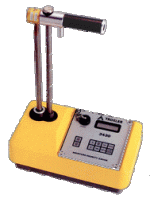
The "Nuclear Densometer" uses radio active source contained in a probe, inserted from the body of the machine and through the lift of fill, in order to measure both the moisture content and material density and is measured in lbs/ft^3.
Proper compaction of backfill materials will prevent unwanted settlement causing damage to the structure.
If your backfill was compacted at a moisture content exceeding the optimum value (again determined by the Proctor Test) then the material should be allowed to drain and be retested and possibly re-compacted.
I recommend that anyone requiring this testing be on site with compaction equipment when the technician arrives so remedial action may be taken at the time of visit.
My experience suggests that in most residential projects the source of compaction test failures is generally attributed to lack of compactive effort (small plate tampers) , improper moisture contents or seggregated materials. Use of "clear stones" in place of granular fills is generally the best way to go on small projects since they are near compact as they are dumped on the site.
 
To avoid these ads, REGISTER NOW!

Coach James

Well-known member
Joined
Jun 24, 2005
Messages
8,933
Location
Sandhills of North Carolina
dexter, are you saying the tester inserts a radioactive isotope into the soil to a specified depth, then the soil density/moisture content, is determined by the amount of radiation reaching a detector at the surface?

Coach
 

dxdexter

Well-known member
Joined
Aug 1, 2006
Messages
1,923
Basically the densometer can be used in two modes: backscatter, in which the machine just sits on the surface and will measure densities down 2" to 4" or direct transmission, in which a rod can be lowered up to 12" into the material.

The radioactive source in the probe will measure the speed of gamma rays as they move from the probe to the gauges receiver to measure density. Moisture content is determined through the detection “fast” neutrons which have been slowed by the hydrogen (water) in the material.

If anyone is interested they can do a google Humboldt or Troxler. These are the two brands of gauges we use.
 

Attachments

  • 3430_trans.gif
    3430_trans.gif
    15.4 KB · Views: 6
OP
R

ron in sc

Well-known member
Joined
Mar 19, 2006
Messages
1,071
Location
Charleston, SC
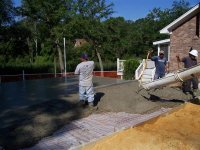
Slab was poured this morning. Guys used power trowel to get finish as smooth as possible.
 

Attachments

  • 000_0827.jpg
    000_0827.jpg
    69.4 KB · Views: 25

lino

New member
Joined
Jul 18, 2007
Messages
4
Interesting.

I used to work for Troxler. I've designed a couple nuclear gauges now...

To elaborate on the excellent description by dxdexter, the density source is a gamma radiation source contained (several times over) in a stainless steel rod that can be pushed some depth (up to 12") into the dirt. The dirt absorbs some of the radiation, so based on the known depth of the probe and the amount reaching a detector in the case, the density of the dirt it's in can be determined.

For moisture, there is a neutron source (americium usually, I think) that's contained in the gauge, not in the main rod. We can't detect the fast-neutrons that are emitted by the source, we can detect them after they have been "thermalized" (slowed down). How much is detected is related to the amount of water (hydrogen, actually) in the soil.

Glad you were able to pass on the second try. Never heard of a nuke test outside of commercial usage. But I'm just a geek engineer, so hear about much anyway...

Oh, since I'm frequently asked this, the answer is "No", the ground is not in any way radioactive after this test. Contrary to what is taught in the movies, radioactivity is not contagious -- being near something radioactive (no matter how strong), will not make it radioactive also...

ciao

lino
 
To avoid these ads, REGISTER NOW!
Top Bottom