To avoid these ads, REGISTER NOW!

failing rotor surface? why?

zendriver

Well-known member
Joined
Dec 10, 2014
Messages
30,067
Location
Indiana
rest assured, those larger spots are indentations in the coating--coating that has chunked off, so to speak. It ain't paint or anything else that's in globs stuck there. Since I went back to bed them in exactly as Raybestos recommended I can see most other areas of the rotor coating that are now slightly wearing in a nice even way. As you would expect. Kind of raises the question as to what happens when the coating is entirely worn off....what was the point of having it on there to begin with.

Anyway, it makes complete sense to me that some fault in the underlying iron caused a problem with the coating adhering. OR that the coating itself is defective. Either way i'm not messing with totally coated rotors again.
The act of vehicle braking is a composite brake pad/shoe being forcefully pushed, against a steel disc/drum with considerable opposing force .

Hard to imagine Annie coating holding up in that situation or any period of time at all.

It’s almost seems like a marketing gimmick, and a bit ironic since most goals when doing brake are to have the braking surfaces as clean as possible. Now there’s a bunch of contamination of whatever the coating

I am with you to pass on it next time.

 
To avoid these ads, REGISTER NOW!

Old Man Roger

Well-known member
Joined
Apr 6, 2017
Messages
17,703
Location
Palm Coast Florida
The act of vehicle braking is a composite brake pad/shoe being forcefully pushed, against a steel disc/drum with considerable opposing force .

Hard to imagine Annie coating holding up in that situation or any period of time at all.

It’s almost seems like a marketing gimmick, and a bit ironic since most goals when doing brake are to have the braking surfaces as clean as possible. Now there’s a bunch of contamination of whatever the coating

I am with you to pass on it next time.
Both of you missed my last post. The coating on the friction surface is only there temporarily.

It’s also probably easier and cheaper to coat the whole rotor, rather than mask the friction surface.
 

mogandave

Well-known member
Joined
Nov 4, 2021
Messages
3,052
Location
Bangkok
Both of you missed my last post. The coating on the friction surface is only there temporarily.

It’s also probably easier and cheaper to coat the whole rotor, rather than mask the friction surface.
The calipers need to be protected as well. The peace of mind these provide is well worth the $15 investment.brembo .jpg
 

zendriver

Well-known member
Joined
Dec 10, 2014
Messages
30,067
Location
Indiana
Both of you missed my last post. The coating on the friction surface is only there temporarily.

It’s also probably easier and cheaper to coat the whole rotor, rather than mask the friction surface.
I did miss it, but your first point was pretty obvious and your second point it’s just a guess

My guess would be considering the price of paint, modern manufacturer could figure out someway to spray just the inside cooling Ames.

Just another guess but here is their marketing sounds kinda like BS


Old Man Roger

Well-known member
Joined
Apr 6, 2017
Messages
17,703
Location
Palm Coast Florida
I did miss it, but your first point was pretty obvious and your second point it’s just a guess

My guess would be considering the price of paint, modern manufacturer could figure out someway to spray just the inside cooling Ames.

Just another guess but here is their marketing sounds kinda like BS

I agree it BS where they claim it helps “Maximize Friction Life” but in a place that uses salt on the roads, rust protection has value. Especially if you’ve ever had a rotor rusted solid to the hub.lol
 

Old Man Roger

Well-known member
Joined
Apr 6, 2017
Messages
17,703
Location
Palm Coast Florida
And where it might be obvious to most that the coating on the friction surface is meant to be temporary, by reading some of the posts, it doesn’t look like everyone thought it was obvious.
 

bwringer

Well-known member
Joined
Jan 1, 2013
Messages
10,314
Location
Indianapolis
Both of you missed my last post. The coating on the friction surface is only there temporarily.

It’s also probably easier and cheaper to coat the whole rotor, rather than mask the friction surface.
Yes, this.

I seriously have NO idea what is so hard for so many to understand here.

When you have these in hand, it looks like the entire rotor is dipped; the coating is down in the fins inside, and covers all surfaces of the rotor inside and out. It is quite obviously NOT galvanizing or a similar process; it is a thick paint or powder coat sort of stuff. Apparently it has some sort of friction particles in it so it's safe to use the rotors right away without removing the coating. The coating does not feel or look like cast iron when you handle it in person.

These rotors arrive inside a plastic bag inside a box. Unlike most other rotors, they are dry, NOT coated with grease because the coating protects the whole thing from corrosion in storage and shipping. You can slap them on right away with no added prep.

It should also be (but apparently is not) OBVIOUS that the coating in the area contacted by the brake pads is MEANT to wear away quickly revealing the bare cast iron surface.

However, the coating remains in the "hat" area and down inside the fins, etc. so over time, these rotors maintain their appearance far better and corrode far less than bare rotors (if they sit for a few days, they rust in the pad area like any rotor, and of course the pads soon scrape the rust off, like any other rotor), and they aren't as subject to sticking to the hub and wheel. In other words, between the scraping of the pads and the coating, these rotors are very well protected from rust.

I've installed at least two sets of these (I think three, actually), and they're working great and look great. The pad surfaces looked messy, exactly like those photos for a while, until the coating wore away, and there were bits of the coating on the wheels for a while. They do create kind of a mess.


Now then. Apparently the OP believes that there are also pits in the casting. If that is the case, it is obviously NOT normal, and NOT OK, but it is an entirely separate issue from the coating. I have no idea why these pits would not have been obvious before installation. Again, the coating is a paint or maybe powder coat, and is not thick enough to fill or hide voids.
 
OP
T

toddmorr

Well-known member
Joined
May 4, 2017
Messages
649
Location
Potomac, Maryland
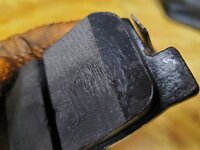
finally got the pads and rotors off and started probing more carefully. bwringer was right. The marks on the rotors aren't indentations, failures in the rotor surface, or rotor coating material that has come off. No, those are literally clumps of some kind of material used to coat the pads---it almost looks like a paint, a bit glossy almost. Maybe you can see the contrast in the pic where it has worn off, and still there on the downward slope part.

in any case, the rythmic scraping as the clumps on the rotor went round against the pad was way too audible. No way a customer would accept that, even for some brief period of time until it entirely wore off. Besides, as the pad wore, more "paint" would probably come off the edge and deposit on the rotor. Anyway, not buying these pads again. No issue with the rotors. 20230221_155129.jpg
 
To avoid these ads, REGISTER NOW!

jayemm

Well-known member
Joined
Dec 18, 2018
Messages
1,541
Location
up high down low
finally got the pads and rotors off and started probing more carefully. bwringer was right. The marks on the rotors aren't indentations, failures in the rotor surface, or rotor coating material that has come off. No, those are literally clumps of some kind of material used to coat the pads---it almost looks like a paint, a bit glossy almost. Maybe you can see the contrast in the pic where it has worn off, and still there on the downward slope part.

in any case, the rythmic scraping as the clumps on the rotor went round against the pad was way too audible. No way a customer would accept that, even for some brief period of time until it entirely wore off. Besides, as the pad wore, more "paint" would probably come off the edge and deposit on the rotor. Anyway, not buying these pads again. No issue with the rotors. 20230221_155129.jpg
Could you post some pictures of the rotor (s). I have Raybestos Element 3 EHT pads front and back with no weird coating issues. Best pads I've had in years. Better than the OEM Mazda pads by Akebono. Mine were made in Mexico, where were yours made. Haven't used their rotors though.
 
Last edited:

2ndGearRubber

Well-known member
Joined
Mar 24, 2014
Messages
14,185
Location
Pittsburgh
finally got the pads and rotors off and started probing more carefully. bwringer was right. The marks on the rotors aren't indentations, failures in the rotor surface, or rotor coating material that has come off. No, those are literally clumps of some kind of material used to coat the pads---it almost looks like a paint, a bit glossy almost. Maybe you can see the contrast in the pic where it has worn off, and still there on the downward slope part.

in any case, the rythmic scraping as the clumps on the rotor went round against the pad was way too audible. No way a customer would accept that, even for some brief period of time until it entirely wore off. Besides, as the pad wore, more "paint" would probably come off the edge and deposit on the rotor. Anyway, not buying these pads again. No issue with the rotors. 20230221_155129.jpg


That can be a result of overheating on first bed-in. Although I've seen elements 3 hybrids as well as other brands do this when the opposite axle has stuck pads, overworking the other axle. Typically this transfer wears off quickly, and doesn't cause issue. I've also seen pads do what you have experienced, through no fault of anyone, just not made right. We just swap them out under warranty. Happens from time to time.

FWIW element 3 likes a more leisurely break in. Not quite like Bosch pads you can just slam day one and be fine.
 
OP
T

toddmorr

Well-known member
Joined
May 4, 2017
Messages
649
Location
Potomac, Maryland
yeah maybe someone at the Raybestos pad line got a little sloppy with that "paint" and put it on all surfaces, not just the metal surfaces, dunno.

rotor pics are at the start of the thread btw
 

kaymccampbell

Well-known member
Joined
Feb 27, 2015
Messages
29,584
Location
Upstate New York
I agree it BS where they claim it helps “Maximize Friction Life” but in a place that uses salt on the roads, rust protection has value. Especially if you’ve ever had a rotor rusted solid to the hub.lol
That rotor I cut off the car a few weeks ago, it had a special rust preventative coating. It obviously did less than jack. IMG_20230126_131333.jpg
 

theoldwizard1

Well-known member
Joined
Feb 22, 2011
Messages
43,218
Location
SE MI
I am a Raybestos fan (Buyer beware ! They sell more than one grade of pads and rotors.) I am not sure if the retailer would replace them, but those are defective for sure !
 

rust in the eye

Well-known member
Joined
Oct 2, 2017
Messages
2,802
Location
Chicagoland
Did you bed those pads in? Important to follow correct procedure. Don't just "drive the **** out of them". Look on the Raybestos site and read their recommended procedure. The coating on the face should be gone after the pads gets bedded in. That said, I am not a Raybestos fan. I used to use them but now install Powerstop rotors & pads. Have been installing Geomet coated rotors and when calipers need replaced, have been using rebuilt Cardone coated calipers. Always purchase them from Rockauto.
^^^ This
Not too late to try and bed them in. Also be sure everything is free to move about as intended.
 

bwringer

Well-known member
Joined
Jan 1, 2013
Messages
10,314
Location
Indianapolis
Could you post some pictures of the rotor (s). I have Raybestos Element 3 EHT pads front and back with no weird coating issues. Best pads I've had in years. Better than the OEM Mazda pads by Akebono. Mine were made in Mexico, where were yours made. Haven't used their rotors though.
I've also installed these exact same pads at least twice (IIRC, I used Akebono pads on another vehicle) with excellent performance and no issues at all. Weeeeeeeeeird...

I don't remember for sure whether there was paint on the friction material or not, but I don't really think so. Maybe I can take a peek at my wife's car.
 

n8n

Well-known member
Joined
Mar 11, 2014
Messages
3,607
Location
Curtis Bay, MD
The act of vehicle braking is a composite brake pad/shoe being forcefully pushed, against a steel disc/drum with considerable opposing force .

Hard to imagine Annie coating holding up in that situation or any period of time at all.

It’s almost seems like a marketing gimmick, and a bit ironic since most goals when doing brake are to have the braking surfaces as clean as possible. Now there’s a bunch of contamination of whatever the coating

I am with you to pass on it next time.

I don't think anyone, not even Raybestos, would expect the coating to last more than a couple stops on the braking surface. Certainly not through a "bed-in" procedure where you do a couple hard 40-0 stops and get the pads good and hot. I don't think the coating is a gimmick either, I have and likely will continue to pay more for premium rotors that are coated because the appearance is worth it to me. Sure I could clean them, then coat them with high temp paint and bake them but the factory coated ones don't cost much more enough to make it worth my time. I've used Centric Premium rotors on several vehicles and currently have some Zimmerman ones waiting to go on the front of my GTI. All coated...

Now as for the OP's situation, I would expect that once the coating is worn off the braking surface should look and act like any other good quality rotor. That's not happening here so either there's a dragging brake situation or else the metal of the rotor itself is NFG.
 
OP
T

toddmorr

Well-known member
Joined
May 4, 2017
Messages
649
Location
Potomac, Maryland
Now as for the OP's situation, I would expect that once the coating is worn off the braking surface should look and act like any other good quality rotor. That's not happening here so either there's a dragging brake situation or else the metal of the rotor itself is NFG.
Yes, you would expect that but after a bed in, and at least another 10 miles of driving on and off, the clumps of "paint" were still there, somewhat better, but still there. No way I'd return the car to a customer with that scraping sound. So either the paint material was misapplied at the plant or I don't have the patience to wait for it to work off.

Rotors are fine, it's the pads I got a beef with.
 
To avoid these ads, REGISTER NOW!
Top Bottom