To avoid these ads, REGISTER NOW!

Filter/Regulator Question

Bull

Super Moderator
Joined
Dec 12, 2005
Messages
16,189
Location
MA
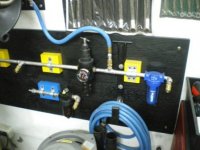
I want to order a filter/regulator this week to get my compressor hooked up. I am looking at this one on Amazon: Ingersoll-Rand (IRTC38221610)

The only reviewer writes this about the unit:

"While I'm at it, keep in mind that this regulator has a pretty substantial pressure drop as the CFM goes up. For example the regulated pressure is 10-15 PSI less at 10CFM than what you set it to when you are not drawing air out. At its maximum CFM rating the pressure drop across this is about 30 PSI. This is true for almost any regulator of this size, so make sure this fits your application."

What do you fellows make of this? I really don't know if it is something that I need to be concerned about. My intended use for the compressor (60 gallon CH, I think) is to run a blast cabinet, air ratchet, 1/2 impact, maybe some sanders etc.
 
To avoid these ads, REGISTER NOW!

Lookin4'67Galaxieconv

Well-known member
Joined
Jul 2, 2008
Messages
16,642
Location
Atlanta, GA
I wouldn't worry much about it. I have a 60 gallon Campbell Hausfeld and it works fine for those things. Though running the blast cabinet it will likely be running continuously.
 

dwm

Well-known member
Joined
Aug 28, 2010
Messages
861
Location
Southeast Michigan
For what it's worth, the gauges on the ARO units are tiny. I had the ARO regulators on my wish list but wound up removing them after I saw them in person. Nice, but the gauge was smaller than I wanted (I like to be able to see it from the other side of the garage). I wound up with Milton instead.
 
OP
B

Bull

Super Moderator
Joined
Dec 12, 2005
Messages
16,189
Location
MA
I wouldn't worry much about it. I have a 60 gallon Campbell Hausfeld and it works fine for those things. Though running the blast cabinet it will likely be running continuously.

I'm not worried about the compressor so much as this specific regulator. I am not sure what to make of the fellow's remarks regarding the drop in pressure as CFM increases :headscrat

For what it's worth, the gauges on the ARO units are tiny. I had the ARO regulators on my wish list but wound up removing them after I saw them in person. Nice, but the gauge was smaller than I wanted (I like to be able to see it from the other side of the garage). I wound up with Milton instead.

I hadn't thought of that. Really, I need a budget-friendly setup to get me in the game. I am dying to glass bead some stuff...never done it before. This regulator unit seems like it might be decent quality for low money. No idea if it is foreign made, though. What model Milton did you go with, and is it domestically produced?
 

MattT

Well-known member
Joined
Feb 20, 2010
Messages
3,201
I'm not worried about the compressor so much as this specific regulator. I am not sure what to make of the fellow's remarks regarding the drop in pressure as CFM increases :headscrat

Hard to tell. The guy might know what he's talking about and it really is dropping that much at 10cfm. More likely he doesn't though.

Anyways for a 60 gallon tank I'd step up to a 3/8" ported filter regulator. And skip the lubricator. You don't want or need that.
 

uf-engineer

Well-known member
Joined
May 1, 2011
Messages
52
Location
North Florida
I was also considering the ARO and ended up with the Milton for the same reason, tiny gauges. I should have it by the end of the week.
 

kc-steve

Well-known member
Joined
Jun 22, 2010
Messages
4,240
Location
Kansas City
Hi Bull;

I agree with others here, it won't influence your applications.

BUT, as a painter, this is GOOD information! However, I bypassed the CFM problem or pressure drops by simply adding and using a regulator and pressure gauge at the paint gun in order to ensure that I have the necessary pressure at the gun for proper paint application. In that configuration I don't worry about pressure drops.

It is important for the HVLP paint guns (high-volume low pressure). BTW, I also bought a Milton. :)

Steve
 
Last edited:

Sancho

Well-known member
Joined
Jan 5, 2011
Messages
162
Location
The backwoods
Hard to tell. The guy might know what he's talking about and it really is dropping that much at 10cfm. More likely he doesn't though.

Anyways for a 60 gallon tank I'd step up to a 3/8" ported filter regulator. And skip the lubricator. You don't want or need that.

I agree with this, I've never been a fan of lubricators simply because I dont like oil in lines I may spray paint from.

I concur 3/8 is the way to go if you only have one reg.
 
OP
B

Bull

Super Moderator
Joined
Dec 12, 2005
Messages
16,189
Location
MA
Is it clear that I am a dolt when it comes to this issue?

Based on another internet thread, I had thought that a 1/4" setup would be fine for all but 3/4 inch impact stuff or other high volume apps?

Also, someone mentioned not needing a regulator at all. This baffles me. Aren't they required as part of all compressor setups?

Finally, I knew that the super-cheap oilers were frowned upon, but did not realize that some of you don't like them in general. You guys just manually oil tools before each use?

Please advise.

Sincerely,

Dum-dum Dave
 

diesel research

Well-known member
Joined
Sep 12, 2010
Messages
5,440
Location
gulf coast, TEXAS
Also, someone mentioned not needing a regulator at all. This baffles me. Aren't they required as part of all compressor setups?

Not really. You will find that most professional shops are not typically equipped with them.

Impacts and other air tools do have an air psi rating BUT the airline and quick disconnects are already reducing psi.

There are certain times when a mini regulator may be desireable at the tool, such as painting or fine control of drill motors, grinders, sanders. Probably will never need it on a grinder/sander, since they are air hogs anyways. Could come in handy for slowing down air drills a little.

If you were thinking it is a safety factor, no not necessary. Your airlines/fittings will handle well over the 135psi or so your compressor puts out.

We have 2 regulators in the shop. Both specified for the torque guns, since torque guns are sensitive to pressure changes. Impacts, grinders, riveters, metal shears, sanders, drills, tire inflators and a few other air tools are just plugged into straight line pressure.
 

kc-steve

Well-known member
Joined
Jun 22, 2010
Messages
4,240
Location
Kansas City
Is it clear that I am a dolt when it comes to this issue?

Based on another internet thread, I had thought that a 1/4" setup would be fine for all but 3/4 inch impact stuff or other high volume apps?

Also, someone mentioned not needing a regulator at all. This baffles me. Aren't they required as part of all compressor setups?

Finally, I knew that the super-cheap oilers were frowned upon, but did not realize that some of you don't like them in general. You guys just manually oil tools before each use?

Please advise.

Sincerely,

Dum-dum Dave

Although SOME people like to make others think otherwise, NONE of us were born with this knowledge. We ALL had to learn it somehow and that usually means from friends and coworkers. :)

I think most people oil their air tools manually, a drop in the port before use.

YES, all compressors should have a regulator and pressure gauge. Unfortunately, many of the cheap oil-less types have them built-in and those people think the bigger compressors have them built-in as well. Not so. The reason is because everyone customizes their air system to their needs.

The bigger the piping for air the better, especially on long runs across the garage.

Steve
 
Last edited:

shoot summ

Well-known member
Joined
Jun 8, 2010
Messages
2,960
I had been looking at the IR regulator and filter, based on the comments I'm looking at Milton now....
 

JayL

Well-known member
Joined
Apr 17, 2008
Messages
1,789
Location
Manila, Philippines
I separated the Regulator / Filter from the Lubricator. Anyway I don't use the oiler that much except for a few air tools like grinders and sanders. I just hook it up by hose to the (regulated pressure) quick disconnect output when needed.

I also have a dedicated hose for oiler to air tool use only.
 

Attachments

  • IMGP3290.JPG
    IMGP3290.JPG
    35.9 KB · Views: 85

Sancho

Well-known member
Joined
Jan 5, 2011
Messages
162
Location
The backwoods
Im no fan of line oilers, exception being on power feeds where the only lines getting dirty will feed that machine alone.

I put a drop or two in before using the tool myself.

I know on my sand blaster, you dont want anything restricting flow, if it could be fed directly from the tank via a 2" hard line I would do it. Not sure if the same principal applies for blast cabinets.
 

amolaver

Well-known member
Joined
Mar 10, 2009
Messages
835
if you were to put a guage at the point of use, right before your <impact/grinder/blaster>, and 'pull the trigger', you'd see a pressure drop. no regulator needed. in fact, its the principle by which the dang tools operate :) pressure flows from high to low. no pressure differential, no flow, no work. now, the idea is that the low pressure is atmospheric, outside the tool, but frictional losses between the tank and the point of use prevent stored air from 'perfectly' refilling the lines (ie, no pressure drop in use).

I've got the same 1/2" milton dwm noted above (as recommended by someone else here), and even with 3/4" hard lines from my compressor, i still see 10-15psi drop when the impact starts spinning. when the blast cabinet fires up...lets just say 7CFM@90psi is not sufficient :)

as others have said, the lubricator is probably not a good idea. my experience has been that at the very least, it is really hard to understand how much oil is getting to the tools - could be not enough, or waaaay too much (much more likely). putting in a drop into each tool at the start of the day just becomes habit. more importantly, you can't use a line thats been oiled for your blast cabinet - the abrasive will just clump into useless blobs.

ahm
 

mikeatrpi

Well-known member
Joined
Jan 10, 2006
Messages
383
Location
Home
Not to hijack Bull, but the Milton regulator posted by DWM above has a max input pressure of 160psi and a regulator range of 5 - 125 psi.

What do you do if you have a 2-stage compressor capable of 175 PSI?
 
To avoid these ads, REGISTER NOW!

kc-steve

Well-known member
Joined
Jun 22, 2010
Messages
4,240
Location
Kansas City
Not to hijack Bull, but the Milton regulator posted by DWM above has a max input pressure of 160psi and a regulator range of 5 - 125 psi.

What do you do if you have a 2-stage compressor capable of 175 PSI?

That's a good point. I know mechanics that like to run "full blast" to get the best power from their tools, but the tools have their max ratings as well.

Steve
 

kc-steve

Well-known member
Joined
Jun 22, 2010
Messages
4,240
Location
Kansas City
Besides the last post (#20), I think the main reason to have a regulator and pressure gauge in the system is to monitor the overall health of your air delivery system. It isn't "required" but it sure helps to know what you are running and how well the seals are holding up as you use it.

And that's also why it is NOT a good idea to have the pressure gauge and regulator built into the compressor. That configuration tells you nothing about the air delivery system.

Steve
 

diesel research

Well-known member
Joined
Sep 12, 2010
Messages
5,440
Location
gulf coast, TEXAS
The gauge itself is cheap and non detrimental to flow. Can pick one up in large sizes up to 4.5" or larger in whatever range you want from surplus center. Northern also has them, so does horridfreight. I think the HF ones might actually be US sourced. They are ValleyIndustries brand and aren't but maybe $5-$10.
 

dwm

Well-known member
Joined
Aug 28, 2010
Messages
861
Location
Southeast Michigan
Not to hijack Bull, but the Milton regulator posted by DWM above has a max input pressure of 160psi and a regulator range of 5 - 125 psi.

What do you do if you have a 2-stage compressor capable of 175 PSI?

You'll be fine. The max input pressure for the Milton 1108 is 250 PSI. See the page from the Milton catalog. I don't know why Northern assumes that the gauge's max reading is the same thing as the max inlet pressure.
 
OP
B

Bull

Super Moderator
Joined
Dec 12, 2005
Messages
16,189
Location
MA
Pretty interesting stuff.

One or two folks mentioned investing the money saved from not buying a regulator into buying a dryer. I actually might have an older, high quality dryer "thing-a-ma-bob" that my dad gave me about fifteen years ago. I'll find it, post a pic, and you guys can tell me if it is something I should use.

What about the issue of a filter? Some of these regulators are combined with filters/water traps, which all seem like reasons to get them.
 

MattT

Well-known member
Joined
Feb 20, 2010
Messages
3,201
Bull,

Depends what you want. Yeah you can hook a 3/8" hose directly to your tank. That might give the correct, at tool, pressure for high demand tools and will overwork the rest. Plus blow water and trash thru' your tools.

To maximize safety and tool life you need to be feeding your tools clean dry air at the correct pressure. What I do is leave my reg set at 90# unless I need more from an impact then I'll crank it wide open. I'm not flat rate so I don't see any reason to push things all the time. I ain't gonna make any extra money wearing out my air tools prematurely.
 

kc-steve

Well-known member
Joined
Jun 22, 2010
Messages
4,240
Location
Kansas City
Pretty interesting stuff.

One or two folks mentioned investing the money saved from not buying a regulator into buying a dryer. I actually might have an older, high quality dryer "thing-a-ma-bob" that my dad gave me about fifteen years ago. I'll find it, post a pic, and you guys can tell me if it is something I should use.

What about the issue of a filter? Some of these regulators are combined with filters/water traps, which all seem like reasons to get them.

Most definitely you will need a filter toward the end of your piping system. So it is convenient to purchase a filter/regulator/pressure gauge like you initially asked about (Milton preferred). Like MattT says, you don't want to spend money replacing air tools prematurely. That also means getting a filter that reduces moisture in the air. I use a filter for that purpose among other things.

In addition, I also recommend building your piping system from either black steel pipe or copper pipe to condense the moisture in the system so a filter can actually trap it before it goes to your tools. The air coming out of the compressor is hot and humid and moisture can't be properly filtered out in that condition. Metal pipe cools the air in long runs across your garage then the moisture condenses in the pipe and then can be easily removed by a filter as well as pipe drop-downs with valves to drain water at various points.

In my paint gun attached regulator/pressure gauge I also use a desiccant filter as the last protection from a bad paint job due to moisture in the air. I even have a friend that goes so far as to use refrigeration to condense moisture in his piping.

I also use a regulated/filtered as well as unregulated/unfiltered outputs for such things as filling tires. But never for tools and painting. As mentioned, the regulators help keep from exceeding the maximum ratings of air tools and that goes back to reducing premature air tool replacement.

I have to add here, I was only convinced when I read about a manufacturing company that spent a great deal of money rebuilding the previously professionally built air delivery system due to the fact they were spending too much money replacing air tools, sometimes in a matter of weeks. They did a lot of things mentioned here in the air lines to remove moisture and filter the trash. Problem solved.

Steve
 
Last edited:

Carl B

Well-known member
Joined
Feb 3, 2006
Messages
525
Location
Clearwater, Florida USA
I want to order a filter/regulator this week to get my compressor hooked up. I am looking at this one on Amazon: Ingersoll-Rand (IRTC38221610)

and;

My intended use for the compressor (60 gallon CH, I think) is to run a blast cabinet, air ratchet, 1/2 impact, maybe some sanders etc.

Hi Bull:
Ingersoll-Rand unit won't do, it has 1/4" inlets/outlets - - your compressor more than likely has a 1/2" outlet - so I would recommend using a filter/regulator with 1/2" inlets/outlets. The Milton 1108 mentioned for the price looks like the ticket for you.

For your piping - you'll want to use at least 1/2" up to your quick-disconnects - - connected at the output end to 3/8's hose for the applications you mention. That would give you the most consistent supply of air based on your compressor's capabilities and the uses you mention.


Why use a filter/regulator? Let's say that your compressor has a 135psi upper limit, and that it is capable of putting out 11.5 CFM at 40 psi and 10.2 CFM at 90 lbs. Note that as output pressure goes UP the CFM that your compressor can supply constantly go DOWN.

Now let's say that you are running a blast cabinet. Different blast media call for different air pressures - you want to use the proper air pressure because that limits the amount of friction and thus heat that you will put on the object being blasted. For example Glass beads blasting an aluminum valve cover is quite different than Sand blasting an old cast iron vise, relative to the amount of heat you want to subject each item too and how long you expect the media to last. You can effectively cut the useful life of your media in half by using too high a pressure when blasting.

Oh.. yes - you will want a dryer at that blast cabinet outlet for sure. Moisture will cause most media to clog/clump up. So a line drain and a dryer are highly recommended.

Secondly - it's a matter of efficiency. You want to supply your blast cabinet {or any air tool for that matter} with the amount of pressure needed to do the job - without wasting compressed air. Wasting compressed air cost money in terms of how much electricity your compressor uses and in terms of how long your compressor will last. More important to me - is how much compressor noise I have to listen to as the compressor runs on and on and on... Running "un-regulated" you'll simply empty your 60gal tank sooner than required.

Just my opinon FWIW,
Carl B.
 
Last edited:
OP
B

Bull

Super Moderator
Joined
Dec 12, 2005
Messages
16,189
Location
MA
I sorta love you guys.

I quickly read the newest replies. I need to read them again after work.

I was hoping to just run a Goodyear rubber line from the tank for my immediate air needs. I am so beyond-behind on projects, I don't have time to get my dad over here with his Ridgid pipe threader and run hard black line anytime soon. Is this a bad plan?

I also had intended to install the filter/regulator right at the compressor. You guys seem to be saving me from that mistake. But, if I do just use a rubber hose for now, the mounting location of the unit becomes a challenge.

Am I to understand that I should have a separate dryer unit mounted directly to the sandblasting cabinet inlet?
 

kc-steve

Well-known member
Joined
Jun 22, 2010
Messages
4,240
Location
Kansas City
Bull you didn't name names and I hate to be pretentious and assume I am included, but I will say that MOST of us here want to help you, as well as anyone, achieve the desired results of your project.

As Carl points out, attempting to run a blast cabinet without the proper set up will only result in frustration. Don't ry using a paint gun either. However, I think filling tires and running air tools should be fine for a limited amount of time.

:beer:
Steve
 

shoot summ

Well-known member
Joined
Jun 8, 2010
Messages
2,960
I sorta love you guys.

I quickly read the newest replies. I need to read them again after work.

I was hoping to just run a Goodyear rubber line from the tank for my immediate air needs. I am so beyond-behind on projects, I don't have time to get my dad over here with his Ridgid pipe threader and run hard black line anytime soon. Is this a bad plan?

I also had intended to install the filter/regulator right at the compressor. You guys seem to be saving me from that mistake. But, if I do just use a rubber hose for now, the mounting location of the unit becomes a challenge.

Am I to understand that I should have a separate dryer unit mounted directly to the sandblasting cabinet inlet?

I previously had a regulator/filter/water trap on the compressor, and a smaller regulator/filter/dryer at the blast cabinet. No harm in making darn sure no moisture gets in the media. And it's nice to be able to regulate the air at the cabinet. I just ran an air line from the compressor to the cabinet.

I'm probably going to do the same thing with the new set up although I have noticed the new/larger compressor seems to put out alot more moisture.
 

dwm

Well-known member
Joined
Aug 28, 2010
Messages
861
Location
Southeast Michigan
Bull, you don't have to thread your own pipe just for the purpose of removing moisture to run your blast cabinet. The big box stores have various lengths of black iron that's already threaded on both ends. All you really need to do is build a small labyrinth out of off-the-shelf black iron pipe and fittings (you're just building a heat exchanger) to give the water vapor a chance to condense, place your filter and regulator at the end of it. I'm in a rental so I cable-tied mine to some pegboard that was already in place. Put a drip valve at the bottom of one or more of the legs so you can drain them once in a while. If you're not going to use the blast cabinet a lot, you can then use a disposable dessicant filter at the cabinet.

This has been my setup for many years. Though I don't have a blast cabinet at the moment, I do quite a bit of powdercoating which is just as fussy (if not more so) about moisture. I've not had any problems at all with moisture.
 
Last edited:

kc-steve

Well-known member
Joined
Jun 22, 2010
Messages
4,240
Location
Kansas City
This is just an afterthought, . . . but it might be instructive or helpful to know where others are located when they discuss using moisture removal systems and their viability as moisture removal systems.

In other words, removing moisture from a compressed air system is considerably easier in Tuscon AZ (desert) where atmospheric humidity is VERY LOW compared to high humidity areas such as the East coast.

Steve
 

dwm

Well-known member
Joined
Aug 28, 2010
Messages
861
Location
Southeast Michigan
Steve is correct. I'm in Michigan, on lakefront. It's humid here (I drive through fog quite regularly), and this year we've had lots of precipitation. Got 2 more inches of rain today.
 

diesel research

Well-known member
Joined
Sep 12, 2010
Messages
5,440
Location
gulf coast, TEXAS
I originally mentioned not knowing how blast cabinets work with regulators, since that isn't my area of expertise. I haven't used one on a regular basis since I was 17.

Paint guns are obvious, but should be right at the gun.

Today's test was in your honor (kind of).

Compressor setup is 2 screw compressors in a compressor house. No active water filtration, but does have some semi-effective drop leg traps. Your choice of 1/2" hose or 3/8" hose.

Impact was feeling real weak. Could barely rattle off lugs, probably took 25+ seconds per lug.

I looked around, and noticed it was not running "unregulated" as usual. It was plumbed into the regulator with a 6ft "whip hose". Regulator was reading 115psi. Freespeeding, it would drop to 90psi. Ok, no big deal. Now the tricky part was to watch the regulator BEHIND me, while running the impact under a real load (lugs). A trick trick to do, removing lugs with back facing the wheel, but I did it. Under load, pressure would dip into the 60s or even less. This is only 6ft of 1/2" air hose

Plug it into unregulated drop hose next to it, power came back to life. Although line pressure is around 140psi or so, under load, this drops to much more reasonable levels.

Many air tools are rated in the 90-120psi range BUT this is with no quick connect fittings or other obstructions, and a very short hose distance. Those pressure ratings are at the gun, while under full load.
 
To avoid these ads, REGISTER NOW!
Top Bottom