To avoid these ads, REGISTER NOW!

Finding Conduit sandwiched between flooring?

danski0224

Well-known member
Joined
Jan 29, 2005
Messages
13,515
Location
Near Naperville, IL
In some areas near me, it was common practice to run residential conduit between the subfloor (1 x 6 lumber- pre plywood) and the hardwood floor.

There are sleepers installed on the subfloor, in line with the floor joists. The wood flooring is nailed to the sleepers. The sleepers are notched/cut for the conduit.

There is tar paper on top of the subfloor, so you can't see anything from below.

A stud finder doesn't work, nor did the AC alert function.

A circuit breaker finder didn't work.

A low voltage tone generator didn't work.

Short of x-ray scanning, any ideas?

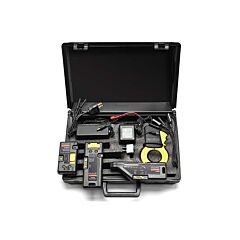
Amprobe and others have a $1,000+ wire tracer, but I've never seen one used in the field. Looks great in the videos, but skeptical.
 
To avoid these ads, REGISTER NOW!

dscheidt

Well-known member
Joined
Apr 26, 2017
Messages
2,909
Wtf? Wonder what the Justification was

Load it up for a bit and try a thermal camera?
The choice is either this, or on the ceiling of the floor below. This is almost always rigid conduit ( or just straight out gas pipe), not emt, and there's no way in hell you're feeding through the joists. I expect a good strong magnet (try the rack-a-tiers studball, even if it doesnt owrk for this, it's amazing at finding nails in studs, even little ones for lath behind an inch of plaster) would find them.
 
OP
D

danski0224

Well-known member
Joined
Jan 29, 2005
Messages
13,515
Location
Near Naperville, IL
Wtf? Wonder what the Justification was

Load it up for a bit and try a thermal camera?
Just how it was done at some point. It's easier than drilling studs horizontally through the wall.

I have a thermal imager. IF it works, it would take a long time to show up through 3/4" or so of wood.
 

Innovate1

Well-known member
Joined
Jul 28, 2014
Messages
4,292
Location
Illinois near St. Louis, Missouri
Metal detector or magnet. They used to make and maybe still do a stud/nail finder that was a small magnet on a pivot. When run over a nail the small magnet would move as you passed over the nail. Not sure how welll it will work if the conduit has a thick wood cover. You should be able to get some idea where the run is from where the wires are at the ends - or are the wire exits hidden?

Found the nail finder:
https://www.acehardware.com/departments/tools/hand-tools/stud-finders/20887
 

sparky 1971

Well-known member
Joined
Oct 9, 2018
Messages
7,997
Location
Central Iowa
That looks like a time saver/money maker.
It is. I have lost two of the magnet leads that go inside the wall though. Both times they go stuck on something so bad that I broke either the chain of the pull string that was attached to it. Not quite as profitable when that happens, but it has paid for itself many times over.


rharman

Well-known member
Joined
Apr 22, 2012
Messages
8,897
Location
SoCal
That magnetic nail finder from Amazon might not have enough pull. This little guy has worked really well for me on drywall or lath & plaster. I thought it was a gimmick but it works better than my expensive Franklin electronic one.

The Stud-Pop...

1698207135028.png
 
To avoid these ads, REGISTER NOW!
OP
D

danski0224

Well-known member
Joined
Jan 29, 2005
Messages
13,515
Location
Near Naperville, IL
I'm not sure about a magnet pulling through 3/4" of oak flooring.

The Stud Pop will (should) pick up the nails used to fasten the flooring.

For me, a scanner or wire tracer would have more additional uses vs a magnetic wire pulling setup. I had not seen one of those, so it is neat.
 

sparky 1971

Well-known member
Joined
Oct 9, 2018
Messages
7,997
Location
Central Iowa
I'm not sure about a magnet pulling through 3/4" of oak flooring.

The Stud Pop will (should) pick up the nails used to fasten the flooring.

For me, a scanner or wire tracer would have more additional uses vs a magnetic wire pulling setup. I had not seen one of those, so it is neat.

I don't know about 3/4" oak but I've found steel studs through two layers of 5/8" drywall with the roller part of the Magnepull.
 

RyanE

Well-known member
Joined
Feb 4, 2013
Messages
201
Location
Golden, BC
Pin locator like the one linked below (no affiliation, just a good example).

I use these to locate buried culverts and iron survey pins all the time. Sweeping across the floor you will very quickly locate the position of any steel/iron. If you sweep in a grid pattern, you should be able to identify your steel conduit easily. I've also used one to locate rebar in a sidewalk.

Pin Locator
 

RPH

Well-known member
Joined
Dec 17, 2006
Messages
4,190
Location
Michigan Thumb
Use your new induction heater to warm conduit. Then take a thermal image. It will show the location of it.
 

Innovate1

Well-known member
Joined
Jul 28, 2014
Messages
4,292
Location
Illinois near St. Louis, Missouri
Pin locator like the one linked below (no affiliation, just a good example).

I use these to locate buried culverts and iron survey pins all the time. Sweeping across the floor you will very quickly locate the position of any steel/iron. If you sweep in a grid pattern, you should be able to identify your steel conduit easily. I've also used one to locate rebar in a sidewalk.

Pin Locator
Interesting. Looks like a common metal detector with a smaller, maybe longer coil for better detection and/or location of pins...
 

rlitman

Well-known member
Joined
Oct 18, 2010
Messages
24,651
Location
Long Island
...I have a thermal imager. IF it works, it would take a long time to show up through 3/4" or so of wood.
So, what's the rush? Plug in a space heater and give it a few hours. It WILL find that circuit. Don't believe me? Take your thermal imager to your refrigerator and you'll be able to trace that circuit too.
 

sparky 1971

Well-known member
Joined
Oct 9, 2018
Messages
7,997
Location
Central Iowa
I'm confused. Is the conduit steel?

Cause if it's plastic a magnet isn't going to find it and it certainly won't find the copper conductor either.

Also...you can rent this:

If it's PVC run right under 3/4 flooring any nail or screw 1" or longer is going to eff it up. It's steel and every time I've seen it done, which isn't very many times, it was rigid.

EDITED: spell check got me
 
Last edited:

RPH

Well-known member
Joined
Dec 17, 2006
Messages
4,190
Location
Michigan Thumb
We used the induction units with a rope style coil. This would be wrapped or laid out as needed. Power switched on causing the highway frequency energy to intersect with the metal. The metal would warm and the thermal picture would indicate rebar or conduit within bridge abutment, cement columns, and such. Very unique application.
 

engineer2

Well-known member
Joined
Dec 13, 2009
Messages
11,824
Location
Chicago burbs
If it's near Naperville, a Chicago suburb, I can almost guarantee it will be EMT.
A thermal imager might pick it up if there is enough temperature differential. Put a 12 amp load on the circuit for a few hours to warm up the circuit and then try it. If you were closer, I'd try it with my thermal imager.
I can easily see a 2 degree differential. This is hot water subfloor heat through an area rug.
floor.png
 
OP
D

danski0224

Well-known member
Joined
Jan 29, 2005
Messages
13,515
Location
Near Naperville, IL
If it's near Naperville, a Chicago suburb, I can almost guarantee it will be EMT.
A thermal imager might pick it up if there is enough temperature differential. Put a 12 amp load on the circuit for a few hours to warm up the circuit and then try it. If you were closer, I'd try it with my thermal imager.
I can easily see a 2 degree differential. This is hot water subfloor heat through an area rug.
I have a thermal imager and yeah, it will pick up hydronic loops.

It's certainly possible that something like a space heater, left on for a couple/few hours, will generate enough heat to show up.

One issue is time (or, was). The other one is missing that possible extra conduit run that's on a different circuit. Oh, and the company doesn't have a thermal imager, I do.

There is one spot left to cut out, and there is an outlet nearby. This hole is much bigger than the others, so the odds of hitting something are pretty good.

At the other locations, the customer decided to cut out part of the subfloor from the basement to do a visual for conduit at the locations I marked. This approach was mostly successful, but there were 2 locations where the conduit was just out of reach by hand and deemed "good to go".

Fortunately, the provided drill bit was not as sharp as it could be, and the delay told me that there was something else there. Other holes from below revealed the hiding conduit.

Yup, I suppose that a borescope up through the subfloor is a possibility, but the hole would have to be on an angle to get it into the ~3/4" space, and drill access is limited in the needed direction. Or something like a 1" hole and an articulating borescope.

The boxes in the walls are more like current "old work" boxes- only 1 device fits inside. The visible bigger boxes are more octagonal in shape but still will not fit 2 devices. I suspect this pre-dates what is now called a 1900 box. The in wall boxes have a conduit going straight down, and there is one off the side that also eventually goes down. So, depending on which side the load is connected to, the other part may not show up.

I have had a need to find buried stuff once in a while, just often enough to be a pain. Towards that end, the discussion interests me.

The multi-surface radar scanners look interesting, but again, more mixed reviews.
 
OP
D

danski0224

Well-known member
Joined
Jan 29, 2005
Messages
13,515
Location
Near Naperville, IL
I don't know about 3/4" oak but I've found steel studs through two layers of 5/8" drywall with the roller part of the Magnepull.
That's surprising, steel studs are not heavy gauge.

I can easily notice a difference sticking a magnet to a steel stud directly vs something like an I beam.
 

dave*99

Well-known member
Joined
May 5, 2009
Messages
4,277
Location
Coastal NJ
The choice is either this, or on the ceiling of the floor below. This is almost always rigid conduit ( or just straight out gas pipe), not emt, and there's no way in hell you're feeding through the joists. I expect a good strong magnet (try the rack-a-tiers studball, even if it doesnt owrk for this, it's amazing at finding nails in studs, even little ones for lath behind an inch of plaster) would find them.
Stud ball huh …… You just cost me $20. I had to have it. :)
 

RPH

Well-known member
Joined
Dec 17, 2006
Messages
4,190
Location
Michigan Thumb
This is the one I use. Excellent tool, good software too.
 
To avoid these ads, REGISTER NOW!
Top Bottom