RoninB4
Well-known member
Aaron hit it. Also the 3 rectangular things with serrations are chuck jaws. There's a set of 3 for gripping the outside of work and a set for gripping on the inside of work to be chucked up. There is a sequence to changing them (#1-#2-#3) so look for the numbers on the jaws AND on the chuck itself. Easy to get them started wrong and you'll have to "unwind" them and start over. Be very wary of how many "teeth" are engaged in the chuck. All too easy on small lathes to chuck too large a piece in it, having not enough "teeth" engaged and throwing one of the jaws out at speed, it can destroy anything it hits.
The long red shank things are most likely carbide brazed cutting tools, the cheap Chinese ones all look like this. Try NOT to use these until you have to as they're easily chipped/broken and can't be satisfactorily sharpened without a special (expensive) wheel in the bench grinder. You do appear to have one decent boring bar that takes carbide inserts, avoid using this one as well until you really need it.
You also have two "dead" centers which support long work like turning a shaft. You'll want to use a "live" center when that time comes. There are operating handles which screw into locations on the lathe (the half-nuts for feed for example) to engage/disengage movement of the saddle, cross feed, and half-nuts. Find a manual for YOUR machine (likely on-line from Grizzly) so you know which ones go where.
You really need to be familiar with ALL the controls BEFORE you ever turn it on. If any of the feed controls are engaged it can crash the machine and potentially ruin it in short order. When I approach a lathe I'm unfamiliar with I bring the saddle all the way as far back as possible to give myself enough time to stop operations before the saddle crashes into the chuck. The big red emergency stop button (called E-Stop) is the first thing to identify on ANY machine.
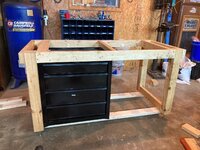
While I applaud your effort at making a stand I really think you need to verify how much twist is in the lathe bed in the "free" state. Bolting it down can/will mirror how flat the mounting surface is. If you don't have a reference starting profile you won't know if twist is in the stand top or your lathe. Read up on how to check the twist and chuck alignment to the bed. These checks can be done with the lathe just sitting on a any flat surface, even the floor.
You're also going to want/need a drill chuck to go in the tail stock and a small bench grinder. I know you're wanting to fire the lathe up but I'd advise taking the extra steps I've suggested for reasons that will be clear to you later. If you're just wanting to polish up a few pins (nothing longer than 6" at this point) then that's fine too. You're not quite ready to make chips yet unless your FIL is there and says so. Not trying to be a jerk, just don't want you to get hurt or ruin your first machine. Both will come later but sooner than you think....
The long red shank things are most likely carbide brazed cutting tools, the cheap Chinese ones all look like this. Try NOT to use these until you have to as they're easily chipped/broken and can't be satisfactorily sharpened without a special (expensive) wheel in the bench grinder. You do appear to have one decent boring bar that takes carbide inserts, avoid using this one as well until you really need it.
You also have two "dead" centers which support long work like turning a shaft. You'll want to use a "live" center when that time comes. There are operating handles which screw into locations on the lathe (the half-nuts for feed for example) to engage/disengage movement of the saddle, cross feed, and half-nuts. Find a manual for YOUR machine (likely on-line from Grizzly) so you know which ones go where.
You really need to be familiar with ALL the controls BEFORE you ever turn it on. If any of the feed controls are engaged it can crash the machine and potentially ruin it in short order. When I approach a lathe I'm unfamiliar with I bring the saddle all the way as far back as possible to give myself enough time to stop operations before the saddle crashes into the chuck. The big red emergency stop button (called E-Stop) is the first thing to identify on ANY machine.
While I applaud your effort at making a stand I really think you need to verify how much twist is in the lathe bed in the "free" state. Bolting it down can/will mirror how flat the mounting surface is. If you don't have a reference starting profile you won't know if twist is in the stand top or your lathe. Read up on how to check the twist and chuck alignment to the bed. These checks can be done with the lathe just sitting on a any flat surface, even the floor.
You're also going to want/need a drill chuck to go in the tail stock and a small bench grinder. I know you're wanting to fire the lathe up but I'd advise taking the extra steps I've suggested for reasons that will be clear to you later. If you're just wanting to polish up a few pins (nothing longer than 6" at this point) then that's fine too. You're not quite ready to make chips yet unless your FIL is there and says so. Not trying to be a jerk, just don't want you to get hurt or ruin your first machine. Both will come later but sooner than you think....