NewShockerGuy
Well-known member
I am planning on tiling our laundry room this weekend. It's not big at all. The tiles I have are about 16" in length and about a foot wide. Total tiles I have are 24 which will be more than enough to do the room. They were given to me because they are extra from a friend that just did his bathrooms and rather than him throwing them out I said I could use them so he gladly gave them to us.
I've never done ceramic/porcelain tiles wanted to ask a couple questions since this is going to prep me for doing our basement which will be over 1,000sq ft of tile in about 5 months.
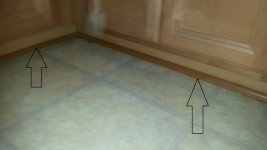
Currently we have crappy laminate in the laundry room. Nothing special, looks like *** and was what the builder used 10 years ago. Around the baseboard is corner molding, same with under the base cabinets. Now when I did the wood flooring on the entire upper floor I took off the baseboards and had the wood go to the walls then put the baseboards back on minus the any edge molding. I like the look without molding because it looks like the floor was planned rather than an after thought. Is there any reason NOT to do this with tile? Especially on the base cabinets I planned on removing the lower trim and getting tile right up against it then putting the trim back on the lower cabinet.
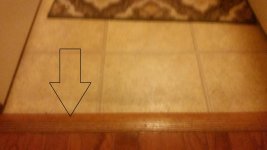
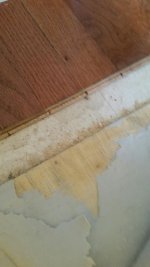
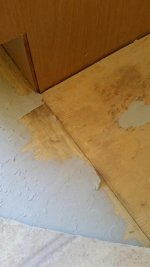
Next there is a wood transition piece from the hardwood flooring to the laminate. (see picture below) How does one remove this piece and once I put tile down wouldn't the tile sit higher than this piece causing it to be out of place? Or do I rip that piece out and then use something completely different to transition from wood flooring in the kitchen to the tile in the laundry room?
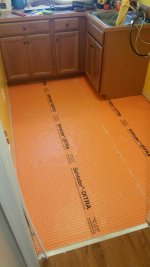
I've taken a picture of the tile below. The back looks like a checker board. Is there a specific thinset/grout that is recommended and also what type of notch should be used? I went to the hardware store and noticed the trowels are smooth/flat, square notches, round half circle, triangle...etc. I have no clue what to even use. The heaviest object on the tiles will be our front loading washer/dryer. Normal foot traffic but the room is not big enough to store heavy or large *** objects in it.
I was told wait at least 24 after putting tile down before doing the grout. If this isn't correct please let me know.
For the thin set is there something I should be looking for? Is it like mud for dry wall that you can buy premix/ready or DIY powder...etc. I know from reading on here that people like to double butter and do the floor and tile but is that necessary for a laundry room. I will not have extra tile so I don't want them cracked if someone accidently drops something. In this case would that be better just for sheer peace of mind?
Other than that I think that's all I have for now. I don't suspect this is going to be extremely hard but just a lot of unanswered questions are going through my mind. My friend is letting me borrow his wetsaw so that shouldn't be a problem cutting the tiles for a 100% perfect fit.
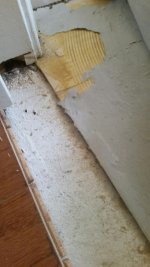
Sorry for the crappy quality pics. Had to snap them real quick before coming to work.
Thanks,
-Nigel
I've never done ceramic/porcelain tiles wanted to ask a couple questions since this is going to prep me for doing our basement which will be over 1,000sq ft of tile in about 5 months.
Currently we have crappy laminate in the laundry room. Nothing special, looks like *** and was what the builder used 10 years ago. Around the baseboard is corner molding, same with under the base cabinets. Now when I did the wood flooring on the entire upper floor I took off the baseboards and had the wood go to the walls then put the baseboards back on minus the any edge molding. I like the look without molding because it looks like the floor was planned rather than an after thought. Is there any reason NOT to do this with tile? Especially on the base cabinets I planned on removing the lower trim and getting tile right up against it then putting the trim back on the lower cabinet.
Next there is a wood transition piece from the hardwood flooring to the laminate. (see picture below) How does one remove this piece and once I put tile down wouldn't the tile sit higher than this piece causing it to be out of place? Or do I rip that piece out and then use something completely different to transition from wood flooring in the kitchen to the tile in the laundry room?
I've taken a picture of the tile below. The back looks like a checker board. Is there a specific thinset/grout that is recommended and also what type of notch should be used? I went to the hardware store and noticed the trowels are smooth/flat, square notches, round half circle, triangle...etc. I have no clue what to even use. The heaviest object on the tiles will be our front loading washer/dryer. Normal foot traffic but the room is not big enough to store heavy or large *** objects in it.
I was told wait at least 24 after putting tile down before doing the grout. If this isn't correct please let me know.
For the thin set is there something I should be looking for? Is it like mud for dry wall that you can buy premix/ready or DIY powder...etc. I know from reading on here that people like to double butter and do the floor and tile but is that necessary for a laundry room. I will not have extra tile so I don't want them cracked if someone accidently drops something. In this case would that be better just for sheer peace of mind?
Other than that I think that's all I have for now. I don't suspect this is going to be extremely hard but just a lot of unanswered questions are going through my mind. My friend is letting me borrow his wetsaw so that shouldn't be a problem cutting the tiles for a 100% perfect fit.
Sorry for the crappy quality pics. Had to snap them real quick before coming to work.
Thanks,
-Nigel





 to that ^^^^^^^^^^^^^^^^^^^