To avoid these ads, REGISTER NOW!

Flex head torque wrenches...I don't get it.

impactims

Well-known member
Joined
Nov 24, 2011
Messages
1,168
The whole point to a flex head ratchet is to break loose with the ratchet straight then bend the ratchet to use it as a speeder. Thats my experience anyways. No good way to break loose when flexed. The socket wants to jump off of the fastener. Maybe I'm missing something or doing it wrong.

Anyways, many torque wrenches have a flex head. I personally have never had one. Mine have always been with a fixed head.

So, what is the purpose of a flexing head on a torque wrench?

Seems to me that torquing down to, let's say 100 ft lbs, with the head flexed being would be very wonky. I see no good way to do that. Flexing the head then applying torque makes no sense to me. What am I missing?
 
To avoid these ads, REGISTER NOW!

kbeefy

Well-known member
Joined
Sep 14, 2013
Messages
3,453
Location
Harington, Eastern Washington
I have one 1/4" flex head, it only flexes like 10 degrees.
It's handy for clearance occasionally, but I would honestly like a fixed one better.

I have another 1/2 flex head, it also only flexes about 10 degrees. It's not as floppy as the 1/4" one and doesn't bother me.
I can't remember it ever being beneficial to having it flex.
 

AEAdam

Well-known member
Joined
May 27, 2023
Messages
2,783
Location
SE PA
Thats the only point to it that I have ever seen.

Take this for instance.

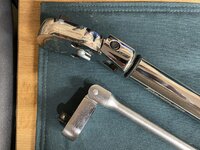
What is all that flex in the head going to do for me @ 250 ft lbs?

torque.png
This tool‘s head only flexes 10 degrees or so. Any more and the flex would impact the tool’s accuracy. The head doesn’t flex 90+ degrees like a normal flex head.

I very very rarely flex my long flex heads as you described. Sometimes I will with flex stubbies tho. I think I would be perfectly happy if my flex ratchets were limited to 45 degrees
 

L.Cheapo

Well-known member
Joined
Oct 23, 2014
Messages
5,971
I have one 1/4" flex head, it only flexes like 10 degrees.
It's handy for clearance occasionally, but I would honestly like a fixed one better.

I have another 1/2 flex head, it also only flexes about 10 degrees. It's not as floppy as the 1/4" one and doesn't bother me.
I can't remember it ever being beneficial to having it flex.
The flex joint on my Techangles allows me to torque lug nuts, particularly on my Wrangler and Ram using only a deep socket, no extensions. A few degrees makes a big difference 2' from the fulcrum. the 15* or so it flexes does not appreciably affect torque applied.
 
OP
I

impactims

Well-known member
Joined
Nov 24, 2011
Messages
1,168
A guy at work has one and I swear it flexes quite a bit. Maybe I'm wrong about that. I'll double check Monday.
 

u2slow

Well-known member
Joined
Nov 20, 2011
Messages
3,606
Location
BC
I don't like flex heads. Too delicate and get floppy after some hard use. Same with the box ratchet wrenches like that.

I prefer a short extension or the 10° wobble extension for clearance.
 

AEAdam

Well-known member
Joined
May 27, 2023
Messages
2,783
Location
SE PA
A guy at work has one and I swear it flexes quite a bit. Maybe I'm wrong about that. I'll double check Monday.
Don’t waste your time. No snap on torque wrench flexes more than 10 degrees or so. Anything more would defeat the purpose.
 

AEAdam

Well-known member
Joined
May 27, 2023
Messages
2,783
Location
SE PA
I don't like flex heads. Too delicate and get floppy after some hard use. Same with the box ratchet wrenches like that.

I prefer a short extension or the 10° wobble extension for clearance.
Cheap flex heads do that. Good quality ones don’t. The Snap On flex heads have no detent stops. It’s just friction, but the joint is well machined and quite stiff. You can tighten or loosen the binding screw to suit your preference, but all the Snap On flex heads I have, and I have many, are quite stiff. If the joint isn’t well made, tightening the screw may not make the joint tighter. But that’s always worth a try.
 

liliysdad

Well-known member
Joined
Jul 18, 2008
Messages
5,431
Torquing lug nuts without an extension is a prime example.

10 degrees is all any decent torques wrench will flex. It’s ain’t much but it’s plenty.
 

dchawk81

Well-known member
Joined
Jul 31, 2014
Messages
14,410
The whole point to a flex head ratchet is to break loose with the ratchet straight then bend the ratchet to use it as a speeder. Thats my experience anyways. No good way to break loose when flexed. The socket wants to jump off of the fastener. Maybe I'm missing something or doing it wrong.

Anyways, many torque wrenches have a flex head. I personally have never had one. Mine have always been with a fixed head.

So, what is the purpose of a flexing head on a torque wrench?

Seems to me that torquing down to, let's say 100 ft lbs, with the head flexed being would be very wonky. I see no good way to do that. Flexing the head then applying torque makes no sense to me. What am I missing?
My flex head ratchets give me access in places I couldn't otherwise get or would be a much bigger PITA.

I can usually break things loose at an angle, because not everything is torqued to 300 ft-lbs.

I don't have a flex head torque wrench though. I don't consider them the same as a ratchet.
 

kbeefy

Well-known member
Joined
Sep 14, 2013
Messages
3,453
Location
Harington, Eastern Washington
The flex joint on my Techangles allows me to torque lug nuts, particularly on my Wrangler and Ram using only a deep socket, no extensions. A few degrees makes a big difference 2' from the fulcrum. the 15* or so it flexes does not appreciably affect torque applied.

I always grab a 6-8" extension when torquing wheels.
The only thing I can torque without an extension is my VW golf.
I don't know what to say jokingly about your wrangler and ram, but I'm sure someone else around here does.
 

mikey03

Well-known member
Joined
May 17, 2024
Messages
2,144
I use a deep socket and a flex head torque wrench and that’s enough clearance for most small cars lug nuts I work on honestly
 
To avoid these ads, REGISTER NOW!

dchawk81

Well-known member
Joined
Jul 31, 2014
Messages
14,410
If you don't understand why you need a flex head on a torque wrench, be happy. It means you aren't jamming a torque wrench around a bunch of BS trying to torque something.
I used a flex ratchet to do my truck's thermostat housing and couldn't find torque specs so I put the bolts back in approximating the effort used to take them out. The service bulletin from the manufacturer didn't even have specs.

Holding so far and avoided taking off the aforementioned BS.

I didn't fully appreciate flex head ratchets until then.
 

dchawk81

Well-known member
Joined
Jul 31, 2014
Messages
14,410
I guess what I'm really saying is if I had those specifications I would have bought a flex head torque wrench for the job. A straight ratchet would not have worked so a straight torque wrench wouldn't either.
 

2ndGearRubber

Well-known member
Joined
Mar 24, 2014
Messages
14,185
Location
Pittsburgh
I guess what I'm really saying is if I had those specifications I would have bought a flex head torque wrench for the job. A straight ratchet would not have worked so a straight torque wrench wouldn't either.

That is the situation OP should be thrilled to not be encountering.

Same idea as "why do torque wrenches need to have reverse levers on the ratchets?". Praise the heavens you need not know.
 

dchawk81

Well-known member
Joined
Jul 31, 2014
Messages
14,410
That is the situation OP should be thrilled to not be encountering.

Same idea as "why do torque wrenches need to have reverse levers on the ratchets?". Praise the heavens you need not know.
Yah. Ignorance is bliss.
 

tamaraw

Well-known member
Joined
Jun 6, 2022
Messages
843
Besides what others have mentioned, torque wrenches tend to be longer than most other tools.

A regular fixed wrench or ratchet might be fine to assemble something but you may not have clearance for the longer torque wrench, especially for stuff that is deep in a bay or recessed behind another piece.

That's where the flex is really nice to have and a hell of a lot better than trying to hold a universal joint straight (if you even have the vertical clearance).
 

L.Cheapo

Well-known member
Joined
Oct 23, 2014
Messages
5,971
I always grab a 6-8" extension when torquing wheels.
The only thing I can torque without an extension is my VW golf.
I don't know what to say jokingly about your wrangler and ram, but I'm sure someone else around here does.
Joke all you want. That Ram is about to have its 28th birthday and the Wrangler is 11. Point is, they are vehicles with larger than usual tires, and you would need an extension if you didn't have a flex head on your torque wrench, which is what this thread is about.
 

AEAdam

Well-known member
Joined
May 27, 2023
Messages
2,783
Location
SE PA
Yah. Ignorance is bliss.
Hang on. That’s not the message. If whatever the OP is doing doesn’t require a flex head we’re “good for you and hope your work stays like that”. Ignorance isn’t the right word.
I used a flex ratchet to do my truck's thermostat housing and couldn't find torque specs so I put the bolts back in approximating the effort used to take them out. The service bulletin from the manufacturer didn't even have specs.

Holding so far and avoided taking off the aforementioned BS.

I didn't fully appreciate flex head ratchets until then.


You couldn’t find the torque spec for your thermostat and it magically worked out ok for you. That’s a better example of “ignorance is bliss”.

God usually punishes me when I do that sort of stuff because I know better, can calculate those torques, and know exactly what the failure mode is. You know better so that must have been your one free ride.

I recently had a water pump on and off three times as penance for my misdeeds.

And you, my GJ friend, should have used my bolt head chart, which has basic torque specs on it for metric screws. I’ve posted it many times. Let me know if you need me to send it to you. Seriously, print it, and stick in your toolbox.

Of all the things to skip torques on, thermostats, water pumps, oil pans, valve covers, yeah, I guess lugs, aren’t looked on favorably by the great mechanic in the sky.

And one last reminder: at work we grounded a fleet of military aircraft when we discovered the maintainers were misusing their torque wrenches (on jet engine bolts).

  1. You must hit the target while moving. If it “instaclicks” back it off and start over.
  2. Don’t pull through the click! You stop when you feel the tool release. If you pull thru the click you just over torqued it REF Snap Ons “early warning system” patent for the tech wrenches. Back it off and do it over.
  3. Don’t click it again Moses! You get exactly one click. Try again and you get banned from the mechanic holy land for all eternity.
 

mikey03

Well-known member
Joined
May 17, 2024
Messages
2,144
  1. Don’t click it again Moses! You get exactly one click. Try again and you get banned from the mechanic holy land for all eternity.
how much extra torque does it add to reclick would you guess? I always reclick lug nuts because I’m star patterning them so idk if it really fully seated on the first pass thru
 

M635_Guy

Well-known member
Joined
Dec 5, 2019
Messages
4,335
Location
NC
how much extra torque does it add to reclick would you guess? I always reclick lug nuts because I’m star patterning them so idk if it really fully seated on the first pass thru
It depends how hard you pull :dunno:. On lugs, I don't think that matters much.
 

L.Cheapo

Well-known member
Joined
Oct 23, 2014
Messages
5,971
how much extra torque does it add to reclick would you guess? I always reclick lug nuts because I’m star patterning them so idk if it really fully seated on the first pass thru
On a lug nut? Probably none. The torque required to further tighten an already torqued nut/bolt is higher than while it was actively turning during the initial torquing.
 
OP
I

impactims

Well-known member
Joined
Nov 24, 2011
Messages
1,168
Access.

For example, one of my old BMW's has a motor that's tilted, and a straight torque wrench has a lot to run into/foul. The small amount of flex eliminates that issue.
Double checking, what you and others are saying, is that the flex head on a torque wrench makes it so that you don’t need to use an extension or perhaps a wobble extension? That’s it?
 

2ndGearRubber

Well-known member
Joined
Mar 24, 2014
Messages
14,185
Location
Pittsburgh
how much extra torque does it add to reclick would you guess? I always reclick lug nuts because I’m star patterning them so idk if it really fully seated on the first pass thru

If the wrench does not turn the fastener, you can click it 1000 times after and nothing happens aside from cycling/wearing the torque wrench. Once static friction needs overcome, it no longer matters. That's why people on GJ say they have M12x1.5 lug nuts torqued to 600ft/lb, they confuse install torque with removal torque, as removal involves overcoming static torque plus any corrosion. The torque to over come and rotate a fixed fastener which is stationary is more than application torque.

Set the wrench to 80 ft/lb, let's say you snugged it up to 60. Wrench rotates, overcomes friction of a static fastener, 70, 71, 72, 73, 74, 75, 76, 77, 78, 79, 80, torque increases until CLICK and you release. You can click the wrench over and over, it's not going to add any torque.


Your lug nut method is correct BTW, which is why many gasket surfaces tell you to go over twice, or have a sequence of increasing torque. On those 1st few bolts, they alone are trying to crush the entire gasket, and their torque spec cannot properly compress this 18" long valve cover. So they meet the tension/force requirement to make the wrench click, but once all 20 other bolts are now helping to compress the gasket we find the center bolts are actually loose. Thus, two passes.

If you go back to lug 1 after tightening all of them, and it rotates, the wheel wasn't flush. That's the reason wheels typically fall off, goober forgets to gun them on or there's a mass of corrosion on the wheel and a torque stick can't crush the wheel flat against the hub. Click click click click click, wrench applied 80ft/lb, but there's still 3/8" of stud showing between the wheel and hub, wheel falls off. If you're torquing wheels, always re-check the lug nut you started with. Tire shops will have two and sometimes 3 people all torque the wheels, sometimes all of those people doing the pattern twice. That's up to 6 torque cycles, and it proves nothing as far as the wheel being installed properly. Looks good to know-nothing legal dept people though.

I double-click sometimes, it's a compulsive thing, it does nothing. Nothing aside from minuscule wear/cycles on the wrench. Which for most of us, is not a relevant amount versus our lifetime use of a tool.


Double checking, what you and others are saying, is that the flex head on a torque wrench makes it so that you don’t need to use an extension or perhaps a wobble extension? That’s it?

Nope, you still need wobbles, extensions, crows feet, torque adapters, etc. The difference is you don't break off that petrified vacuum hose or bang into the subframe over and over while torquing things. You can often get more degrees per swing as well, as the wrench doesn't contact an obstruction that would make you have to ratchet it backwards.
 

AEAdam

Well-known member
Joined
May 27, 2023
Messages
2,783
Location
SE PA
On a lug nut? Probably none. The torque required to further tighten an already torqued nut/bolt is higher than while it was actively turning during the initial torquing.
Correct! It’s the difference between static friction and kinetic friction. It’s always harder to get something moving than it is to keep it moving.

But that also means that extra click is ensuring nothing. It adds no value to a lug with a typically high static friction due to corrosion etc.

The place where it can get you is on low torque applications with gaskets like water pumps where the inertia of the wrench alone can send you over.

For those of us with TechAngles, the wrench warns you when you are approaching your target and records the final torque and flashes it when you go over. It’s an excellent training tool I wish every mechanic could afford and use for every bolt for his or her first 2 years. If you get one, use it and try to forget you are using it and see if you have bad habits.

My guess is guys like @dchawk81, that I was teasing earlier, has very consistent torque and can probably get pretty close to the right torque based on his years of experience. I know I personally consistently under torque. Make no mistake about it; The skill to torque something without a torque wrench usually takes years of using a torque wrench.
 

L.Cheapo

Well-known member
Joined
Oct 23, 2014
Messages
5,971
Correct! It’s the difference between static friction and kinetic friction. It’s always harder to get something moving than it is to keep it moving.

But that also means that extra click is ensuring nothing. It adds no value to a lug with a typically high static friction due to corrosion etc.

The place where it can get you is on low torque applications with gaskets like water pumps where the inertia of the wrench alone can send you over.

For those of us with TechAngles, the wrench warns you when you are approaching your target and records the final torque and flashes it when you go over. It’s an excellent training tool I wish every mechanic could afford and use for every bolt for his or her first 2 years. If you get one, use it and try to forget you are using it and see if you have bad habits.

My guess is guys like @dchawk81, that I was teasing earlier, has very consistent torque and can probably get pretty close to the right torque based on his years of experience. I know I personally consistently under torque. Make no mistake about it; The skill to torque something without a torque wrench usually takes years of using a torque wrench.
I have 1/4, 3/8, and 1/2 Techangles. They are fantastic, but as you pointed out, pricy.

I do the typical star pattern, then I go around the lugs in a circle starting at the lug closest to 12:00. Why? Because it confirms to me I torqued every single lug and didn't somehow miss one. I also start with the memory of my Techangle at 0...and when I finish I make sure the memory says the # of lugs the vehicle has x2. Belt and suspenders, I suppose.

I work on a very small number of vehicles these days, so extra cycles on the wrench are meaningless.
 
OP
I

impactims

Well-known member
Joined
Nov 24, 2011
Messages
1,168
If the wrench does not turn the fastener, you can click it 1000 times after and nothing happens aside from cycling/wearing the torque wrench. Once static friction needs overcome, it no longer matters. That's why people on GJ say they have M12x1.5 lug nuts torqued to 600ft/lb, they confuse install torque with removal torque, as removal involves overcoming static torque plus any corrosion. The torque to over come and rotate a fixed fastener which is stationary is more than application torque.

Set the wrench to 80 ft/lb, let's say you snugged it up to 60. Wrench rotates, overcomes friction of a static fastener, 70, 71, 72, 73, 74, 75, 76, 77, 78, 79, 80, torque increases until CLICK and you release. You can click the wrench over and over, it's not going to add any torque.


Your lug nut method is correct BTW, which is why many gasket surfaces tell you to go over twice, or have a sequence of increasing torque. On those 1st few bolts, they alone are trying to crush the entire gasket, and their torque spec cannot properly compress this 18" long valve cover. So they meet the tension/force requirement to make the wrench click, but once all 20 other bolts are now helping to compress the gasket we find the center bolts are actually loose. Thus, two passes.

If you go back to lug 1 after tightening all of them, and it rotates, the wheel wasn't flush. That's the reason wheels typically fall off, goober forgets to gun them on or there's a mass of corrosion on the wheel and a torque stick can't crush the wheel flat against the hub. Click click click click click, wrench applied 80ft/lb, but there's still 3/8" of stud showing between the wheel and hub, wheel falls off. If you're torquing wheels, always re-check the lug nut you started with. Tire shops will have two and sometimes 3 people all torque the wheels, sometimes all of those people doing the pattern twice. That's up to 6 torque cycles, and it proves nothing as far as the wheel being installed properly. Looks good to know-nothing legal dept people though.

I double-click sometimes, it's a compulsive thing, it does nothing. Nothing aside from minuscule wear/cycles on the wrench. Which for most of us, is not a relevant amount versus our lifetime use of a tool.


Nope, you still need wobbles, extensions, crows feet, torque adapters, etc. The difference is you don't break off that petrified vacuum hose or bang into the subframe over and over while torquing things. You can often get more degrees per swing as well, as the wrench doesn't contact an obstruction that would make you have to ratchet it backwards.

Hmmm, I don’t know man.

I’ve always used a fixed torque wrench and extensions have always made everything possible. Yet flex heads make up a big portion of the market. I’ll probably get one just to see what it’s all about. Probably Cornwell split beam, flex head.
 
To avoid these ads, REGISTER NOW!
Top Bottom