To avoid these ads, REGISTER NOW!

Floating/wall mounted U.S. General Toolboxes

spartansix

Member
Joined
Jul 21, 2020
Messages
18
Location
CT
The new (to me) garage I'm building out has a 6"x6" concrete stem wall running along all of the walls, which means that any cabinet or box that sits on the floor is at least 6" away from the wall.

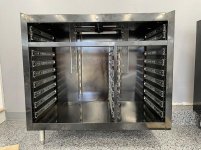
I've been brainstorming how to deal with this, and as a fan of the U.S. General boxes I got the idea to wall mount a pair of the 44" boxes to make a floating workbench.

Instead of putting on the casters, I was planning to rest the back of the box on the stem wall, remove all the drawers, and drill and fasten the box to the (2x6) studs with 4" lag screws and fender washers.

Even though the stem wall would take part of the weight, this could be a fair amount of weight on the wall once the boxes are loaded up, right? Am I nuts to try this? Other ideas or suggestions?
 
To avoid these ads, REGISTER NOW!

kaymccampbell

Well-known member
Joined
Feb 27, 2015
Messages
29,471
Location
Upstate New York
I'd add triangulation from the outer edge to the wall-floor joint, to help transfer some of the weight. Also, fender washers will ****. Your box will bend. Use a full width chunk of 1/4x3 band iron across the back, inside the box. It will spread the load, and transfer it nearer to the side frames.
 

Moss

Well-known member
Joined
Dec 21, 2013
Messages
148
Location
Ontario Canada
I'd add triangulation from the outer edge to the wall-floor joint, to help transfer some of the weight. Also, fender washers will ****. Your box will bend. Use a full width chunk of 1/4x3 band iron across the back, inside the box. It will spread the load, and transfer it nearer to the side frames.
These are great ideas and I think it would work if followed. I think I'd just put legs under the front so I didn't have to think about too much though.

Sent from my SM-G930W8 using The Garage Journal mobile app
 

That Guy Scott

Well-known member
Joined
Dec 31, 2010
Messages
139
Location
SoCal
Search “Steevo toolbox” or something similar, and then make the bench top 6” deeper in the back. Win, win- awesome design and functionality.
 

kwb

Well-known member
Joined
May 1, 2009
Messages
1,771
Location
PNW
I would add a cheater about half way out from the stem and let the box rest on it as well, you still get the floating look but a lot less stress on the upper attachment points.

I would also use an angle or something with a bit of geometry and not just a 1/4" flat bar for the attachment in the top corner. Don't get me wrong 1/4" is heavy stuff but in that orientation on 16" centers it still is going to be a bit flexy unless you are also grabbing a double thickness where top and back walls are spot welded together.
 

Moosefire

Well-known member
Joined
Oct 26, 2018
Messages
754
Location
Detroit
Maybe some plywood inside across the whole back would help to spread the load and keep the back sheet steel from ripping or bending?

Sent from my SM-N960U using Tapatalk
 

Ron_J

Well-known member
Joined
Jul 10, 2018
Messages
295
Location
Central PA
Keep in mind that if you mount it to the wall, you won't be able to add a top box as the lid won't go up.
 
OP
S

spartansix

Member
Joined
Jul 21, 2020
Messages
18
Location
CT
Lots of helpful ideas here. My original plan was a deeper version of the Steevo box but it would require fabricating sides to avoid having a 6" gap and it's also somewhat wasteful of space. My fabrication capabilities are somewhat limited until the shop is set up so simpler is probably better.
 

fourbyford

Well-known member
Joined
Aug 3, 2017
Messages
913
Location
North Idaho... almost Canada!
I think that if you incorporate Kay's idea of adding a strip of 1/4" flat bar across the (inside) top of your boxes, your plan will work. Personally, I stopped using "lags" long ago. There are a variety of newer fastners that are far superior in strength and holding force and are easier to drive. The brand I've been using lately is Spax. Many of these screws advertise that pilot holes aren't necessary but I always drill appropriately sized holes.

As far as the load/weight...
The upper cabinets in my mom's kitchen are pretty big... probably 14" deep and probably 28" - 30" tall. While I haven't examined these cabinets, my guess is that they're held up by a few wood screws through the wood frame. And, they are not resting on any sort of sill... those few screws carry ALL the weight. Every cabinet has been LOADED with heavy glassware for the past 40+ years. I still have a hard time believing they've held up all these years.

If you're really concerned about the weight, you could place a flat bar with screws across the top, then drop down a few inches and install a second bar with screws. Since the boxes will be resting on the concrete footer, the screws will not be carrying the weight of the tools... merely keeping the boxes from tipping.

You're right about the efficient use of space. Personally, I would go for it! If you notice any sagging, drawers binding, etc, you can always add adjustable legs toward the front if needed.

Be sure to post up results... with pics!!!

...D
 

rsanter

Well-known member
Joined
Dec 22, 2007
Messages
18,496
Location
visalia ca
Yup, you are nuts

Do your plan but add adjustable feet to the front of the boxes.
Why stress the wall in that way
 

Pontiac787

Well-known member
Joined
May 31, 2016
Messages
797
Location
New Hampshire
Yup, you are nuts

Do your plan but add adjustable feet to the front of the boxes.
Why stress the wall in that way

Exactly. I would put the weight on the stem wall in back and on adjustable legs in the front and call it a day. The weight of the box and tools will keep everything in place.
 

Firebrick43

Well-known member
Joined
May 12, 2015
Messages
14,010
Location
West central Indiana
The box chassis in no way is designed to take a cantilevered load like that. It’s designed to be support be the bottom.

And there is a huge difference in stress of a 14” deep cabinet holding 50-75 pounds of glass and 22” hold a thousand pounds plus of tools.
 

JRC3

Well-known member
Joined
Jun 30, 2014
Messages
12,481
Location
Southwestern OH
At my old house I did something similar to get over the block foundation/footer. If you look closely at the cheap CM grey and red workbench/cabinet to the left in this pic, you'll notice the front legs are floating. I used it like that for about 10 years and another 5 years it's still there being used by my buddy who lives there. That drill press sat on it for all but the last year or so I was there. The drawers were junk drawers full hardware and nuts and bolts...Not as heavy as tools, but still.

attachment.php
 

matt_i

Well-known member
Joined
Mar 14, 2008
Messages
10,725
Location
SE Michigan
I'd go with essentially 4 steel posts/legs with a welded flange at the end of the tube that attaches to where the casters would normally go.

Then you get the lift you need, the cabinet is supported the way it was designed, no stress on the walls.

If the back post is such that it would interfere with the concrete wall, then you could modify to run flat bar from front to back that attach to the caster flanges and then offset the rear leg forward enough to provide clearance.

Set in place with a pallet jack and various cribbing stacks while empty.
 

JRC3

Well-known member
Joined
Jun 30, 2014
Messages
12,481
Location
Southwestern OH
Hmm, this thread has me thinking of removing the casters and doing something like this. Install front and back or sit the back on the wall footer/foundation and put the legs only on the front.

https://www.ikea.com/us/en/p/lillangen-leg-stainless-steel-00322053/
https://www.ikea.com/us/en/p/silveran-leg-gray-40268006/
https://www.ikea.com/us/en/p/lillangen-leg-stainless-steel-00326763/

There are probably some other more robust options out there. The adjustability would be good for leveling the slope common to garage floors.
 

bradpac

Well-known member
Joined
Sep 8, 2013
Messages
721
Location
Central TX
I'm a fan of setting it on the wall and legs on the ground. That's a pretty deep tool box, plus even more stress when you open a drawer. It would probably work with some reinforcement to the box, but legs would be the strongest solution, never know when you might throw an engine up on top of it.
 

PugetDude

ALLIANCE MEMBER
Joined
Mar 13, 2013
Messages
22,347
Location
Superstition Mountains, AZ
The only way I would even consider hanging one of those boxes on the wall would be it I set the back on a ledger bolted to the wall (or bearing on the floor since it's out of sight and out of the way) and added a diagonal brace on the outside ends of the box, bolted into the wall and supporting a full length angle running the length of the front. That would pick up the design load points (the four corners) and still give you the look you want.
Done right this would look good, I had a neighbor (architect) who designed his upper kitchen cabinets this way, he used 1/2" x 2-1/2" flat bar on edge under the cabinets and 3/8" x 1-1/2" flat bar as diagonal braces, with hidden flanges that were bolted to the wall and covered by the cabinets. The diagonals had water jetted slots so the 1/2" bar went through them.
 
To avoid these ads, REGISTER NOW!

fourbyford

Well-known member
Joined
Aug 3, 2017
Messages
913
Location
North Idaho... almost Canada!
The box chassis in no way is designed to take a cantilevered load like that. It’s designed to be support be the bottom.

And there is a huge difference in stress of a 14” deep cabinet holding 50-75 pounds of glass and 22” hold a thousand pounds plus of tools.

I didn't even mean to imply that a large tool box was the same as a kitchen cabinet. The point i was trying to make (but obviously didn't) is that a relatively flimsy box made of plywood and held to a wall with a hand full of wood screws... with no other means of support... is capable of holding, in some instances, in excess of a couple of hundred pounds, indefinitely. No damage to the box or to the walls. And if you think a cabinet can't hold a couple of hundred pounds... glass weighs nearly 160# per cubic foot... even accounting for "wasted space", the weight can add up.

So, my analogy is that if a plywood box is capable of supporting a (proportionally) heavy load, a toolbox made of steel... with folded and welded corners and with internal structure should be capable of having the lower back edge of the cabinet rested on a ledge and the upper-back of the cabinet used to secure the box to the wall. In this case, the sides would act as gussets preventing the box from racking. If that were not the case, how is a "lower" box capable of having an "upper" box placed on top of it and then pushed/pulled around a shop? If the boxes are so flimsy, wouldn't the weight/dynamic load be enough to crush the lower box? I've never owned a US General box, but I do own a C'man upper and lower 44" set. As a machinist, I had both boxes loaded pretty heavily. My box was moved on a fairly regular basis. It was bumped by pallet jacks and once or twice by a fork lift. People and objects leaned against it. It never fell apart, never flexed, never stopped working.

So, my thought is that, the rear-most 6" of the box (according to the OP) is sitting on a 6" wide ledge... the load is straight down in that area, the same as it would be if the casters were there. I realize the front of the box is unsupported but, the amount of force needed to keep it upright is less than you might think.. because the height of the box is essentially acting as a lever. Think about using a 2 wheeler (or hand truck or dolly or whatever you might call it) to move a box that may weigh a few hundred pounds. The force required to tilt the loaded hand truck back is a fraction of the weight of what you're trying to move. Same concept applies to bolting a toolbox to a wall. A fraction of the total weight would be required to keep it upright. And, in my estimation, the boxes are built solidly enough to withstand the loads. I'm not sure about setting an engine on top of it... lol... And, if every loaded drawer were to be opened at the same time, all bets are off. But, doing the same to a free standing box would result in a fairly spectacular crash as well.

Anyways, the OP asked for opinions and this is mine. Personally, I think it's a great idea for efficiently using space and, if he does set it up as he'd thought, would make cleaning under the box a breeze. If I had a similar situation in my shop, I'd go for it. But, I don't... I'm just trying to help a brother out... The ultimate decision is his to make...

...D
 
OP
S

spartansix

Member
Joined
Jul 21, 2020
Messages
18
Location
CT
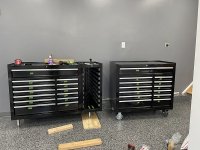
Well, I did it!

After considering all the helpful input in this thread, I decided to make a couple of modifications to my plan.

First, instead of using lag bolts and washers to attach the boxes to the studs, I used three GRK 5/16 x4" structural screws through a 18x3x3/16 steel plate at each stud. This seems a lot sturdier and really spreads out the load across the back of the boxes.

Second, I added an adjustable leg at each of the unsupported (front) corners of the box. These are each rated to 2000lbs. I set them back a little bit so that I wouldn't constantly stub my toes on them.

I have 95% of the visual effect I wanted and it should still be easy to clean under the boxes. Right now everything seems to be holding up nicely, but of course they are still empty and don't have a top yet! If they start to sag, I have designed it so I can add a third leg in the middle.

FYI, this was a pretty big pain, as every drawer had to come out (I labeled them so I could get them back in the right places) and even without drawers the boxes are very heavy. A floor jack was a critical tool for getting them into place.

Some photos are attached.
 

Attachments

  • IMG_0005s.jpg
    IMG_0005s.jpg
    83.4 KB · Views: 255
  • IMG_0006s.jpg
    IMG_0006s.jpg
    130.1 KB · Views: 241
  • IMG_0008s.jpg
    IMG_0008s.jpg
    123.8 KB · Views: 247
  • IMG_0009s.jpg
    IMG_0009s.jpg
    81 KB · Views: 252

Moosefire

Well-known member
Joined
Oct 26, 2018
Messages
754
Location
Detroit
Looks real good. Just bolts holding the boxes to each other?

Sent from my SM-G991U1 using Tapatalk
 
OP
S

spartansix

Member
Joined
Jul 21, 2020
Messages
18
Location
CT
Looks real good. Just bolts holding the boxes to each other?

Sent from my SM-G991U1 using Tapatalk

The center box (14") is designed to hang off the side of a larger box, so it has channels at the top that hook over the left and right boxes. Those hold the three together at the top for positioning, and then I added bolts to tie everything together (the box has threaded M8 holes to receive them).

I also discovered that the spacing between drawer rails is such that you can swap a double height drawer for two single height drawers. The 44 inch boxes are set up 2 - 1 - 1 - 1- 1 - 2 but the 14 inch box comes 1 - 1 - 1 - 1 - 1 - 2 - 2.

I swapped the top two drawers on the 14 inch box with the first double height drawer, and think it looks much neater now that it's set it up to match the 44 inch boxes.
 

Attachments

  • Image from iOS (6).jpg
    Image from iOS (6).jpg
    147.2 KB · Views: 153

Black300zx

Well-known member
Joined
Apr 8, 2019
Messages
782
Location
Elkton, Md
Much better than the original plan, but the front inside corners are still unsupported and cantilevered off of the back wall, right? My 0.02 - I'd add an additional support foot on the inner corners of the boxes as well. As you load up the box I think you'll find that the box frame may start to rack a bit and cause drawer binding.

Heck of a lot easier to add two more feet now while they're empty and never have to worry about it again. It would **** to find out that you need the extra legs AFTER you have the boxes loaded.
 

Max

ALLIANCE MEMBER
Joined
Jun 16, 2018
Messages
3,325
Location
Georgia
Looks nice! Kudos to not loosing space due to the wall.

I took too long to respond, and it looks like you might not like the aesthetics either, but one option would be to build a lower drawer assembly under the tool boxes out of plywood. This would give you more storage and would also support the front of the boxes. You could set it back a bit to still have a kickplate, and with full extension slides you’d be able to see everything in the box.
 

jpaw

Well-known member
Joined
Dec 23, 2018
Messages
524
Location
Michigan
Much better than the original plan, but the front inside corners are still unsupported and cantilevered off of the back wall, right? My 0.02 - I'd add an additional support foot on the inner corners of the boxes as well. As you load up the box I think you'll find that the box frame may start to rack a bit and cause drawer binding.

Heck of a lot easier to add two more feet now while they're empty and never have to worry about it again. It would **** to find out that you need the extra legs AFTER you have the boxes loaded.

Agreed.

Nice job.
If you didn't need the floor space I would have probably just left the casters on and made a deeper bench top. You can never have enough bench space.
 

Ohmthis

Well-known member
Joined
Jan 20, 2013
Messages
3,009
Location
Outside of Louisville KY
I’d make a top (butcher block maybe) that is 6” deeper than the box. No worries about stressing the box or wall. If you need to move it (we never plan for everything) you can take the top off and there you go. I have a side box on my main box that’s not as deep. My plan has always been to add a top that is the same depth. I’ve even thought of drilling holes at the back where that gap would be to store pry bars or similar.

Edit: I went back and read all of the thread. I just realized that you had already done the project. Great job! Let us know what it’s like when weight is added to the boxes.
 
Last edited:
OP
S

spartansix

Member
Joined
Jul 21, 2020
Messages
18
Location
CT
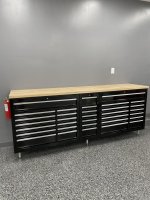
The box now has a top and a center leg, but it turns out after some tests that right now everything is angled back towards the wall about 0.5 degrees and there's very little weight on the front legs.

I can move the adjusters so that they no longer make contact with the floor and the cabinets hold themselves up. I'm starting to add tools now, so we'll see how it goes.
 

Attachments

  • IMG_0020.jpg
    IMG_0020.jpg
    130.8 KB · Views: 97

rayra

Well-known member
Joined
Dec 1, 2014
Messages
4,724
Location
Escaped from Los Angeles
Lots of helpful ideas here. My original plan was a deeper version of the Steevo box but it would require fabricating sides to avoid having a 6" gap and it's also somewhat wasteful of space. My fabrication capabilities are somewhat limited until the shop is set up so simpler is probably better.


The gap in back - which you seem to think of as wasted space - is where your flat stock gets stored.
 
To avoid these ads, REGISTER NOW!
Top Bottom