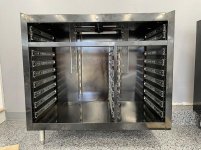
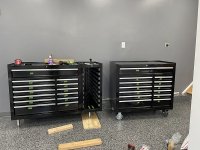
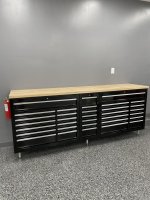
The box chassis in no way is designed to take a cantilevered load like that. It’s designed to be support be the bottom.
And there is a huge difference in stress of a 14” deep cabinet holding 50-75 pounds of glass and 22” hold a thousand pounds plus of tools.
I didn't even mean to imply that a large tool box was the same as a kitchen cabinet. The point i was trying to make (but obviously didn't) is that a relatively flimsy box made of plywood and held to a wall with a hand full of wood screws... with no other means of support... is capable of holding, in some instances, in excess of a couple of hundred pounds, indefinitely. No damage to the box or to the walls. And if you think a cabinet can't hold a couple of hundred pounds... glass weighs nearly 160# per cubic foot... even accounting for "wasted space", the weight can add up.
So, my analogy is that if a plywood box is capable of supporting a (proportionally) heavy load, a toolbox made of steel... with folded and welded corners and with internal structure should be capable of having the lower back edge of the cabinet rested on a ledge and the upper-back of the cabinet used to secure the box to the wall. In this case, the sides would act as gussets preventing the box from racking. If that were not the case, how is a "lower" box capable of having an "upper" box placed on top of it and then pushed/pulled around a shop? If the boxes are so flimsy, wouldn't the weight/dynamic load be enough to crush the lower box? I've never owned a US General box, but I do own a C'man upper and lower 44" set. As a machinist, I had both boxes loaded pretty heavily. My box was moved on a fairly regular basis. It was bumped by pallet jacks and once or twice by a fork lift. People and objects leaned against it. It never fell apart, never flexed, never stopped working.
So, my thought is that, the rear-most 6" of the box (according to the OP) is sitting on a 6" wide ledge... the load is straight down in that area, the same as it would be if the casters were there. I realize the front of the box is unsupported but, the amount of force needed to keep it upright is less than you might think.. because the height of the box is essentially acting as a lever. Think about using a 2 wheeler (or hand truck or dolly or whatever you might call it) to move a box that may weigh a few hundred pounds. The force required to tilt the loaded hand truck back is a fraction of the weight of what you're trying to move. Same concept applies to bolting a toolbox to a wall. A fraction of the total weight would be required to keep it upright. And, in my estimation, the boxes are built solidly enough to withstand the loads. I'm not sure about setting an engine on top of it... lol... And, if every loaded drawer were to be opened at the same time, all bets are off. But, doing the same to a free standing box would result in a fairly spectacular crash as well.
Anyways, the OP asked for opinions and this is mine. Personally, I think it's a great idea for efficiently using space and, if he does set it up as he'd thought, would make cleaning under the box a breeze. If I had a similar situation in my shop, I'd go for it. But, I don't... I'm just trying to help a brother out... The ultimate decision is his to make...
...D