To avoid these ads, REGISTER NOW!

Fluke 87V....$100?

To avoid these ads, REGISTER NOW!

jallyn

Well-known member
Joined
Jun 29, 2015
Messages
448
Location
Fort Wayne, Indiana
That would be a great deal. I have this meter and it does everything you could want with this type of multi-meter.

These are the quick checks for a multi-meter:
1. Set to Ohms. Touch test leads together. Should read 0.2 Ohms or less. Press the sound button. Touch test leads together again and this time you will also hear the tone indicating continuity.
2. Bring a fresh AA battery. Set to Volts DC. Should read about 1.6 Volts DC.
3. Set to Volts AC. Insert both leads into a duplex receptacle. Should read about 120 Volts AC. While plugged in press the Hz button. Should read 60 Hz.

If all that checks out the meter should be fine.
 

Davefr

Well-known member
Joined
Jan 7, 2010
Messages
11,815
Location
OR
Found a used Fluke 87V on craigslist local to me for $100.

I have to drive about an hour, but I want to test to make sure its in good shape/reading properly. What do you guys recommend to do that so I am not getting a bad meter?

https://kansascity.craigslist.org/for/5407687418.html

Turn it on and make sure all LCD segments come on during the self test.

Test the internal fuses. Download the manual and it'll show you how without opening the case.

Make sure there's no corrosion in the battery compartment.

Short the leads and make sure ohms read close to zero.

Turn it on AC Volts and plug the leads into 120VAC and make sure it registers approx. that value.

Turn on the audible diode test and make sure it beeps when leads are shorted.

Turn on the backlight and make sure it lights up the screen.

Those tests should give you about 99% confidence it's OK.

That's a very good price!!
 
Last edited:

Can I try?

Well-known member
Joined
Mar 2, 2015
Messages
374
Location
SE PA
Ideally, you'd want to take a recently calibrated meter to compare readings.

The leads, screen, and fuses are the most common wear/failure points. They are all replaceable items, but none are inexpensive.

The first thing I would do if I was considering purchasing a used Fluke is a visual inspection. Does it power up OK? Is the LCD screen intact with strong contrast? Does the screen backlight work? Are the leads in good condition?

Then I would start taking readings - I would start with AC and DC voltage. I would then check the resistance of the leads to make sure they're good. Finally, I would also use resistance to check that the current fuses are good. I would be satisfied with just those readings, but you can check them all if you'd like. It's your perogative.

Also consider if the meter includes any genuine Fluke accessories, like additional leads or a case. They are pricey if purchased separately.

As a side note, if I were selling that meter I would make sure you knew what we're doing before I let you test the current function, both setting up the meter and placing the leads. I wouldn't want someone blowing the fuses because the didn't know what they were doing.

Good luck - hopefully everything works out.
 
OP
D

Derek1387

Well-known member
Joined
Apr 6, 2009
Messages
249
Location
KC, MO
its just the meter and the leads attached.

I was looking for a basic meter to get me started, and came across this deal...almost wonder if its too much/out of my league and i should just go new?
 

jallyn

Well-known member
Joined
Jun 29, 2015
Messages
448
Location
Fort Wayne, Indiana
You will never regret getting a Fluke at an amazing price. Ask anybody who uses meters. If they ever question a reading they grab a Fluke to compare it to because they are the best.
 

Can I try?

Well-known member
Joined
Mar 2, 2015
Messages
374
Location
SE PA
its just the meter and the leads attached.

I was looking for a basic meter to get me started, and came across this deal...almost wonder if its too much/out of my league and i should just go new?

No, it's not out of your league. It's only a meter, and a decent deal at that.

I think it's okay to be up front with the seller that you're just starting out, and ask for a demonstration. If I were selling I'd be happy to oblige for $100.

As another poster mentioned, even with minor problems you'll still come out ahead in the deal. And, being a Fluke, it is a repairable meter.

I would strongly recommend this meter over anything you can buy new for $100.
 

jallyn

Well-known member
Joined
Jun 29, 2015
Messages
448
Location
Fort Wayne, Indiana
Also with the name Fluke and the protective cover this should last you for many years, dare I say decades. The 87V is the meter all others are measured against.
 

crerus75

Well-known member
Joined
May 2, 2011
Messages
301
The entire 87 series is pretty durable. I believe the documentation is available from Fluke for all of them. The two non-misuse failures I see most often are:

-LCD segments flake out. This is often a problem with a conductive rubber strip near the LCD screen. Many people have had good luck taking the strip out, cleaning it with rubbing alcohol, and reinstalling. The strip is also available as a replacement part for many meters.

-Multi-function switch contacts dirty or tarnished. This is usually solved by cleaning the contacts on the multi-function switch and the wiper arms with rubbing alcohol. Some people soak typing paper with alcohol and use it to buff the contacts, since the paper is a (very mild) abrasive and will remove surface oxidation.

These meters clean up really well for the most part. This website talks about repairs to various Fluke meters, including replacing the fusible resistor in a model 87 (not sure what version).
 

pedrodagr8

Well-known member
Joined
Aug 25, 2013
Messages
613
Turn it on and make sure all LCD segments come on during the self test.

Test the internal fuses. Download the manual and it'll should you how without opening the case.

Make sure there's no corrosion in the battery compartment.

Short the leads and make sure ohms read close to zero.

Turn it on AC and plug the leads into 120VAC and make sure it registers approx. that value.

Turn on the audible diode test and make sure it beeps when leads are shorted.

Turn on the backlight and make sure it lights up the screen.

Those tests should give you about 99% confidence it's OK.

That's a very good price!!

This post here gives you a great starting point. This meter is a robust all-around meter. It isn't very advanced but it is damn robust. The BIGGEST issues I see with these meters are blown fuses and blown protection parts. The AC Voltage test, the DC Voltage test mentioned one post before will tell you if any of the PTCs and MOVs are shot (or worse the input circuitry). While the fuse test will let you know if the fuse have been blown. These fuses are NOT cheap but they are a major part of the reason these meters are so safe. At $100 this is a steal. Also, the cover should clean up nicely with degreaser like simple green or somethign similar. I would jump on this in a heart beat if I was you. I deal with these meters a lot (refurb and buying lots etc) and this is a VERY good price.
 
Last edited:
OP
D

Derek1387

Well-known member
Joined
Apr 6, 2009
Messages
249
Location
KC, MO
Fair enough....ill go grab it, then teach myself how to use it. Most of my work is automotive, so i know this isnt the RIGHT multimeter for that, but it seems like it will do everything well....
 

454ragtop

Well-known member
Joined
Mar 24, 2008
Messages
5,010
Location
Carver, MA
Ad says $150, don't know if you negotiated a lower price, or he read this thread and raised the price........
Good luck, Jim
 

n8n

Well-known member
Joined
Mar 11, 2014
Messages
3,607
Location
Curtis Bay, MD
If the screen doesn't light up all segments that is not a deal killer but ask for a discount.

I trash picked a Fluke from work with that problem. Had it repaired for a little over $100

after I asked the repair guy what the issue was he told me that it was the "elastomeric contacts" for the display; I had an older Fluke (77?) that I now no longer needed because the new one made three, it had always had some dim segments, I opened it up, removed the display, and cleaned the contacts with isopropanol, damn I should have done that 10 years ago. Gifted it to a young kid with no tools so he'd have a decent safe meter.
 

n8n

Well-known member
Joined
Mar 11, 2014
Messages
3,607
Location
Curtis Bay, MD
its just the meter and the leads attached.

I was looking for a basic meter to get me started, and came across this deal...almost wonder if its too much/out of my league and i should just go new?

I feel safer around a pro using a cheap meter than I do a n00b using a cheap meter. Or in other words if you're not confident you know what you're doing and are going to have to figure it out on your own, get a GOOD meter that will protect you if something goes wrong. Fluke and Simpson use better fuses than e.g. Harbor Freight so if you do something dumb you are less likely to kill yourself.

this is why I kept a Greenlee meter and gifted a Fluke to a 20 y.o. if he is learning I'd rather him not get kilt when he makes his first mistake with it. Those sand filled fuses are expensive and require a trip to Grainger (or an online order) to replace, but they do their job whereas a regular AGC might not fully protect you.

http://hackaday.com/2010/05/05/when-multimeters-go-boom/

yeah, I've used cheap meters and cut corners, but do as I say not as I do
 
OP
D

Derek1387

Well-known member
Joined
Apr 6, 2009
Messages
249
Location
KC, MO
Picked it up. Everything SEEMS to test out correctly. It jumping around on the mV setting had me spooked, but i think thats because it is UBER sensitive, im assuming. It was always near 0 on MV.

Backlight works, all buttons work, cleaned up nicely. Has a set of Fluke leads, but i think im going to go ahead and replace them, and grab a fluke bag while im at it.

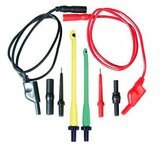
What leads does everyone recommend to have on hand? General automotive and house hold stuff to start. Stick with fluke leads? Or are there other "less expensive" quality leads that I can look at?
 
To avoid these ads, REGISTER NOW!

FigureItOut

Well-known member
Joined
Sep 14, 2015
Messages
3,267
Location
Bentonville AR
Good buy, wish it was me.

This is a good set, affordable and built to endure some kinking and twisting. It has the best clips I've ever seen.

https://www.amazon.com/gp/product/B0029XJANE/?tag=atomicindus08-207958004f01c9e9c8b23c8f7f555201fa.jpg


These are awesome, over-built in a good way, very versatile with the extra banana jack at the base, and you'll eventually want to have some wire piercing probes, of which the included ones are among the best.https://www.amazon.com/gp/product/B000MJXQ64/?tag=atomicindus08-206bdbb957873335684288077e491bd031.jpg


Sent from my SAMSUNG-SGH-I337Z using Tapatalk
 

454ragtop

Well-known member
Joined
Mar 24, 2008
Messages
5,010
Location
Carver, MA
Picked it up. Everything SEEMS to test out correctly. It jumping around on the mV setting had me spooked, but i think thats because it is UBER sensitive, im assuming. It was always near 0 on MV.

Backlight works, all buttons work, cleaned up nicely. Has a set of Fluke leads, but i think im going to go ahead and replace them, and grab a fluke bag while im at it.

What leads does everyone recommend to have on hand? General automotive and house hold stuff to start. Stick with fluke leads? Or are there other "less expensive" quality leads that I can look at?

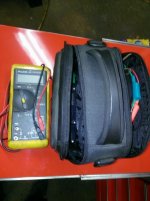
Congrats, the fluke bags are stupid expensive for what they are, IMO, I ended up getting a small camcorder bag. More protection, 2 compartments, with a couple zippered pouches, use 1 side for the meter, and extra test leads, alligator clips and other accessories in the other side.
Jim
 
OP
D

Derek1387

Well-known member
Joined
Apr 6, 2009
Messages
249
Location
KC, MO
Congrats, the fluke bags are stupid expensive for what they are, IMO, I ended up getting a small camcorder bag. More protection, 2 compartments, with a couple zippered pouches, use 1 side for the meter, and extra test leads, alligator clips and other accessories in the other side.
Jim

Good idea!
Any link to the one you used at all?
 
Last edited:

Mohawk Dave

Well-known member
Joined
Oct 7, 2012
Messages
5,068
Location
SoCal
Last edited:

dogdad

Well-known member
Joined
Dec 19, 2013
Messages
289
Location
Down south
Curious...what is the difference between a 87 and 87V ?
Not the best pic...but not "v" looking at it.
495f20d0841df3f0c20d2936255f9f85.jpg
 
Last edited:

454ragtop

Well-known member
Joined
Mar 24, 2008
Messages
5,010
Location
Carver, MA

Attachments

  • WP_20160120_001.jpg
    WP_20160120_001.jpg
    61.2 KB · Views: 28
  • WP_20160120_002.jpg
    WP_20160120_002.jpg
    68 KB · Views: 27

pedrodagr8

Well-known member
Joined
Aug 25, 2013
Messages
613
Curious...what is the difference between a 87 and 87V ?
Not the best pic...but not "v" looking at it.
495f20d0841df3f0c20d2936255f9f85.jpg

That is most definitely an 87 Series I. The 87 Series I doesn't have a CAT rating, as they weren't invented yet. The Series II looks identical (it isn't called the series II on the meter) but it has a CAT III rating. The lack of a CAT rating means that it isn't as safe as the 87V.

Otherwise:
  • 87 Series I is 4000 count versus 87V's 6000 count
  • 87 Series I is 0.1% Max Accuracy versus 87V's 0.05% Max Accuracy
  • 87 Series I you have to shut the meter off to enter 4.5 digit mode versus the 87V where you can do it without shutting the meter off
  • 87 Series I defaults to DC on current, while the 87V defaults to AC on current
  • 87 Series I lacks a battery door you have to remove the whole case to change the battery, while the 87V has an easy access battery door.
  • The 87 Series I lacks a temperature functions, while the 87V has it
  • The 87 Series I lacks a low-pass filter on AC measurements, while the 87V has it.
  • The 87 Series I lacks peak detect, while the 87V has it.
  • The 87 Series I lacks smoothing, while the 87V has it.
  • The 87 Series I has a max capacitance of 5uF, while the 87V has a max of 9999uF
  • The 87 Series I has an old green backlight, while the 87V has a white backlight.

That is all of the differences that I can find.

Picked it up. Everything SEEMS to test out correctly. It jumping around on the mV setting had me spooked, but i think thats because it is UBER sensitive, im assuming. It was always near 0 on MV.

Backlight works, all buttons work, cleaned up nicely. Has a set of Fluke leads, but i think im going to go ahead and replace them, and grab a fluke bag while im at it.

What leads does everyone recommend to have on hand? General automotive and house hold stuff to start. Stick with fluke leads? Or are there other "less expensive" quality leads that I can look at?

Get silicone leads, trust me on this. They are so much easier to use than PVC coated leads. I like the Pamona 5519A for probes. Pamona is a Fluke subsidiary and these are literally the Fluke TL-71 test leads, just $10-15 cheaper. They have a 1 meter silicone cable that is VERY flexible (even in the cold) and doesn't easily tangle. All for around $14-17 (compared to $25-35 for the Fluke TL71).

As for adapters, there are a variety of adapters you can source. This is a seller I have used extensively out of HK. He stocks some REALLY solid quality stuff for a good price. Usually even if the stuff looks similar to other sellers it is higher quality. For example, the mini-grabbers that I got from him have a much stronger spring and a better feeling plastic (even though mini grabbers look more or less identical). Shipping from HK to the USA takes 6-8 days. He has banana cables but he also has a good number of probe tip adapters. Like these, these and these. You get more versatility with banana plugs, but you can use these three adapters to do 95% of what you want. It just depends on which direction you want to go. For myself I have the 5519A for everyday probing and banana plugs with adapters for everything else.
 
Last edited:

jallyn

Well-known member
Joined
Jun 29, 2015
Messages
448
Location
Fort Wayne, Indiana
This is a really cool thread. Nothing against Snap-On ratchets, etc... I'm an electrical engineer by training with 12 years in heavy industry doing maintenance management and capital project engineering. And I learned lots of stuff about test leads and the Fluke 87V capabilities (which I own :lol:) from this thread. :thumbup:
 

n8n

Well-known member
Joined
Mar 11, 2014
Messages
3,607
Location
Curtis Bay, MD
I wish this thread had happened earlier... I've been disappointed in some recent test lead purchases :(
 
OP
D

Derek1387

Well-known member
Joined
Apr 6, 2009
Messages
249
Location
KC, MO
Greatly appreciate all the information given in this thread. Very much so. Been reading and watching Youtube videos on this multimeter....wow, this thing is incredible!
 

LG63

Well-known member
Joined
Sep 7, 2012
Messages
1,003
Another option for leads is the retractable set TL175. They are silicone and a bargain on Amazon right now at $21

Edit: Amazon lumps all the Fluke lead reviews together so you need to look specifically for the TL175 reviews if you're interested in what other users think
 
Last edited:

Dabhand

Member
Joined
Nov 2, 2015
Messages
17
Location
West London, England
Curious...what is the difference between a 87 and 87V ?
Not the best pic...but not "v" looking at it.
495f20d0841df3f0c20d2936255f9f85.jpg

The main difference is the age of the instrument, the 87 pictured is a much earlier design, and the 'V' the mk 5 version, they also did a 187 and now the current version is a 287.

I'm a metrologist specialising in electronic calibration and we still see loads of these meters each week coming into the lab from various customers and they are a very robust bit of kit. When buying second hand you're find they either work or don't, very rarely do we need to adjust one. I'd be happy with either for home use.
Probably find the uncertainties are a bit better on the 'V' but nothing to worry about.
 

BMack37

Well-known member
Joined
Aug 28, 2015
Messages
1,091
The main difference is the age of the instrument, the 87 pictured is a much earlier design, and the 'V' the mk 5 version, they also did a 187 and now the current version is a 287.

I'm a metrologist specialising in electronic calibration and we still see loads of these meters each week coming into the lab from various customers and they are a very robust bit of kit. When buying second hand you're find they either work or don't, very rarely do we need to adjust one. I'd be happy with either for home use.
Probably find the uncertainties are a bit better on the 'V' but nothing to worry about.

At my shop we have a fair amount of old Fluke multimeters, several over 10 years old one over 15 years old. None have ever been serviced, we check accuracy with a new meter and they are still spot on. ...and it's not like all are high end, some are entry level. Flukes don't die from old age, they get murdered or live forever.
 

pedrodagr8

Well-known member
Joined
Aug 25, 2013
Messages
613
The main difference is the age of the instrument, the 87 pictured is a much earlier design, and the 'V' the mk 5 version, they also did a 187 and now the current version is a 287.

When buying second hand you're find they either work or don't, very rarely do we need to adjust one.

There is also the difference in the safety protections. The wafer switches used in the Fluke 87 Series I are not nearly as safe as the later space separated traces used in modern multimeters. Also, I have seen these same wafer switches get dirty or if the meter is heavily abused by turning the dial really hard these wafers can get bent. Both of these cause the switches to make bad contact. Both of these are EASY fixes (cleaning and/or bending the switches back in place), just not quite as robust as modern implementations.

Semantics, but the 287 is not a new version of the 87. It is an entirely new line. Much like a BMW 7 series is not a new version of the 5 series. It gets a bit more hazy with the 187, because the 187 started as the 87IV (they are identical) but Fluke realized it was far too different from the other 87s, and as a result shifted to form a new line as the 187. The 87V returned the 87 series to its original feature set line continuing with only minor improvements.


At my shop we have a fair amount of old Fluke multimeters, several over 10 years old one over 15 years old. None have ever been serviced, we check accuracy with a new meter and they are still spot on. ...and it's not like all are high end, some are entry level. Flukes don't die from old age, they get murdered or live forever.

In general true, there are a few failure modes for the older generations. There is the issues with the wafer switches I mention above. There is also the issue with the zebra strip of the display degrading over time. This causes the fading digits/segments issue. Once again, this pretty much affects the older generations. Fluke claims they fixed this issue with a reformulation of the polymers in the zebra strip. Other than these, the parts are of sufficient quality that they hold their specs pretty well.

Note all of this discussion exludes the Chinese mades 77 (I cant remember if it is the 77-III or 77-IV) but that thing is a steaming pile of ****. VERY un-Fluke, in that they broke easily, had difficulty maintaining specs and the inside build quality is much worse. It was Fluke's first attempt at international manufacturing and it showed. Recent Chinese made Flukes like the 101, 105, 107, 115-117, etc. have much better build quality.
 
Last edited:

BMack37

Well-known member
Joined
Aug 28, 2015
Messages
1,091
Luckily those display problems are pretty easily remedied by just about any one that would own a Fluke.

I have one of the Chinese-made 115s and if it didn't say so on the package I never would have guessed, the quality of this generation's Chinese-made meters is really good.

Basically, I'm agreeing with everything you said haha.
 
To avoid these ads, REGISTER NOW!
Top Bottom