To avoid these ads, REGISTER NOW!

Fluke multimeter or..?

mrjaw14

Well-known member
Joined
May 22, 2012
Messages
1,959
Location
Nashville, TN
If I got a used meter I might have the meter calibrated once just to ensure it's as good as can be, but I think the OP's just needing the resolution to capture small current draw that wouldn't register on a less sensitive meter and be sure it's not phantom voltage readings.

Technically you can do a voltage drop test, but the way the OP's thinking of measuring the circuit is probably easier for his purposes. Fluke is one of the most respected brands. Certainly can't go wrong with them. There's other good brands, I have a tripplett meter personally, but I don't need it to go that low. I'd like to get a fluke meter with a built-in scope, but those are still $$$. maybe in a few years they'll be a bit cheaper. Sounds like a Fluke 87 is the model for you
 
To avoid these ads, REGISTER NOW!

richfinn

Well-known member
Joined
Jan 29, 2011
Messages
4,809
Location
Leeds, Yorkshire, England
I just finished a few hours of surfing here and the net trying to figure out what multimeter I need to fit the bill for what I do, and there are so many options I'm almost more confused after all my reading. I'm a motorcycle mechanic by trade, but like many of us I tinker with all sorts of stuff. I have a Fluke 73 meter (NOT the series III) that I've had since I studied electrical engineering in college almost 20 years ago. That 73 has served me well for 99% of what I've had to do since I've had it. I recently found a shortcoming with it, and that's why I'm researching and looking for advice. When doing current leakdown tests on motorcycles I need something that has better low end resolution. This 73 can actually only read down to 100 milliamps (.01 amps) and I need a meter that can read down to at least .1 milliamps, possibly even lower to give me a little "space".

I've looked at the Fluke 87, Fluke 787, some Ideal models, Amprobe, and of course there is a ton of China **** out there. I know there are other companies besides Fluke, and despite being happy with my existing model for so many years, I'm not brand loyal. I just don't want to buy ****. I'd love to get something once that will last me another 20 years.

What would guys who are automotive type techs recommend that would fit the bill for what I need, but also cover things I may not have even thought about yet? I have a separate (plug-in style) peak voltage adapter so if there's a meter with that built in, great - but that is not a deal breaker.

A friend recommended the Fluke 87, but I'm open to all suggestions if they do what I need and aren't junk. If nothing else, what brands are good/bad? Fluke, Amprobe, Extech, Ideal, Greenlee, etc? Lastly, I'd very respectfully ask that if you don't do this kind of work regularly please don't recommend anything specific. I'm hoping to get solid feedback from users with similar jobs, and I don't believe that most DIY'ers would have the same needs and experience.

Thanks in advance! :)

If 1 amp equals 1000mA, 0.1A is equal to 100mA

Therefore your meter reading of 0.01A is actually 10mA

I would have thought even on a bike with a little battery this would be adequate for current drains???
 

Steinmetz

Well-known member
Joined
Oct 11, 2012
Messages
2,274
Location
Washington State
I just finished a few hours of surfing here and the net trying to figure out what multimeter I need to fit the bill for what I do, and there are so many options I'm almost more confused after all my reading. I'm a motorcycle mechanic by trade, but like many of us I tinker with all sorts of stuff. I have a Fluke 73 meter (NOT the series III) that I've had since I studied electrical engineering in college almost 20 years ago. That 73 has served me well for 99% of what I've had to do since I've had it. I recently found a shortcoming with it, and that's why I'm researching and looking for advice. When doing current leakdown tests on motorcycles I need something that has better low end resolution. This 73 can actually only read down to 100 milliamps (.01 amps) and I need a meter that can read down to at least .1 milliamps, possibly even lower to give me a little "space".

I've looked at the Fluke 87, Fluke 787, some Ideal models, Amprobe, and of course there is a ton of China **** out there. I know there are other companies besides Fluke, and despite being happy with my existing model for so many years, I'm not brand loyal. I just don't want to buy ****. I'd love to get something once that will last me another 20 years.

What would guys who are automotive type techs recommend that would fit the bill for what I need, but also cover things I may not have even thought about yet? I have a separate (plug-in style) peak voltage adapter so if there's a meter with that built in, great - but that is not a deal breaker.

A friend recommended the Fluke 87, but I'm open to all suggestions if they do what I need and aren't junk. If nothing else, what brands are good/bad? Fluke, Amprobe, Extech, Ideal, Greenlee, etc? Lastly, I'd very respectfully ask that if you don't do this kind of work regularly please don't recommend anything specific. I'm hoping to get solid feedback from users with similar jobs, and I don't believe that most DIY'ers would have the same needs and experience.

Thanks in advance! :)

As others have suggested, put a resistor in the circuit, and read the voltage drop. From that you can determine the current through the resistor. You don't need a high resolution current-sensing capability for a simple diagnostic test like this.
In addition, I'd bet that the current leak you think may be the problem is too small to actually be causing a significant battery discharge.
 

theoldwizard1

Well-known member
Joined
Feb 22, 2011
Messages
43,072
Location
SE MI
In addition, I'd bet that the current leak you think may be the problem is too small to actually be causing a significant battery discharge.
CONCUR !

I seem to recall that 5 - 10 mA draw would NOT completely discharge a typical car battery over a period of a week or 2.

Dirt on the outside of a battery can actually cause a parasitic draw, probably more than 0.1mA.
 

ttpete

Well-known member
Joined
Mar 8, 2011
Messages
6,737
Location
Dearborn, MI
Is there something other than Fluke? Hahah

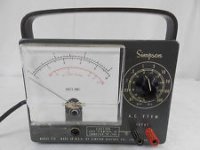
Sure. Simpson 260. There are uses for analog units, and these are still made. I own one in addition to 2 Fluke DMMs, one a bench unit, the other a hand held. Also a dedicated Fluke snap-over ammeter.
 

Steinmetz

Well-known member
Joined
Oct 11, 2012
Messages
2,274
Location
Washington State
Sure. Simpson 260. There are uses for analog units, and these are still made. I own one in addition to 2 Fluke DMMs, one a bench unit, the other a hand held. Also a dedicated Fluke snap-over ammeter.

Hear Hear! I own several Simpson 260's and a few Triplett 630's. I use them quite often.
 

richfinn

Well-known member
Joined
Jan 29, 2011
Messages
4,809
Location
Leeds, Yorkshire, England
I personally think a Fluke 70 series is still a pretty good basic meter for working on bikes and cars, I use a 78 and I,ve never needed micro amps in 25years and I've found plenty of current drains on vehicles.

What is the actual reading on your meter on the bike in question??
 

Rickss96

Well-known member
Joined
Sep 23, 2010
Messages
455
Location
SoCal
The 787 wasn't mentioned by anyone here, but it's at a local pawn shop for $250 in good condition.

A 787 for $250 sounds like a very good deal. It does not have as many functions and features as the Fluke 87 but it is still a good meter. Accuracy is reduced but good enough for most automotive work. Go to the Fluke website and it will let you compare the two meters side by side. The 87 is top of the line but has functions you may never need like capacitance, conductance.

HubbaBubba asks: Is there something other than Fluke?
I will put in a vote for Agilent - they make excellent test equipment.
 
OP
B

bareass172

Well-known member
Joined
Aug 5, 2012
Messages
817
Location
N'awlins
I appreciate the heads up on calibration, but I was already expecting that if I end up getting one used. I'm weighing calibration costs vs just buying new, I think new will likely win.

As for my specific current problem bike, it's a long story and that's why I've tried to keep from explaining it. I know what the problem is, and I am very confident that it's not a parasitic draw issue, but I want to be able to physically show that to the customer so he understands and believes me.

I'm not really here asking for advice on how to fix the bike - just advice on a meter. Please know I appreciate the help and I mean this VERY RESPECTFULLY. I recognize and value what you've told me for future use, but in this case I'm just trying to find the right meter. I know it's a lot of money to spend to show one customer one thing, but I've known for awhile that I would like a better meter than my old 73 AND this is a long-time customer who has spent a lot of money with me so I don't mind going the extra mile for him.

Just for reference sake, and I know that the books aren't always right, but the book spec for this specific bike is anything more than .1 mA is considered parasitic draw and too much. So this is what I need to be able to show the customer.

Thanks again for all the suggestions. I did a little comparison shopping today, but my entire evening was ******* helping a friend who just bought a new home. ;)
 

xwarp

Well-known member
Joined
Oct 15, 2011
Messages
165
Get a Triplett 630 off the bay for cheap.

60 microamp range.

That in addition to the customer seeing an older analog might be more convincing.
 

richfinn

Well-known member
Joined
Jan 29, 2011
Messages
4,809
Location
Leeds, Yorkshire, England
I appreciate the heads up on calibration, but I was already expecting that if I end up getting one used. I'm weighing calibration costs vs just buying new, I think new will likely win.

As for my specific current problem bike, it's a long story and that's why I've tried to keep from explaining it. I know what the problem is, and I am very confident that it's not a parasitic draw issue, but I want to be able to physically show that to the customer so he understands and believes me.

I'm not really here asking for advice on how to fix the bike - just advice on a meter. Please know I appreciate the help and I mean this VERY RESPECTFULLY. I recognize and value what you've told me for future use, but in this case I'm just trying to find the right meter. I know it's a lot of money to spend to show one customer one thing, but I've known for awhile that I would like a better meter than my old 73 AND this is a long-time customer who has spent a lot of money with me so I don't mind going the extra mile for him.

Just for reference sake, and I know that the books aren't always right, but the book spec for this specific bike is anything more than .1 mA is considered parasitic draw and too much. So this is what I need to be able to show the customer.

Thanks again for all the suggestions. I did a little comparison shopping today, but my entire evening was ******* helping a friend who just bought a new home. ;)

I can understand that you would want a 4.5 count meter working to that tolerance.

Before you decide though consider what other features you might want in the future.

True RMS on AC??

Data logging??

Glitch capture??

Temp??

RPM/dwell angle??

Pulse width mS/Frequency Hz??

backlight??

min/max record??

The 87/88 are different in a few ways, and there are some European meters tailored to automotive work that can convert mV to amps when using a clamp probe among other things although you can convert most things using charts it may be easier to use. I find with more highly featured meters the controls can be a bit "busy" and I revert to picking up my simple trusty Fluke 78 even though the lack of a simple backlight and the ranges in going 4/40/400/4000 can be a pain when most ECM references are 5v annoys me sometimes.

There is a Fluke buyers guide on the website and an unofficial guide on eBay that might help you choose, as already suggested EEV blog on YouTube has lots of info.

Good luck.
 

ttpete

Well-known member
Joined
Mar 8, 2011
Messages
6,737
Location
Dearborn, MI
Hear Hear! I own several Simpson 260's and a few Triplett 630's. I use them quite often.

I also have a military TS-352-B/U unit made by Barnett, which is in a heavy watertight metal case. I suspect it's a copy of a Triplett 630 inside.
 
OP
B

bareass172

Well-known member
Joined
Aug 5, 2012
Messages
817
Location
N'awlins
I actually can't believe I forgot about Triplett. I grew up with one (forget which model) but it's what my dad had when he studied electrical engineering in college. Way, way before I ever got a digital meter that was my go to. I'll check those out too, for the price it never hurts to have an extra option around.

Richfinn - that's exactly why I'm asking here in addition to doing some homework. I want to think forward, not about doing what I do already but with better resolution but about what I'll be able to do with new features.
 

01ps

Well-known member
Joined
Feb 3, 2013
Messages
131
Last winter I hunted for weeks for the right dvom for automotive. I wanted quality and reliability but had a budget. I found the 2 don't seem to go hand in hand. I looked seriously at amprobe and a few others but finally found new in box fluke 85 series III on ebay for a reasonable price and couldn't be happier. Somebody may have mentioned it but eevblog has lots of meter reviews on YouTube. He is kind of annoying but very thorough.
 

hemdale

Well-known member
Joined
Jan 4, 2014
Messages
267
Location
France
+1 for the Fluke 116. I love mine and the temperature sensor is way more handy than I thought !
 

exmaxima1

Well-known member
Joined
Jun 25, 2011
Messages
6,339
Location
Midwest
You've given up on doing useful things, I see.

Nope. I just haven't found anything yet that an ancient Simpson 260 could do better than a modern Fluke meter. I suppose I could use my Simpson to monitor line voltage as a conversation piece......
 
To avoid these ads, REGISTER NOW!
OP
B

bareass172

Well-known member
Joined
Aug 5, 2012
Messages
817
Location
N'awlins
I think I have this narrowed down to the Fluke 87V (as so many have suggested) and the Test Products International 194 (re-branded as Snap On). There were so many great suggestions, but these 2 seemed to really stand out. Anyone have any reasons why one would be absolutely better than the other?

I asked a friend who works extensively with meters in his job, similar capacity to what I do but much more specialized. He said he thought the TPI looked like a better option but his one hangup was simply that Fluke is the industry standard and owning one speaks volumes all by itself.
 

SuzukiGS750EZ

Well-known member
Joined
Apr 26, 2012
Messages
3,273
If you want in hand pics or anything of the TPI unit just ask. Not trying to sell you on it but when I went to buy it I only found pictures from the manufacturer and nobody I could find owned one.
 

zkling

Well-known member
Joined
Jan 23, 2007
Messages
16,939
You are comparing two different types of meters. The 87 is a standard multimeter real time measurements with max, min and holds. The TPI is a data logging meter. Do you need a data logging meter? The TPI is more geared towards vehicle and engine work where as the 87 is an all around from the bench to the field solid multimeter. You might get more use out of the TPI for what you are doing.
 

Steinmetz

Well-known member
Joined
Oct 11, 2012
Messages
2,274
Location
Washington State
Nope. I just haven't found anything yet that an ancient Simpson 260 could do better than a modern Fluke meter. I suppose I could use my Simpson to monitor line voltage as a conversation piece......

Fair enough. I bought my first Fluke when I was a graduate student in 1982. It recently inadvertently received a HV jolt from one of my AM transmitters and gave up the ghost.

The two other Flukes I own usually have dead batteries when I want to use them (usually when I need very high impedance), and can't find my (wait for it…) vacuum tube voltmeter.
 

ttpete

Well-known member
Joined
Mar 8, 2011
Messages
6,737
Location
Dearborn, MI
Fair enough. I bought my first Fluke when I was a graduate student in 1982. It recently inadvertently received a HV jolt from one of my AM transmitters and gave up the ghost.

The two other Flukes I own usually have dead batteries when I want to use them (usually when I need very high impedance), and can't find my (wait for it…) vacuum tube voltmeter.

RCA Voltohmyst? :D
 
OP
B

bareass172

Well-known member
Joined
Aug 5, 2012
Messages
817
Location
N'awlins
If you want in hand pics or anything of the TPI unit just ask. Not trying to sell you on it but when I went to buy it I only found pictures from the manufacturer and nobody I could find owned one.
I actually sent you a PM this afternoon.

zkling - this was my thought as well. The features of an 87V seem like they're all available in the 194 too, except the 194 has a few extra bells and whistles. The data-logging is an external thing with a cable, so I might not use it right away but I'd have the option if it became necessary. I am a fan of the multiple hold feature, but I am kinda in love with the 3 displays at once thing. I fully realize that these are not features I'll use every single day, but once in awhile when I need them I think they'll be handy.

With that said, I'm still not totally convinced of the 194 versus the 87, but I believe that's mostly because the 87 is so overwhelmingly popular. I doubt I'd ever regret the 87, I just think the 194 might be a bit of (dare I say) a step up. :headscrat
 
OP
B

bareass172

Well-known member
Joined
Aug 5, 2012
Messages
817
Location
N'awlins
EEV Blog seems to be down right now, but I'll check the link. Thanks for posting.

I still haven't jumped to make a choice on this. I'm mulling it over some more, I've checked my problem and (as expected) I don't seem to have any draw. Now to show the customer this... ;)
 

exmaxima1

Well-known member
Joined
Jun 25, 2011
Messages
6,339
Location
Midwest
Fair enough. I bought my first Fluke when I was a graduate student in 1982. It recently inadvertently received a HV jolt from one of my AM transmitters and gave up the ghost.

The two other Flukes I own usually have dead batteries when I want to use them (usually when I need very high impedance), and can't find my (wait for it…) vacuum tube voltmeter.

I'm near your age---I got my EE in 1978. My last Simpson 260 was held together with various adhesives and I finally tossed it years ago when I couldn't get consistent readings range-to-range. My wife bought me my first Fluke 73, which lasted nearly forever until I literally blew it up (HUGE FLASH) attempting to test the magnetron in a microwave oven--who knew those things were such high voltage!
Along the way, I tossed my Simpson 715 VTVM and Triplett VOM's in favor of Flukes. Battery life has never been an issue since they (at least the 73/75/77) have auto shutoff. And in any case, a 9v battery for the Fluke is cheaper than the (4) AA and single D in the 260. In fact, if I recall, my older Simpson used some weird battery that cost more than the meter was worth..
 

Attachments

  • vtvm.jpg
    vtvm.jpg
    7.9 KB · Views: 21
OP
B

bareass172

Well-known member
Joined
Aug 5, 2012
Messages
817
Location
N'awlins
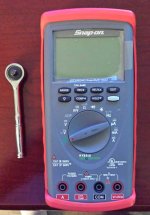
I just wanted to update this thread and say that I chose to go with the SnapOn EEDM604C. There were a lot of great recommendations in this thread, but SuzukiGS750EZ recommended the Test Products International (TPI) model 194. This is the same unit SnapOn resells as this EEDM604C. Putting this unit side by side with Flukes, I feel like this thing competes with what Fluke can do but also has additional features that make this thing stand out. I was going to buy a TPI new but then noticed that the SO version sells super cheap on Ebay for some reason. Surprisingly, it sells cheaper than the lesser model EEDM504C. Maybe they're not as popular, or maybe some people get confused by how much these can do and want something more basic. I dunno, but I got the SO version, which is $450 new, for $94 shipped.

It was "used but new", the seller said it was used one time. The pictures showed it in great shape, and I believe what they said - this thing still had the plastic wrap on the screen and the test leads were sealed in their original packaging.

My first impression is that I'm going to like it a LOT. The size of this thing makes my old Fluke 73 look like a toy! Granted, my picture is a little skewed because the ratchet is a tiny TN72 I had on my desk, but it really is a lot of meter. :D

Thanks so much for everyone who contributed.
 

Attachments

  • 20140430_140603.jpg
    20140430_140603.jpg
    48.7 KB · Views: 53

Brownsfan

Well-known member
Joined
Apr 16, 2012
Messages
5,974
Location
Cleveland Ohio
You got a hell of a deal. That is a great meter. Especially for the money you paid. It should serve you well. I also went against the fluke is the only meter made and couldn't be happier. Nothing against fluke. They are great. I own a 113. But i like my Klein mm2000 and cl2000 clamp meter better than anything I have used.
 

nanofrog

Well-known member
Joined
Mar 1, 2012
Messages
1,323
...this thing still had the plastic wrap on the screen...
A lot of people leave it on to help protect the screen from scratches.

Personally, I pull them off and put on cell phone screen protector film if they don't already have it. Easier to see the display (film is clearer), and still protects the screen from scratches.
 
OP
B

bareass172

Well-known member
Joined
Aug 5, 2012
Messages
817
Location
N'awlins
You got a hell of a deal.
I agree, but honestly they sell for ~$100 on Ebay most of the time (this is what I saw looking at sold auctions). I was surprised!

Personally, I pull them off and put on cell phone screen protector film if they don't already have it. Easier to see the display (film is clearer), and still protects the screen from scratches.
Thank you SO MUCH for this tip. I have some of that stuff extra from a tablet protector application that didn't go well recently, so I'm all set. :rocker:
 

zkling

Well-known member
Joined
Jan 23, 2007
Messages
16,939
Congrats, looks like that meter will do evertying you needed and then some. Sounds like you go a good deal too. Sometimes things just align them selves just right :beer:
 
To avoid these ads, REGISTER NOW!
Top Bottom