To avoid these ads, REGISTER NOW!

Foam vs Fiberglass Insulation.

mpr455

Active member
Joined
Mar 15, 2010
Messages
28
Location
lombard IL
My question is which is better? Also i've been told that you can achieve r-20 with foam. Can you do this with fiberglass? Without breaking the bank? Hopefully somebody that has gone through this can answer.
 
To avoid these ads, REGISTER NOW!

walrus

Well-known member
Joined
Nov 12, 2008
Messages
11,679
Location
Maine
My question is which is better? Also i've been told that you can achieve r-20 with foam. Can you do this with fiberglass? Without breaking the bank? Hopefully somebody that has gone through this can answer.

Where are you putting it and how thick a cavity. Foam is way better than Fiberglass but costs should be weighed also. Personally, energy costs are going to keep going up so the more R value the better.
 

dlenkewich

Well-known member
Joined
Jan 27, 2011
Messages
1,409
Location
Saskatoon, Sk, Canada
Here's it straight - "Which is better?", there going to be a whole-lot of couch and keyboard experts come in here and tell you foam.

My career is in insulation, and no, it isn't in sprayfoam. It doesn't make me bais, but it does make me informed and realistic.

You'll spend a whole **** load more money on foam then you would on fibreglass batts. Both systems can achieve essentially any R-value you want. Fibreglass batts come in a standard R19/R20 batt. For thermal applications, depending on your area you'll want to use kraft backed batts or faceless batts and a seprate vapour barrier.

Foam has some great potential in area's where you have limited space and need to achieve a high R-Value. Foam is great for under bonus rooms where cold floors are a complaint, this is because in a typical home, the vapour barrier has to be 'bagged' to allow heat to circulate underneath the floor, because of this there is area's where the VP and the batt's are not flush and tight together. Batt's and VP need to work together to achieve optimal results. Another great area for spray foam is joist spaces where tight areas and pertrusions (vents, pipes and wires) make area's hard to seal tightly. It can also be a good choice for renovating an older structure where extra rigidy is desired.

Foams greatest killer is the cost to the consumer. Reality is, joe public want's the best for his home... Until he finds out that the standard system is 1/3rd the cost and they'll likely never have a problem with the insulation system in their lifetime. Atleast where I am, my business is alive and growing. In my many years of installing, I've never had to preform warranty. Perhaps that's because I excel at what I do. Insulation, like a lot of trades, has been hurt by poor installers, but you know what? Sprayfoam can also be installed poorly or even completely wrong as well, google has many stories of bad sprayfoam installs requiring great lengths to be remedied.

Sprayfoamers intended on coming into the insulation market and changing the game. When they made the push into my city, the told folks at the trade shows that soon code would dictate a mandatory sprayfoam for insulation, that was 4 years ago(I was told that personally by a rep at a tradeshow) Polyurethane foam has been around for decades, and has been trying to enter the residential market for almost as long. (Don't believe me? I found an article last year off google from 1982 on a study of sprayfoam for a residential market, and the study concluded that it was too un-economical, I don't have a link but I printed it off for my records, I'm sure it can still be found.)

Sorry to make this so long. You could never know what it's like to be told by friends and family who have no experience in neither insulation or construction, how great spray foam is, then a week/year(s) later they the friends and family are asking "When can I come get you to do my house/reno/garage/attic?". People believe whatever the ****-tube tells them. And it's not that sprayfoam isn't good - It does a good job, but the cold hard fact is that I can do just a good of job, and you'll have money left over to buy a car. No joke.

And before someone chimes in about the energy savings, Sprayfoam rates their potential energy savings kinda like car manufactures rate fuel savings, are they flat out lying? No.. But the savings are never as good as they boast. Sprayfoamer's never compare their system to a properly Batt & Poly'd house, they only compare it to the Insulation batt itself. Local ad states "Sprayfoam stops airflow unlike traditional Pink insulation." Seems rock solid to the consumer, until you tell them code here states a 6mill sealed vapour barrier.

I have an issue with people calling it "Better" or "Best". If it was really the best, or even better, I'd be out of business and more then 1 out of 20 homes would be done with something other then Fibreglass batt's and VP.. Perfect example is here on GJ, how many builds have you seen with Sprayfoam?

..Sorry, Rant off.
 
Last edited:

ridgwel

Member
Joined
Mar 15, 2011
Messages
15
I've got sprayed-in-place foam. It is more expensive. At the time I was building my house (3 years ago), I priced both and the foam was twice the standard bat in the wall with blown in the ceiling. I decided on an "envelope" job. They sprayed the walls (6" studs) and under the roof (6" & 8" rafters). This made the attic area stay warm from the heat that passed through the ceiling and light fixtures, etc. in the ceiling. For example when it was in the single digits last winter, the attic was still a respectable 60-65. But for me, the one thing that foam does that conventional insulation job doesn't do is seal all the cracks to the outside. I know you could wrap your house with house-wrap and caulk everything you could find, but you still won't seal it up like a complete envelope of foam. A concern from a tight house is fresh air exchange. A non-foamed house will breath through the cracks in the skin, but a foamed house has very few, if any, cracks....only opening and closing doors and windows will let fresh air in (well a fireplace is an opening that will allow breathing). I was so concerned about this that I installed a fresh air exchanger (to conserve energy). I also went geothermal ....great move, from where I sit.

Some negatives, besides price, is remodel-ability. It's hard to scrap the foam off of the wood....it's almost impossible to pull wire after the foam goes on. Some say that foam isn't as fireproof as fiberglass...but it does put a barrier between the fire and the wood. Some say foam gives off an order....I haven't detected one yet. Some say foam will eventually harden and crack....mine has changed color, but is still quite in tack. I'm sure there are other negatives to foam....these are the ones I can think of off the top of my head.

I see where a combination of both systems may be the way to go. But I still think it's a personal preference on which way one should do. Do your research. You need to weigh all the pro's and con's to decide which is right for you. But as it was stated in an earlier reply, energy prices are going up.....so insulate all you can.
 

amt

Well-known member
Joined
Jun 11, 2007
Messages
96
IMO, foam is still too damn expensive, and honestly I don't know why it is. I would use it for a small remodel job, or places where the thickness of insulation is limited (and high the high R value foam), but damn, is it expensive!!!

I have read about some installations where spray foam is used very minimally on the "cold" side of the wall, just enough to seal it, then blown in insulation is used to fill the cavity. I guess this was done to get great sealing (I guess some really prefer sealing on the "cold" side) and still keep the costs down, with using primarily a "cheap" insulator. Best of both worlds maybe?

A while back Fine Homebuilding magazine had all sorts of different efficient insulating designs described. It was interesting to see just how many ways you could do this. One design even used the I-beam wood floor joists as wall studs to get insane wall thickness (and high r value), some others used foam panels on the exterior. There was so many options it would make you dizzy.

I do have one gripe about all the energy saver pitches: All the products pitch that you can save you "up to" X amount in energy costs. WTF is "up-to"??? That is such a cop-out. Although I really want to be energy conserving, it really pisses me off. Basically none of the claims can be trusted.
 

walrus

Well-known member
Joined
Nov 12, 2008
Messages
11,679
Location
Maine
I do have one gripe about all the energy saver pitches: All the products pitch that you can save you "up to" X amount in energy costs. WTF is "up-to"??? That is such a cop-out. Although I really want to be energy conserving, it really pisses me off. Basically none of the claims can be trusted.

There are alot of variables. A building in the field isn't a test lab where a tech does a job perfectly. What if you don't get the place tight enough, you aren't going to get"up to", you're going to get something less. I don't know if you can trust the claims but I know my building is comfortable in the middle of a Maine winter. Sheet Foam, Cellulose and Fiberglass installed correctly got me an energy efficient building.
 

devilphrog

Well-known member
Joined
Sep 13, 2009
Messages
294
Location
Melbourne, Florida
I think in last month's Fine Homebuilding had an article on using a thin spray foam providing envelope protection with traditional batts providing the bulk of the R-value as a more cost effective meansof using foam to seal out air leaks.
 

dlenkewich

Well-known member
Joined
Jan 27, 2011
Messages
1,409
Location
Saskatoon, Sk, Canada
I've got sprayed-in-place foam. It is more expensive. At the time I was building my house (3 years ago), I priced both and the foam was twice the standard bat in the wall with blown in the ceiling. I decided on an "envelope" jobDon't know what your codes are, but our codes dictacte the same envelope, it's done with a 6mil vapour barrier, all cracks, joints and poly-to-poly is sealed with acoustical sealant, electricl boxes are installed with poly pans which are pulled through the 6mil and taped or secured and caulked to the 6mil.. They sprayed the walls (6" studs) and under the roof (6" & 8" rafters). This made the attic area stay warm from the heat that passed through the ceiling and light fixtures, etc. in the ceiling. For example when it was in the single digits last winter, the attic was still a respectable 60-65. But for me, the one thing that foam does that conventional insulation job doesn't do is seal all the cracks to the outsideHow do you figure? again, our codes dictate all gaps and cracks are to be sealed or if its a gap, it's stuffed with insulation or we carry canned foam for such cases, all gaps and cracks are still sealed off by the 6mil vapour barrier. I know you could wrap your house with house-wrap and caulk everything you could find, but you still won't seal it up like a complete envelope of foamHow so? Batts nor Foam go behind or infront of the outside wall studs to create a thermal break, the only way to stop that cold trasfer would be to do an exterior foam wrap or horizontal framing over the outside wall, with more insulation on the interior. A concern from a tight house is fresh air exchangeAgain, codes, but all new houses are built with air exchangers, our houses are called "Super Seal" or "P-2000", they are sealed. A non-foamed house will breath through the cracks in the skin, but a foamed house has very few, if any, cracks....only opening and closing doors and windows will let fresh air in (well a fireplace is an opening that will allow breathing). I was so concerned about this that I installed a fresh air exchanger (to conserve energy). I also went geothermal ....great move, from where I sit.

Some negatives, besides price, is remodel-ability. It's hard to scrap the foam off of the wood....it's almost impossible to pull wire after the foam goes on. Some say that foam isn't as fireproof as fiberglass...but it does put a barrier between the fire and the wood. Some say foam gives off an orderThis is called off-gasing, I believe most people should not experience this, from my research it's said to be caused by a poor quality instal(Spraying to much foam at once, the foam will get so hot due to the chemical reaction process it will start to bake itself....I haven't detected one yet. Some say foam will eventually harden and crack....mine has changed color, but is still quite in tack. I'm sure there are other negatives to foam....these are the ones I can think of off the top of my head.

I see where a combination of both systems may be the way to goI commented a few weeks back about a top-of-the-line Energy Star home we were envolved in, the whole house was spray foamed, we went back to blow R40 over the existing R20 spray foam sprayed on the attic floor, it is an extremely expensive option, but I will admit the system is quite interesting.. But I still think it's a personal preference on which way one should do. Do your research. You need to weigh all the pro's and con's to decide which is right for you. But as it was stated in an earlier reply, energy prices are going up.....so insulate all you can.

IMO, foam is still too damn expensive, and honestly I don't know why it isTrue story, we quoted a mansion type build, one of those small acreage a step outside the city deals. They originally wanted sprayfoam because of all the hype, the sprayfoam quote came in at $60k, we came in at $15k. Guess who got the job?:pimpflash. I would use it for a small remodel job, or places where the thickness of insulation is limited (and high the high R value foam), but damn, is it expensive!!!

I have read about some installations where spray foam is used very minimally on the "cold" side of the wall, just enough to seal it, then blown in insulation is used to fill the cavity. I guess this was done to get great sealing (I guess some really prefer sealing on the "cold" side) and still keep the costs down, with using primarily a "cheap" insulator. Best of both worlds maybe?

A while back Fine Homebuilding magazine had all sorts of different efficient insulating designs described. It was interesting to see just how many ways you could do this. One design even used the I-beam wood floor joists as wall studs to get insane wall thickness (and high r value), some others used foam panels on the exterior. There was so many options it would make you dizzy.
I also just read about these options, not only are there many ways to construct a home to insulate it better, but beyond traditonal insulation and spray foam, there are many ways to have you home insulated. Search 'Bib system', radiant barriers, spyder system, just to name a few.

I do have one gripe about all the energy saver pitches: All the products pitch that you can save you "up to" X amount in energy costs. WTF is "up-to"??? That is such a cop-out. Although I really want to be energy conserving, it really pisses me off. Basically none of the claims can be trusted.

My comments in red are not ment to be critical, just for the sake of the discussion.

When I first joined here I thought I'd be able to help out a lot as there are a lot of questions about insulation here, but I quickly learned that depending on your region in North America, things are done quite differently from one province or state to the next. I want to post a picture of how we do things here so those interested in what I'm blabbing about might understand my position better(I'm posting a picture marked with my business lettering to try and deter web-thieves, it's not meant to 'promote' me or anything, as most of you live very far away), this is one of my best photo's that show the detail in what we do in every house:

006edit.jpg


This photo is of a house freshly finished with Batt & Poly. It would be boarded next and then we'd go in and blow in the attic's as per the home-owners/builders wishes.

Things to note in the picture: Walls are built with what we call "Transition Poly" which we tie our poly into and inturn creates a continuous vapour barrier on the ceilings and walls. Windows and doors are foamed with window grade foam, the excess space is stuffed gently with fibreglass insulation and the window is caulked with acoustical sealant which seals the poly to the window/door. All penetrations are caulked, taped or foamed(Wires, pipes, or anything that penetrates the thermal envelope.). Poly pans around electrical have the wire penetrations sealed and the poly pan pulled through and taped, or for potlights, the pan is stapled to hard backing and caulked to the VP. You'll also notice that all poly meeting poly is sealed together, and rooms and walls are done in as few pieces as possible. We commonly use 20ft wide poly, the biggest pieces I've put up in one solid piece is in the 1000-1500SF range, I'd kiss the man who first made 6mil poly available this wide if I had the chance, less overlaps and connections = less chance of an issue with the seal.

I consider what I do kind of an art, and I try to take pictures of every property, so If anyone would like to see more, just speak up. :beer:
 
Last edited:

toyotadriver

Well-known member
Joined
Dec 30, 2010
Messages
1,586
Do your research and make up your own mind.

http://static.monolithic.com/pdfs/foambook.pdf

Depends a lot on how much heating and cooling you need to decide if it will pay for itself in a reasonable amount of time. If I lived in a very cold climate or a very hot climate I would DEFINATELY use foam.

I just built my shop building and I used 1.5 inch closed cell foam sheets between the purlins. Checked on the price of open cell spray foam between the studs and price is about $1500-2000. Fiberglass batts will be about $500. I have not decided yet but will probably end up with fiberglass. With the fiberglass and the foam sheets, I'll have about R21 in the walls. Add in the double bubble foil covering everything, I'll have close to R25 or better in the walls. Spray foam would be a little more and be better but since I'm only going to heat it in the winter as needed, it will take a very long time to pay for the spray foam. I love spray foam and it's DEFINATELY better than fiberglass. However, it will be MANY years for it to pay off in the relatively mild climate that I live in. Our heat costs for an entire winter will only be about $100 or so. Even if I was to cut that cost in half, that's only a savings of $50-75 per winter. Basically FOR ME, foam probably won't pay. YMMV

FYI...if you want to stop sound, open cell foam works pretty well.
 
Last edited:

dirttracker18

Well-known member
Joined
Aug 10, 2009
Messages
3,191
Location
Slate River, ON
Thanks for the clarification on sealing. I am a fan of spray foam but the argument that spray seals better in a new home is just wrong. Even worse is the argument that you must exchange air when using foam but not with batts and vb.
 

trbomax

Well-known member
Joined
Mar 21, 2010
Messages
2,556
Location
starvation lake,mi.
In my shop buildings I like 1.5" foam sheet between the outsidewall girts,then a low perm foam wrap,tape the seams and steel side.Wall girts on the inside with glass batts in the cavity,then more 1.5" sheet between the inside purlins.

On the cieling I used 1.5' foam sheet between the trusses,then purlins 24" oc with 1.5" sheet foam between, then VB and steel.Then blow in 18" of celulose. I can heat that place with a candle when its done that way.
 
To avoid these ads, REGISTER NOW!

toyotadriver

Well-known member
Joined
Dec 30, 2010
Messages
1,586
In my shop buildings I like 1.5" foam sheet between the outsidewall girts,then a low perm foam wrap,tape the seams and steel side.Wall girts on the inside with glass batts in the cavity,then more 1.5" sheet between the inside purlins.

On the cieling I used 1.5' foam sheet between the trusses,then purlins 24" oc with 1.5" sheet foam between, then VB and steel.Then blow in 18" of celulose. I can heat that place with a candle when its done that way.


Can you post pics of what you are talking about??
 

trbomax

Well-known member
Joined
Mar 21, 2010
Messages
2,556
Location
starvation lake,mi.
I scrolled thru over 2k pics to find these,I really didnt take too many pics when this one went up,so think about this. std pole barn const,trusses 48"oc. The outside wall girts go on. In between them is 1.5" sheet foam,cut to fit. Over that 3/8" polar foam low perm wrap,foil side in,all sea
ms taped. Then the steel outer sideing.Now we will work on the inside of the wall.2x4 stud walls built between the posts,either 16 or 24"oc. Fiberglass roll insulation placed in these cavities.Wall girts put on the inside , over the studs,24" oc 1.5" foam placed in the spaces between these girts,then drywall. Doing it this way you will have the most effective thermal break between inside and outside,for all practical purposes it is 100%.There is a total of 3 3/8" of foam @ r6/inch =r-19, plus the fg which is r-13 for a total value of about r-32.

Now ceilings. I used either 2" or 1.5"(its what I had) and rip the sheets the long way so that they are a friction fit between the trusses. I went so far as to caulk the edges and **** joints. Now we ran 2x4 purlins at right angles to the trusses, 24"oc and filled the space between them with 1.5" foam For the VB I used the same 3/8" low perm wrap that I used on the outside of the building with the foil side faceing in,and taped all joints. Spray foam around all elec boxes and trim flush. 26ga steel on cieling. So now i have a cieling that is 3 7/8" of foam @ around 6r/inch for a total of r-20. We then blew 18" of celulose in the attic @ roughly r-30 for a total cieling r value of about r-50.

In both the walls and ceiling we have the foil which acording to the mfg will create up to r-2 reflective value,which I am sceptical about and therefore do not count. There is not a 100% plastic vb here,but the foam is low perm and the polar brand wrap is less than 2. For a building on slab heated only as needed in my climate,my experience has been that a 100% vb is actually NOT what is needed,the vapor needs to be able to travel both ways (IMO). I have my old shop built in 1973 this way,fully drywalled and for the last 15 yrs was actually heated full time w/o and moisture issues. My sons building is only 5 yrs old,but no issues.

So this is what has worked for me for almost 40 yrs. Others may do as they wish,but I know what works here and this is it.

edit) this wall is the one w/o post,it was built as a stud wall because of the mono trusses above it,but if you just visulize the posts every 8 it would be the same.the inside wall shot is before the interiorgirts were put on. The outside shot shows everything but the steel,the ceiling shot shows the finished wall,j channel and steel being hung under the polar wrap.
 

Attachments

  • IMG_0497.jpg
    IMG_0497.jpg
    137.7 KB · Views: 145
  • IMG_2041.jpg
    IMG_2041.jpg
    69.9 KB · Views: 136
  • IMG_0749.jpg
    IMG_0749.jpg
    135.7 KB · Views: 124
Last edited:

brewchief

Well-known member
Joined
Sep 20, 2008
Messages
2,370
Location
Michigan
My comments in red are not ment to be critical, just for the sake of the discussion.

When I first joined here I thought I'd be able to help out a lot as there are a lot of questions about insulation here, but I quickly learned that depending on your region in North America, things are done quite differently from one province or state to the next. I want to post a picture of how we do things here so those interested in what I'm blabbing about might understand my position better(I'm posting a picture marked with my business lettering to try and deter web-thieves, it's not meant to 'promote' me or anything, as most of you live very far away), this is one of my best photo's that show the detail in what we do in every house:

This photo is of a house freshly finished with Batt & Poly. It would be boarded next and then we'd go in and blow in the attic's as per the home-owners/builders wishes.

Things to note in the picture: Walls are built with what we call "Transition Poly" which we tie our poly into and inturn creates a continuous vapour barrier on the ceilings and walls. Windows and doors are foamed with window grade foam, the excess space is stuffed gently with fibreglass insulation and the window is caulked with acoustical sealant which seals the poly to the window/door. All penetrations are caulked, taped or foamed(Wires, pipes, or anything that penetrates the thermal envelope.). Poly pans around electrical have the wire penetrations sealed and the poly pan pulled through and taped, or for potlights, the pan is stapled to hard backing and caulked to the VP. You'll also notice that all poly meeting poly is sealed together, and rooms and walls are done in as few pieces as possible. We commonly use 20ft wide poly, the biggest pieces I've put up in one solid piece is in the 1000-1500SF range, I'd kiss the man who first made 6mil poly available this wide if I had the chance, less overlaps and connections = less chance of an issue with the seal.

I consider what I do kind of an art, and I try to take pictures of every property, so If anyone would like to see more, just speak up. :beer:

Things are done a lot different here where I'm at, I've been in a lot of houses and never seen one done like that, typical here is tyvek house wrap under the siding, osb sheathing, fiberglass batts with paper facing and then drywall. I think a house done like you do it would compete with foam pretty dang good. One question I have is how do they attach drywall to the studs with the poly there? no glue I take it? Here drywall gets glued and screwed but I don't see gluing to the poly helping.
 

bigred292

Well-known member
Joined
Oct 5, 2010
Messages
377
Location
Rhode Island
I'm in the process of getting quotes to insulate my garage/addition right now.
I usually do just about everything myself but realize it's more cost feasible to have insulation done by a pro.
24x32 garage, 12 ft ceiling w/ radiant floor heat, master bedroom above garage and 16x10 connecting room on second floor. First floor connector is screened-in porch.
Price for fiberglass batts $2700--- not bad.
Second price involves spraying ceilings only. Fiberglass in the walls- first price $8800, second price $9600!
I believe in doing things right the first time but I can't come to grips with the price difference-- not to mention can't come up with the coins.
 

trbomax

Well-known member
Joined
Mar 21, 2010
Messages
2,556
Location
starvation lake,mi.
the way I have been doing it just about has to incorporate the insulation into the original construction, so it would be impossible to duplicate w/o at least removeing the outside steel. I feel that the outer foil faced wrap (polar) is critical because steel sideing lets a lot of air through. Not to say other wraps wont work,but the steel still would have to come off to do it.I am not a fan of spray foam because it encapsulates the wood,and I have seen a lot of rotted wood that was directly due to encapsulation. At least one side of the wood must be open to allow breathing, IMO.
 

IH82BL8

Well-known member
Joined
Jun 4, 2009
Messages
500
Location
Bowie, Md
You could consider open-cell foam as an option. In a 3 1/2" wall cavity, open-cell foam is R-13, closed-cell is R-21. That's a difference of about 50% better, but the cost is about 3.4 times as much for closed-cell. With open-cell, you'd still need a separate vapor barrier, but you'd still achieve the same end result for a lot less money.

I think the biggest advantage of closed-cell is that it insulates well and air seals so it makes sense for small confined spaces. For example, I'd use it on a band joist but not for the entire basement wall.

As far as building codes go, closed-cell will have to become a LOT cheaper before it becomes a code requirement. I think the next significant code change will be an air-sealing requirement and that will go a long way in making a home more efficient and comfortable.
 

GSCS11

Member
Joined
Mar 31, 2011
Messages
11
Location
Freehold, NJ
Great discussion! Some info on me. I have been trained and certified by the Building Performance Institute (BPI) as a Building Analyst Professional, Envelope Professional, Heating, AC and Heat Pump Professional. I have analyzed and tested many homes in the NJ area for the Home Performance with Energy Star program.

Heat flow through the building shell depends on two main mechanisms: Transmission and air leakage. Without going into too much technical jargon, you need to address both insulation AND air sealing to be effective.Without proper air sealing insulation is only an expensive air filter. Ever see dark colored batts come out of a wall cavity? Thats air movement depositing dirt and dust. Air leakage in buildings represents anywhere from 5% to 40% of the space conditioning costs, and even if the building is insulated you can still be throwing money out the window without properly air sealing.

The following list represents average R-Values per inch of material:
Fiberglass batts, blown, board - 2.4-4.4
Cellulose blown - 3.0-3.6
Mineral Wool batts, blown, board - 2.4-4.4
Expanded Polystyrene - 3.6-4.2
Extruded Polystyrene - 5.0
Polyisocyanurate board - 5.6-7.6

Using the above information you can calculate how many inches of material will be required to achieve the desired R-Valve. However without stopping the airflow it will not matter. You are better off going with less R-Value and insuring airflow is stopped than stuffing the walls with insulation but allowing unrestricted convective currents within the walls.

An advantage of spray foam is that it does both. It insulates and air seals. However it can be costly. You can get similar results by purchasing a good foam gun and sealing all the cracks and penetrations first, then using fiberglass or the insulating material of choice. Its more work but it will be worth it! A good foam gun is the Pageris by Todol.

Hope this helps!
 

Mavawreck

Well-known member
Joined
Jan 30, 2011
Messages
1,835
Location
Durham NC
Another energy auditor/green rater chiming in, actually from the hotel room at my HERS class...

the argument about cost vs r-value has already been stated pretty clearly. Spray foam is awesome, but finding a contractor who is really energy conscious is difficult and they often make a lot of mistakes. The knowledge and equipment keeps the average joe from being able to do it themselves. We regularly test and evaluate homes that have been sprayed and what we find is surprising. You can't just spray it and walk away without ever evaluating the home and the areas of concern.

One of my question is how much can you do? Can you do the insulation and air sealing yourself? Batt insulation is very difficult to install to the degree of completeness where it was designed to perform at. But it isn't really rocket science. I believe that the average person could do it themselves but you may not be able to find someone else or afford to pay someone to take that much attention to detail. No gaps, no crushed batts, and air seal all seems and penetrations before hand. That is as easy as using a tube of caulk, expandable foam, and fire foam to catch all the air leaks. Splitting the batts to fill in around plumbing penetrations and wires, cutting and piecing in new ones around ever obstruction. Loose blown is great once again installed correctly and care is taken to keep it in place for years to come. Rigid board insulation is awesome, but once you start paying a crew to cut and install it, it gets expensive.

I'd advice you to find someone like Ryan (or myself) in your area to consult - there are people in this business who are not necessarily interested in selling one insulation type or another, rather to get your contract by offering a solution that fits your needs and budget. We will work with people all day long, even if they want to do some of the work themselves. We also go back to make sure the work we do was successful.
 

toyotadriver

Well-known member
Joined
Dec 30, 2010
Messages
1,586
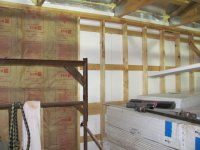
This is what I did with my recent build. 1.5 inches of XPS sheets between the purlins. Spec'd the builder to place the purlins 24.25 inches apart (not on center). I bought the sheets from Home Depot (best price in my area). I'm VERY impressed so far. Very good insulation. Probably going to use fiberglass between the studs simply because it's quite a bit cheaper and with the mild weather here (most of the time) I don't think that foam will be recouped in less than 20 years. If I lived up north, I'd definately spray foam it.

There is double bubble foil under the metal.


100_3027.jpg
 

dlenkewich

Well-known member
Joined
Jan 27, 2011
Messages
1,409
Location
Saskatoon, Sk, Canada
Things are done a lot different here where I'm at, I've been in a lot of houses and never seen one done like that, typical here is tyvek house wrap under the siding, osb sheathing, fiberglass batts with paper facing and then drywall. I think a house done like you do it would compete with foam pretty dang good. One question I have is how do they attach drywall to the studs with the poly there? no glue I take it? Here drywall gets glued and screwed but I don't see gluing to the poly helping.

I haven't seen drywallers here glue drywall, I understand that's how they do it in some regions. It's just screwed in place, here.
 
To avoid these ads, REGISTER NOW!
Top Bottom