To avoid these ads, REGISTER NOW!

"Forged Steel" DBE Wrenches

LNKMK8

Well-known member
Joined
Feb 6, 2013
Messages
1,186
Location
Overland Park, KS
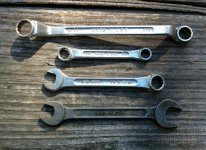
I've been searching around Alloy Artifacts and here and am not having any luck coming up with any info on these wrenches I picked up. They are a nice set, but don't have much more on them than "Forged Steel" on one side and "Made in USA" on the other. There is a small letter on each, but each size has a different letter: D O J K F
 

Attachments

  • IMG_6529.jpg
    IMG_6529.jpg
    144.5 KB · Views: 138
  • IMG_6533.jpg
    IMG_6533.jpg
    143.8 KB · Views: 108
  • IMG_6535.jpg
    IMG_6535.jpg
    144.4 KB · Views: 81
To avoid these ads, REGISTER NOW!

d42jeep

Well-known member
Joined
Oct 22, 2014
Messages
16,527
Location
Northern California
According to GJ member DadsTools those wrenches were made by Lectrolite. If you check the Dunlap thread you will be able see his responses on the subject. Below is a closeup of one of my Dunlap DBE wrenches that is very similar to yours.
-Don
 

Attachments

  • IMG_5629.JPG
    IMG_5629.JPG
    116 KB · Views: 71
OP
L

LNKMK8

Well-known member
Joined
Feb 6, 2013
Messages
1,186
Location
Overland Park, KS
Very cool, thanks guys. I do find it odd that there doesn't appear to be any Brand or Company name on them.

I always know I've got a good set when it has those odd ball sizes in it, like 25/32 or **/64 :)
 

DuroChrome

Well-known member
Joined
Apr 24, 2015
Messages
323
Location
Oregon
They must have been made back in the day when a 25/32" was a popular size!

Were those oddball sizes introduced to fit metric fasteners? It would make sense to buy a few extra sockets or wrenches to add to your set, rather than an entire metric set.
 

r_olson_06

Well-known member
Joined
Feb 12, 2012
Messages
4,090
Location
SD
Were those oddball sizes introduced to fit metric fasteners? It would make sense to buy a few extra sockets or wrenches to add to your set, rather than an entire metric set.
That was my impression as well. 19/32 is so close to 15mm and 25/32 is close to 20mm.

Sent from my XT1080 using Tapatalk
 
OP
L

LNKMK8

Well-known member
Joined
Feb 6, 2013
Messages
1,186
Location
Overland Park, KS
I've got a set of Indestro sockets from the 1930's that have a 11/32, 12/32, 17/32, 19/32, 25/32, and a 31/32 among them.
 

Private Lugnutz

Well-known member
Joined
Mar 30, 2012
Messages
30,527
Location
The Authentic Jersey Shore
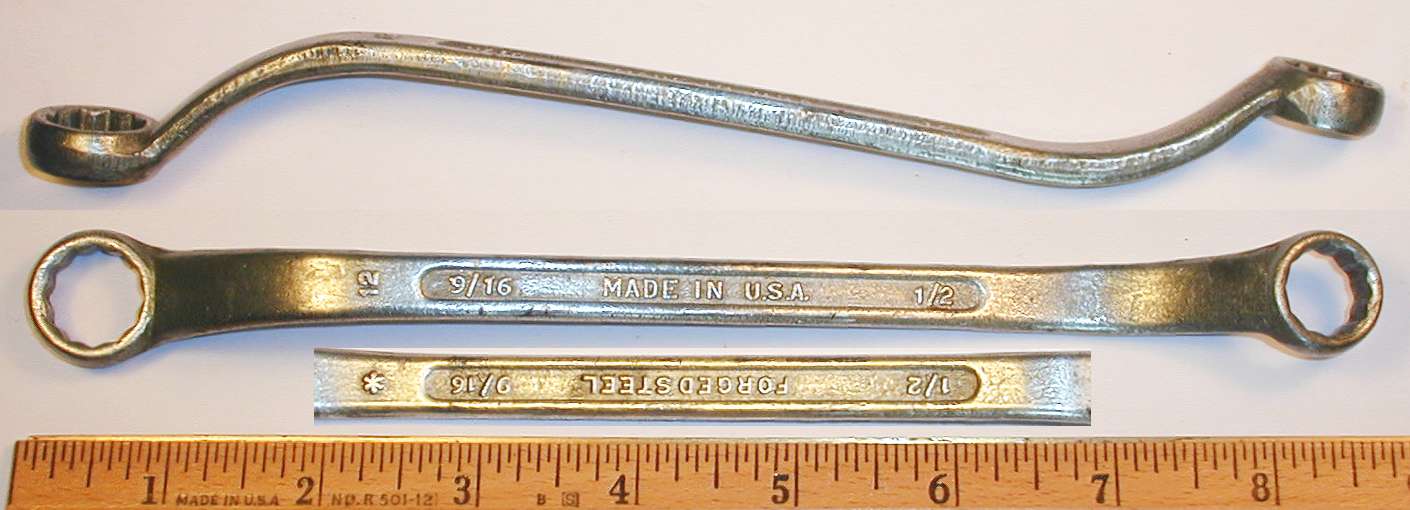
Here are my Forged Steel DBEs. These have some kind of dusty military grade or economy line plating (phosphate, possibly cadmium) and were also finished crudely (see the unfinished heads).

View media item 74743
View media item 74749
View media item 74750
Note the star or asterisk mark found, as I mentioned in my first post on this thread, on many 1940’s Vlchek-marked DBEs

View media item 74744
View media item 74745
Here is the ‘MADE IN USA’ flip side with forged-in die or forge numbers (1, 2, and 11), also a recognizable Vlchek characteristic

View media item 74747
View media item 74748
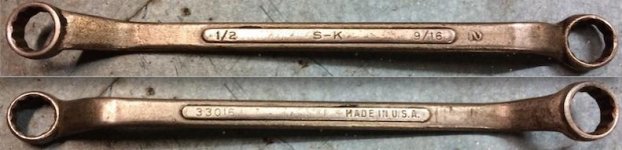
Now look at this SK DBE… It has a raised (instead of a sunken) panel bar, but note the asterisk mark!

20161222_163048_zpsiudftmdm.jpg


20161222_163115_zpsoxqp20kp.jpg


20161222_163128_zpsdxs4irqf.jpg


Due to the forge numbers and the asterisk, AA identifies Forged Steel as Vlchek. Here is one from the AA collection.

vlchek_db1618_wrench_offset_panel_f_cropped_inset2.jpg


I tend to agree with them. But my “missing link” SK DBE tends to make me believe Lectrolite may have been making them for Vlchek and SK at some point. That seems more likely to me than Vlchek making them for SK and Lectrolite, anyway.
 
Last edited:

Private Lugnutz

Well-known member
Joined
Mar 30, 2012
Messages
30,527
Location
The Authentic Jersey Shore
As for the /32nds increments, the reason is very well documented, and it has nothing to do with the metric system. The proximity of some of the sizes to some metric sizes is purely coincidental. It also has nothing to do with deliberately odd or funky parts. Study any catalog, any edition of Machinery's Handbook or any vintage automobile or truck bolting chart prior to the 60's, and you will see that /32nd increments corresponded to U.S. Standard (U.S.S.) HEAVY bolts, which had different size heads than American Standard LIGHT (or S.A.E.) bolts of the exact same bolt diameter.

For example, only an open or box end wrench with a 25/32” milled opening would fit the head of a U.S.S. 7/16” bolt. Conversely, though, only an open or box wrench with a 5/8” milled opening would fit an S.A.E. 7/16” bolt.

That's why pre-war, wartime, and early 50's tool-sets had engineers wrenches, box wrenches, ignition wrenches and sockets in /32nd increments. As bolts were standardized heading into the late 50's and 60's, they were no longer needed.
 

twertsy

Well-known member
Joined
Jan 5, 2014
Messages
6,726
Location
Reedville, VA
Re: "Forged Steel" DBE Wrenches

Here are my Forged Steel DBEs. These have some kind of dusty military grade or economy line plating (phosphate, possibly cadmium) and were also finished crudely (see the unfinished heads).

View media item 74743
View media item 74749
View media item 74750
Note the star or asterisk mark found, as I mentioned in my first post on this thread, on many 1940’s Vlchek-marked DBEs

View media item 74744
View media item 74745
Here is the ‘MADE IN USA’ flip side with forged-in die or forge numbers (1, 2, and 11), also a recognizable Vlchek characteristic

View media item 74747
View media item 74748
Now look at this SK DBE… It has a raised (instead of a sunken) panel bar, but note the asterisk mark!

20161222_163048_zpsiudftmdm.jpg


20161222_163115_zpsoxqp20kp.jpg


20161222_163128_zpsdxs4irqf.jpg


Due to the forge numbers and the asterisk, AA identifies Forged Steel as Vlchek. Here is one from the AA collection.

vlchek_db1618_wrench_offset_panel_f_cropped_inset2.jpg


I tend to agree with them. But my “missing link” SK DBE tends to make me believe Lectrolite may have been making them for Vlchek and SK at some point. That seems more likely to me than Vlchek making them for SK and Lectrolite, anyway.
I tend to agree Greg. I also have at least 1 wrench that shouldn't have a star, also an SK I think?? Or maybe it was a Bonney....

EDIT: It is a Bonney....

Sent from my VS990 using Tapatalk
 
Last edited:

Username already in use

Well-known member
Joined
Sep 4, 2015
Messages
2,177
Location
Ohio
Lugz, I picked up this vintage SK long pattern DBE just today at the flea. Same make as your short pattern example posted above, but this one has a '2' on the shank, no star.

attachment.php
 

Attachments

  • SK long dbe.jpg
    SK long dbe.jpg
    30.5 KB · Views: 331

d42jeep

Well-known member
Joined
Oct 22, 2014
Messages
16,527
Location
Northern California
None of the Vlchek looking examples the you guys have posted really resemble the wrenches the OP shows at the beginning of the thread. His examples have little letters rather than the star. The end of the offset by the box portion of the wrenches have a very unique squared off look that is only matched by my Dunlap wrench.
-DonIMG_5634.JPGIMG_5635.jpg
 
Last edited:
OP
L

LNKMK8

Well-known member
Joined
Feb 6, 2013
Messages
1,186
Location
Overland Park, KS
Thanks for all the information and thoughts on this. I agree the shape of the offset seems to suggest a different manufacturer, as they are very squared off as d42jeep mentioned.

Speaking of odd sizes, I picked up a DOE Snap-On with 15/16" and 1-1/16" :)
 

d42jeep

Well-known member
Joined
Oct 22, 2014
Messages
16,527
Location
Northern California
Here is the information from the Dunlap thread. DadsTools makes a very compelling argument.

Originally Posted by DadsTools
Okay, I'll let the cat out of the bag....these are re-labeled Lectrolite Corp. TruFit wrenches. I've studied Lectrolite extensively for a couple of reasons. Alloy Artifacts speculates that the LC stands for Letrolite Corp., but I'm very confident it's indeed what those initials stand for. These were made starting in the early 1950s, and were made in the very same Defiance Ohio plant that made the S-K wrenches up until its bankruptcy and acquisition by Ideal. The LC can be found on many contract wrenches from that era that have no brand name on them, sold by who knows how many companies--I know they sold a slew of them!

The Lectrolite 'fingerprint' is the length/shape of the recess and that odd sharp angle where the descending offset meets the box. Almost all that are not marked TruFit will have the little LC initials, but not all. Once you get an eye for them, you can instantly pick them out of a tool pile a mile away.

Lectrolite made the TruFit design double box ends for Sears starting sometime in the first half of the 1950s. They are first marked Dunlap until about 1958, when corporate decided to phase out the name on these kinds of wrenches, replacing it with just the plain SEARS name. The only difference I have observed is that the Dunlap/Sears/no-name contract versions appear to have a better finish than the TruFit marked, probably so Lectrolite could distinguish them from the high-end SK-Lectrolite within the brand itself, but did a better finish for the contract tools.

Around 1962, Sears changed manufacturers to overseas. You'll see many more Sears DBEs marked BF Japan (the BF code is still a mystery as to what mfr it represents). They are virtually identical in appearance to the LC USA Sears, so there's little doubt that Sears sent the mfr a sample of the LCs and said to copy them exactly. The reason for the changeover could be one of two factors. The date corresponds to the purchase of SK and the Lectrolite Corp. by Wayne Industries (this is when the LECTROLITE brand name disappeared, no doubt being seen as a bit odd, and was certainly redundant and confusing with regard to having that name on the SK line). It could very well be that Wayne either decided to end that contract or raised the prices beyond what Sears wanted to pay. I believe it might be the former because I think it less likely that Sears essentially counterfeited the LC TruFit design without some sort of nod from Wayne ("we're not going to make these for you under contract any more, but feel free to have anyone else make them because we ourselves are abandoning the design."). But it's also true that at around this same time, Sears management was making some major changes to its marketing/merchandising/branding strategies and so decided to move overseas with these wrenches, but I also think this less likely because I just don't see Wayne simply allowing Sears to rip off their Lectrolite TruFit design.

Anyway, that's the scoop as I know it. One more vintage tool secret released into the public domain.
 

leg17

Well-known member
Joined
Aug 11, 2011
Messages
1,371
Location
Kentucky
Thanks for all the information and thoughts on this. I agree the shape of the offset seems to suggest a different manufacturer, as they are very squared off as d42jeep mentioned.

Speaking of odd sizes, I picked up a DOE Snap-On with 15/16" and 1-1/16" :)

Not so odd.
That is sizes for 'light' 5/8 and 'heavy' 5/8 nut.
Wrenches used to be made with the user in mind.
 

Private Lugnutz

Well-known member
Joined
Mar 30, 2012
Messages
30,527
Location
The Authentic Jersey Shore
None of the Vlchek looking examples the you guys have posted really resemble the wrenches the OP shows at the beginning of the thread.
I didn't say they did, and didn't mean to imply it, either, Don. Sorry if that was unclear. My takeoff points were the use of the same name - "FORGED STEEL" - and the Lectrolite connection. I think the OP's wrenches are clearly later.
 
To avoid these ads, REGISTER NOW!

d42jeep

Well-known member
Joined
Oct 22, 2014
Messages
16,527
Location
Northern California
I get it now. It seems to me that I posted some DOE wrenches marked forged steel some time back and the consensus was that they were Vlchek. Too bad these manufacturers weren't more consistent! :dunno:
-Don
 

DadsTools

Well-known member
Joined
Jul 27, 2017
Messages
1,852
According to GJ member DadsTools those wrenches were made by Lectrolite. If you check the Dunlap thread you will be able see his responses on the subject. Below is a closeup of one of my Dunlap DBE wrenches that is very similar to yours.
-Don
Bingo! Lectrolite, for sure.
 

DadsTools

Well-known member
Joined
Jul 27, 2017
Messages
1,852
The OP's set reveals another "secret" about Lectrolite and SK from that period. Although I've seen some speculation to the contrary, any single-letter forge mark on these wrenches are NOT date codes. It's only when you encounter a complete set that's all original (as the OP's set appears to be) do you realize that they can't be date codes because the letters are all different. This will be true on all 1950s-1962 Lectrolite, and same period SK made at the Lectrolite factory (including early SK-Wayne a few years beyond the Lectrolite-marked wrenches). Two-letter codes that came later may possibly be date codes, but to the best of my knowledge no one has yet been able to decipher them in any coherent way.
 

twertsy

Well-known member
Joined
Jan 5, 2014
Messages
6,726
Location
Reedville, VA
The OP's set reveals another "secret" about Lectrolite and SK from that period. Although I've seen some speculation to the contrary, any single-letter forge mark on these wrenches are NOT date codes. It's only when you encounter a complete set that's all original (as the OP's set appears to be) do you realize that they can't be date codes because the letters are all different. This will be true on all 1950s-1962 Lectrolite, and same period SK made at the Lectrolite factory (including early SK-Wayne a few years beyond the Lectrolite-marked wrenches). Two-letter codes that came later may possibly be date codes, but to the best of my knowledge no one has yet been able to decipher them in any coherent way.

Nope, believe me I've tried. Hundreds of wrenches and ratchets with one and two letter codes, and there is NO discernable pattern that would indicate a date coding method. However, if you contact S-K, they will tell you it is indeed a date code system, but won't reveal the key to figuring it out. I've no idea why, but they refuse to say.
 

Jp267

Well-known member
Joined
Aug 6, 2017
Messages
427
Location
New England
Thanks for the extra info fellas! I counted the; Lectrolite, Tru-Fits and letter marked Lectrolites, and came up with almost 60, that my grandfather had stored in a 1960s refrigerator crisper drawer in the basement.

Don't ask me!?? He worked at Wisconsin Steel across from the Chicago Ford assembly plant on Torrance Ave. I think when they declared bankruptcy, and laid everyone off, he cleaned the place out. He had been there 40 years and lost most of his pension. Maybe he thought he might as well get something out of the 40 years. ::Shrug::

Sent from my XT1635-02 using Tapatalk
 

d42jeep

Well-known member
Joined
Oct 22, 2014
Messages
16,527
Location
Northern California
Since I've learned about this style of wrenches, I've found a few more at a garage sale so I picked them up.
-DonIMG_5771.jpgIMG_5772.jpg
 
Last edited:

Youngguns

Well-known member
Joined
Jul 11, 2014
Messages
643
Location
Mtns of Western Maryland
I don't want to derail this thread, but I think this would be a good place to ask without starting my own thread. Does anyone have any information about "chrome vanadium" tools? I have a few tools that look pretty old, but also look (and feel) like quality pieces that are just stamped "chrome vanadium." Was there a particular manufacturer that produced these?
 

red94chev

Well-known member
Joined
Jan 29, 2015
Messages
556
Location
Northeastern MD
I don't want to derail this thread, but I think this would be a good place to ask without starting my own thread. Does anyone have any information about "chrome vanadium" tools? I have a few tools that look pretty old, but also look (and feel) like quality pieces that are just stamped "chrome vanadium." Was there a particular manufacturer that produced these?

In for this answer, I have a set of them. They were one of my first wrench sets from my grandpa and they are pretty decent wrenches, at least I've never broke one.
 

Private Lugnutz

Well-known member
Joined
Mar 30, 2012
Messages
30,527
Location
The Authentic Jersey Shore
Does anyone have any information about "chrome vanadium" tools?
This steel composition term was very popular as a branding mechanism. Trademarked by Bonney with a hyphen ("Chrome-Vanadium"), and used on very popular wrench lines, but also used by other Mfgrs, most notably Duro Metal Products, on Duro-Chrome and Indestro tools, without a hyphen (CHROME VANADIUM) and with the full spelling of the first precious metal, like this: CHROMIUM VANADIUM. As such, too generic without other references, markings, and features. Have to post pictures for a definitive ID.
 

DadsTools

Well-known member
Joined
Jul 27, 2017
Messages
1,852
This steel composition term was very popular as a branding mechanism. Trademarked by Bonney with a hyphen ("Chrome-Vanadium"), and used on very popular wrench lines, but also used by other Mfgrs, most notably Duro Metal Products, on Duro-Chrome and Indestro tools, without a hyphen (CHROME VANADIUM) and with the full spelling of the first precious metal, like this: CHROMIUM VANADIUM. As such, too generic without other references, markings, and features. Have to post pictures for a definitive ID.
Yep, this.

Funny thing about this "Chrome Vanadium" or its variants is that upon the alloy lottery in hand tools during WW2, most of the mfrs dropped the term afterward, figuring that the public would still buy them if just marked ALLOY or something vague like that. The funny thing is that the Japanese started using it, then the Chinese, so that anything thereafter marked Chrome Vanadium is almost certainly imported. What irony (so to speak).
 

DadsTools

Well-known member
Joined
Jul 27, 2017
Messages
1,852
Since I've learned about this style of wrenches, I've found a few more at a garage sale so I picked them up.
-Don
Yep. As I mentioned earlier, once you learn to identify the Lectrolite 'fingerprint, you'll find them everywhere and can pick them out of a pile a mile away. They obviously made many more of these unbranded TruFit patterns for a slew of companies because they're everywhere.

And you know what? They're a pretty decent wrench too! They were my Dad's go-to economy wrenches, and if you read my posts before, you know he was hard-core on top tool brands of the time. From what I can tell, they appear to be made from the very same alloy as the post-war Raised Panel Lectrolite/SK-Lectrolite/SK-Wayne except not finished as nicely and with less metal because of the recessed handle. If you start using them I think you'll find you like them a lot. Best part about them too is that sellers just think they're some kind of junk so just about give them away. Funny. One of the (former) best-kept vintage tool secrets.
 

DadsTools

Well-known member
Joined
Jul 27, 2017
Messages
1,852
Nope, believe me I've tried. Hundreds of wrenches and ratchets with one and two letter codes, and there is NO discernable pattern that would indicate a date coding method. However, if you contact S-K, they will tell you it is indeed a date code system, but won't reveal the key to figuring it out. I've no idea why, but they refuse to say.
I think the only way to possibly get a clue is to find complete period sets that you positively know are all original and were all purchased at the same time. If that doesn't shed any light, then perhaps the idea they are in fact date codes is dubious.They could be another kind of identifier. Sure, if you call Ideal today, they may tell you they're date codes. But maybe there's an ulterior motive for that. Or maybe they're not really sure but want to sound like they are. After all, Ideal closed the Lectrolite/Defiance plant and moved out of state. So how much info really survived? And how many old timers actually moved with the company? I remember my research into some fishing tackle lines, and found it quite common that when a company changed hands or locations, the old records were lost or destroyed. These folks could have never imagined their products would one day be collectibles, and for the most part did not approach their records management with such a perspective.
 

Private Lugnutz

Well-known member
Joined
Mar 30, 2012
Messages
30,527
Location
The Authentic Jersey Shore
Funny thing about this "Chrome Vanadium" or its variants is that upon the alloy lottery in hand tools during WW2, most of the mfrs dropped the term afterward
During, actually.

Nickel, Chromium, Vanadium, and Molybdenum were strictly allocated by the WPB, in that order, as early as mid 1941 through Dec 1941. When that wasn't sufficient to control the use of these vital elements, on January 1, 1942, Nickel, Chromium, and Molybdenum were limited to .6% in steel production, and Vanadium was eliminated completely (0.00 %), wrecking all the favorite pre-war recipes (and branding!). With the writing on the wall in 1941, a consortium of scientists assembled by the WPB, including the WPB, industry, academia, and SAE/AISI, had been working on so-called "New Emergency" steel compositions for months. In the metallurgy labs, they cooked up the triple alloys (Nickel-Chrome-Moly) in the AISI 86XX and 87XX series that dominate alloy steel to this day, discovering that using less of each with another added in was actually stronger, lighter, more durable, and less expensive to manufacture. Or they dropped back to other alternative steel mixes, such as AISI 1340, Carbon-Manganese (see Herbrand), AISI 4000, Mang-Moly (see Bridgeport MQ), or increased production of improved AISI 1000 series Carbon Steel wrenches (see Williams Superior line).

Everyone had to comply, and everyone that used the composition (Chrome Molybdenum, Chrome-Vanadium, etc) in their branding, had to switch to something else, typically just ALLOY, as you alluded to, ALLOY STEEL (see Vlchek), or nothing at all (see Bonney, which moved their name to the face of the jaw, dropped the "(CV)" symbol, and left the shank blank) on new dies, so as not to make their tools suspect of violation.

Herbrand went one better, forging the acceptable AISI numbers into their tools, so there could be no mistake.

And a couple Mfgrs, it should be noted, were probably ahead of the curve - in my analysis. Billings VITALLOY M-1xxx series and Bonney -ZENEL- wrenches were being made before the war (with each company boasting new better secret recipes at that time without revealing what the recipes were to the rest of the industry), and continued without change in markings during the war. My hunch is they were triple alloys.

Anyway, the drop dead leniency date for using high-content pet formula double-alloy steel the Mfgrs already had in stock was Nov 1942. (When you see Bonney wrenches with CV markings and 1943 date codes, they're almost certainly either examples of the last of Bonney's stock, or mistaken dies.)

The point is that by mid 1943, all those proud pre-war double-alloy rich markings were gone.

And I agree, it is supremely ironic on the imports (e.g., "Cr-Mo")
 

Jp267

Well-known member
Joined
Aug 6, 2017
Messages
427
Location
New England
I've got a few old DBE wrenches marked Chrome Molybdenum, makers mark is 'Acciaio' (sp?) which I think means Steel in Italian. Some of the toolkit wrenches supplied with Maserati and possibly Ferrari cars in the '50's? had this Acciaio marking.

B~
I have a few double open end with the same markings. Well the chrome molybdenum. The maker is worn off.

Sent from my XT1635-02 using Tapatalk
 

ssdave

Banned
Joined
Apr 11, 2015
Messages
2,913
Location
Eastern Oregon
Got a whole bunch of these old wrenches today in with some tools I wanted. Had the * and number stamps, some were marked vlcheck, some just chrome vanadium. Was interesting to see the post on it here!
 

DadsTools

Well-known member
Joined
Jul 27, 2017
Messages
1,852
During, actually.

Nickel, Chromium, Vanadium, and Molybdenum were strictly allocated by the WPB, in that order, as early as mid 1941 through Dec 1941. When that wasn't sufficient to control the use of these vital elements, on January 1, 1942, Nickel, Chromium, and Molybdenum were limited to .6% in steel production, and Vanadium was eliminated completely (0.00 %), wrecking all the favorite pre-war recipes (and branding!). With the writing on the wall in 1941, a consortium of scientists assembled by the WPB, including the WPB, industry, academia, and SAE/AISI, had been working on so-called "New Emergency" steel compositions for months. In the metallurgy labs, they cooked up the triple alloys (Nickel-Chrome-Moly) in the AISI 86XX and 87XX series that dominate alloy steel to this day, discovering that using less of each with another added in was actually stronger, lighter, more durable, and less expensive to manufacture. Or they dropped back to other alternative steel mixes, such as AISI 1340, Carbon-Manganese (see Herbrand), AISI 4000, Mang-Moly (see Bridgeport MQ), or increased production of improved AISI 1000 series Carbon Steel wrenches (see Williams Superior line).

Everyone had to comply, and everyone that used the composition (Chrome Molybdenum, Chrome-Vanadium, etc) in their branding, had to switch to something else, typically just ALLOY, as you alluded to, ALLOY STEEL (see Vlchek), or nothing at all (see Bonney, which moved their name to the face of the jaw, dropped the "(CV)" symbol, and left the shank blank) on new dies, so as not to make their tools suspect of violation.

Herbrand went one better, forging the acceptable AISI numbers into their tools, so there could be no mistake.

And a couple Mfgrs, it should be noted, were probably ahead of the curve - in my analysis. Billings VITALLOY M-1xxx series and Bonney -ZENEL- wrenches were being made before the war (with each company boasting new better secret recipes at that time without revealing what the recipes were to the rest of the industry), and continued without change in markings during the war. My hunch is they were triple alloys.

Anyway, the drop dead leniency date for using high-content pet formula double-alloy steel the Mfgrs already had in stock was Nov 1942. (When you see Bonney wrenches with CV markings and 1943 date codes, they're almost certainly either examples of the last of Bonney's stock, or mistaken dies.)

The point is that by mid 1943, all those proud pre-war double-alloy rich markings were gone.

And I agree, it is supremely ironic on the imports (e.g., "Cr-Mo")
Yep, this.
 

Jp267

Well-known member
Joined
Aug 6, 2017
Messages
427
Location
New England
During, actually.

Nickel, Chromium, Vanadium, and Molybdenum were strictly allocated by the WPB, in that order, as early as mid 1941 through Dec 1941. When that wasn't sufficient to control the use of these vital elements, on January 1, 1942, Nickel, Chromium, and Molybdenum were limited to .6% in steel production, and Vanadium was eliminated completely (0.00 %), wrecking all the favorite pre-war recipes (and branding!). With the writing on the wall in 1941, a consortium of scientists assembled by the WPB, including the WPB, industry, academia, and SAE/AISI, had been working on so-called "New Emergency" steel compositions for months. In the metallurgy labs, they cooked up the triple alloys (Nickel-Chrome-Moly) in the AISI 86XX and 87XX series that dominate alloy steel to this day, discovering that using less of each with another added in was actually stronger, lighter, more durable, and less expensive to manufacture. Or they dropped back to other alternative steel mixes, such as AISI 1340, Carbon-Manganese (see Herbrand), AISI 4000, Mang-Moly (see Bridgeport MQ), or increased production of improved AISI 1000 series Carbon Steel wrenches (see Williams Superior line).

Everyone had to comply, and everyone that used the composition (Chrome Molybdenum, Chrome-Vanadium, etc) in their branding, had to switch to something else, typically just ALLOY, as you alluded to, ALLOY STEEL (see Vlchek), or nothing at all (see Bonney, which moved their name to the face of the jaw, dropped the "(CV)" symbol, and left the shank blank) on new dies, so as not to make their tools suspect of violation.

Herbrand went one better, forging the acceptable AISI numbers into their tools, so there could be no mistake.

And a couple Mfgrs, it should be noted, were probably ahead of the curve - in my analysis. Billings VITALLOY M-1xxx series and Bonney -ZENEL- wrenches were being made before the war (with each company boasting new better secret recipes at that time without revealing what the recipes were to the rest of the industry), and continued without change in markings during the war. My hunch is they were triple alloys.

Anyway, the drop dead leniency date for using high-content pet formula double-alloy steel the Mfgrs already had in stock was Nov 1942. (When you see Bonney wrenches with CV markings and 1943 date codes, they're almost certainly either examples of the last of Bonney's stock, or mistaken dies.)

The point is that by mid 1943, all those proud pre-war double-alloy rich markings were gone.

And I agree, it is supremely ironic on the imports (e.g., "Cr-Mo")
Man what don't you know!? [emoji23][emoji23]

Sent from my XT1635-02 using Tapatalk
 

leg17

Well-known member
Joined
Aug 11, 2011
Messages
1,371
Location
Kentucky
Nickel, Chromium, Vanadium, and Molybdenum were strictly allocated by the WPB, in that order, as early as mid 1941 through Dec 1941. .....

Everyone had to comply, and everyone that used the composition (Chrome Molybdenum, Chrome-Vanadium, etc) in their branding, had to switch to something else, typically just ALLOY, as you alluded to, ALLOY STEEL (see Vlchek), or nothing at all.....


Thanks PvtLN
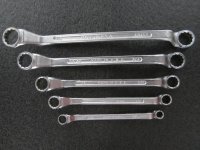
That explains this largest wrench in my Lectrolite Defiance set.
 

Attachments

  • P1000394.jpg
    P1000394.jpg
    143.6 KB · Views: 64
OP
L

LNKMK8

Well-known member
Joined
Feb 6, 2013
Messages
1,186
Location
Overland Park, KS
I ended up buying another set of these wrenches a week later, and also saw a Tru-Fit brand wrench that looked like the same casting. On Friday, I picked up another set sold under "Sears" that appear to be the same casting design.
 
To avoid these ads, REGISTER NOW!
Top Bottom