I realize this is an old thread but I just happened to stumble on it while searching for some unrelated gypcrete information. I figured I'd take a minute to possible help clarify some things...
I'm currently a design-build general contractor, but for many years we were a relatively high production framing subcontractor and during our time doing that, I developed a system very much like the one shown in some of the images above. The workflow was/is as follows:
- Install pressure treated sill plate bolted down with 1/4"x3"x3" bearing plates
- Install either 1x6 pine or 3/4" plywood on top of the treated plate from bearing plate to bearing plate
- Cut off all thread right above 5/8" nuts using a cut-off tool or portable band saw.
- Frame and sheath walls as usual and stand right on top of furring strips.
The benefits of the furring strips/shims are many, but just to name a few.
- There's no need to drill holes or notch bottom plates which saves time for marking and drilling and avoids compromising the plates
- Completely eliminates the need for notching vertical framing members at anchor bolt locations
- Completely eliminates the need for placing studs, king posts, trimmers, cripples, posts or any other framing members in specific locations in order to avoid conflicts with anchor bolts
- Allows for full end nailing of each and every framing member regardless of location (if you have to drill or notch your bottom plates then you can't nail at any of those locations)
- Allows for a continuous bottom plate with FULL bearing. The thing with having to drill or notch for anchor bolts and 3x3 bearing plates is that your bottom plate is either grossly compromised (a 3x3 plate has a diameter of 4-1/4" which means a 2x4 gets completely eliminated or a 2x6 has almost nothing left) or its still going to end up making contact with one or more plates. When the bottom plate is sitting on top of 1 or more bearing plates, the result is that the wall is bearing on only those very small locations and is otherwise floating up off the treated sill plate. This is especially true if the walls are sheathed before standing.
- From a production standpoint it also makes more of the work require less thinking. Its easy to line a very base level laborer out with installing the furring strips and cutting off excess bolts. Its a lot more mentally demanding though to mark out and drill/notch bottom plates accurately. Its also a lot easier to lay out vertical framing members when you can completely disregard anchor bolt locations.
Hope that helps clarify a bit. We've framed both ways over the years, but using the furring strips is by far the most efficient and effective way to frame in my opinion. I actually came up with the idea myself and this is the first time I've seen it used by others. My engineer loved the idea when I showed him. I'm frankly a little surprised its not used more commonly than it is.


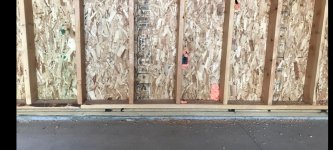
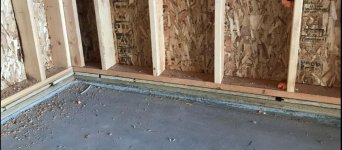

 Nothing to shoot some foam in I guess.