To avoid these ads, REGISTER NOW!

Free tank

niget2002

Well-known member
Joined
Oct 2, 2012
Messages
11,121
Location
Josephine, TX
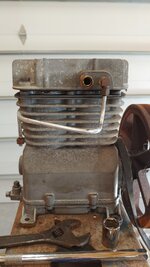
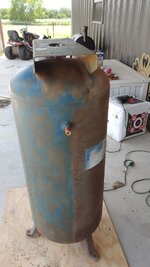
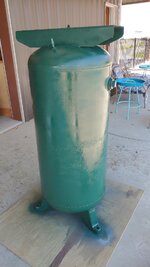
I've had this pump waiting for a tank for a few years now. A friend of mine is moving this weekend and offered me this tank. It has surface rust, but the tank is sound as far as I can tell. I'll sand it down and hit it with some spray paint.

Right now I just sat the pump on it for the picture. I'll need to drill new holes to bolt it on.

The pump was free. The tank was free. Wonder how many years it would take to come across a free 5hp motor... 318e280bac969b3d3d42a0dbae3de8bd.jpg

Sent from my LM-G820 using Tapatalk
 

Attachments

  • 318e280bac969b3d3d42a0dbae3de8bd.jpg
    318e280bac969b3d3d42a0dbae3de8bd.jpg
    447.6 KB · Views: 1
To avoid these ads, REGISTER NOW!

liliysdad

Well-known member
Joined
Jul 18, 2008
Messages
5,378
Run it, don't hug it the first few uses, it'll be fine.

Yep..everyone on this forum thinks every compressor tank is some giant bomb waiting to go off. In reality, a rusty tank typically develops a pin hole and a minute air leak when it lets go. Even then, you can weld a patch on it and rock for years.
 
OP
N

niget2002

Well-known member
Joined
Oct 2, 2012
Messages
11,121
Location
Josephine, TX
Yep..everyone on this forum thinks every compressor tank is some giant bomb waiting to go off. In reality, a rusty tank typically develops a pin hole and a minute air leak when it lets go. Even then, you can weld a patch on it and rock for years.
I should know. My first air compressor was a hand me down that someone used bolts and jb weld to fix air leaks multiple times. I had know idea that could be an issue until I joined this forum.

Sent from my LM-G820 using Tapatalk
 

John in OH

Well-known member
Joined
Jun 2, 2007
Messages
2,444
Location
SE Ohio & Eastern Virginia
Yep..everyone on this forum thinks every compressor tank is some giant bomb waiting to go off. In reality, a rusty tank typically develops a pin hole and a minute air leak when it lets go. Even then, you can weld a patch on it and rock for years.

Sorry, I strongly disagree. SOMETIMES they will develop a pin hole leak first ... but sometimes they won't. Please read the following from the Iowa State Agriculture Extension service:

“… air-compressor equipment manuals usually contain warning notices or procedural steps alerting operators that failure to remove condensation will cause the tank to rust prematurely.

“Draining the moisture from the tank may be viewed as an unnecessary task,” said Charles Schwab, Iowa State University professor and extension specialist in agricultural and biosystems engineering. “Unfortunately, if these manual procedures are not followed, there is a serious potential for injury.” With the case of the air-compressor tank, the moisture in the tank will cause it to rust.

Schwab acknowledges that over time, internal rusting weakens the structural integrity of the tank, potentially creating a violent explosion.

“When under pressure, pieces or the tank itself will become projectiles that can inflict injuries or cause damage,” said Schwab. “No one can predict when a rust-weakened tank will explode and where the projectiles will fly.”

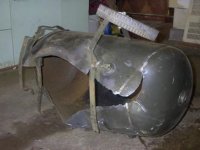
Compressor Explosion blast (1).jpg Compressor Explosion blast (2).jpg

Compressor Explosion blast (3).jpg Compressor Explosion blast (4).jpg

Don't be a fool. Protect yourself, your family, your friends, and your shop.

You most likely have NO idea about the maintenance or operating history of this tank you are considering. Nor, do you have any idea what the INTERNAL condition of the tank may be. Be smart, perform a static hydrotest on the tank before you use it that is at least 1.5 times the maximum operating pressure that you plan to run the tank pressure.

And, also make sure it has a functional safety pressure relief valve.

If it passes your test, and you put it into service, make sure you blow down all tank condensation at least once per day.
 

liliysdad

Well-known member
Joined
Jul 18, 2008
Messages
5,378
How many have you personally witnessed fail in manners similar to those photos?
 
OP
N

niget2002

Well-known member
Joined
Oct 2, 2012
Messages
11,121
Location
Josephine, TX
Original Poster here...

Another question. How do I know what speed motor I need to run the pump? I know the pump came off of an air compressor that had a 5 hp 220V motor, but I'm seeing more than one RPM when I look at motors online.
 

Bigblockyeti

Banned
Joined
Feb 1, 2018
Messages
2,550
Location
Upstate, SC
You need to determine the minimum and maximum speed for the pump is first. I would go with a low speed, four pole motor (~1800rpm) and size the drive pulley appropriately to run the pump at your desired speed.
 
OP
N

niget2002

Well-known member
Joined
Oct 2, 2012
Messages
11,121
Location
Josephine, TX
Another question I have is about the two pipes coming off of the pump. The one on the left goes to the tank. I'm guessing the one in the right went to the pressure cut off?

This tank has a bung on the front for the switch. Can this one just be capped off? ee772bc650fa0e6cc940f667f5767ba2.jpge67006642878bf70c52d246449227150.jpg

Sent from my LM-G820 using Tapatalk
 

Attachments

  • e67006642878bf70c52d246449227150.jpg
    e67006642878bf70c52d246449227150.jpg
    376.4 KB · Views: 1
  • ee772bc650fa0e6cc940f667f5767ba2.jpg
    ee772bc650fa0e6cc940f667f5767ba2.jpg
    389.7 KB · Views: 1
OP
N

niget2002

Well-known member
Joined
Oct 2, 2012
Messages
11,121
Location
Josephine, TX
Regarding the motor. Not sure if it helps, but I have the motor pulley that was on the old compressor.

The compressor pulley is 10"
The motor pulley is 2 9/16"

Sent from my LM-G820 using Tapatalk
 
OP
N

niget2002

Well-known member
Joined
Oct 2, 2012
Messages
11,121
Location
Josephine, TX
Here's a bit of back story on the pump.

Around 2010 I bought the original air compressor from a friend for $100. I was in a house that I couldn't run 220 in, so it just sat in the garage. A few years go by and one of my dad's friend and I get to talking and he says that he could use it. So I sold it to him for the same $100.

About 4 years ago, him and I are talking at my dad's place and he tells me about replacing the pump with a 2-stage unit. He mentions he still had the pump sitting on a shelf and asked if I wanted it back. I said sure.

Now that I think about it... I'm betting most of these motor questions could be solved by a simple phone call to my dad's friend :/ I'll do that later today.
 

Bigblockyeti

Banned
Joined
Feb 1, 2018
Messages
2,550
Location
Upstate, SC
Ok, I did a quick search, that pump is made by Devilbiss and was put on 100's of thousands of compressors. It's rated for a maximum of 135psi and the motor driving it would have been a 56 frame motor spinning at 3450rpm. I have the same pump on my Porter Cable air compressor and because it's running off 120VAC instead of 240VAC, the drive pulley is smaller than your's given the lower power available from lower voltage. The difference in the 120V vs. the 240V motor were all internal and looked otherwise identical from the outside. My motor is running at an actual 1.4HP, the 240V motor was at an actual 2.9HP. If you've had the chance to look at one of these motors, it would state "SPL" horsepower. That is an acronym that stands for "we're lying to you" so don't believe it.

The second air line is for the pressure switch.
 

nafterclifen

Well-known member
Joined
Nov 22, 2014
Messages
525
Location
Poconos, PA
How many have you personally witnessed fail in manners similar to those photos?

That's like asking someone "how many people have you personally witnessed get shot?" People get shot, probably every day, but you don't see it. Does that mean people never get shot? I'm not implying that air tanks explode everyday. But you get the point, right?

To answer your question though - I personally only know of one tank that exploded. But it was due to over pressurization. I don't know the fully story but my uncle went on vacation with his family and his compressor motor kept running and running. Maybe failed pressure switch? It put a big hole in his cinder block foundation and blew out all of the windows in his basement and broke some of the floor joists. His father, my grandfather, somehow got a hold of him and told him that he better come home because there is a big hole in his house.
 
Last edited:

liliysdad

Well-known member
Joined
Jul 18, 2008
Messages
5,378
That's like asking someone "how many people have you personally witnessed get shot?" People get shot, probably every day, but you don't see it. Does that mean people never get shot? I'm not implying that air tanks explode everyday. But you get the point, right?

To answer your question though - I personally only know of one tank that exploded. But it was due to over pressurization. I don't know the fully story but my uncle went on vacation with his family and his compressor motor kept running and running. Maybe failed pressure switch? It put a big hole in his cinder block foundation and blew out all of the windows in his basement and broke some of the floor joists. His father, my grandfather, somehow got a hold of him and told him that he better come home because there is a big hole in his house.

I am not denying it happens.....but the rarity is such that, in my opinion, its barely worth worrying about. The tanks I have seen fail, as I stated, failed with a small hole and a leak....I have seen one that split, but even that one caused zero issue other than a destroyed tank.

Everything will kill you....there isn't enough time in the day to worry about all of it.
 

nafterclifen

Well-known member
Joined
Nov 22, 2014
Messages
525
Location
Poconos, PA
At the end of the day, there are just some things in certain conditions that you just probably replace instead of fixing when they leak or develop a hole. Things such as gas tanks, propane tanks, air tanks, etc. I know we all love fixing stuff and getting the most out of it. But it's not always the safest or best decision.

In short, all I'm recommending is that the OP test the tank before putting it into service, especially since he is not the original owner. If it doesn't leak, use it. If it leaks, get rid of it.
 
OP
N

niget2002

Well-known member
Joined
Oct 2, 2012
Messages
11,121
Location
Josephine, TX
Ok, I did a quick search, that pump is made by Devilbiss and was put on 100's of thousands of compressors. It's rated for a maximum of 135psi and the motor driving it would have been a 56 frame motor spinning at 3450rpm. I have the same pump on my Porter Cable air compressor and because it's running off 120VAC instead of 240VAC, the drive pulley is smaller than your's given the lower power available from lower voltage. The difference in the 120V vs. the 240V motor were all internal and looked otherwise identical from the outside. My motor is running at an actual 1.4HP, the 240V motor was at an actual 2.9HP. If you've had the chance to look at one of these motors, it would state "SPL" horsepower. That is an acronym that stands for "we're lying to you" so don't believe it.

The second air line is for the pressure switch.

I'm impressed. My google-fu is usually pretty strong, but I was having difficulties. Your information is very useful. Thank-you.
 

gnpenning

Well-known member
Joined
Jan 25, 2015
Messages
2,754
Location
I have more questions than answers.
While I don't doubt that rusted tanks will come apart, the ones in the pictures look like they were over pressured to me. I know some on here can get really blow up pictures ( yes, bad pun intended) and tell how much rust is really on the edges of where they came apart???? Just thinking they may be bad examples.

As mentioned get the motor to match the pump with a motor who's specs are real world
 

nafterclifen

Well-known member
Joined
Nov 22, 2014
Messages
525
Location
Poconos, PA
By the way, I have the same pump on an old Sears compressor. Everything is original from 1984. Here is a pic of the motor specs.
 

Attachments

  • IMG_0102.jpg
    IMG_0102.jpg
    64.8 KB · Views: 71
To avoid these ads, REGISTER NOW!

liliysdad

Well-known member
Joined
Jul 18, 2008
Messages
5,378
Not the person you asked, but I've seem around five explode, one of which seriously injured a bystander.

I find that hard to believe you've seen 5 explode in such a dramatic manner, but who am I to argue?
 

Dh3256

Well-known member
Joined
Mar 19, 2018
Messages
1,139
I find that hard to believe you've seen 5 explode in such a dramatic manner, but who am I to argue?

Not sure why you would question another's experience for no reason, but the important point is that it's a fairly common occurrence, as most here have pointed out. If you look at accident statistics that may help document that it's fairly common, especially among hobbyists. For that matter, there are videos on Youtube.

Using an untested tank is very dangerous. It's not that hard to test and definitely worth the time if you insist on using a used tank.
 

sweetk30

Well-known member
Joined
Jan 2, 2011
Messages
2,306
Location
finger lakes area upstate ,ny
do your self a favor . mount the pump on rubber pads and also the motor if you can . i did my build this way and its so much less harmonic noise when running . to still adjust the motor for the belt i used a 20.00 motor mount thats adjustable after its mounted solid via a center screw . then you just need a flex line between the pump and tank system . everyone wounders how i got my huge I.R. t-30 to be so quiet . :bounce: i did it after reading another members thread here . :rocker:
 

Monza Harry

Well-known member
Joined
Dec 29, 2018
Messages
1,433
Location
Windsor ON
A long time ago when my income and my dreams were further (OK a very little further) apart and air compressors were way more money than now [straight up with-out inflationary correction] I was bugging the "Living $#!+ out of the industrial compressor people trying to make big air for ~Free. I found out a few things that should help you. The compressor people say that the compressor head [pump] should not turn more than 900 RPM, this usually just creates heat, not additional useable air [we are talking about reciprocating piston pumps here like the OP posted in his picture]. For "Horsepower" ratings you can comfortably "Guesstimate the horsepower at 5.** Amps @ 240V per HP, my 5HP Baldor on my IR T30 says 5.0 HP and 26.4 Amps @ 240 Volts or 5.28 A @ Hp @ 240V, other motors I have checked all come in at similar numbers. 5.28 A x 240 V = 1,267.2 W, 746 Watts per perfect HP/1,267.2W = 58.9% efficiency typical of advertised ratings [reliable companies, Baldor, US Motors etc.] So Big Block's reference to that 15A @ 240V motor being 2.9 is spot on with my education and experience (I round that off to ~3HP)
As for testing the tank I doubt it will cost much over $100 for a nice safe feeling, that can be used in a court of law if EVERYTHING imaginable goes wrong! That would be considered "Due Diligence" along with some detailed pictures of a similar unit, that you copied! This will not remove liability completely, but should help deflect some as standard procedures were taken.
Harry
 

2oolhound

Well-known member
Joined
Dec 18, 2010
Messages
5,918
Location
BC Canada
Another safety measure for compressors is where they are located. I've seen them located in their own cinder block closets and outside the shop in small built on sheds just for the noise factor. I've always thought this would be good in the event of an explosion as well.
 
OP
N

niget2002

Well-known member
Joined
Oct 2, 2012
Messages
11,121
Location
Josephine, TX
I'll probably get it tested before putting in to service.

This weekend I'm spending time cleaning it up with a wire wheel and am going to get some paint on it to stop the surface rust.

I did block off the ports and hooked my existing air compressor up to it. I only ran it up to 30 psi to see if I heard anything. I know it's not a real pressure test.

As far as tanks exploding, I guess I shouldn't show ya'll the 60 yo compressor I have that has 3 holes in the bottom plugged with a bolt and jb weld.

I received that compressor with 2 of the plugs already in it. 5 years ago it sprung a leak. I picked it up to see where the leak was and that's when I noticed the other two holes plugged, so I just plugged the new hole the same way.

Fast-forward 5 years and now I'm learning that was apparently a bad idea.

These pictures are half way through cleaning it. Right now, I'm done with the wire wheel and am trying out using vinegar to reduce surface rust before I hit it with some primer.

The tank is a speedy-aire and I can read the serial number plate now that I've cleaned it. I'm thinking about emailing them and seeing how old it is. f7a6292af23cb9779a2371b5e5fda537.jpg2a5bae3297707efcd34a64215b11b30a.jpg

Sent from my LM-G820 using Tapatalk
 

Attachments

  • f7a6292af23cb9779a2371b5e5fda537.jpg
    f7a6292af23cb9779a2371b5e5fda537.jpg
    468.8 KB · Views: 1
  • 2a5bae3297707efcd34a64215b11b30a.jpg
    2a5bae3297707efcd34a64215b11b30a.jpg
    421.6 KB · Views: 1

Dh3256

Well-known member
Joined
Mar 19, 2018
Messages
1,139
I'll probably get it tested before putting in to service.

This weekend I'm spending time cleaning it up with a wire wheel and am going to get some paint on it to stop the surface rust.

A boresight camera - those $15 small diameter cameras on a long cord - could also be used to inspect the inside of the tank to determine condition. Might be a good first step before spending money to test a tank, in case the tank is rusted inside.
 

Citation

Well-known member
Joined
Jan 20, 2016
Messages
3,212
Location
Indy
If you don't patch it and you don't over pressurize it you will be fine. The tanks are designed to fail via a pinhole before they get to the point where they will burst. The critical part is don't fix the pinhole! If you get a pinhole in one spot a larger area is compromised.
 

Kevin54

MEMBER EMERITUS
Joined
Jan 12, 2005
Messages
29,341
Location
Urbana, Ohio
On the pics above with the exploded tanks, it's one of two things....Either the pop off valve didn't work correctly, or the compressor shut off didn't work correctly. I've had two tanks that developed pinholes in the bottom, and both times they were welded shut. I know others that have also done it. No explosion unless they are over pressurized.
 
OP
N

niget2002

Well-known member
Joined
Oct 2, 2012
Messages
11,121
Location
Josephine, TX
If you don't patch it and you don't over pressurize it you will be fine. The tanks are designed to fail via a pinhole before they get to the point where they will burst. The critical part is don't fix the pinhole! If you get a pinhole in one spot a larger area is compromised.

I think my pump is only good up to 135 psi. I think most 80 gallon tanks are rated at 200 psi. Part of the reason I want to contact the manufacturer and get the information from the serial number.
 

liliysdad

Well-known member
Joined
Jul 18, 2008
Messages
5,378
On the pics above with the exploded tanks, it's one of two things....Either the pop off valve didn't work correctly, or the compressor shut off didn't work correctly. I've had two tanks that developed pinholes in the bottom, and both times they were welded shut. I know others that have also done it. No explosion unless they are over pressurized.


Absolutely.

Folks worry too much.
 
OP
N

niget2002

Well-known member
Joined
Oct 2, 2012
Messages
11,121
Location
Josephine, TX
Finished wire-wheeling the tank last night and got a coat of primer with rust-converter on it this morning.

Tomorrow I'll hit it with a coat of filler primer to clean the tank up a bit more. I'm not looking for showroom quality, but somewhat even final coat would be nice.

I think I'm going to pull the main pulley off of the pump and paint the two pulleys to match the tank color. They'll be on the back of the tank, so not sure if you'll ever even notice.
 

Attachments

  • 0801201403.jpg
    0801201403.jpg
    75.8 KB · Views: 41
OP
N

niget2002

Well-known member
Joined
Oct 2, 2012
Messages
11,121
Location
Josephine, TX
Tank paint is done. Next step is picking out a motor. Definitely "work shop use" quality.

d2db2447a787a496b653e25b1514ee79.jpg2cb7102b1d1cde108f102761bb3596b2.jpg

Sent from my LM-G820 using Tapatalk
 

Attachments

  • 2cb7102b1d1cde108f102761bb3596b2.jpg
    2cb7102b1d1cde108f102761bb3596b2.jpg
    455.1 KB · Views: 1
  • d2db2447a787a496b653e25b1514ee79.jpg
    d2db2447a787a496b653e25b1514ee79.jpg
    403.8 KB · Views: 1

The Cobbler

Super Moderator
Staff member
Joined
Oct 24, 2013
Messages
25,824
Location
Niagara Region, Ontario, Canada
the small line originally went to the unloader valve on the pressure switch. it is designed to unload the pressure from the head so it can restart without pressure. you don't need to use that specific port per sai, but you should have an unloader circuit in the pressure side of the pump .
a good reference for rpm calculations here https://www.blocklayer.com/pulley-belteng.aspx
 
OP
N

niget2002

Well-known member
Joined
Oct 2, 2012
Messages
11,121
Location
Josephine, TX
the small line originally went to the unloader valve on the pressure switch. it is designed to unload the pressure from the head so it can restart without pressure. you don't need to use that specific port per sai, but you should have an unloader circuit in the pressure side of the pump .
a good reference for rpm calculations here https://www.blocklayer.com/pulley-belteng.aspx
Thank you. I've done a lot of research and read about that.

Sent from my LM-G820 using Tapatalk
 

John in OH

Well-known member
Joined
Jun 2, 2007
Messages
2,444
Location
SE Ohio & Eastern Virginia
If you don't patch it and you don't over pressurize it you will be fine. The tanks are designed to fail via a pinhole before they get to the point where they will burst. The critical part is don't fix the pinhole! If you get a pinhole in one spot a larger area is compromised.

On the pics above with the exploded tanks, it's one of two things....Either the pop off valve didn't work correctly, or the compressor shut off didn't work correctly. I've had two tanks that developed pinholes in the bottom, and both times they were welded shut. I know others that have also done it. No explosion unless they are over pressurized.

OK. I was gonna let this all rest, but there is too much bad info getting posted on the subject of air tank integrity.

First, I'll offer my chops ... I'm a registered Mechanical Engineer in Ohio, hold an ASME Section 1 Pressure Piping Inspection Certificate, and hold a National Board Boiler Inspector stamp. Also, a certified pressure piping welder.

Regarding tank design ... tanks are NOT designed to leak first ... via pinhole or anything else. Tanks are designed not to leak at all. I will admit that in the petro-chemical industry there are some designs that use pre-drilled "pits" in specific vessels for active corrosion detection, but that does not apply to air tanks.

Pinholes develop due to internal corrosion ... typically from the accumulation of moisture. If the corrosion becomes severe, a through-wall pinhole will often develop. BUT, a single pinhole seldom occurs alone ... if there is one, there are probable more (like cockroaches ... if you find one, there are probably more). You might weld up the one leaking, but that doesn't repair the remainder and, unless you take appropriate action, the corrosion in the other pits will most likely continue.

If you get enough of these pits (not yet through-wall) you will begin to weaken the tank wall, and if the weakening gets bad enough the tank can fail (another corny analogy ... it's sort of like pulling on a piece of perforated notebook paper, at first the paper holds, but then suddenly rips along the perforated line). Result is a catastrophic burst of the tank.

I really find it rather baffling that anyone would argue against performing a static hydrotest on a tank with unknown provenance. It's a simple test and is basic common sense. And it could save someone's life or save you a lot of bucks in damage repair.
 
To avoid these ads, REGISTER NOW!
Top Bottom