

benwah
Well-known member
Hey all, just finished up a 660 square foot garage for a customer wanted to post some pictures and explain my process on how I do these types of floors.
First Step was to mask off the house man door from the garage and the windows, and other important items in the garage that I did not want concrete dust to get into.
After that I started the perimeter and body grind. Ground the body with 60/80 grit metal Bond diamonds. Next I routed out all cracks and joints with a four and a half inch hand grinder with a diamond blade on it.
After a good vacuum I filled all of the joints with sand and 100% solids epoxy joint filler and let it sit overnight. The next morning I came in and ran the grinder real quick over all joints and areas that I filled with the joint filler to make them flush with the slab.
For primer I used 3 gallons of clear 100% solids epoxy and thinned it 20% with solvent. Roughly 220 sq ft per gallon.
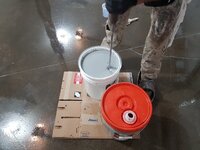
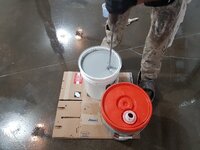
The next day I came in for the body coat. Ended up using 4.5 gallons of 100% solids epoxy with light grey pigment. Roughly 150 sq ft per gallon. Then I broadcast flake to rejection. I usually go closer to 100 sq ft/gallon but this slab was in excellent condition.
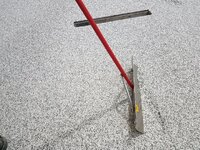
The next morning I came in and scraped all of my flake from east to west, then north to south. I then broomed it into a pile and reclaimed it. Then I gave the floor and excellent vacuum. Pictured is the scraper I like to use. It is heavy and does a great job.
For the top coat/grout coat I used 6 gallons of a two-component 100% solids Polyaspartic. Roughly 110 sq ft pet gallon @ 14 mils thickness. One coat.
Here are some pics of the process...




First Step was to mask off the house man door from the garage and the windows, and other important items in the garage that I did not want concrete dust to get into.
After that I started the perimeter and body grind. Ground the body with 60/80 grit metal Bond diamonds. Next I routed out all cracks and joints with a four and a half inch hand grinder with a diamond blade on it.
After a good vacuum I filled all of the joints with sand and 100% solids epoxy joint filler and let it sit overnight. The next morning I came in and ran the grinder real quick over all joints and areas that I filled with the joint filler to make them flush with the slab.
For primer I used 3 gallons of clear 100% solids epoxy and thinned it 20% with solvent. Roughly 220 sq ft per gallon.
The next day I came in for the body coat. Ended up using 4.5 gallons of 100% solids epoxy with light grey pigment. Roughly 150 sq ft per gallon. Then I broadcast flake to rejection. I usually go closer to 100 sq ft/gallon but this slab was in excellent condition.
The next morning I came in and scraped all of my flake from east to west, then north to south. I then broomed it into a pile and reclaimed it. Then I gave the floor and excellent vacuum. Pictured is the scraper I like to use. It is heavy and does a great job.
For the top coat/grout coat I used 6 gallons of a two-component 100% solids Polyaspartic. Roughly 110 sq ft pet gallon @ 14 mils thickness. One coat.
Here are some pics of the process...
Attachments
-
 4aa7891ec7995120ba72bedafe3019d7.jpg340.3 KB · Views: 17
 -
 931c21cfbd87db59555e0456e1d48cf8.jpg354.9 KB · Views: 13
 -
 a871ec36fddb259b55a9db76317f1002.jpg360.5 KB · Views: 11
 -
 91ed039941912d9e2fde494ec13c6d82.jpg187.3 KB · Views: 15
 -
 eaee212e281b668a1a53868aec1cd667.jpg365.1 KB · Views: 16
 -
 767ca4bd5a6528c6e8ffa0325d7d9da6.jpg69.4 KB · Views: 17
 -
 f58d354c58c937ae9586969ece723271.jpg298.8 KB · Views: 11
 -
 f5d168435b907b527fd27d9e8fc94095.jpg246.7 KB · Views: 11

