To avoid these ads, REGISTER NOW!

Garage Door Headers: LVL vs Truss?

FunfDreisig

Well-known member
Joined
Feb 12, 2008
Messages
413
Has anyone spanned a large garage door opening with stacked floor trusses vs a built up LVL beam?

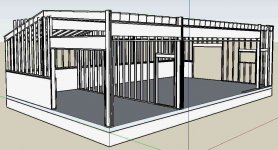
My new garage will have a 24' wide "garage door" opening that will be covered by sliding "barn" doors.The span tables for the 24' opening, using a built up LVL beam, requires 3 - 1 3/4" x 16" LVLs to handle the roof load etc.. That seems like a lot of weight/hassle (and possibly $$$) for a beam that will not be visible. So I'm looking for something a bit less heavy (and hopefully less expensive) that can handle the same load. This wall will be framed with 2x6s. So I have room for three floor trusses stacked side by side. Has anyone done this?

Thanks in advance - Funf Dreisig
 

Attachments

  • Header.jpg
    Header.jpg
    75.6 KB · Views: 99
Last edited:
To avoid these ads, REGISTER NOW!

Matti

Well-known member
Joined
Nov 16, 2007
Messages
412
Location
Canada
I think you are looking at some kind of engineered beam or possibly a steel I-beam for that kind of span.
 
OP
F

FunfDreisig

Well-known member
Joined
Feb 12, 2008
Messages
413
I think you are looking at some kind of engineered beam or possibly a steel I-beam for that kind of span.
Thanks for your comment.

FWIW Our cabin has two 24' walls spanned by pairs of 16" GLULAMS with similar sliding "barn" doors forming the "walls". So I'm certain that I won't need a steel I-beam for this 24' opening :) My only question is whether anyone has spanned 24" with stacked floor trusses vs a built-up LVL beam, or a pair of 16" GLULAMs?

Thanks again - Funf Dreisig
 
Last edited:

IHI

Banned
Joined
Mar 6, 2008
Messages
464
Location
Iowa
Span charts/Ratings are in place for a reason, use it. I understand trying to save a buck, but are you saving anything doing this twice? Installed the 16" LVL's to ensure it will handle the load and not cause any structure problems later, and without an engineers stamp to say okay, this floor joist type would work, you can stack floor trusses all day long, but inspector wont let it fly without a stamp.

That is a HUGE span, and if your in snow country, that will be a HUGE load on that beam to keep things string straight forever. If that's what the prints call for-use it, is saving $200 now going to be worth the hassle of a do over and thousands later when you get an opening that looks like a smiley face since you thought you out smart charts designed for safety?
 

Chris J

Active member
Joined
Feb 23, 2008
Messages
30
I know this isn't what you want to read, but I doubt the floor trusses have the strength to handle this sort of span safely. You don't say what the height of the floor trusses is, or what the load is that they are designed for, but a residential grade (40 lb/sq.ft.) truss is going to be rather tall to span that distance.

I had to use FOUR 1-3/4"x16" LVLs laminated together just to span my 16' garage door. We do have a high snow load requirement here (80 lb/sq.ft). The cost for the four LVLs was $500 (US) and yes it's a pain handling them and it took a boom truck to lift the assembled header, but I KNOW that header will never sag. I don't think you can count on that with floor trusses over that distance.
 

Junkman

Well-known member
Joined
Dec 18, 2006
Messages
6,626
Location
Northeastern CT
One trick to increase the carrying capacity of a LVL header is to put a 1/4" steel plate sandwiched between each one of them. Clamp the assembly together, and then drill through the assembly and firmly nut and bolt it together. You will need a boom truck to lift it, but I guarantee that it isn't going to ever sag. If you can't find a piece of steel long enough, then you can get it **** welded together, and grind the welds smooth. Don't forget to use large washers to keep the bolts from collapsing into the wood..
 

IDASHO

Well-known member
Joined
Mar 5, 2007
Messages
1,809
Location
Moscow, Idaho
With that kind of span you will probably have to have additional engineering in the footings/foundation as well. LOTS of load on those posts.
 

IHI

Banned
Joined
Mar 6, 2008
Messages
464
Location
Iowa
With that kind of span you will probably have to have additional engineering in the footings/foundation as well. LOTS of load on those posts.

Good point, huge footing modification to handle the load, and they make him install 3-4 jacks per side for it to sit on, possibly a few more to spread the load out so it's dispersed on the footing over a broader span.
 
OP
F

FunfDreisig

Well-known member
Joined
Feb 12, 2008
Messages
413
Thanks for all the replies.

Sorry I forgot to provide location info. The garage is in a rural part of the Texas Hill Country: no HOA, no snow load, no engineering stamp, no inspections -- period. So I am on my own ticket for designing and constructing a safe, cost effective structure that I want to work in and look at for the rest of my life :)

The headers will be in a 2x6 wall with a minimum of 2ft of space between the garage door rough opening and the base of the engineered I beam rafters (16 OC). The reason for the original question is that the span tables I've found for floor trusses don't show their capacity when stacked side by side. And more importantly when physically linked to each other.

I am not trying to be cheap. But I'd be happy to use trusses if it saved money and did the same or better job than a built up LVL. OTOH I will be spanning 12" in the ridge of the third bay (on the left in the image I posted earlier). Since this beam will be visible, I'l use a built up LVL or GLULAM.

FWIW I don't consider 24' a large span. For reference, i built our shed roof cabin which is essentially a post and beam structure built on pier and beam foundation. Although it has 20 4" square steel piers, only four of them carry the full load of the roof and most of the walls. Two of those walls (forming a corner) are each spanned by a pair of 24' long 3 1/4 by 16 in GLULAMS (i.e. 6.5"x16"x24') which support glass clear stories and sliding "barn" doors which form the walls. The roof is supported by twinned 16" GLULAMS that are 36' long, providing a 6 ft wide covered porch on three sides. And OBTW we lifted and assembled all of these these GLULAMs by hand :)

Thanks again - Funf Dreisig
 
Last edited:
OP
F

FunfDreisig

Well-known member
Joined
Feb 12, 2008
Messages
413
One trick to increase the carrying capacity of a LVL header is to put a 1/4" steel plate sandwiched between each one of them. Clamp the assembly together, and then drill through the assembly and firmly nut and bolt it together. You will need a boom truck to lift it, but I guarantee that it isn't going to ever sag. If you can't find a piece of steel long enough, then you can get it **** welded together, and grind the welds smooth. Don't forget to use large washers to keep the bolts from collapsing into the wood..
Thanks for the tip. I've seen this done before. I don't think I'll need to do this because i have plenty of space at least 24" head room for these headers. But I'll keep it in mind.

Funf Dreisig
 
Last edited:
OP
F

FunfDreisig

Well-known member
Joined
Feb 12, 2008
Messages
413
Good point, huge footing modification to handle the load, and they make him install 3-4 jacks per side for it to sit on, possibly a few more to spread the load out so it's dispersed on the footing over a broader span.
I'm a novice at slabs. So please bear with my nOOb questions. What are "jacks" and where are they placed in a slab?

I haven't fully spec the slab. But my current plan was for a 6" 4000PSI slab with a 12" wide x 12" deeper perimeter beam and 6" deeper beams every 12' in both directions. The ground is clay loam with significant gravel (pea to fist size) for at least the first 6 feet.

FWIW the piers on the cabin are in the same soil and are 3'x'3'x3' cubes of cement (with rebar). The roof deck on the garage will be a little lighter than the cabin. The same metal roofing but the roof deck will be 3/4in Polar-Ply instead of 2x6 T&G pine.

Funf Dreisig
 
Last edited:

IHI

Banned
Joined
Mar 6, 2008
Messages
464
Location
Iowa
The jacks are what your header sits on...wall studs cut down to compensate for heigth of header. Typically when you start going large span, the load on those two bearing points increases greatly putting ALOT more pressure in a smaller are, so most code requires you install more jacks to spread the load out...so instead of having one jack per side like a normal entry door or window opening, when doing 16' wide OHD openings we're required to use two jacks per side.

Then since all the weight gets transfered through the cripples, into the header, and down into the jacks that are supporting it, which places a huge load on the footing are the jacks are sitting on, typically when one area has such a high load they make you beef up the footings in that area so it wont crack the cement/footings and insures it has enough nutz to support that kind of weight.

No snow makes a big difference, but a 24' opening is huge by anybodies standard, ALOT of forces at work at both ends of it.
 
OP
F

FunfDreisig

Well-known member
Joined
Feb 12, 2008
Messages
413
The jacks are what your header sits on...wall studs cut down to compensate for heigth of header. Typically when you start going large span, the load on those two bearing points increases greatly putting ALOT more pressure in a smaller are, so most code requires you install more jacks to spread the load out...so instead of having one jack per side like a normal entry door or window opening, when doing 16' wide OHD openings we're required to use two jacks per side.

Then since all the weight gets transfered through the cripples, into the header, and down into the jacks that are supporting it, which places a huge load on the footing are the jacks are sitting on, typically when one area has such a high load they make you beef up the footings in that area so it wont crack the cement/footings and insures it has enough nutz to support that kind of weight.

No snow makes a big difference, but a 24' opening is huge by anybodies standard, ALOT of forces at work at both ends of it.
Thanks. I think the the framers around here call the short studs under the ends of the headers "cripples" and the full length studs "king studs" but I could be wrong. In any case I had planned to support the ends of the 24' and 12' spans with two short studs attached to two full length studs. These "columns" will be at the intersections of the thicker subsurface "beams" of concrete (reinforced with re-bar) to distribute the weight along the edge(s) of the slab and into the center of the slab. I'll get the concrete contractor to beef up the perimeter beam re-bar at these intersections.

FWIW the 24' spans on the cabin don't sit on "jacks" - they rest in welded collar brackets which are through bolted to them and 6 1/2 x 6 1/2 doug fir posts. The 36 ft GLULAMS sit on top the posts using through bolted welded H brackets. The cabin has already seen 45+mph winds several times from different angles (critical side and front loading forces) and is rock solid :)

Funf Dreisig
 
To avoid these ads, REGISTER NOW!

IHI

Banned
Joined
Mar 6, 2008
Messages
464
Location
Iowa
Thanks. I think the the framers around here call the short studs under the ends of the headers "cripples" and the full length studs "king studs" but I could be wrong. In any case I had planned to support the ends of the 24' and 12' spans with two short studs attached to two full length studs. These "columns" will be at the intersections of the thicker subsurface "beams" of concrete (reinforced with re-bar) to distribute the weight along the edge(s) of the slab and into the center of the slab. I'll get the concrete contractor to beef up the perimeter beam re-bar at these intersections.

FWIW the 24' spans on the cabin don't sit on "jacks" - they rest in welded collar brackets which are through bolted to them and 6 1/2 x 6 1/2 doug fir posts. The 36 ft GLULAMS sit on top the posts using through bolted welded H brackets. The cabin has already seen 45+mph winds several times from different angles (critical side and front loading forces) and is rock solid :)

Funf Dreisig

Are the posts construction grade 6x6's or treated 6x6's? Be very cvareful as the old version of the new ACQ2 lumber, the treatment they impregnate into the lumber eats everything metal, it eats non ferrious material VERY quickly in medium damp environments, and slowly eats away at steel. Locally once they found out about all the metal failures with this treated material, they mandated we switched over to stainless fasnters for everything since that showed the slowest deterioration process, and then every place else that had normal galvanized to treate lumber -like joist hangers/brackets-required us to wrap the ends of the boards with a rubberized vulcanizing wrap to the treated lumber did'nt eat away at the brackets as fast. They've since changed the formula since it was a severe safety hazard and i know we had ALOT of redo work going back on finished projects and taking them apart, redoing in light of this information coming out, so conctractors nation wide were losing thousands fixing this problem out of our own pockets with no help from the stuppid companies that turned the other direction when the biitching started on our part.


So long as the guys building know what they call'em, is all that matters, construction naming varies region to region actually...in this trade there's is a hundred different ways to skin a cat, and most will end up at the same destination.

Typically the terms in my area are as follows for reference:
Sole plate-bottom board that sits on block/poured wall that the bottom of the wall studs nail to

Studs-the boards that make up the wall framing between both ends of the wall

King studs are usually the studs that go bottom to top plate that the jacks are nailed to, then header gets nailed through the king as well

Jacks-the short studs that headers sit on/bear the weight of the header and transfer the load down to the foundation

Cripples are the little fillers above headers between header and top plate

Top plate-board that runs along the top of the wall the tops of the studs are nailed through.

Header-boards that span openings for window/doors

Beam-typically found under the floor, the beam is the supporting member that the floor trusses or joists rest on to break up a large span, the beam will sit on top of posts that direct it's load into pre placed footing in the ground..simply setting the posts ontop of a basement slab just any ole place is not advised and illegal is about all juristiction since a 4" concrete slab will not/cannot support the tremdious load placed at thesse points

Floor joists/trusses are the boards that make up your floor system and the sit ontop of the mud sill/bottom plate on top of a foundation if doing a crawl space/basement

Rim joist/band joist is the outside board that runs the perimeter of your house that gets nailed to all the floor joists to box the outside edge of the floor system together.

subfloor is the 3/4" wood that gets nailed to the floor joists

underlayment is the 1/4" wood that gets nailed/stapled down to the subfloor as the finished floor substrate prior to having a laminate floor installed, carpets will typically be installed right over the subfloor. But any place a adhesive is used, yoou HAVE to use a second layer of floor so if one day you ever decided to replace it, it's alot easier to pull up underlayment as opposed to cutting your sub floor out completely and redoing

Sorry to be redunadnat for anybody that knows this stuff already, but i'm sure there will be a few guys that might get something out of it.:beer:
 
OP
F

FunfDreisig

Well-known member
Joined
Feb 12, 2008
Messages
413
Thanks for the framing primer. It always helps to have someone in the trade to help out with translation.

FWIW the four main posts in the cabin are Douglas Fir milled from the same log. They (and the Doug Fir GLULAMs) were sanded, stained and oiled before they were installed. The brackets for the GLULAMs were painted and the bolts are 1/2" galvanized. These posts and GLULAMs are completely exposed (inside and out) but sheltered by the 6 foot overhang of the roof on their exterior sides.

Funf Dreisig
 
Last edited:

s_ontario

Well-known member
Joined
Jan 5, 2006
Messages
552
Location
canada
FunfDreisig: not to highjack your thread but You mentioned you had douglas fir beams. do you happen to remember the price you paid ? reason I ask I have 6 - 30' 8x8 douglas fir beams here and have no idea what they are worth

as far as beam over 24' span on a side door here they use steel beams end beams with truss they use 3 2x12"

I have one 20' door thats a steel 8x8 H beam But have snow load
 
OP
F

FunfDreisig

Well-known member
Joined
Feb 12, 2008
Messages
413
FunfDreisig: not to highjack your thread but You mentioned you had douglas fir beams. do you happen to remember the price you paid ? reason I ask I have 6 - 30' 8x8 douglas fir beams here and have no idea what they are worth ...
This is your lucky day. In May of 2005 I paid $530 for three 8x8 rough doug fir posts. 2 @ 12ft and 1 @ 16ft. FWIW I cut the 16 footer into 2 8ft posts. I'm guessing you can do the math. BTW I'd take real good care of those babies :)

Funf Dreisig
 

Matti

Well-known member
Joined
Nov 16, 2007
Messages
412
Location
Canada
One other thing to check out is the allowable deflection of a door header vs a floor truss. It's possible that floor truss sizing is based on greater allowable deflection than would be recommended for a door header. Generally, when something hasn't been done before there is a reason why even if it is only economics. Can a local truss company that builds these trusses do the sizing for you?
 
OP
F

FunfDreisig

Well-known member
Joined
Feb 12, 2008
Messages
413
One other thing to check out is the allowable deflection of a door header vs a floor truss. It's possible that floor truss sizing is based on greater allowable deflection than would be recommended for a door header. Generally, when something hasn't been done before there is a reason why even if it is only economics. Can a local truss company that builds these trusses do the sizing for you?
Good question. I'll be talking with one of my local lumber yards in the next few days to get a bid on the framing lumber. I plan to ask for quotes on several options, including LVLs, GLULAMS and floor trusses. And have him run the load numbers.

BTW I got the idea for using floor trusses instead of LVLs from our architect while discussing the plans for our house. He's doing our house -- I'm doing MY garage. I'd ask him to run the numbers; but his fees would be more than I could save using trusses. Besides, I wouldn't want him to get the idea that I couldn't do it myself -- with the help of you guys, of course :)

Funf Dreisig
 
Last edited:

Matti

Well-known member
Joined
Nov 16, 2007
Messages
412
Location
Canada
I'm wondering if the problem may be the height of the truss ie perhaps you would need a 24" tall or taller truss??? You are talking about a parallel chord type truss or am I OTL here?
 
OP
F

FunfDreisig

Well-known member
Joined
Feb 12, 2008
Messages
413
I'm wondering if the problem may be the height of the truss ie perhaps you would need a 24" tall or taller truss??? You are talking about a parallel chord type truss or am I OTL here?
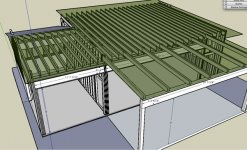
Yes I'm talking about a parallel chord type truss and yes I would expect it to be roughly 24" tall. But with no snow load and a metal roof I can have a very low roof pitch (1 on 12). So even with a shed roof spanning 25' (see image in the OP) , I can keep the back wall at roughly 13' with a front wall at only 11' leaving 2' for the truss and still have a 9' high door opening. Note: add roughly 1' to the walls heights (for the roof beams, deck, etc.) to get the overall height of the structure.

FWIW the garage will have a 12' "portico" to shade the front (AKA south) wall. So I actually need an 11' front wall to get at least 8' clearance, 12' further south, without changing the pitch of the roof. I'll post another Sketchup model as soon as I incorporate the "sister" rafters for the portico into the model.

Funf Dreisig
 
Last edited:
OP
F

FunfDreisig

Well-known member
Joined
Feb 12, 2008
Messages
413
Here is the 3/4 profile view (with key dimensions) of the 3 bay 42x25' garage with the 12x24' "portico" which shades the entrance to the two fully enclosed bays. Of course it will also need an LVL, GLULAM or steel beam to span the 24'. Because of the 1 on 12 roof pitch and the use of twined 2x8 sister rafters (24"OC), even a beam 16" tall will leave the same 9' clearance as the main opening. I'm thinking I'll either use a built up LVL beam or steel on the "portico".

Funf Dreisig
 

Attachments

  • Headershot1.jpg
    Headershot1.jpg
    69.8 KB · Views: 20
OP
F

FunfDreisig

Well-known member
Joined
Feb 12, 2008
Messages
413
I recently used a paralam beam to replace a load bearing wall.

This site has sizing charts:

http://www.ilevel.com/walls/w_MicrollamLVL_headers.aspx

Actual chart:

http://www.ilevel.com/literature/TJ-9000.pdf
Thanks. Those are charts I'm using too.

FWIW I've pretty much given up on trying to use stacked floor trusses instead of built up LVL headers. I'd take the risk if I got something really cool out of it. But it looks like all I'd do is save a bit of money on a beam that will be hidden from view.

Funf Dreisig
 
To avoid these ads, REGISTER NOW!
Top Bottom