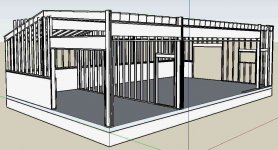
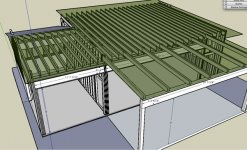
Thanks. I think the the framers around here call the short studs under the ends of the headers "cripples" and the full length studs "king studs" but I could be wrong. In any case I had planned to support the ends of the 24' and 12' spans with two short studs attached to two full length studs. These "columns" will be at the intersections of the thicker subsurface "beams" of concrete (reinforced with re-bar) to distribute the weight along the edge(s) of the slab and into the center of the slab. I'll get the concrete contractor to beef up the perimeter beam re-bar at these intersections.
FWIW the 24' spans on the cabin don't sit on "jacks" - they rest in welded collar brackets which are through bolted to them and 6 1/2 x 6 1/2 doug fir posts. The 36 ft GLULAMS sit on top the posts using through bolted welded H brackets. The cabin has already seen 45+mph winds several times from different angles (critical side and front loading forces) and is rock solid

Funf Dreisig
Are the posts construction grade 6x6's or treated 6x6's? Be very cvareful as the old version of the new ACQ2 lumber, the treatment they impregnate into the lumber eats everything metal, it eats non ferrious material VERY quickly in medium damp environments, and slowly eats away at steel. Locally once they found out about all the metal failures with this treated material, they mandated we switched over to stainless fasnters for everything since that showed the slowest deterioration process, and then every place else that had normal galvanized to treate lumber -like joist hangers/brackets-required us to wrap the ends of the boards with a rubberized vulcanizing wrap to the treated lumber did'nt eat away at the brackets as fast. They've since changed the formula since it was a severe safety hazard and i know we had ALOT of redo work going back on finished projects and taking them apart, redoing in light of this information coming out, so conctractors nation wide were losing thousands fixing this problem out of our own pockets with no help from the stuppid companies that turned the other direction when the biitching started on our part.
So long as the guys building know what they call'em, is all that matters, construction naming varies region to region actually...in this trade there's is a hundred different ways to skin a cat, and most will end up at the same destination.
Typically the terms in my area are as follows for reference:
Sole plate-bottom board that sits on block/poured wall that the bottom of the wall studs nail to
Studs-the boards that make up the wall framing between both ends of the wall
King studs are usually the studs that go bottom to top plate that the jacks are nailed to, then header gets nailed through the king as well
Jacks-the short studs that headers sit on/bear the weight of the header and transfer the load down to the foundation
Cripples are the little fillers above headers between header and top plate
Top plate-board that runs along the top of the wall the tops of the studs are nailed through.
Header-boards that span openings for window/doors
Beam-typically found under the floor, the beam is the supporting member that the floor trusses or joists rest on to break up a large span, the beam will sit on top of posts that direct it's load into pre placed footing in the ground..simply setting the posts ontop of a basement slab just any ole place is not advised and illegal is about all juristiction since a 4" concrete slab will not/cannot support the tremdious load placed at thesse points
Floor joists/trusses are the boards that make up your floor system and the sit ontop of the mud sill/bottom plate on top of a foundation if doing a crawl space/basement
Rim joist/band joist is the outside board that runs the perimeter of your house that gets nailed to all the floor joists to box the outside edge of the floor system together.
subfloor is the 3/4" wood that gets nailed to the floor joists
underlayment is the 1/4" wood that gets nailed/stapled down to the subfloor as the finished floor substrate prior to having a laminate floor installed, carpets will typically be installed right over the subfloor. But any place a adhesive is used, yoou HAVE to use a second layer of floor so if one day you ever decided to replace it, it's alot easier to pull up underlayment as opposed to cutting your sub floor out completely and redoing
Sorry to be redunadnat for anybody that knows this stuff already, but i'm sure there will be a few guys that might get something out of it.