To avoid these ads, REGISTER NOW!

Garage GFCI questions for planning (mostly)

tmcdonal

Well-known member
Joined
Jan 8, 2013
Messages
62
Location
San Antonio, TX
I hate it when someone comes on to a forum and obviously hasn't used the search function before asking questions. I've been reading articles here and elsewhere like crazy and I have a few remaining things where I'm unclear, so here goes my first post...

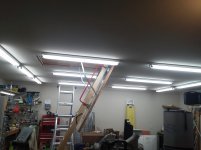
I have a detached garage (approx. 4 cars), which is being walled off to provide me with a 16' x 22' workshop. It's finished, with outlets every 6' approximately 4' off the ground. It has an attic space and is currently all wired off a single 20A circuit from the main house with 12/2 NM-B through the header studs in series. None of the romax is in any conduit and it's not required in this open air area.

I had an electrician run a new 100A subpanel here and I'm now planning how to change the wiring. The panel does not have a main disconnect, so part of my planning is staying under 6 throws to kill all circuits.

I'm planning:
- 20 amp multiwire branch circuit from the ceiling to two dedicated 20A outlets powering a dust collector and table saw
- 20 amp circuit to power a refrigerator, 2nd upright freezer, remaining wall outlets outside of the shop, and garage door opener.
- 20 amp circuit to power a wall of outlets and where my workbench is
- 20 amp circuit to power a wall of outlets where misc. power tools are (bandsaw, drill press, sander, scroll saw.) These will not be used concurrently.
- 20 amp circuit for the lights (surface mounted T8 fluorescents, permanently wired)
- 20 amp circuit dedicated for 120V Dual split A/C-Heater

My questions:
1) I'm seeing conflicting interpretations of GFCI being required if not "readily accessible". The ceiling is 8' tall. There's an outlet where the garage door opener is. Does that need to be GFCI protected? Also, behind the upright freezer and refrigerator?
2) I'm clear on the wiring of the multiwire branch circuit. Since they are dedicated and from the ceiling, is GFCI required here?
3) I'm planning on using 12/3 for the multiwire branch circuit and 12/2 for everything (which I'll just call romax for both.) The top of the new subpanel is about 27" from the ceiling. Technically, I could secure the romax to the wall and run them through the ceiling, but I don't like that look. Is there any issue with running a couple of runs of rigid PVC from the subpanel through the ceiling without a j-box? These would just be for protection and not complete conduit system.

Anything else I might be missing from what I described? Thanks.

-Tom
 
To avoid these ads, REGISTER NOW!

Tyberius

Well-known member
Joined
Nov 26, 2013
Messages
312
Location
Wilmette, IL
1) I'm seeing conflicting interpretations of GFCI being required if not "readily accessible". The ceiling is 8' tall. There's an outlet where the garage door opener is. Does that need to be GFCI protected? Also, behind the upright freezer and refrigerator?

I think so, so either hardwire it in and put it on your light circuit or GFCI protect it. I know that I would use the overhead plug if convenient, and that is what the code is trying to protect.

2) I'm clear on the wiring of the multiwire branch circuit. Since they are dedicated and from the ceiling, is GFCI required here?

I think they should if you want them to be safe. The dust collection could easily pick up water or be hit with water. I've used my table saw not on the stand but instead on the floor. But also, you could unplug those devices and use your wetdry vac to mop up water.

3) I'm planning on using 12/3 for the multiwire branch circuit and 12/2 for everything (which I'll just call romax for both.) The top of the new subpanel is about 27" from the ceiling. Technically, I could secure the romax to the wall and run them through the ceiling, but I don't like that look. Is there any issue with running a couple of runs of rigid PVC from the subpanel through the ceiling without a j-box? These would just be for protection and not complete conduit system.

That one really depends on the municipality and their inspectors, but I'm guessing it will need to be box to box, but that really helps you with maintenance and expansion down the line as you can replace or add to the section in the conduit and tie into the romex inside the box.
 

pattenp

Well-known member
Joined
Jun 4, 2008
Messages
10,175
Location
Virginia - USA
All 120V outlets need to be GFCI, no exceptions for height or behind the frig. MY opinion is to not have any MWBC. The MWBC is problematic to do GFCI.
 

Mustang51js

Well-known member
Joined
Jan 24, 2014
Messages
1,734
Location
Haskell nj
As said above legally they all need to be,but I have never failed a job for not putting the garage door opener outlets on a gfci. As far as the other outlets in the ceiling you could put the gfi down low to cover those.
 
OP
T

tmcdonal

Well-known member
Joined
Jan 8, 2013
Messages
62
Location
San Antonio, TX
All 120V outlets need to be GFCI, no exceptions for height or behind the frig. MY opinion is to not have any MWBC. The MWBC is problematic to do GFCI.

In hindsight after typing the original post, I realized that the table saw is actually powered through an attached 20 amp power strip from a server cabinet, along with a couple of other items - (shop vac, pancake compressor, and miter saw). As such, the power strip would be "accessible". Regardless I have no problem adding the GFCIs if need be in the other places.

Regarding your comment of the MWBC. I understand how there can be issues feeding additional outlets downstream off the load side, but I thought if they are both individual and dedicated, and I pigtail the neutral, then I wouldn't have a problem. Not true?

-Tom
 
OP
T

tmcdonal

Well-known member
Joined
Jan 8, 2013
Messages
62
Location
San Antonio, TX
That one really depends on the municipality and their inspectors, but I'm guessing it will need to be box to box, but that really helps you with maintenance and expansion down the line as you can replace or add to the section in the conduit and tie into the romex inside the box.

I added flooring to the attic space and a ladder for access. Even still, very little traffic up there. I left the original romax laying on what is now the attic floor where it crossed over the joists. Running new 12/2 and only using junction boxes when I tie into existing romax was what I had in mind.

If I have to go with box, then I know I'm better off running THHN and tying into the romax. Since I'm allowed to run the bare romax along the wall and into the attic, I'm having trouble seeing why I couldn't use a length of conduit just for appearance/protection on this section. Also, this is right at the corner where the roof comes down, so it's a tight area if I had to work inside a j-box.

-Tom
 
Last edited:

pattenp

Well-known member
Joined
Jun 4, 2008
Messages
10,175
Location
Virginia - USA
That's true. My point is that GFCI outlets have to be wire in a certain manner to work properly when used in a MWBC. I'm just not a big fan of MWBC. The wire cost savings to me is not that much. I assume you know that a MWBC needs to protected by a double pole breaker or two singles with handle ties.

In hindsight after typing the original post, I realized that the table saw is actually powered through an attached 20 amp power strip from a server cabinet, along with a couple of other items - (shop vac, pancake compressor, and miter saw). As such, the power strip would be "accessible". Regardless I have no problem adding the GFCIs if need be in the other places.

Regarding your comment of the MWBC. I understand how there can be issues feeding additional outlets downstream off the load side, but I thought if they are both individual and dedicated, and I pigtail the neutral, then I wouldn't have a problem. Not true?

-Tom
 

pattenp

Well-known member
Joined
Jun 4, 2008
Messages
10,175
Location
Virginia - USA
You can run Romex in conduit for appearance/protection if you want to. If you are using metal conduit as a sleeve you need to use bushings on the ends and staple the wire within 12" of the conduit ends. Be sure to use the proper size conduit to meet fill requirements.

I added flooring to the attic space and a ladder for access. Even still, very little traffic up there. I left the original romax laying on what is now the attic floor where it crossed over the joists. Running new 12/2 and only using junction boxes when I tie into existing romax was what I had in mind.

If I have to go with box, then I know I'm better off running THHN and tying into the romax. Since I'm allowed to run the bare romax along the wall and into the attic, I'm having trouble seeing why I couldn't use a length of conduit just for appearance/protection on this section. Also, this is right at the corner where the roof comes down, so it's a tight area if I had to work inside a j-box.

-Tom
 
OP
T

tmcdonal

Well-known member
Joined
Jan 8, 2013
Messages
62
Location
San Antonio, TX
That's true. My point is that GFCI outlets have to be wire in a certain manner to work properly when used in a MWBC. I'm just not a big fan of MWBC. The wire cost savings to me is not that much. I assume you know that a MWBC needs to protected by a double pole breaker or two singles with handle ties.

Correct. I'm 100% clear on wiring it. I'm not looking for a cost savings, as much as trying to stay in code with the 6 throws to kill all power. Something needs to be combined on a MWBC to do so. Alternately, I'd have to change out the subpanel to something with a main breaker. It seemed that the two ceiling outlets which will be very close together made the most logical sense.

-Tom
 
Last edited:

Mustang51js

Well-known member
Joined
Jan 24, 2014
Messages
1,734
Location
Haskell nj
You could add a main breaker onto the panel you have now, would just need a main breaker lock kit for your panel. As far as multi circuit runs I do them where I can because of the time savings and little cost savings on the wire, the main reason I used to do them was because before arc fault breakers became common the panels didn't give you a lot of spaces for grounds and nuetrals, so by running a 3 wire it saves two spots for other wires. Now a days they are almost to a point where any 3 wire circuit will be illegal until the arc fault outlet comes more common
 

Charles (in GA)

Well-known member
Joined
Jan 11, 2006
Messages
12,489
Location
50 mi south of Atlanta
I hope the OP didn't cheap out and use a tiny panel. 12 or 16 space should be minimum in a shop like this, possibly more.

Easy to install a 100 amp double pole breaker as a main, just use the approved hold down kit for it. You will find those hanging on the pegs in the big box stores just above the breakers, right next to the ground bars and GFCI breakers in blister packs.

To be honest, the best would be to have a disconnect before the panel, or outside the building, so the whole panel is dead when you pull it to work in the panel.

For refrigerators and freezers, I would not want them on circuits with other equipment, if you are planning ahead on this. My fridge is not on a dedicated circuit, but it is the only thing plugged into a three receptacle circuit. I would be more concerned about the freezer.

Oh and its Romex® (not Romax) a registered trade mark name of the Southwire Corporation of Carrolton, GA (gotta get a plug in for the Georgia boys who done good). Go to the company web site and read their history.... Family owned and very successful.

http://www.southwire.com/romex.htm

Charles
 
Last edited:

Aceman

Well-known member
Joined
Jan 28, 2007
Messages
2,513
Location
Eastern Oregon
You can run Romex in conduit for appearance/protection if you want to. If you are using metal conduit as a sleeve you need to use bushings on the ends and staple the wire within 12" of the conduit ends. Be sure to use the proper size conduit to meet fill requirements.

Solid advice, just one quick note. Fill requirements don't apply to sleeves, only complete raceway systems. Ch. 9, notes to tables (2).
 

pattenp

Well-known member
Joined
Jun 4, 2008
Messages
10,175
Location
Virginia - USA
I'm aware of the section you referenced for complete raceways but I was thinking that the NEC stated somewhere that sleeves over 24" needed to be sized correctly because of heat. I must have dreamed that one up.

Edit: Can't find a thing in the NEC about conduit sleeves. Regardless, I think it's a good practice to size long sleeves based on conduit fill requirements.

Solid advice, just one quick note. Fill requirements don't apply to sleeves, only complete raceway systems. Ch. 9, notes to tables (2).
 
Last edited:
OP
T

tmcdonal

Well-known member
Joined
Jan 8, 2013
Messages
62
Location
San Antonio, TX
That's a good suggestion on dedicating one circuit for the refrigerator/freezer. Looking over my plan, there are two outlets and the garage door opener tied to the same run. I'm going to keep the outlets as I have a power failure alarm plugged into an adjacent outlet and they will be rarely used. However, I'll transfer the door opener to another circuit. Also going to make everything GFCI protected, regardless of "accessible".

I'm a little red-faced on romex. I've referred to it for 25 years without ever typing it. That's locked in the long term memory now.

When I get home, I'll check the number of spaces in the panel. From memory, I'd guess it's at least 20. When I discussed what I wanted with the electrical subcontractor, I just went with his suggestion. When it was done, I chuckled to myself at what seemed like a ridiculous number of spaces.

Since starting to plan out the wiring, I learned the "6 switch rule". If I knew then what I know now, I would have asked for a panel with a main breaker. I'll also check out the model number of the panel and see if I can get a main breaker kit. I can live within the confines of 6 breakers for now, but I'd hate to have to change it all out down the road.

-Tom
 

Mustang51js

Well-known member
Joined
Jan 24, 2014
Messages
1,734
Location
Haskell nj
They are starting to make arc fault breakers be used for every circuit, and with those breakers you need a 2 wire feed because you can't share a neutral on the 3 wire like with normal breakers
 

pattenp

Well-known member
Joined
Jun 4, 2008
Messages
10,175
Location
Virginia - USA
I know that GFCI breakers don't work with a shared neutral, but why would a shared neutral matter to an arc fault breaker? They have 2 pole AFCI that can be used on a MWBC.

They are starting to make arc fault breakers be used for every circuit, and with those breakers you need a 2 wire feed because you can't share a neutral on the 3 wire like with normal breakers
 
Last edited:
To avoid these ads, REGISTER NOW!

Mustang51js

Well-known member
Joined
Jan 24, 2014
Messages
1,734
Location
Haskell nj
I know that GFCI breakers don't work with a shared neutral, but why would a shared neutral matter to an arc fault breaker? They have 2 pole AFCI for MWBC.

All the arc faults I have used are hooked up like a gfci breaker, with the nuetral of the circuit going on the breaker. I'm hearing they are starting to come out with arc fault outlets like gfci outlets but it's going to take some time before the price comes down.
 

Mustang51js

Well-known member
Joined
Jan 24, 2014
Messages
1,734
Location
Haskell nj
I guess you could use a two pole arc fault and wire nut a tail to the nuetrals so one wire goes on the breaker,I never used a two pole acr fault so not sure if it would work
 

Mustang51js

Well-known member
Joined
Jan 24, 2014
Messages
1,734
Location
Haskell nj
Good to know about them,thanks, I will have to look up the other brands since I mostly see square d and cutler hammer.
 
OP
T

tmcdonal

Well-known member
Joined
Jan 8, 2013
Messages
62
Location
San Antonio, TX
It's always bigger in your mind. What I said a ridiculous number of spaces, that would be... 12.

There are 28 knockouts on the front, but that's for the 1/2" breakers. The panel is TLM1212CCU - 125 amp panel. It looks like THQMV125D is the main breaker kit. I had a little sticker shock in pricing a main breaker kit - $125-ish??? Does that sound correct? That's the whole price of some panels with breakers already installed.

-Tom
 

Charles (in GA)

Well-known member
Joined
Jan 11, 2006
Messages
12,489
Location
50 mi south of Atlanta
100 amp breakers are something just under $40 big box store prices. No need for the expensive main breaker kit except to keep from losing two spaces.

The kit you quote, $94.69 on Amazon (third party seller), or a THQMH125CP that also fits that panel, for $65 inc shipping. Also THQMH100CP is $37 and free shipping, 100 breaker with main kit.

Ebay, $50 with no bids yet, 47 hrs to go. Another at $85 or best offer (throw $75 at 'em, bet they will take it), and another $80 buy it now.

Charles
 
Last edited:

Mustang51js

Well-known member
Joined
Jan 24, 2014
Messages
1,734
Location
Haskell nj
Yeah not sure what your looking at but all you need is a 100 amp ge two pole breaker,the lock kit I was talking about are under $15 but might be quicker to go to a supply house and see what they have, it's basically a plastic clip that keeps the breaker from popping out. It's really not needed but your supposed to have it.
 

Charles (in GA)

Well-known member
Joined
Jan 11, 2006
Messages
12,489
Location
50 mi south of Atlanta
Yeah not sure what your looking at but all you need is a 100 amp ge two pole breaker,the lock kit I was talking about are under $15 but might be quicker to go to a supply house and see what they have, it's basically a plastic clip that keeps the breaker from popping out. It's really not needed but your supposed to have it.

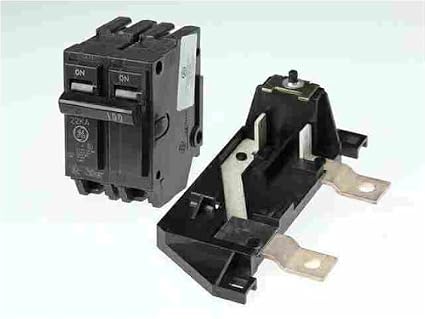
He is looking at the main breaker kit, which is a mounting base that connects where the lugs are, and uses the main breaker knockout in the face of the panel. Keeps from wasting precious space in the panel. The 100 amp breaker and mounting kit is only $37 on Amazon. Its just being used as a disconnect, as the wires supplying the panel are being protected by the feeder breaker in his main panel.

41PIRJEEg%2BL._SX425_.jpg
 

Mustang51js

Well-known member
Joined
Jan 24, 2014
Messages
1,734
Location
Haskell nj
That's not a bad price for that, the only other thing I would check is if your panel cover has a knockout space for the main or else you need to order a new cover also.
 
OP
T

tmcdonal

Well-known member
Joined
Jan 8, 2013
Messages
62
Location
San Antonio, TX
That's not a bad price for that, the only other thing I would check is if your panel cover has a knockout space for the main or else you need to order a new cover also.

Correct, I do not have a knockout on the main panel. In looking at the pics I was pretty sure I understood how to install the main breaker, but couldn't figure how it would come through the front panel. Thought it might use the top two spots. However, I now understand that's what you were talking about with the clip. Install a 100 amp breaker into the top two slots and back feed it to power the panel with a clip to hold it into place.

To do it right, my choices are:
1) (Above) Install a 100 amp breaker into the top two slots and back feed it to power.
2) Install a main breaker kit and replace the panel cover
3) Replace the panel.

I'm leaning toward #3 with a 100 amp panel. The feed comes in from the bottom left corner through the back of the panel and runs to the top lugs, so I have plenty of cable to work with. I verified the breaker from the main panel is 70 amps. Abandoning the MWBC, I need 7 slots for all my planned circuits. That will leave me 3 to later grow if need be.

I'm heading out tomorrow for a weeklong family vacation, so will address this when I get back. It'll likely be weeks before I get this done. However, I want to say thanks for talking me through this. In reading a lot of these threads, there's a commonality of people saying "I want to do X, can I get away with that?" and despite all the comments against it, they try to find justification to do it against code.

That's where I came into this thread - wanting 7 circuits in a panel without a main breaker and wanting to avoid some GFCI circuits. Instead of working within the confines of too small a box, I'm now going to do it correctly and have a main breaker and GFCI's on everything. Also going to run THHN to the attic through complete conduit to a junction box to run the romEx. Good excuse to buy a new tool - knockout punch.

I'll follow up again down the road, and probably have more questions, but thanks for now.

-Tom
 

Mustang51js

Well-known member
Joined
Jan 24, 2014
Messages
1,734
Location
Haskell nj
Yeah I would go with a 20 space 100 amp main breaker panel, it should be around $75-$100. This way you have the extra spaces even if you don't need them,it would look better to future owner if you ever decide to sell.

If you feel comfortable you could cut the panel cover also but it normally doesn't work out to well and gets cut crooked.
 

Charles (in GA)

Well-known member
Joined
Jan 11, 2006
Messages
12,489
Location
50 mi south of Atlanta
You could install a 30 or 40 space 200 amp panel for that matter. Sometimes they are about as cheap as the smaller ones due to volume of sales. The fact that it is a higher amperage number is not relevant, so long as it is capable of the current being supplied to it, in this case, 70 amps, you are OK, the main breaker at this point becomes nothing more than a disconnect switch.

Charles
 
OP
T

tmcdonal

Well-known member
Joined
Jan 8, 2013
Messages
62
Location
San Antonio, TX
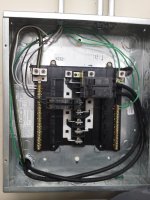
It's been a while, but I wanted to follow-up with a big thank you on all the comments. I ended up back feeding in the power to the sub-panel. I did get the clip to secure the main breaker, but it was quite the challenge to figure out how to attach it, as it was packaged without instructions. I finally found a description of installation on another forum.

For anyone else stumbling across this and is equally confused, zoom into the first picture (part# THQLRK3CP):
20140407_231146.jpg

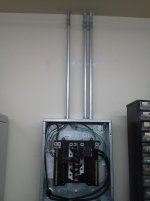
I also ran conduit up to the attic area properly. It wasn't at all difficult once I realized I could do it in two segments and I'm glad I did so:
20140407_231309.jpg

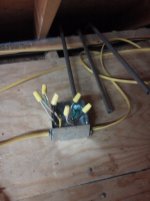
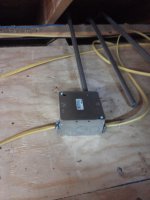
Up in the attic, the wires go into a j-box and then branch to the Romex from there:
20140407_230558.jpg

20140407_231105.jpg

Let there be light!
20140407_231326.jpg

Anyway, thought a follow-up thank you would be in order. I certainly appreciate it.

-Tom
 
To avoid these ads, REGISTER NOW!
Top Bottom