To avoid these ads, REGISTER NOW!

Garage Pad pour issues... Advice needed!

g1teg

Member
Joined
Mar 10, 2019
Messages
22
Location
In my dreams
Hi All!

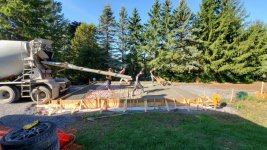
I hired a company to do my pour. I did an 8" slab, in floor heat, with an 18" thickened edge footing.

32 MPa, 5-8%. Pour took about 3 hours, and the crew finished the floor (smooth) for about 3 additional hours. They were good, hand screeded, hand trowel, then finished with a couple different pads on the power trowel.

it was a pretty cool day. 68F as the high. Pad was nearly completely in the shade when the guys finished. We wet it lightly and they told me to wet it a few more times that night, and again in the morning.

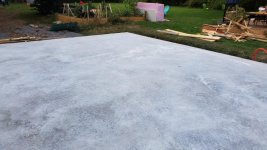
Today when I got home from work (~26 hours after they finished), I saw some cracks, which I was fine with, but as I walked on it, I could hear crunching. Tapping on the floor in most spots feels hollow, and some of it was moving considerably. I think about 1/8" on top has separated over most of the pad.

See pics. What can be done? What should I expect them to do? Right now, theyre claiming maybe it was bad concrete from the supplier.
 

Attachments

  • bB9GLIS1S5eXrzfAa0WP7A.jpg
    bB9GLIS1S5eXrzfAa0WP7A.jpg
    156.6 KB · Views: 262
  • r9X9NQv9TQ23lpwunDmfrg.jpg
    r9X9NQv9TQ23lpwunDmfrg.jpg
    163.8 KB · Views: 252
  • d_gykRLqSXeGwU3tGbyu1Q.jpg
    d_gykRLqSXeGwU3tGbyu1Q.jpg
    153.2 KB · Views: 292
  • uQ_ZFd0NSKCoxg_-ETRhNg.jpg
    uQ_ZFd0NSKCoxg_-ETRhNg.jpg
    150.2 KB · Views: 288
  • cbz_ji_FSPSvd4kOaTy8XQ.jpg
    cbz_ji_FSPSvd4kOaTy8XQ.jpg
    77 KB · Views: 325
To avoid these ads, REGISTER NOW!

Countyroadtrailers

Well-known member
Joined
Feb 14, 2019
Messages
102
Location
Alabama
Wow....who had the supplier come, them or you?

If they ordered it I'd say it's still their problem. Gets to be a gray area if you did. I'd definitely be saving the delivery receipts from the concrete trucks either way.

Sent from my Pixel 3a XL using Tapatalk
 

carnutdallas

Well-known member
Joined
Nov 6, 2013
Messages
141
Got to grind it off and see what it is like below. That super *****. I have never heard of wetting again after it is is finished off. I have never been told to do that!?! I am a construction neophyte, but my concrete guy has done several projects for me and I have been a part of several commercial builds and never ever seen or been told that. Keep us posted.


Sent from my iPhone using Tapatalk
 
OP
G

g1teg

Member
Joined
Mar 10, 2019
Messages
22
Location
In my dreams
Their GC ordered the concrete, though only 1 of 2 trucks left a receipt.

They added a tiny bit of water, you can see the water bottle in his hand, a squirt here and there was all really...
 
OP
G

g1teg

Member
Joined
Mar 10, 2019
Messages
22
Location
In my dreams
This was a good quick read as I googled issues for my own knowledge of your problem
https://www.cement.org/docs/default...auses-prevention-repair.pdf?sfvrsn=4&sfvrsn=4


Sounds like delamination, less likely blisters based on pic??

Sounds exactly like delamination in that article, thanks! I only tapped with my fingers to expose that hole...!

So botched pour/bad surface finish... Will grinding and sealing be sufficient? Repour the whole thing?!?

This is the only part of the entire job I'm paying for professionals!
 
OP
G

g1teg

Member
Joined
Mar 10, 2019
Messages
22
Location
In my dreams
Reading about delamination, it's definitely that.

The causes all add up. Vapour barrier, cold subgrade (started early after a cold night), thick slab (8-18" depth) sun exposure during the pour, windy day and air entrainment!

I'm feeling sick, glad I haven't paid for it yet!
 

KnurledNut

Well-known member
Joined
Jan 28, 2011
Messages
8,194
Location
n/a
Did they bull float it after screeding?
When they hand troweled (before power troweling) did they use steel trowels or mag floats?
Steel traps the bleed water and air to early.
Also, over troweling can cause spalling.
 
Last edited:
To avoid these ads, REGISTER NOW!
OP
G

g1teg

Member
Joined
Mar 10, 2019
Messages
22
Location
In my dreams
Did they bull float it after screeding?
When they hand troweled (before power troweling) did they use steel trowels or mag floats?
Steel traps the bleed water and air to early.
Also, over troweling can cause spalling.

I'm not 100% sure to be honest. I *think* screed, to mags around the perimeter at least, and then steel, then power trowel.
 

bdk1976

Banned
Joined
Feb 19, 2007
Messages
285
Holy **** that is bad. I vetted my concrete guy like I was a PI and was still worried sick when the first truck rolled up. Like you, this is the only thing I hired out.

You might still have some leverage if you haven't paid, IMO, but might not be a pretty fight. Best of luck and let us know how this works out.
 
OP
G

g1teg

Member
Joined
Mar 10, 2019
Messages
22
Location
In my dreams
Holy **** that is bad. I vetted my concrete guy like I was a PI and was still worried sick when the first truck rolled up. Like you, this is the only thing I hired out.

You might still have some leverage if you haven't paid, IMO, but might not be a pretty fight. Best of luck and let us know how this works out.

Thanks, I went through a few first, and this crew came highly recommended! They clearly cared about the job. I was very happy until tonight.

I'm also not worried about the strength beyond the surface, and if they can fix this, I'll be fine... I just want to be sure it's not a patch job just to get paid and I'll be back here in a year.!

All the prep, insulation, forms, steel and heating I did... They just poured/finished it.
 

James-W

Well-known member
Joined
Feb 3, 2013
Messages
12,432
Location
Southeastern Wisconsin
WOW, that is not good. I am not sure what the best course of action is. If it were me, i would prefer it to be ripped out and do it over. But you have to know full well the concrete guys are not going to want to do that. It would likely turn into a court case and I suspect you will win. Problem is, it would no doubt be a long time before the case even gets to court and that means your project will be held up for quite some time.

I suppose you could have it ripped out and re-poured by another concrete crew and then take the first concrete crew to court and sue for damages and the cost of ripping out the "bad pour" but again, this could take quite awhile to get to court and it isn't 100 percent certain you would win. I really don't know what to suggest.
 

joes169

Well-known member
Joined
Sep 19, 2011
Messages
663
Location
WI
Not sure this one can be blamed on the finishing crew if they didn't order the concrete. Whoever decided to order up to 8% air entrainment for a power trowelled floor holds the most responsibility, imo, especially with a strong wind.

I know a lot of folks here suggest doing exactly what you did, all of the prep yourself and then hiring a good concrete crew to pour and finish. This is one of the downsides of doing so, though, as it often spreads the liability to several parties, creating murky waters.

I personally contract several hundred yards of power troweled floors out every year, there's no way I'm allowing anyone else to decide what concrete mix I'm going to warranty.
 
OP
G

g1teg

Member
Joined
Mar 10, 2019
Messages
22
Location
In my dreams
Not sure this one can be blamed on the finishing crew if they didn't order the concrete. Whoever decided to order up to 8% air entrainment for a power trowelled floor holds the most responsibility, imo, especially with a strong wind.

I know a lot of folks here suggest doing exactly what you did, all of the prep yourself and then hiring a good concrete crew to pour and finish. This is one of the downsides of doing so, though, as it often spreads the liability to several parties, creating murky waters.

I personally contract several hundred yards of power troweled floors out every year, there's no way I'm allowing anyone else to decide what concrete mix I'm going to warranty.

The engineer spec'd the concrete for the job. The GC ordered the trucks, and hired the crew, having inspected the site, and knowing the concrete specs. When I double checked with him on the 5-8%, he answered "That's standard for slabs so yeah, I priced it accordingly. ��"

This is the exact reason I had them order the concrete themselves
 

joes169

Well-known member
Joined
Sep 19, 2011
Messages
663
Location
WI
I can guarantee you that full air entrainment is NOT recommended for power troweled concrete.

Best of luck figuring this all out, but it sounds like you need to have a discussion with your GC first.
 
OP
G

g1teg

Member
Joined
Mar 10, 2019
Messages
22
Location
In my dreams
I can guarantee you that full air entrainment is NOT recommended for power troweled concrete.

Best of luck figuring this all out, but it sounds like you need to have a discussion with your GC first.

Yeah I'm not arguing that, I never told them to power trowel either... That's why I hired an engineer to spec it, and a company to manage and pour it... This is all new to me!

I'm mostly looking for opinions on the best repair that will last, so I can be sure I don't get screwed in a few months when it separates or something... Thanks for the input for sure!
 

ard

Well-known member
Joined
Feb 16, 2015
Messages
4,391
Location
Sierra Foothills... California
Id hire one more pro:

a concrete construction (litigation) expert. So you know what to demand from the GC...


sorry to hear. I cant tell you how to remediate. Grind, polish, densify for a polished look? or grind then epoxy? 8" should be plenty thick. But that assumes it is only a surface defect and the bulk strength is unaffected
 

ConCretin

Well-known member
Joined
Jan 20, 2011
Messages
3,379
Location
Central Maine
Sounds like you’ve already figured out the problem so I’ll just add my two cents. It appears to be a pretty clear case of de-lamination caused by steel troweling of air entrained concrete.

The chemical admixture that is used to achieve the air entrainment slows down the release of bleed water. If the surface is sealed too quickly with steel trowel blades, rising bleed water and air pool just below the surface creating a void and leaving the thin surface layer detached from the concrete below. Given the weather conditions and the fact that he had to add water to the surface during finishing, this is almost certainly the case.

Your finisher was apparently aware of the fact that the concrete was air entrained so he bears some culpability. He should have warned against it or taken steps to mitigate the potential problem. Given the specifics of your placement, there wasn't much he could have done however. De-lamination was almost inevitable in your case for the reasons you mention; weather, vapor barrier, depth of concrete, etc.

In addition, there was no reason for the engineer to spec air entrainment on an interior slab in the first place so he has some responsibility here too. Air entrainment is used to resist damage from freeze/thaw conditions caused by moisture in the concrete. Moisture that isn't really present in interior slabs. The vast majority of architects and engineers are aware of this hazard prohibit air entrained concrete on interior floor slabs.

The good news - if there is any- is that de-lamination is a surface defect and the underlying concrete is fine. Once it is resolved, it won't be a continuing issue. You could attempt spot repairs but it wouldn't be very attractive or durable. You could remove and fill the de-laminated areas and cover the floor with an epoxy. You could also grind off the entire surface and polish the surface. Another option would be to overlay the entire floor with new concrete, which it probably what I'd do.

In all these scenarios, you'll want to find and remove all the defective concrete. The best way to do this is to drag a chain over the surface and listen for a change in tone. Once you find the bad areas, chip off the surface until you find sound edges.

It's really too bad this happened. Unfortunately, your not the first person to experience this problem and it sounds like you did everything 'right'. For a material used by the Romans a couple thousand years ago, concrete still confounds us regularly.
 
Last edited:
OP
G

g1teg

Member
Joined
Mar 10, 2019
Messages
22
Location
In my dreams
Thanks all!

For me, since it's already an 8" pad, I don't really want to go thicker. The problem areas run almost entirely throughout the pad, edges are the exception, so patches don't make sense.

Ideally, I'll have them grind maybe 1/2" off, and polish the aggregate. I like the look of it exposed, and I won't have to worry about a top layer coming detached later.

Any issues with that idea?
 
To avoid these ads, REGISTER NOW!
Top Bottom