billconner
Well-known member
I'd think a simple 4 sided box with ply top and composite on that would be simpler than 4 stringers.


I agree. I wouldn't be cutting stringers for this, but thw OP seemed to want to go that wayI'd think a simple 4 sided box with ply top and composite on that would be simpler than 4 stringers.
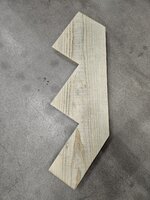
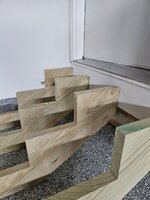
Pressure treated stringers and Trex boards, been outdoors since 1995, no issues.Yes I have thought about and looked at composite boards
I built my 12x20 patio with Apex and it's held up nice

I'd agree.I do like the PT stringers and composite stair treads
Three boxes would be too many parts connected together for a small step. If one tiny small piece is out of whack it's going to be a wobbler.While I do like the box construction, I also wouldn't want to have 3 boxes stacked up
If I can design and build a two box setup that is what I would prefer, if possible
Why would the number of steps impact stability? The bottom box is the only one in contact with the ground and can easily be leveled with 2x4 legs on the insideThree boxes would be too many parts connected together for a small step. If one tiny small piece is out of whack it's going to be a wobbler.
You're on the right track with your thinking. Make a solid base and do a two step box on top.
I can tell you that the advice about even step height is a big deal. We bought a place with some old hack repairs. One was a three step section that came off a landing at 90 degrees . Each step had different height and none matched the upper section. Those three steps dang near got me a few times while hauling stuff. Maybe the brain gets used to those things over time but I didn't wait. Redoing those steps was one of the first projects.
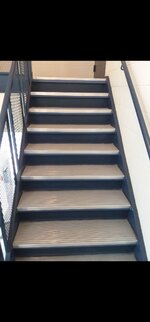


Handrails aren't required till you get to 4 rise stairs. Current Code reads "more than 3 risers".I also "pretty upped" a set of standard garage stairs for a customer with oak tread caps and composite risers. They're sold at the big box stores. You need to cut nose off existing tread and the new risers and trends glue onto the old stairs.
Don't have a picture of original stairs but they were just builder grade. This pic is after risers and tread caps were installed.
Completed with railings etc.
Side view
Handrails aren't required till you get to 4 rise stairs. Current Code reads "more than 3 risers".
Those tread caps create unequal risers. The first riser at bottom of stair increases by the thickness of the cap, then the risers are equal, and then the one prior to the landing is short unless the landing is capped with equal thickness. Course this is all moot if the cap thickness is less than 3/8" (allowable riser variance min to max within the flight).
Stair guy here. Larry’s correct about everything. I’d recommend a landing if possible, but even with floor in house; not top of threshold and not one step down. Single steps down are unexpected and I myself miss seeing them and get surprised. You’re allowed to do it. I just wouldn’t. Steps down could be turned 90 degrees or at an angle between straight and 90.I did a house with concrete steps in the garage for a customer. Broom finish for all surfaces. Customer loves it.
I plan to replace my similar garage stair with concrete this summer when I install my Race Deck floor.
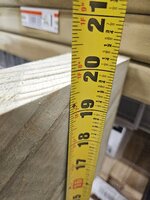
Yes you can place a platform (landing) in the stair, it will need to be 3'x3'. It could be flush with the bottom of the metal door sill, 1 rise down from the metal sill, etc (wherever you want it in the flight). Looks like you are stuck with a 3-rise stair (3R).
In new construction (at least in my region), the stair total rise is measured from the floor to the top of the door adjustable sill (not metal sill pan). Measure this and divide by your 3 risers to get your rise height.
The number of risers remains the same whether you have a landing or not. IRC Code today will limit you to a max of 7.75" rise height. Many areas (including mine) take exception to the IRC Code and allow a max rise of 8.25" and a minimum tread depth of 9". Old building Codes typically enforced the 8.25" max,
The number of treads is one less than the number of risers, in your case 2.
If your slab is pitched, this affects the total rise measurement. Treads are typically in the 10.5-11.5" depth range for comfort, so recheck your total rise measurement at around 22" out from the adjustable sill. If you add a landing (and have a pitched slab), this pushes your stair out even further thus increasing the total rise.
Adding a landing may push your total stair out enough that it encroaches on vehicles, so be mindful of this.

Three boxes would be too many parts connected together for a small step. If one tiny small piece is out of whack it's going to be a wobbler.
You're on the right track with your thinking. Make a solid base and do a two step box on top.
I can tell you that the advice about even step height is a big deal. We bought a place with some old hack repairs. One was a three step section that came off a landing at 90 degrees . Each step had different height and none matched the upper section. Those three steps dang near got me a few times while hauling stuff. Maybe the brain gets used to those things over time but I didn't wait. Redoing those steps was one of the first projects.
What do they use for the top toe kick? Looks like concrete in the rendering but I have to imagine it's a deck board or some 3/4 trim?Here is the 3R concrete stair I mentioned earlier in this thread. It was poured in one shot with a stiff mix, manually vibrated by banging forms with hammer. Forms were strip within hours of pour as it set up and a broom finish applied to the surfaces.
Note how the top concrete riser is less tall compared to the others. This is because the rise is to the top of the adjustable sill.
I am planning similar for my 2R garage stair.
That's not a rendering, that's the actual picture of the concrete. Not sure what was up with my iphone camera at the time.What do they use for the top toe kick? Looks like concrete in the rendering but I have to imagine it's a deck board or some 3/4 trim?
Wow, really looks like a cad program.That's not a rendering, that's the actual picture of the concrete. Not sure what was up with my iphone camera at the time.
Top riser (toe kick) is concrete.
Yeah I can't explain the quality of that picture, about 4 phones ago....Wow, really looks like a cad program.
How durable is that thin piece?
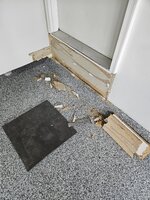
Lol. Yeah, that'll workFor the backing board on the wall and under the threshold, I'm using a pressure treated 2x8.......
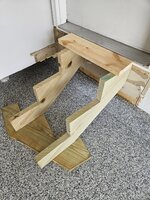
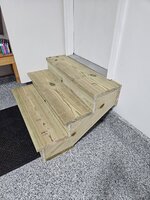
Under the stringers on the ground, I'm using a pressure treated 2x12 with Liquid Nails and I will use some TapCon screws into the concrete to secure the structure