To avoid these ads, REGISTER NOW!

Garage support pillar recommendations

dirtyboots

Active member
Joined
Jan 29, 2015
Messages
26
Location
Sonoma County, CA
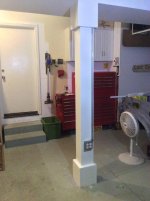
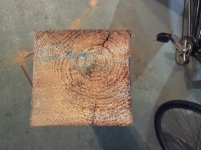
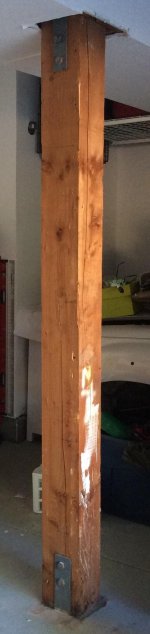
The attached pictures show a pillar / column that supports a second story, across the span of a three car garage. I have heard that the builder used green Doug fir and other construction methods that left our development with a lot of warped floors, joists, and columns. Just a little back ground if it matters to those in the know. This project is taking place just north of San Francisco about an hour.

The column is 1" out of plumb at half height. At some point either the builder or prior owner squared some timber around it to hang drywall. They cut 2x4s at angles to compensate for the warp, so the drywall was square and plumb.

I would like to replace the column with something of a smaller diameter, or leave the column in place if it's unnecessary and would cause potential for other issues by shifting the house that has settled together, if that makes sense. Any suggestions?
 

Attachments

  • image.jpg
    image.jpg
    98.5 KB · Views: 137
To avoid these ads, REGISTER NOW!

wssix99

Well-known member
Joined
Mar 2, 2011
Messages
5,156
Location
Chicago, IL
I would like to replace the column with something of a smaller diameter, or leave the column in place if it's unnecessary and would cause potential for other issues by shifting the house that has settled together, if that makes sense. Any suggestions?

You can replace the column with something smaller, but it's going to be messy and expensive. A 4" steel column would take the load, but you'll need an engineer to design the new connection, jack the house up and temporarily support it, jack hammer out the post foundation, re-pour the foundation for the new column and attaching hardware, and then beg for your spouse's forgiveness (for a very long time) for the mess.

Does the post worry you in some way or do you just want a smaller one?
 

David C

Well-known member
Joined
Mar 10, 2014
Messages
157
Location
Northern California
When a column is out of plumb there additional bending as well as compression forces that are imposed on the column. Eccentric loading can lead to instability and column failure. Imagine a column at a 30 deg angle; you can see that the entire system would want to translate sideways.

What probably happened is the framers made an error and the point of attachment of the column top was not directly over the center of the pad footing. Or vice versa, the concrete contractor misplaced the concrete pad. Or then again it could have been a design error.

It would not be too hard to replace this column with a smaller tube steel section. What you would need to provide your engineer is information on what is loading the column and the size of the pad footing below the column. He could also include the eccentric loading of the column in his column calculations.

The construction costs would likely not be in the $100 of dollars.

It is typical throughout California to use green structural lumber in residential and light commercial construction framing. KD costs more, is not required by CBC (California Building Codes), except schools and hospitals, and generally green lumber does not present any problems.
 
OP
D

dirtyboots

Active member
Joined
Jan 29, 2015
Messages
26
Location
Sonoma County, CA
Does the post worry you in some way or do you just want a smaller one?[/QUOTE]

The post does concern me so I am considering replacement options. It's great to know your thoughts on what steps it would take to put in a smaller beam, much appreciated...Kinda like all of the column elimination threads, it just doesn't seem worth it for the amount gained.

When a column is out of plumb there additional bending as well as compression forces that are imposed on the column. Eccentric loading can lead to instability and column failure. Imagine a column at a 30 deg angle; you can see that the entire system would want to translate sideways.

What probably happened is the framers made an error and the point of attachment of the column top was not directly over the center of the pad footing. Or vice versa, the concrete contractor misplaced the concrete pad. Or then again it could have been a design error.

It would not be too hard to replace this column with a smaller tube steel section. What you would need to provide your engineer is information on what is loading the column and the size of the pad footing below the column. He could also include the eccentric loading of the column in his column calculations.

The construction costs would likely not be in the $100 of dollars.

It is typical throughout California to use green structural lumber in residential and light commercial construction framing. KD costs more, is not required by CBC (California Building Codes), except schools and hospitals, and generally green lumber does not present any problems.

Know anyone in the area that could pull this off in the hundreds? Thank you for the specific information, very informative.

Easy / cheapest remedy jack the column, replace the curved 8x8 and move the top mount to plumb so I don't have to fool with the footer?
 

wssix99

Well-known member
Joined
Mar 2, 2011
Messages
5,156
Location
Chicago, IL
I'd say your biggest issues are that you are in a seismic zone and that changing the column type means changing the connections/footer.

The design guidelines for wood assume that these members will shrink, bend, warp, etc. over time. Even though your 8X8 is out of plumb, there is a 7X7 (at least - probably larger if you want to do the trigonometry/geometry) area of material within it that is plumb to the gravity load and perfectly capable of holding up the load.

If it worries you, having an engineer bless what you have may be less effort/expense than a replacement.

If you are sagging up above, you might be better off shimming the top of the post, etc. It would be really difficult to get a new one in there and get it just perfect. A new post would probably need to be shimmed anyway.
 

David C

Well-known member
Joined
Mar 10, 2014
Messages
157
Location
Northern California
You could call around and see if you can find a civil engineer just starting out, he might take on your project. SE's probably not. The problem with a cheap solution is the designer might miss something important.

I did this kind of work when I started out. I made about $5 to maybe even as much as $10/hr. And at that there were a lot of complaints about charging too much. I had to give up residential construction and homeowners.

If I were doing the job I would review the existing plans. Take a long look at what is happening above the column top; is the structure shifting, is the column tied into the structure, etc. You would be surprised what passes for acceptable in construction. Your repair might get more expensive if there are other construction errors that require repair.

I would want to verify the actual location, and design of the pad footing below. Is it adequately reinforced and it is concentric with the column.

As for construction costs, replacing the wood with another post would not cost very much, but if you want a TS (tube steel) section the fabricator would need to weld on a base plate, and a top plate. The base plate would need to be secured to the concrete footing with post installed anchors; drill new holes and use chemical or expansion anchors. The new top plate would need to be attached to structure. You can estimate construction costs from this info.

Wood columns and posts are rarely if every used to resist seismic lateral forces and it almost certain that this column is not part of the lateral force resisting system of your house. Your location, or seismic design criteria, would not affect the column design or attachment. The CBC, and most codes, require that the column attachment design be cable of resisting a lateral force equal to a percentage of the axial load on the column. This is not a seismic load but simply to ensure a major support column is attached to structure. You can imagine what would happen to your building if the col wasn't well secured and your car bumped into it.

I hope that helps and good luck with whatever you chose to do.
 
To avoid these ads, REGISTER NOW!
OP
D

dirtyboots

Active member
Joined
Jan 29, 2015
Messages
26
Location
Sonoma County, CA
If you are sagging up above, you might be better off shimming the top of the post, etc. It would be really difficult to get a new one in there and get it just perfect. A new post would probably need to be shimmed anyway.

wssix99,Thank you for your input, it's great to get your knowledge, and hopefully will continue to help out anyone else searching this topic! That's some excellent points to consider...I wondered if it was in specifications even thought crooked, as you mention the actual support area may be big enough. I will have to do some figuring...If anyone has a link to get the acceptable specs for a column please chime in.


David C, you've nailed it, SEs in the area were very polite in letting me know this home repair wasn't on their planet. Which makes sense, I can imagine how frustrating it would be to work on a small job that isn't very profitable only to get critiqued for overcharging. I have some family in engineering (EE) and the education is no joke. The service should not be cheap.

I found kiln dried (don't want to run green, want to paint it will be exposed, also for the LF cost difference [$2 LF more for kiln] kiln seems like a better option) for $145 for a 10' section that the yard will cut to spec. The idea was to rent two jacks for either side of the support, remove the old column, slide the upper mount over to plumb on the new column, mark the holes, drill the holes on a DP, line everything up, insert the gigantic bolts, and tighten everything up. Worse case scenario, I destroy my house and vehicles. No biggie.
 

wssix99

Well-known member
Joined
Mar 2, 2011
Messages
5,156
Location
Chicago, IL
A junior engineer might also be overly conservative....

You might see if a local library has a copy of this book for you: http://ca.wiley.com/WileyCDA/WileyTitle/productCd-0471931519.html

^ This will probably give you the best opinion as to how far out of plumb is too far. (BTW - Too far may not mean it's unsafe, but this is probably a good reference as to what workmanship is out of bounds.)

If you are going to replace the post and leave it exposed, maybe you could get an old barn timber, or something like that? (These days, God doesn't make wood like he used to...) An old barn timber will probably be stronger than any KD piece you can get off the shelf and you can also be sure that it won't ever warp on you. It also might look really cool if you aren't going to finish over it.
 
OP
D

dirtyboots

Active member
Joined
Jan 29, 2015
Messages
26
Location
Sonoma County, CA
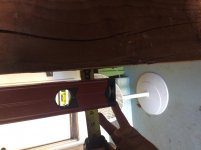
Very nice reference...It looks like 1/2" although section 6-6 states that there is no standard, just a culmination of various manuals. This column is almost an inch out of plumb, so, it looks like I should probably replace it. It would be super cool to find some old timber and do something creative. Is jacking it up and sliding a replacement in there a "watch this moment" or does it seem as simple as I think it sounds[1]

[1]The OP is not fishing for someone to blame in the event of catastrophic failure. After watching a "this Old House" segment where the host jacks up a two car garage with a base and support 2x6 wedge in hammer set up, it kinda makes me think it's possible.
 

Attachments

  • Untitled.jpg
    Untitled.jpg
    53.4 KB · Views: 11

wssix99

Well-known member
Joined
Mar 2, 2011
Messages
5,156
Location
Chicago, IL
I think that passage is about thickness of the lumber after its milled. (Back to my comment about there being allowances for a lot of variability around the core material that you need for the structure.)

Google books doesn't have the whole thing online, or the part that you really need. If you get one from the library, I'd expect that you'll find another section in there about guidelines for plumb of wood columns/posts. (Google Books has this for concrete, but doesn't have the full table of contents - so I'd hope they would have the same passages for other materials.)


You can probably find a youtube video of someone jacking a beam and replacing a column on Youtube, like This Old House. It's pretty straight forward and you can get special beam jacks (sometimes called basement jacks) to do the job. Depending on how your beam is constructed, you may need two of them - one on either side. You'll probably also want to put them on some plywood/blocks to distribute out the load on your floor.
 
OP
D

dirtyboots

Active member
Joined
Jan 29, 2015
Messages
26
Location
Sonoma County, CA
For anyone that may search this thread in the future here's what I did:

picked up a kiln dried center cut dug fir

jacked up each side of overhead horizontal support beam with bottle jacks and 2x6s

raised up horizontal support beam just enough to get old post out

slid new post in top bracket

slid top bracket over along the overhead beam to get new post plum

lowered beam on new post

drilled holes in new post using pre existing footer support and beam support bracket holes as template

sealed with primer then top coat

surrounded footer bracket and top bracket (and bolt heads and nuts) with a 2x12, routed out the inside to cover over the hardware, silicone on the joints

finally stepped back and looked at the cracks in the old column

(edit: post and column are describing the same item throughout thread thx ez for the extra set of eyes)
 

Attachments

  • IMG_0566.jpg
    IMG_0566.jpg
    143.4 KB · Views: 31
  • IMG_0564.jpg
    IMG_0564.jpg
    145.7 KB · Views: 30
Last edited:
To avoid these ads, REGISTER NOW!
Top Bottom