Maybe he just made all that up!?
Yes and no. Concentric pipes are quite common, think heat exchanger. I have not implemented this yet. My slab was poured long ago, so I too am trying to determine a suitable method and am open to suggestions.
In my case my garage side wall is straight out from the main house. No jogs in the wall, windows, or doors in the way. Also double stud 2x4 wall for 7" of stud.
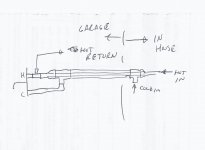
See attached crude sketch.
Hot water runs straight thru to the fixture at the end (hot and cold frost free hose bib) and then tee returns to my kitchen sink. Each time the kitchen faucet is run, or when the dishwasher is run (every night), hot water flows to the fixture and then returns to the kitchen. A timed circ pump could be put in place as well during the cold months.
Reducers and tees allow cold water to run between the annulus formed by the concentric pipes. The cold water inlet tee will be within the thermal envelope of the house. The cold water exit tee will be right at the fixture. Insulation will cover all of the pipes.
Use of the kitchen sink hot or the dishwasher will cause the stagnant cold water to get hot. Yes when cold only is used, I will get a slug of hot/warm water.
I am thinking that the faucet might be the high point. This might allow the stagnant cold to thermosyphon, keeping the higher temperatures at the fixture which will be of the frost free type. Given the double stud nature of my walls, the piping will be held tight to the inside with the wall insulation of the back side.
The hot inlet and outlets could be reversed from the sketch to make it counter flow and increase the performance by increasing the delta-T.
This past winter, my attached garage, with no insulation or heat, only hit a low of 30F and the laundry tub in the garage did not freeze.
I think this scheme may work for me. Open to suggestions.