To avoid these ads, REGISTER NOW!

Garage water lines issue

C2 Turbo

Well-known member
Joined
Mar 18, 2014
Messages
392
Location
Out skirts of Louisville, KY
Hey guys, the third bay (closer to the window) is a dedicated car wash bay but today, the plumber said he can't put the water bib there as the water lines will freeze if he was to put them in the outside wall.

Half of the left side wall is an outside wall too so he ended up putting the hot/cold water lines in the middle of the left wall, right where the center bay is.

I will take better pictures tomorrow.
 

Attachments

  • Garage 1.jpg
    Garage 1.jpg
    46.7 KB · Views: 218
Last edited:
To avoid these ads, REGISTER NOW!

SALIV8

Well-known member
Joined
Dec 11, 2008
Messages
2,114
Location
chicago and s/w michigan
Not sure what you're asking but if it gets below freezing temps in Louisville ky then they might freeze without much use, on the outside wall. I would at least insulate them, maybe heat tape, and possibly think of adding a return and a pump to keep flow when needed. Or plumb to drain the lines.

I'm dealing with a frozen and cracked main supply from this past winter and don't wanna deal with it ever again.
 
OP
C

C2 Turbo

Well-known member
Joined
Mar 18, 2014
Messages
392
Location
Out skirts of Louisville, KY
Yes there is... LOL

How do I get the lines over to the other side of the garage with out risking them to freeze in the winter months as they would be in the outside walls?

The Plumber didn't show any interest in giving any ideas as to how I can get a commercial style car wash where the it swivel around the car?

So can I insulate the lines?

Any other ideas?
 

sixty4

Well-known member
Joined
Dec 1, 2007
Messages
1,424
Location
CT
Pitch the water line and have the shut off in an area that will not freeze. You could also add a tap right after the valve and blow it out when your worried about low temps. Is this garage going to be heated in any location?
 
Last edited:
OP
C

C2 Turbo

Well-known member
Joined
Mar 18, 2014
Messages
392
Location
Out skirts of Louisville, KY
The garage walls/doors will be insulated and I do plan on installing a heater (propane with a progammable thermostat) where the temp will stay around 45* in the winters.
 

Leaflessshadetree

Well-known member
Joined
Aug 1, 2013
Messages
7,175
Location
Don't ask.
Probably too late to run it underground. If you had done that you could have installed an outdoor style hydrant where the actual valve is underground. I have one in my unheated shed.
 

kbs2244

Well-known member
Joined
Nov 11, 2006
Messages
14,065
Two options:
First, just run the pipes exposed on the inside of the wall.
If you are keeping the gagrage at 45 that is what the pipes will be exposed to.
Second, if the above scares you or you do not want the look of exposed pipes, put shut off valves in a box in the inside wall before the pipes to the wash bay. Slant those pipes at least 10 degrees so you can turn off the water at a warm spot and open the bibs in the wash bay so the pipes drain.
 

larry4406

Well-known member
Joined
Jan 27, 2006
Messages
19,543
Location
Northern Virginia
Timely post as I am planning the same thing.

I am planning on using a hot and cold outdoor spigot. I am thinking on running 1/2" copper pipe inside a 3/4" pipe. Hot in the center with cold in the annulus. Tee at the fixture and tee inside. The hot will return to the house and feed the kitchen sink. All will be insulated. Normal use of the kitchen sink and dishwasher will heat the stagnant cold in the annulus keeping it from freezing. Garage will be insulated and heated and kept at 45F min in winter.
 
Last edited:

Leaflessshadetree

Well-known member
Joined
Aug 1, 2013
Messages
7,175
Location
Don't ask.
Timely post as I am planning the same thing.

I am planning on using a hot and cold outdoor spigot. I am thinking on running 1/2" copper pipe inside a 3/4" pipe. Hot in the center with cold in the annulus. Tee at the fixture and tee inside. The hot will return to the house and feed the kitchen sink. All will be insulated. Normal use of the kitchen sink and dishwasher will heat the stagnant cold in the annulus keeping it from freezing. Garage will be insulated and heated and kept at 45F min in winter.

Do they make fittings for doing that?
 
To avoid these ads, REGISTER NOW!

ford33

Well-known member
Joined
Feb 26, 2011
Messages
2,118
Location
Chicago, IL. USA
Here is a link to the cause and prevention for frozen pipes. Written by the "Insurance Institute for business and home safety" and the University of Illinois.

You might be surprised to learn:

It states pipes break not from frozen water expanding and cracking the pipes, but because downstream of the frozen water blockage, pressure builds to extreme levels and this pressure cracks the pipe between the frozen water blockage and typically a faucet. Opening a faucet very slightly relieves this pressure.

Researches discovered that homeowners should be concerned when outside temperatures reach 20 degrees and not 32 degrees. Best solution, insulate pipes with 1 - 2 inches of pipe foam insulation and keep cold air from blowing on the pipe.

http://www.disastersafety.org/wp-content/uploads/Freezing-Bursting-Pipes_IBHS.pdf
 

premierplayer

Well-known member
Joined
Jan 30, 2010
Messages
869
Location
Maryland, USA
I love a challange.
1/2" & 1" would be much more manageable

1/2 x 1 x 1 ccc tee
file the shoulder stop out of the 1/2" end of the tee, pass the 1/2 pipe through, solder or sillfoss
terminate with same method

I don't see how 90's and 45's are doable, but you could use soft tubing and large radius if ample space available.
 

6768rogues

Banned
Joined
Nov 28, 2007
Messages
4,524
Location
Western NY
If the water is not moving, insulation will not work. There is no constant source of heat, so the insulation will get cold and the pipe will freeze.
The inner/outer pipe method might work to avoid freezing if the water is kept moving, but at the end there will be neither hot nor cold water, only tempered water from both pipes.
Heat all areas where the pipes run or as a last resort use heat tape.
 

premierplayer

Well-known member
Joined
Jan 30, 2010
Messages
869
Location
Maryland, USA
you know, with recirc pump running and no cold water usage for a hour or two you'de pretty much have two hot water taps

I never said this would work ;-)
I just figured out how to get a pipe in a pipe, lol
 

CNGsaves

Well-known member
Joined
Sep 26, 2012
Messages
13,233
Location
KS and OK
IF . . . repeat IF . . . garage is close to house and OP has tankless WH, then just bury direct lines (BOTH cold and hot) between the house and garage.

Outside garage, install separate freeze-proof shutoffs that are down in ground below frost line. Have Y connector above ground so water can be used outside garage, or outside Y shut off and water continues up into garage. Build in T's in both lines so plug can be removed and compressed air used to blow out all above ground lines (including all of garage) to prevent freezing in worst of winter conditions. With mild climate in KY, the OP likely would have both hot/cold water most of the year !!

This would give OP flexibility of washing vehicles with hot/cold water both outside garage and inside garage.

* * * * * * *
Alternative if OP only running cold water line from house to garage (ie long distance AND WH is in garage), then consider building "warm space/well house" where any water pipes/heater might be located. Insulate that space and have heating source to keep from freezing. New freeze-proof dual faucet (cold/hot) can be used inside garage (through wall of "well house" space) so that entire garage could go cold and water pipes would still be protected.
 

larry4406

Well-known member
Joined
Jan 27, 2006
Messages
19,543
Location
Northern Virginia
Maybe he just made all that up!?

Yes and no. Concentric pipes are quite common, think heat exchanger. I have not implemented this yet. My slab was poured long ago, so I too am trying to determine a suitable method and am open to suggestions.

In my case my garage side wall is straight out from the main house. No jogs in the wall, windows, or doors in the way. Also double stud 2x4 wall for 7" of stud.

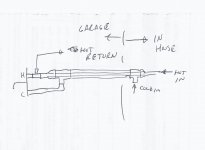
See attached crude sketch.

Hot water runs straight thru to the fixture at the end (hot and cold frost free hose bib) and then tee returns to my kitchen sink. Each time the kitchen faucet is run, or when the dishwasher is run (every night), hot water flows to the fixture and then returns to the kitchen. A timed circ pump could be put in place as well during the cold months.

Reducers and tees allow cold water to run between the annulus formed by the concentric pipes. The cold water inlet tee will be within the thermal envelope of the house. The cold water exit tee will be right at the fixture. Insulation will cover all of the pipes.

Use of the kitchen sink hot or the dishwasher will cause the stagnant cold water to get hot. Yes when cold only is used, I will get a slug of hot/warm water.

I am thinking that the faucet might be the high point. This might allow the stagnant cold to thermosyphon, keeping the higher temperatures at the fixture which will be of the frost free type. Given the double stud nature of my walls, the piping will be held tight to the inside with the wall insulation of the back side.

The hot inlet and outlets could be reversed from the sketch to make it counter flow and increase the performance by increasing the delta-T.

This past winter, my attached garage, with no insulation or heat, only hit a low of 30F and the laundry tub in the garage did not freeze.

I think this scheme may work for me. Open to suggestions.
 

Attachments

  • Concept Sketch.jpg
    Concept Sketch.jpg
    125 KB · Views: 22
OP
C

C2 Turbo

Well-known member
Joined
Mar 18, 2014
Messages
392
Location
Out skirts of Louisville, KY
Pitch the water line and have the shut off in an area that will not freeze. You could also add a tap right after the valve and blow it out when your worried about low temps. Is this garage going to be heated in any location?

Anyway, this is what ^ I talked to my GC today and we both think, is an easier and doable way of keeping them from freezing.

Insulated, yes... heated, well on demand.
 

sublimate

Well-known member
Joined
Aug 4, 2010
Messages
776
Location
Colorado
Yes and no. Concentric pipes are quite common, think heat exchanger. I have not implemented this yet. My slab was poured long ago, so I too am trying to determine a suitable method and am open to suggestions.

Concentric pipes like that would be silly. You could get exactly the same effect by running the cold and hot lines so they're touching each other and wrapping insulation around the bundle.

But I think you'll find that an unpleasant way to keep your pipes from freezing. Your kitchen hot water will be cold for a long time after you first turn it on and then will only slowly heat up to lukewarm.

And what happens when you go out of town?
 

frankthezapper

Well-known member
Joined
Apr 22, 2014
Messages
99
Location
Brunswick Heads, NSW, Australia
Here in sunny Australia we get winter nights down to about 10c (50f) sometimes, so my thoughts are a bit theoretical. Are you planning to use copper or PEX pipe? PEX is much more tolerant of freezing temperatures, and an absolute doddle to install (not to mention cheaper). You could install 2 ball valves with handles linked at your supply with a Tee between, one line going to your wash area and one to a breather. The link on the handles would open the supply to the wash area and close the breather at the same time; water would flow to the wash area. When the supply was closed the breather would open, allowing air to enter and drain the line to the wash area (which an earlier post suggested be angled down). (And you would need to open the bib at the wash area). To ensure a decent fall with no sag you could run the PEX on top of a wooden batten. And to ensure you didn't get a spray from the breather it would need to be long and vented outside.
 

callcoy

Active member
Joined
Nov 14, 2010
Messages
44
Location
Nashville
Check into using PEX flexible plastic water lines some guys say they don't freeze, but I don't know that personally. They could be insulated also for further protection, Very popular here in Tennessee, all new homes use this material, I am using it in my remodel. Google it for more info!
 

kbs2244

Well-known member
Joined
Nov 11, 2006
Messages
14,065
Wow!
Talk about over engineering!

What is wrong with the common, through the wall, hose bibs?
A hot and a cold bib and a “Y” garden hose connecting them?
 

ctfjr

Well-known member
Joined
Oct 30, 2011
Messages
167
Location
Basketball Capitol of the World
I agree this sounds like a lot of overengineering for a simple problem.

It seems to me that what I do here for my sillcocks would work - I pipe my compressor line to the sillcock line through a ball valve and a spring loaded check valve. In the fall I simply open the sillcocks around the house & then blow them out. After all, how often are you doing car washes in sub freezing temps?
 

larry4406

Well-known member
Joined
Jan 27, 2006
Messages
19,543
Location
Northern Virginia
Wow!
Talk about over engineering!

What is wrong with the common, through the wall, hose bibs?
A hot and a cold bib and a “Y” garden hose connecting them?

Nothing.

The problem is sometimes others (prior owners or poor contractors) make sh#%ty decisions and pave the place over or put patios in, and in my case I don't want hoses running 35' to my driveway to wash cars or the dog. I want a point of use tap and one that works year round without draining after each use and one that does not look like a#s via surface mounting on walls in the garage.
 
To avoid these ads, REGISTER NOW!
Top Bottom