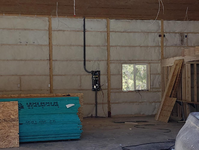
In my shop I put the road side windows high. The view side were at 50 or 52. Outlets, hmm not knowing what a firm lay-out was I put them hi/lo every 4’ or so. 50A outlet by every door so I could move the welder where needed. The floor shown here is a product I picked up off the floor forum here. It is a paint product,Rust Bullet, and applied easily and has held up well. 12 yrs so far. It was worth doing as it made it easier to clean the slab.


You are using an out of date browser. It may not display this or other websites correctly.
You should upgrade or use an alternative browser.
You should upgrade or use an alternative browser.
Garage window installation height
- Thread starter plcguru
- Start date

dcg9381
Well-known member
Note, if you're not heating or cooling, you can use translucent R panel to allow sunlight in. In my area, you don't want to do this on the roof because hail will eventually blast right through it. You do it on the upper part of the vertical wall. Way cheaper than windows.
I don't really care for windows in a shop. I didn't build my shop and the guy that did put in three 30"x48" high windows, plus a couple other smaller ones. The 30x48" windows hat the seal fail and the clouded over. I didn't like them any way I tore them out and closed up the holes. I special ordered one awning window and put in in the one hole and all the way up. I have three windows left in the shop and they are all six feet to the bottom.IMO, they are simply a security risk and temptation for snoopy people.
Craig Balzer
Well-known member
My windows are about 4' tall and are 44" off the floor (measured from floor to bottom of window)
My outlets are 55" from the floor to the screw that secures the plate to the wall
Since you are in the planning stages, maybe these notes I compiled during/after my build will be useful. My shop was built to work on cars. My 2,300 sq ft Hobby Shop is complete and I am working in it daily and still populating it with stuff.
What stuff? How is it all gonna fit? Where’s it gonna go. What goes next to what? See below (sorry -- my OCD kicked in and I got pretty detailed):
GENERAL
• Build as big as you can afford/fit on your property (or you'll regret it).
• You gotta know your plan inside and out – when the builder asks to move something elsewhere, only you can visualize the impact on other things / stuff
• Be flexible when reality shows up – also be true to your overall plan
• Windows? PRO: natural light – CON: entry point for a$$holes
• Skylight(s)? PRO: natural light – CON: then no attic
• Keep the building dimensions in multiples of 4 feet – reduces wastage of wood
• A mezzanine is good for long-time storage of large or awkward items; plan for where the staircase is gonna be placed; plan how to get heavy items up there and back down
FLOOR
• Gonna place light(s) in floor under lift??
• First thing you lay down is 10 mil vapor barrier
• Then closed-cell insulation – 2 inches thick
• In-floor tubing for radiant goes in before concrete pour – plan carefully if a lift is planned. Should be thicker concrete and limit pex tubing near posts
• Lay some plastic conduit in the floor before concrete is poured from the circuit box to the three other walls to allow future wiring to be run without tearing into walls or mounting conduit on the walls
o Since I forgot to do this, I installed a 2-3" PVC pipe in the upper left-hand corner of the circuit breaker box that terminates in the attic with another sweeping 90° curve. This easily allows fishing a new line (or two) into the circuit box. (See photo) The girts needed to be notched so the OSB would lay flat and metal straps were used to hold the pipe in place.
• Thickness? 4” works. Except under lift – my pour was 9-12 inches thick under posts.
• Plan now for smoothness of finish on concrete - - epoxy covering?
• Gonna wash cars in there – floor drain(s)? Lot’s of environmental issues to learn
WALLS
• 2x4 vs 2x6 construction. A 2x6 is pennies more per board and allows thicker insulation
• I have R19 in my walls (Colorado) and the building is noticeably cooler in summer and stays warm in winter even during sub-freezing temps
• I have R49 blown-in above the ceiling
• Sheath with OSB vs Dry Wall. Dry wall looks prettier but to hang anything heavy requires finding a stud or two. OSB has more industrial appearance (and can be a ***** to paint – think “sponge”) but a shelf goes wherever you want to put it
• Windows – already covered
• Height of walls? 12 or 13’ allows most lifts to fit (I have 14’ ceilings in main room)
• Tall walls require more heating capacity, and costs more to heat
ELECTRICAL
• Plan where your 110v outlets are gonna be, then add 50% more of them (mine are 4 feet apart except where a window gets in the way); I have 45x 120V outlets in my 2300 sq ft hobby shop
• Are you gonna use 15- or 20-Amp circuits? (different wiring requirements and different fixtures)
• Place them 45-48” above the floor level so they aren’t hidden later by benches, toolboxes, etc
• Plan for outlet(s) on the exterior of each wall
• Plan for outlet(s) in ceiling for lift or drop light or other
• Plan for outlet(s) in ceiling for garage door opener
• Plan for outlets up high on wall: wall clock, TV, modern “smart” speakers, other
• Lights – fluorescent or LED? Dimmable? Dimmable LEDs are available but require different wiring and dimming switch
• Plan for exterior lights – Colorado Code requires a light above each man-door opening
• Plan for exterior lights – gonna have a patio nearby or BarBQ pit or horseshoe pit or Christmas lights?
• Plan for dedicated circuit for heater
• Plan for dedicated circuit for water heater
• Now plan where circuits are gonna start. Each can handle 8-10 outlets and need to start with a GFIC outlet
• Plan where your 220v outlets are gonna be. Consider welders, air compressor, lift, oven (powder coating), special tools, etc. Even if you won’t have these until the future, plan now to power them.
WATER
• Gonna have water in the garage? A sink to wash up before going into the house is priceless
• Gonna have water in the garage? A sink to wash parts is useful
• A shower is priceless to avoid getting SWMBO’s towels and linens filthy
• Toilet?
• Hot water is nice to wash cars in the winter
• Plan a hose bibb on at least one exterior wall and maybe one inside
A/C
HEAT
• Gonna use in-floor PEX? -- see notes on concrete.
• If not, propane or electric heater will need power and proper placement and capacity
• See comments re height of walls
STUFF
What toys do you have? What toys do you plan to have? Sketch your floor plan to scale on gridded paper; don’t forget to include windows, doors, and the circuit box. And then, to scale, place your toys. All of them. The easy ones are toolbox(es), benches, welders, air compressor, and the like. Did you remember to ID a place to store floor jacks? Creeper? Jack stands? Ladder(s)? Computer desk?
Find a place for place everything:
o Welder
o Plasma Cutter
o Grinder
o Polisher / Buffer
o Powder Coating Oven
o Blast Cabinet
o Parts Washer
o Microwave
o Refrigerator
o Charging station for cordless tools
o Desk lamp
o TV
o Stereo
o Computer
o Phone
o Wall Art / Neon signs
o Other
Expanded details:
STORAGE
• Plan cabinet(s) to store hardware (nuts, bolts, washers, this and that)
• Plan cabinet(s) to store supplies, such as (paint, cleaners, paper towels, etc)
FLUIDS for the car
• Oil
• Oil Filters
• Fuel Filter(s)
• Gear Lube
• Differential Lube/Additive
• ATF
• Brake fluid
• Anti-Freeze
• Power Steering Fluid
• Marvel Mystery Oil
• Starting Fluid
• Lacquer Thinner
• Grease for ball joints/tie rod ends etc
CLEANING yourself
• Hand Cleaner
• Latex (or Nitrile) Gloves
• Shop Towels
CLEANERS for the Car/Engine/Garage/Floor
• Castrol Concentrated Cleaner
• Engine Cleaner
• Brake Cleaner
• Carb Cleaner
• Rust Remover
• Brushable Rustoleum
• Degreaser
• Acetone
• Mineral Spirits
Beauty Products
• Polish
• Wax
• Touch-up paint
• Chrome Cleaner
• Chrome Kleener (Autosol)
WORKING on the Car
• Di-electric grease
• Bearing Grease
• 3-1 oil
• Silicon Spray
• Anti-seize compound
• Loctite
• Teflon tape
• Acousti-Seal, Exhaust System Sealing Compound
• Wellseal Gasket Compound / Gasket sealer
• Wire of various colors and sizes
• Electrical Connectors
• Masking Tape
• Duct Tape
• Electric Tape
• Contact Cement
• 3M Weather-strip Adhesive
• General Purpose Adhesive Solvent Part #: 051135-08984
• 3M Adhesive Remover (Ronson lighter fluid)
• PB Blaster or Kroil -or Knock’er Loose
• Wire ties
• Mechanic's wire
• Cotter pins
• C-clips
• E-clips
• Snap rings
• Hose clamps
• Roloc pads/grinding discs
• Die-grinder burrs/bits
• Buffing wheels/compound
• Razor blades
• Utility knife blades
• Sandpaper
• Emory cloth
• Scotch-brite
• Grease fittings
• Fuel line/brake line and fittings
• Rubber hose: windshield washer, heater, radiator, fuel, vacuum
• Spray paint
• JB Weld
THE MOST IMPORTANT POINT: TAKE TONS OF PHOTOS.
Just like when you disassemble a car or major component, referring to a before photo is priceless during reassembly. I have been able to show my GC photos of the routing of power lines or placement of studs or whatever on at least 5 occasions. Saved guess work by him and potential oop's during drilling or nailing.
You may pick up other tips/hints from this short video of my shop (I build a power point presentation and then videoed it):
My outlets are 55" from the floor to the screw that secures the plate to the wall
Since you are in the planning stages, maybe these notes I compiled during/after my build will be useful. My shop was built to work on cars. My 2,300 sq ft Hobby Shop is complete and I am working in it daily and still populating it with stuff.
What stuff? How is it all gonna fit? Where’s it gonna go. What goes next to what? See below (sorry -- my OCD kicked in and I got pretty detailed):
GENERAL
• Build as big as you can afford/fit on your property (or you'll regret it).
• You gotta know your plan inside and out – when the builder asks to move something elsewhere, only you can visualize the impact on other things / stuff
• Be flexible when reality shows up – also be true to your overall plan
• Windows? PRO: natural light – CON: entry point for a$$holes
• Skylight(s)? PRO: natural light – CON: then no attic
• Keep the building dimensions in multiples of 4 feet – reduces wastage of wood
• A mezzanine is good for long-time storage of large or awkward items; plan for where the staircase is gonna be placed; plan how to get heavy items up there and back down
FLOOR
• Gonna place light(s) in floor under lift??
• First thing you lay down is 10 mil vapor barrier
• Then closed-cell insulation – 2 inches thick
• In-floor tubing for radiant goes in before concrete pour – plan carefully if a lift is planned. Should be thicker concrete and limit pex tubing near posts
• Lay some plastic conduit in the floor before concrete is poured from the circuit box to the three other walls to allow future wiring to be run without tearing into walls or mounting conduit on the walls
o Since I forgot to do this, I installed a 2-3" PVC pipe in the upper left-hand corner of the circuit breaker box that terminates in the attic with another sweeping 90° curve. This easily allows fishing a new line (or two) into the circuit box. (See photo) The girts needed to be notched so the OSB would lay flat and metal straps were used to hold the pipe in place.
• Thickness? 4” works. Except under lift – my pour was 9-12 inches thick under posts.
• Plan now for smoothness of finish on concrete - - epoxy covering?
• Gonna wash cars in there – floor drain(s)? Lot’s of environmental issues to learn
WALLS
• 2x4 vs 2x6 construction. A 2x6 is pennies more per board and allows thicker insulation
• I have R19 in my walls (Colorado) and the building is noticeably cooler in summer and stays warm in winter even during sub-freezing temps
• I have R49 blown-in above the ceiling
• Sheath with OSB vs Dry Wall. Dry wall looks prettier but to hang anything heavy requires finding a stud or two. OSB has more industrial appearance (and can be a ***** to paint – think “sponge”) but a shelf goes wherever you want to put it
• Windows – already covered
• Height of walls? 12 or 13’ allows most lifts to fit (I have 14’ ceilings in main room)
• Tall walls require more heating capacity, and costs more to heat
ELECTRICAL
• Plan where your 110v outlets are gonna be, then add 50% more of them (mine are 4 feet apart except where a window gets in the way); I have 45x 120V outlets in my 2300 sq ft hobby shop
• Are you gonna use 15- or 20-Amp circuits? (different wiring requirements and different fixtures)
• Place them 45-48” above the floor level so they aren’t hidden later by benches, toolboxes, etc
• Plan for outlet(s) on the exterior of each wall
• Plan for outlet(s) in ceiling for lift or drop light or other
• Plan for outlet(s) in ceiling for garage door opener
• Plan for outlets up high on wall: wall clock, TV, modern “smart” speakers, other
• Lights – fluorescent or LED? Dimmable? Dimmable LEDs are available but require different wiring and dimming switch
• Plan for exterior lights – Colorado Code requires a light above each man-door opening
• Plan for exterior lights – gonna have a patio nearby or BarBQ pit or horseshoe pit or Christmas lights?
• Plan for dedicated circuit for heater
• Plan for dedicated circuit for water heater
• Now plan where circuits are gonna start. Each can handle 8-10 outlets and need to start with a GFIC outlet
• Plan where your 220v outlets are gonna be. Consider welders, air compressor, lift, oven (powder coating), special tools, etc. Even if you won’t have these until the future, plan now to power them.
WATER
• Gonna have water in the garage? A sink to wash up before going into the house is priceless
• Gonna have water in the garage? A sink to wash parts is useful
• A shower is priceless to avoid getting SWMBO’s towels and linens filthy
• Toilet?
• Hot water is nice to wash cars in the winter
• Plan a hose bibb on at least one exterior wall and maybe one inside
A/C
HEAT
• Gonna use in-floor PEX? -- see notes on concrete.
• If not, propane or electric heater will need power and proper placement and capacity
• See comments re height of walls
STUFF
What toys do you have? What toys do you plan to have? Sketch your floor plan to scale on gridded paper; don’t forget to include windows, doors, and the circuit box. And then, to scale, place your toys. All of them. The easy ones are toolbox(es), benches, welders, air compressor, and the like. Did you remember to ID a place to store floor jacks? Creeper? Jack stands? Ladder(s)? Computer desk?
Find a place for place everything:
o Welder
o Plasma Cutter
o Grinder
o Polisher / Buffer
o Powder Coating Oven
o Blast Cabinet
o Parts Washer
o Microwave
o Refrigerator
o Charging station for cordless tools
o Desk lamp
o TV
o Stereo
o Computer
o Phone
o Wall Art / Neon signs
o Other
Expanded details:
STORAGE
• Plan cabinet(s) to store hardware (nuts, bolts, washers, this and that)
• Plan cabinet(s) to store supplies, such as (paint, cleaners, paper towels, etc)
FLUIDS for the car
• Oil
• Oil Filters
• Fuel Filter(s)
• Gear Lube
• Differential Lube/Additive
• ATF
• Brake fluid
• Anti-Freeze
• Power Steering Fluid
• Marvel Mystery Oil
• Starting Fluid
• Lacquer Thinner
• Grease for ball joints/tie rod ends etc
CLEANING yourself
• Hand Cleaner
• Latex (or Nitrile) Gloves
• Shop Towels
CLEANERS for the Car/Engine/Garage/Floor
• Castrol Concentrated Cleaner
• Engine Cleaner
• Brake Cleaner
• Carb Cleaner
• Rust Remover
• Brushable Rustoleum
• Degreaser
• Acetone
• Mineral Spirits
Beauty Products
• Polish
• Wax
• Touch-up paint
• Chrome Cleaner
• Chrome Kleener (Autosol)
WORKING on the Car
• Di-electric grease
• Bearing Grease
• 3-1 oil
• Silicon Spray
• Anti-seize compound
• Loctite
• Teflon tape
• Acousti-Seal, Exhaust System Sealing Compound
• Wellseal Gasket Compound / Gasket sealer
• Wire of various colors and sizes
• Electrical Connectors
• Masking Tape
• Duct Tape
• Electric Tape
• Contact Cement
• 3M Weather-strip Adhesive
• General Purpose Adhesive Solvent Part #: 051135-08984
• 3M Adhesive Remover (Ronson lighter fluid)
• PB Blaster or Kroil -or Knock’er Loose
• Wire ties
• Mechanic's wire
• Cotter pins
• C-clips
• E-clips
• Snap rings
• Hose clamps
• Roloc pads/grinding discs
• Die-grinder burrs/bits
• Buffing wheels/compound
• Razor blades
• Utility knife blades
• Sandpaper
• Emory cloth
• Scotch-brite
• Grease fittings
• Fuel line/brake line and fittings
• Rubber hose: windshield washer, heater, radiator, fuel, vacuum
• Spray paint
• JB Weld
THE MOST IMPORTANT POINT: TAKE TONS OF PHOTOS.
Just like when you disassemble a car or major component, referring to a before photo is priceless during reassembly. I have been able to show my GC photos of the routing of power lines or placement of studs or whatever on at least 5 occasions. Saved guess work by him and potential oop's during drilling or nailing.
You may pick up other tips/hints from this short video of my shop (I build a power point presentation and then videoed it):
mike93lx
ALLIANCE MEMBER
Is this Ai generated?My windows are about 4' tall and are 44" off the floor (measured from floor to bottom of window)
My outlets are 55" from the floor to the screw that secures the plate to the wall
Since you are in the planning stages, maybe these notes I compiled during/after my build will be useful. My shop was built to work on cars. My 2,300 sq ft Hobby Shop is complete and I am working in it daily and still populating it with stuff.
What stuff? How is it all gonna fit? Where’s it gonna go. What goes next to what? See below (sorry -- my OCD kicked in and I got pretty detailed):
GENERAL
• Build as big as you can afford/fit on your property (or you'll regret it).
• You gotta know your plan inside and out – when the builder asks to move something elsewhere, only you can visualize the impact on other things / stuff
• Be flexible when reality shows up – also be true to your overall plan
• Windows? PRO: natural light – CON: entry point for a$$holes
• Skylight(s)? PRO: natural light – CON: then no attic
• Keep the building dimensions in multiples of 4 feet – reduces wastage of wood
• A mezzanine is good for long-time storage of large or awkward items; plan for where the staircase is gonna be placed; plan how to get heavy items up there and back down
FLOOR
• Gonna place light(s) in floor under lift??
• First thing you lay down is 10 mil vapor barrier
• Then closed-cell insulation – 2 inches thick
• In-floor tubing for radiant goes in before concrete pour – plan carefully if a lift is planned. Should be thicker concrete and limit pex tubing near posts
• Lay some plastic conduit in the floor before concrete is poured from the circuit box to the three other walls to allow future wiring to be run without tearing into walls or mounting conduit on the walls
o Since I forgot to do this, I installed a 2-3" PVC pipe in the upper left-hand corner of the circuit breaker box that terminates in the attic with another sweeping 90° curve. This easily allows fishing a new line (or two) into the circuit box. (See photo) The girts needed to be notched so the OSB would lay flat and metal straps were used to hold the pipe in place.
• Thickness? 4” works. Except under lift – my pour was 9-12 inches thick under posts.
• Plan now for smoothness of finish on concrete - - epoxy covering?
• Gonna wash cars in there – floor drain(s)? Lot’s of environmental issues to learn
WALLS
• 2x4 vs 2x6 construction. A 2x6 is pennies more per board and allows thicker insulation
• I have R19 in my walls (Colorado) and the building is noticeably cooler in summer and stays warm in winter even during sub-freezing temps
• I have R49 blown-in above the ceiling
• Sheath with OSB vs Dry Wall. Dry wall looks prettier but to hang anything heavy requires finding a stud or two. OSB has more industrial appearance (and can be a ***** to paint – think “sponge”) but a shelf goes wherever you want to put it
• Windows – already covered
• Height of walls? 12 or 13’ allows most lifts to fit (I have 14’ ceilings in main room)
• Tall walls require more heating capacity, and costs more to heat
ELECTRICAL
• Plan where your 110v outlets are gonna be, then add 50% more of them (mine are 4 feet apart except where a window gets in the way); I have 45x 120V outlets in my 2300 sq ft hobby shop
• Are you gonna use 15- or 20-Amp circuits? (different wiring requirements and different fixtures)
• Place them 45-48” above the floor level so they aren’t hidden later by benches, toolboxes, etc
• Plan for outlet(s) on the exterior of each wall
• Plan for outlet(s) in ceiling for lift or drop light or other
• Plan for outlet(s) in ceiling for garage door opener
• Plan for outlets up high on wall: wall clock, TV, modern “smart” speakers, other
• Lights – fluorescent or LED? Dimmable? Dimmable LEDs are available but require different wiring and dimming switch
• Plan for exterior lights – Colorado Code requires a light above each man-door opening
• Plan for exterior lights – gonna have a patio nearby or BarBQ pit or horseshoe pit or Christmas lights?
• Plan for dedicated circuit for heater
• Plan for dedicated circuit for water heater
• Now plan where circuits are gonna start. Each can handle 8-10 outlets and need to start with a GFIC outlet
• Plan where your 220v outlets are gonna be. Consider welders, air compressor, lift, oven (powder coating), special tools, etc. Even if you won’t have these until the future, plan now to power them.
WATER
• Gonna have water in the garage? A sink to wash up before going into the house is priceless
• Gonna have water in the garage? A sink to wash parts is useful
• A shower is priceless to avoid getting SWMBO’s towels and linens filthy
• Toilet?
• Hot water is nice to wash cars in the winter
• Plan a hose bibb on at least one exterior wall and maybe one inside
A/C
HEAT
• Gonna use in-floor PEX? -- see notes on concrete.
• If not, propane or electric heater will need power and proper placement and capacity
• See comments re height of walls
STUFF
What toys do you have? What toys do you plan to have? Sketch your floor plan to scale on gridded paper; don’t forget to include windows, doors, and the circuit box. And then, to scale, place your toys. All of them. The easy ones are toolbox(es), benches, welders, air compressor, and the like. Did you remember to ID a place to store floor jacks? Creeper? Jack stands? Ladder(s)? Computer desk?
Find a place for place everything:
o Welder
o Plasma Cutter
o Grinder
o Polisher / Buffer
o Powder Coating Oven
o Blast Cabinet
o Parts Washer
o Microwave
o Refrigerator
o Charging station for cordless tools
o Desk lamp
o TV
o Stereo
o Computer
o Phone
o Wall Art / Neon signs
o Other
Expanded details:
STORAGE
• Plan cabinet(s) to store hardware (nuts, bolts, washers, this and that)
• Plan cabinet(s) to store supplies, such as (paint, cleaners, paper towels, etc)
FLUIDS for the car
• Oil
• Oil Filters
• Fuel Filter(s)
• Gear Lube
• Differential Lube/Additive
• ATF
• Brake fluid
• Anti-Freeze
• Power Steering Fluid
• Marvel Mystery Oil
• Starting Fluid
• Lacquer Thinner
• Grease for ball joints/tie rod ends etc
CLEANING yourself
• Hand Cleaner
• Latex (or Nitrile) Gloves
• Shop Towels
CLEANERS for the Car/Engine/Garage/Floor
• Castrol Concentrated Cleaner
• Engine Cleaner
• Brake Cleaner
• Carb Cleaner
• Rust Remover
• Brushable Rustoleum
• Degreaser
• Acetone
• Mineral Spirits
Beauty Products
• Polish
• Wax
• Touch-up paint
• Chrome Cleaner
• Chrome Kleener (Autosol)
WORKING on the Car
• Di-electric grease
• Bearing Grease
• 3-1 oil
• Silicon Spray
• Anti-seize compound
• Loctite
• Teflon tape
• Acousti-Seal, Exhaust System Sealing Compound
• Wellseal Gasket Compound / Gasket sealer
• Wire of various colors and sizes
• Electrical Connectors
• Masking Tape
• Duct Tape
• Electric Tape
• Contact Cement
• 3M Weather-strip Adhesive
• General Purpose Adhesive Solvent Part #: 051135-08984
• 3M Adhesive Remover (Ronson lighter fluid)
• PB Blaster or Kroil -or Knock’er Loose
• Wire ties
• Mechanic's wire
• Cotter pins
• C-clips
• E-clips
• Snap rings
• Hose clamps
• Roloc pads/grinding discs
• Die-grinder burrs/bits
• Buffing wheels/compound
• Razor blades
• Utility knife blades
• Sandpaper
• Emory cloth
• Scotch-brite
• Grease fittings
• Fuel line/brake line and fittings
• Rubber hose: windshield washer, heater, radiator, fuel, vacuum
• Spray paint
• JB Weld
THE MOST IMPORTANT POINT: TAKE TONS OF PHOTOS.
Just like when you disassemble a car or major component, referring to a before photo is priceless during reassembly. I have been able to show my GC photos of the routing of power lines or placement of studs or whatever on at least 5 occasions. Saved guess work by him and potential oop's during drilling or nailing.
You may pick up other tips/hints from this short video of my shop (I build a power point presentation and then videoed it):
Not reading it all, but a couple things jumped out at me
2x6 is about 50% more expensive than 2x4...not pennies.
A lift does not call for a 9-12" pad under the posts and actually a uniform thickness pad is better.
Metal-Marc
Well-known member
LoL It must be. Or it's a Cut & Paste from something else.Is this Ai generated?
LoL It must be. Or it's a Cut & Paste from something else.
32x64 Dettached Garage Build - Do's and Don'ts (Suggestions)
Hey everyone, I’m getting ready to build a 32′×64′ detached garage that will match my current residence, and I’ll be contracting all the work myself for the first time. I have preliminary plans drawn up but can still make edits, and I’d really appreciate constructive feedback, lessons learned...
 www.garagejournal.com
Not sure what 99% of it has to do with windows though
Craig Balzer
Well-known member
Is this Ai generated?
LoL It must be. Or it's a Cut & Paste from something else
Not AI at all. Go ahead and chose a phrase from my post that you figure ought to be unique to my posting and search the forum for it. I have posted these notes prolly 6-7 times.Not sure what 99% of it has to do with windows though
Most people find it useful. But if this thread is dedicated to just windows and nothing else (as opposed to thinking through and planning a shop), then I overstepped. I thought someone going through the planning stage could find some nugents in it.
Re the cost of 2x4 vs 2x6, I built my shop pre-COVID before prices got crazy stupid. Maybe not pennies on the dollar, but the cost difference compared to the total cost of a hobby shop (wood, concrete, electrical, doors, openers, framing, roofing, gutters, -- yes even, gasp, windows) is pretty negligible.
Sorry. Won't bother you again. You three guys have all the answers
Last edited:
mike93lx
ALLIANCE MEMBER
No idea how you came to that conclusion, but copy and pasting massive, over the top responses to fairly similar questions is ridiculous. Linking to your post is plentySorry. Won't bother you again. You three guys have all the answers
madison069
Well-known member
I did the same, 48inches from the floor to the bottom of the window. Since my sides of the barn are in the air, I don’t have to worry about outside prying eyes. Sitting at the future bench it will be a nice view to the yard so, the height should work well for me.Thanks all... I settled on 48inches from floor to bottom of windows
Last edited:
Metal-Marc
Well-known member
No need to be pissed.Sorry. Won't bother you again. You three guys have all the answers
TLDR; just post the relevant info and post a link to your thread would be a more efficient post.
andyvh1959
Well-known member
I built my 24x28 shop on a slab with two rows of 8" block, and 8' high walls. I installed four glass block windows for light and security, and located the windows so a full 4x8 sheet of OSB would install below the window sill. That makes the windows 64" above the shop floor level. That way I can also have work areas and shelving below the windows.