Hi have a question. I have a gas well supplying gas to my house there is a pressure regulator at the house. I installed an outbuilding that I want to supply gas to. It is about 70 feet from the house. I installed a 1" gas line from the house to the bldg. Question is can I come off the regulated side or should I come off the supply side and install another regulator at the out bldg? Also how long does the gas line have to hold an air pressure test?

You are using an out of date browser. It may not display this or other websites correctly.
You should upgrade or use an alternative browser.
You should upgrade or use an alternative browser.
gas line new regulator or not
- Thread starter yetisas
- Start date
HoosierBuddy
Well-known member
How much pressure do you have between the well and the regulator?
Do you own the gas well or do you have free gas as a condition of the gas well lease?
If it's free gas as a condition of lease, are there restrictions against running it to another building?
If someone else owns the well, do they also own and maintain the pipe to your home?
What is that pipe made out of, how old is it, and what condition is it in?
Is the natural gas pipeline quality (BTU content, sulfur content, water content, etc.)? If not, what are the issues?
Oh....and to answer your original question, PROBABLY I would hook downstream of the existing regulator. Prior to that, a pressure test at, say 5 PSI against a capped end for a few hours would do it. Pressurize it....let the pressure settle until the air cools down to ambient....from then on the pressure should hold with no noticeable drop.
Phil
Do you own the gas well or do you have free gas as a condition of the gas well lease?
If it's free gas as a condition of lease, are there restrictions against running it to another building?
If someone else owns the well, do they also own and maintain the pipe to your home?
What is that pipe made out of, how old is it, and what condition is it in?
Is the natural gas pipeline quality (BTU content, sulfur content, water content, etc.)? If not, what are the issues?
Oh....and to answer your original question, PROBABLY I would hook downstream of the existing regulator. Prior to that, a pressure test at, say 5 PSI against a capped end for a few hours would do it. Pressurize it....let the pressure settle until the air cools down to ambient....from then on the pressure should hold with no noticeable drop.
Phil
TractorJeff
Well-known member
If the downstream pressure is lower than 1psi, You would/will/may have delivery issues at the building. I also suggest tapping the supply side.
This isn't "Pipe Line" Quality Gas, it is probably raw unless the Well have a Stripper before the Gas gets to you. The BTU content will probably include Propane plus all the other lighter ends that the Stripper would normally remove.
If the Gas is "Free", LUCKY you!
This isn't "Pipe Line" Quality Gas, it is probably raw unless the Well have a Stripper before the Gas gets to you. The BTU content will probably include Propane plus all the other lighter ends that the Stripper would normally remove.
If the Gas is "Free", LUCKY you!
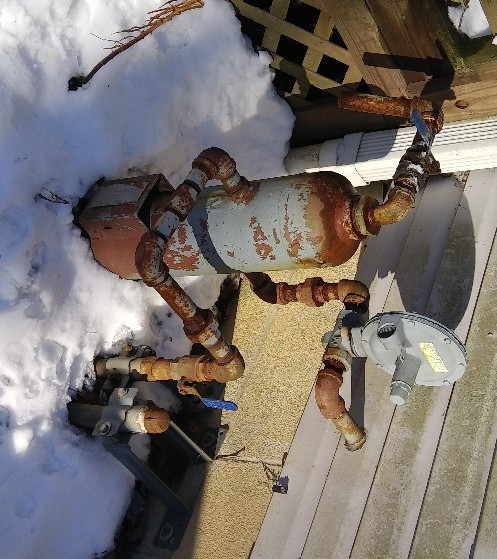
This is the setup going into my house. Do I need to do the same at the out bldg? What is the tank for? Can I install the new regulator in the out bldg? How can I check the pressure coming to the house? Do I need to know that to get the regulator?
Last edited:
If you are talking about measuring the pressure coming in to the house, you need a low pressure gauge (diaphragm gauge VS a bourdon operated gauge). The output of a regulator like that is typically 5-9" W.C.
Something like this one....
http://www.rsdtotalcontrol.com/assets/prod/575.pdf
In your picture, that regulator is mounted upside down. That (threaded) hole is a vent and should point down to keep out the rain and bugs. If you mount that new regulator inside the building, that vent hole needs to be piped outside. That is to take care of diaphragm failure or pressure relief from the regulator itself. Most regulators like that have an internal relief feature to take care of any over pressure down stream.
To size a regulator, you need inlet pressure, desired outlet pressure and the flow (BTU or CFH) That will allow you to select the correct orifice size for your load. If it is Nat Gas, it typically has a BTU content of 1000 per Cu.Ft. (from a gas utility)
Something like this one....
http://www.rsdtotalcontrol.com/assets/prod/575.pdf
In your picture, that regulator is mounted upside down. That (threaded) hole is a vent and should point down to keep out the rain and bugs. If you mount that new regulator inside the building, that vent hole needs to be piped outside. That is to take care of diaphragm failure or pressure relief from the regulator itself. Most regulators like that have an internal relief feature to take care of any over pressure down stream.
To size a regulator, you need inlet pressure, desired outlet pressure and the flow (BTU or CFH) That will allow you to select the correct orifice size for your load. If it is Nat Gas, it typically has a BTU content of 1000 per Cu.Ft. (from a gas utility)
TractorJeff
Well-known member
Go out to the Well to see if there is a pressure gauge. "Usually is!"
Tank like thing is probably a Condensate Trap. I haven't asked out there (Western New York) but usually New Gas Wells will have a lot of light ends that tend to drop out. Old guys used to wash their Oil field clothes in it because it would evaporate off the clothes on the clothes line.
Tank like thing is probably a Condensate Trap. I haven't asked out there (Western New York) but usually New Gas Wells will have a lot of light ends that tend to drop out. Old guys used to wash their Oil field clothes in it because it would evaporate off the clothes on the clothes line.
HoosierBuddy
Well-known member
That tank appears to be some sort of sediment or liquids trap.
If I'm looking at it right, all you have to do to incinerate your house is to open the quarter turn valve and throw a match at that 1" open pipe.
I'm leaving this thread before someone gets hurt.
If I'm looking at it right, all you have to do to incinerate your house is to open the quarter turn valve and throw a match at that 1" open pipe.
I'm leaving this thread before someone gets hurt.
The tank is called ( east coast slang, drip leg, drip pipe, sediment tank, solid or heavy tank, scrubber ). I heard them all used in my time.
The center top fitting should have an inner rod going downward the the bottom of the “tank”. The tanks can be any length ( into the ground ) as they can be made up on the field as needed.
You would just crack the blowoff valve and see if liquids or such come out and measure the volume. Minimum here is an annual check for all drip legs on the entire city grid. Wet gas can cause havoc with the appliances in the home. Worse case older standing pilots could go out, regulator could freeze up and lots of other concerns.
Normal the tank is buried to protect collected liquids from freezing and just the blowoff valve and pipe come to the surface in a small or large curb box or manhole .
That tank could be just a surface tank as well.
In your picture shown, it is unsafe. The blow valve exhaust pipe has to be capped.
Here we also would use a locking valve on the blowoff only and keep it locked closed along with the threaded cap in place.
The regulator has a vent, that’s the threaded opening we can see in the pic. Normally here it is required to have a screen, we have street 90 degree elbows with a metal mesh, screen over them for just this task. This keeps bugs, insects and critters from making a home. Again per code.
Based on your snow loads, code sets the height and ultimate location of the vent as well to keep snow clear, you will see that regulator vent piped upward or away as needed.
I would have piping and such that looked at by a professional for sure.
The center top fitting should have an inner rod going downward the the bottom of the “tank”. The tanks can be any length ( into the ground ) as they can be made up on the field as needed.
You would just crack the blowoff valve and see if liquids or such come out and measure the volume. Minimum here is an annual check for all drip legs on the entire city grid. Wet gas can cause havoc with the appliances in the home. Worse case older standing pilots could go out, regulator could freeze up and lots of other concerns.
Normal the tank is buried to protect collected liquids from freezing and just the blowoff valve and pipe come to the surface in a small or large curb box or manhole .
That tank could be just a surface tank as well.
In your picture shown, it is unsafe. The blow valve exhaust pipe has to be capped.
Here we also would use a locking valve on the blowoff only and keep it locked closed along with the threaded cap in place.
The regulator has a vent, that’s the threaded opening we can see in the pic. Normally here it is required to have a screen, we have street 90 degree elbows with a metal mesh, screen over them for just this task. This keeps bugs, insects and critters from making a home. Again per code.
Based on your snow loads, code sets the height and ultimate location of the vent as well to keep snow clear, you will see that regulator vent piped upward or away as needed.
I would have piping and such that looked at by a professional for sure.
Last edited: