To avoid these ads, REGISTER NOW!

Gas Line Plumbing

Status
Not open for further replies.

harvero

Well-known member
Joined
Nov 16, 2009
Messages
233
Location
Flemington, NJ
So why is that 90° elbows are not used in some gas runs turns. Why do I have these these Tees?

IMG_20110105_111526.jpg


IMG_20110105_111446.jpg
 
To avoid these ads, REGISTER NOW!

KCarGuy

Well-known member
Joined
Feb 5, 2009
Messages
2,075
Location
50 miles outside Chicago, illinois
The Drip Leg is required.
If any debre or flakes or garbage gets pushed through the line, it falls harmlessly past the 90 degree turnoff and falls to rest in the drip leg.
keeps the burner from getting clogged up because of the very low PSI of Gas.
 

Frank The Plumber

Well-known member
Joined
Feb 19, 2011
Messages
2,644
Location
Chicago.
Top picture is an illegal installation, valve is supposed to be at a height of 30" next to heater, valve is required to be ahead of the drip leg. In the event the gas valve was compromised you would not be able to put your hand into the fire ball to turn off the gas. Your home would burn down. Cap at drip bottom is a violation, it is non malleable.
Drip leg is required because there is water in the gas, oil, scale etc. Tee should be full sized as well. A swing joint is not required, there should not be any deflection from expansion on this application.
Second drip leg is also in violation of national gas code if used as a drip, should have a valve between bottom of tee and cap.
 

Mike007

Well-known member
Joined
Dec 4, 2010
Messages
2,601
Top picture is an illegal installation, valve is supposed to be at a height of 30" next to heater, valve is required to be ahead of the drip leg. In the event the gas valve was compromised you would not be able to put your hand into the fire ball to turn off the gas. Your home would burn down. Cap at drip bottom is a violation, it is non malleable.

You do realize the code structure varies by state and in some states it varies by town? I can assure you if he is in NJ there is no violations in that picture.
 

ddawg16

Well-known member
Joined
Jul 11, 2008
Messages
21,005
Location
S. California
You do realize the code structure varies by state and in some states it varies by town? I can assure you if he is in NJ there is no violations in that picture.

Unless of course you don't buy off the inspector......

Not trying to start any thing....but, I have noticed that some of the code rules in NJ seem to be a bit different than mainstream US......

Even here in what some peple refere to the "Republic of Kalfornia", what Frank noted is also correct....with one exception....the tank would also need earthquake straps and we do have to use a flex line due to the potential shaking of the tank.
 

Frank The Plumber

Well-known member
Joined
Feb 19, 2011
Messages
2,644
Location
Chicago.
You do realize the code structure varies by state and in some states it varies by town? I can assure you if he is in NJ there is no violations in that picture.

I can assure you that by the provisions of the national gas code and the National Fire and Safety code that this installation is both illegal and hazardous nationwide and in the event of a fire his insurance may be compromised. If he installed it as a contractor and it results in death or injury he would be tried for a criminal act of negligence. No code allows the gas shut off valve to be installed this close to the gas control valve. This safety lapse is negligent by the installer and should be red tagged and locked out immediately and corrected. It does not matter where it is installed, correct it so it does not harm you or your loved ones.
 

Mike007

Well-known member
Joined
Dec 4, 2010
Messages
2,601
I can assure you that by the provisions of the national gas code and the National Fire and Safety code that this installation is both illegal and hazardous nationwide and in the event of a fire his insurance may be compromised. If he installed it as a contractor and it results in death or injury he would be tried for a criminal act of negligence. No code allows the gas shut off valve to be installed this close to the gas control valve. This safety lapse is negligent by the installer and should be red tagged and locked out immediately and corrected. It does not matter where it is installed, correct it so it does not harm you or your loved ones.

I'm not debating whether it is proper or not. You posted to the OP it's in violation, it is not. We are not operating under the National Gas Code or National Fire and Safety code. We use the IFGC 2009 and I believe the NFPA fire codes. And since a fire permit is not required for gas piping and in most jurisdictions water heater installations, the fire code is a moot point. I see exactly what he posted installed everyday with an "Inspection Passed" sticker on the heater. And I'm quite sure any installer would be safe from being charged with "a criminal act of negligence" since the installation is code compliant and in fact passed inspection. Which is exactly why we have codes and the permit process.
 
Last edited:

Frank The Plumber

Well-known member
Joined
Feb 19, 2011
Messages
2,644
Location
Chicago.
In Chicago and any part of Northern Illinois serviced by NI Gas it would be locked out by any trained and diligent inspector. I would have a difficult time believing that the jurisdictions that provide public safety to The Greater New Jersey area are so negligent as to allow this. If so, the inspectional services are not serving the basic safety needs and are in need of reform. One can not clear the drip leg with out shutting off the entire service to the home, or would one jeopardize the home by doing it on the fly? In the event of a gas control failure and flame up, one can not turn the valve off without placing one's hands in the flame to do so. Absolutely negligent, Absolutely indefensible.
 

theoldwizard1

Well-known member
Joined
Feb 22, 2011
Messages
43,138
Location
SE MI
@Frank - The city was doing some repair on the roads in my subdivision, do the local gas company deiced to run new gas lines including the feeders up to the house. They hung a new meter and plumbed it into my existing piping using galvanized pipe (main and feeder were plastic).

I asked the guy why they were using galvanized and not "black iron" ? He said he didn't know why that that is the way he had been doing it for 20+ years.

So why do we use "black iron" gas pipe inside ?
 

Mike007

Well-known member
Joined
Dec 4, 2010
Messages
2,601
In Chicago and any part of Northern Illinois serviced by NI Gas it would be locked out by any trained and diligent inspector. I would have a difficult time believing that the jurisdictions that provide public safety to The Greater New Jersey area are so negligent as to allow this. If so, the inspectional services are not serving the basic safety needs and are in need of reform. One can not clear the drip leg with out shutting off the entire service to the home, or would one jeopardize the home by doing it on the fly? In the event of a gas control failure and flame up, one can not turn the valve off without placing one's hands in the flame to do so. Absolutely negligent, Absolutely indefensible.

Once again Frank, I'm not debating whether it's right, wrong, safe or unsafe. I'm not in the code writing field. I only read them and abide by them. You told the OP his installation is in violation. I'm telling you you are wrong. Here is what the IFGC says about gas shut offs. This is all I could find, thats it. See section 409.
 

Attachments

  • IFGC Sec. 409.jpg
    IFGC Sec. 409.jpg
    157 KB · Views: 36

tdkkart

Well-known member
Joined
Jun 17, 2006
Messages
6,887
Location
Eastern Iowa
I started typing a long response to this thread and decided I was wasting my time.

Suffice to say, there are large expanses of this country that could give a flying F%^k what the state or national electrical and plumbing codes are. Right or wrong the work gets done, and believe it or not people actually survive it.

Not everybody does things the same as Chicago, thank God.
 

Frank The Plumber

Well-known member
Joined
Feb 19, 2011
Messages
2,644
Location
Chicago.
They may have been using a sleeved or coated gas service pipe or line. Generally we do not like to use galvanized piping on a gas service due to the moisture content of the gas reacting with the zinc component of the galvanizing. If you notice that galvanized pipe reacts and powders or flakes as it degrades. The flakes have a tendency to foul gas control valves, there are a series of balls and check valves within the valve body that gum up from this. This is another reason that we do not like to use copper, the patina within the pipe flakes and can foul a gas valve, in some cases, rare but it does occur a gas control valve can flame. A seal can be lost. Most likely your piping is jacketed and poly inside.
 

ddawg16

Well-known member
Joined
Jul 11, 2008
Messages
21,005
Location
S. California
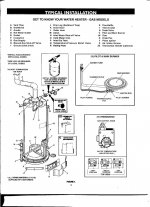
Here is a link to the installation manual for American Water Heater....I would be willing to bet that everyone is pretty much the same.....

The only difference, they show the drip leg at 3" min....but with the disclaimer "Check Local Codes"

Water Heater Installation

Looks like Frank is right.....
 

ddawg16

Well-known member
Joined
Jul 11, 2008
Messages
21,005
Location
S. California
Once again Frank, I'm not debating whether it's right, wrong, safe or unsafe. I'm not in the code writing field. I only read them and abide by them. You told the OP his installation is in violation. I'm telling you you are wrong. Here is what the IFGC says about gas shut offs. This is all I could find, thats it. See section 409.

408.4 says the sediment trap shall be located "Downstream" from the shut off valve.
 

Mike007

Well-known member
Joined
Dec 4, 2010
Messages
2,601
Looks like Frank is right.....

Looks like the D-Dawg is wrong. Here, right out of the installation manual of my AO Smith water heater. Does the location of the shut off valve look: "valve is supposed to be at a height of 30" next to heater" ? I'm telling you guys, Ive pulled 100's of permits in NJ every year. If it was a violation I would not see it pass over and over again. There are some jurisdictions I work in that it's almost impossible to have a job pass inspection first time no matter what you do. If it was even remotely against code they would not pass it.
 

Attachments

  • IFGC Sec. 409 001.jpg
    IFGC Sec. 409 001.jpg
    142.5 KB · Views: 67

Frank The Plumber

Well-known member
Joined
Feb 19, 2011
Messages
2,644
Location
Chicago.
Suffice it to say that just about every one has turned on the news at some point in their lives and seen a story and coverage of a home that has been completely smack flat leveled by a natural gas explosion. Every one in the home dead, half of each of the neighbors homes gone. In almost every one of these cases you will find that even the most basic of safety requirements were not met. Now, I have pointed out to you why exactly there are issues with this installation and I have given you all of your worst case scenarios. If you are a professional installer and this is your method of a favorable and preferred installation, examine your practices, if you are a home owner and you have a similar installation you may be the wiser to investigate it and perhaps correct it. The fact is this, even the home owner could have corrected this install and provided proper safety to his home in the time it takes to read this thread to this point. Why not correct it and ensure the safety? Why promote unsafe installation and negligence?
 

Mike007

Well-known member
Joined
Dec 4, 2010
Messages
2,601
408.4 says the sediment trap shall be located "Downstream" from the shut off valve.

You would be correct. Thats actually quite common knowledge. I did not pick that up. It was not in question.
 
Last edited:
To avoid these ads, REGISTER NOW!

Mike007

Well-known member
Joined
Dec 4, 2010
Messages
2,601
Suffice it to say that just about every one has turned on the news at some point in their lives and seen a story and coverage of a home that has been completely smack flat leveled by a natural gas explosion. Every one in the home dead, half of each of the neighbors homes gone. In almost every one of these cases you will find that even the most basic of safety requirements were not met. Now, I have pointed out to you why exactly there are issues with this installation and I have given you all of your worst case scenarios. If you are a professional installer and this is your method of a favorable and preferred installation, examine your practices, if you are a home owner and you have a similar installation you may be the wiser to investigate it and perhaps correct it. The fact is this, even the home owner could have corrected this install and provided proper safety to his home in the time it takes to read this thread to this point. Why not correct it and ensure the safety? Why promote unsafe installation and negligence?

Frank, it will pass inspection in the state of NJ because it is not "in violation" as you stated. Will it explode and kill eveyone in the house? I really don't know.
 

ddawg16

Well-known member
Joined
Jul 11, 2008
Messages
21,005
Location
S. California
Looks like the D-Dawg is wrong. Here, right out of the installation manual of my AO Smith water heater. Does the location of the shut off valve look: "valve is supposed to be at a height of 30" next to heater" ? I'm telling you guys, Ive pulled 100's of permits in NJ every year. If it was a violation I would not see it pass over and over again. There are some jurisdictions I work in that it's almost impossible to have a job pass inspection first time no matter what you do. If it was even remotely against code they would not pass it.

Notice the "*"? "Install per local codes". Also notice the valve is before the drip leg?

I can see where most inspectors might pass an installation if the valve is not at least 30" high.....but the valve being after the drip leg.....nope....should not pass.....
 

Mike007

Well-known member
Joined
Dec 4, 2010
Messages
2,601
Notice the "*"? "Install per local codes". Also notice the valve is before the drip leg?

I can see where most inspectors might pass an installation if the valve is not at least 30" high.....but the valve being after the drip leg.....nope....should not pass.....

And you would be correct. The location of the drip leg however was not in question in Franks original post.
 

Frank The Plumber

Well-known member
Joined
Feb 19, 2011
Messages
2,644
Location
Chicago.
Every year I go for at minimum 40 hours of recertification training, product training, and seminars. I pay my licensed installers to receive training instruction and guidance. We meet with local inspectors safety officers and fire officials. Part of my recertification is an annual seminar with A O Smith technical support as well as Bradford White and State / Rheem water heaters. The standard for the height of a gas valve shut off is based upon the minimum required height within the confines of the americans with disabilities act. This is based upon either a person in a wheel chair or an elderly person being able to shut that gas valve off. If you put that valve 16 inches off the floor it is difficult for a person who is hindered by age to reach down and turn it off. I am far less concerned about the 30" height argument than I am concerned about the improper location of the valve in relation to the drip leg and the valve in relation to the gas control valve burner assembly. With the manufacturers illustrations that you have provided you have proven and justified my concerns.
My objective is to promote a conscience towards a quality of installation and procedure, thus promoting safety. I do not understand a position counter to that objective.
 

Frank The Plumber

Well-known member
Joined
Feb 19, 2011
Messages
2,644
Location
Chicago.
Top picture is an illegal installation, valve is supposed to be at a height of 30" next to heater, valve is required to be ahead of the drip leg. In the event the gas valve was compromised you would not be able to put your hand into the fire ball to turn off the gas. Your home would burn down. Cap at drip bottom is a violation, it is non malleable.
Drip leg is required because there is water in the gas, oil, scale etc. Tee should be full sized as well. A swing joint is not required, there should not be any deflection from expansion on this application.
Second drip leg is also in violation of national gas code if used as a drip, should have a valve between bottom of tee and cap.
"valve is required to be ahead of the drip leg"

Hmmm, been to an installation training seminar lately? You know, with these new heaters and the protective devices that have been mandated, there are a lot of things needed to know about them. Minimum negative flue pressures, cleaning of the flame arrestor mesh, replacement of the fuel vapor sensors, placement of the flame ignition systems, voltage testing the gas controls. This bull smack we are talking about here is like the 1979 sort of BS, the new heaters are a lot more technical.
 
Last edited:

Mike007

Well-known member
Joined
Dec 4, 2010
Messages
2,601
"valve is required to be ahead of the drip leg"

Hmmm, been to an installation training seminar lately? You know, with these new heaters and the protective devices that have been mandated, there are a lot of things needed to know about them. Minimum negative flue pressures, cleaning of the flame arrestor mesh, replacement of the fuel vapor sensors, placement of the flame ignition systems, voltage testing the gas controls. This bull smack we are talking about here is like the 1979 sort of BS, the new heaters are a lot more technical.

I guess having a discussion with you is futile Frank. You are one of those people who simply will not be wrong. With zero knowledge of the code structure in NJ, you tell a homeowner in NJ something is "Illegal and in violation". Language that often scares homeowners with less knowledge about these things. You provide zero documentation to back your position, and the only documentation that even remotely backs you on one issue was provided by me. I say remotely because we don't even know when the work was done. If it was done prior to NJ adopting the U.C.C., it may very well have been code compliant and thats how it passed inspection. Before the U.C.C. each individual township (500+ if I recall correctly) was responsible for writing there own codes. It was a nightmare. And just because code changes doesn't make existing work "in violation". That is covered by our rehab code.
 

59 wagon man

Well-known member
Joined
Oct 25, 2010
Messages
1,589
Location
hollywood fla
i have worked in ny ,nj and now florida and it def comes down to the local inspector and gas company. i remember talking to a gas company installer in nj while we were doing a 30 meter bar setup .he told me you shoulda put a union here and made your life simple i said the inspector in ny would never accept a union in the middle of a meter bar setup , he replied this is nj doesn't matter about ny. here in fl you barely even see a drip leg , most gas installations i see are 3/8 copper tubing with flare fittings ,run straight into the gas valve with just a petcock. local jurisdication is what counts
 

tdkkart

Well-known member
Joined
Jun 17, 2006
Messages
6,887
Location
Eastern Iowa
In our development was mostly built in about 1976 to 1979ish. Originally every one was either electric or propane, no natural gas.

Story goes, when the gas company's contrator came through to lay in the gas pipe they handed every homeowner a stick and said "put this stick where you would like your gas line to come up beside your house."

Guess where they're all at. Yep, besides most of them being ugly as hell on the front of the house, all are either right beside, or right under a window, completely in violation of the code which states that the meter/regulator vent cannot be within 4ft of a window or door. EVERY meter that I have seen on the street is violation, and the inspector says nothing about it.
 

Frank The Plumber

Well-known member
Joined
Feb 19, 2011
Messages
2,644
Location
Chicago.
Sadly, non enforcement of good practice and policy does not make it right. So if the vent discharges and Grandma is sitting there smoking a cigarette in the home with the window open she's gone. Terrible.
 

redsky49

Well-known member
Joined
Jan 21, 2009
Messages
582
Location
near the coast in eastern North Carolina
As far as I know, all "Model" codes specifically adopt or incorporate NFPA 54, Fuel Gas Code. This is the ruling document.

Local jurisdictions (New York City and Chicago, for example) will often incorporate additional requirements into the Code, but rarely, if ever, do any local amendments lessen the basic Code requirements.

In many small un-incorporated areas, there is no adopted code, and pretty much anything goes unless there is an over-reaching state requirement.

For the most part, the multiple regional codes of the past have all been consolidated.

Now, as to what any specific AHJ will accept (or overlook), that is a separate question.

My vote goes to Frank. :thumbup:

As always, offered only as opinion
 

BBQ&Love

Well-known member
Joined
Nov 12, 2010
Messages
1,061
Location
Texas
I guess having a discussion with you is futile Frank. You are one of those people who simply will not be wrong. With zero knowledge of the code structure in NJ, you tell a homeowner in NJ something is "Illegal and in violation".

New York and Chicago plumbers tend to believe their codes should be universally followed and that any less stringent code is rubbish to be ignored. It's something I have observed numerous times. Doesn't make 'em bad. It just is. And it does provide needed balance to the "any homeowner can do gas" crowd.
 

ishiboo

Well-known member
Joined
Oct 27, 2010
Messages
9,481
Location
Oshkosh, WI
Sadly, non enforcement of good practice and policy does not make it right. So if the vent discharges and Grandma is sitting there smoking a cigarette in the home with the window open she's gone. Terrible.

I don't know jack **** about plumbing, but I can speak to you about electrical code IN YOUR AREA, and as I said to you on another thread your opinion of "best practice" and "safest practice" is just that - an opinion. You're clearly very knowledgeable about plumbing and code in your area, and based on everything you have said I wouldn't hesitate for a second to have you plumb gas or water/drain, but not every area follows the uniform plumbing code, international plumbing code, etc. and you need to respect that without assuming they're jeopardizing lives or performing substandard work.

In Chicago, it's basically "believed" that the only way to SAFELY do electric work is to do some in steel conduit. There are lots of reasons you can come up with to say why this is safer. For example, I can say if someone drives a nail by hand, they won't drive it into an electrical wire, either shorting and causing a potential fire, or making the nail "hot" for someone to touch. This is true.

Fortunately, the rest of the world is living quite safely with a "less safe" NM cable ("Romex") installation at a far cheaper cost. It's not that we don't want to spend the extra bucks to do so, it's just that it's not necessary. If making things safe was the only object, we probably wouldn't have electricity nor gas in our homes. For a while, it was common practice with commercial installs around here to install outlets with the ground up, because if the plug was away from the wall and something metallic fell on it, it would likely land on the ground and not the hot. A great theory, but just that - in practice, this happens so infrequently it's better to just leave them the way they are designed to be.

So, even though this doesn't qualify as your idea, it is still safe in practice even not in theory. Existing gas installations in your home, even without meeting all the new various codes, are still a million times safer than hopping in your car and driving to the store for a gallon of milk.
 
Last edited:

Frank The Plumber

Well-known member
Joined
Feb 19, 2011
Messages
2,644
Location
Chicago.
New York and Chicago plumbers tend to believe their codes should be universally followed and that any less stringent code is rubbish to be ignored. It's something I have observed numerous times. Doesn't make 'em bad. It just is. And it does provide needed balance to the "any homeowner can do gas" crowd.

A less stringent code is perfectly acceptable. If the code is still providing proper protection for the consumer, a consumer who places their trust in the guidance of that code.
I'm wondering if you read this whole thread Rifle, the pictured installation is not up to the water heater manufacturers recommendations either. You must also realize that as I live in a different state I also live under a different legal system. In my state, I would be prosecuted for an improper installation that caused harm or property damage. If it can be proven that my installation was negligent, my insurance can be voided. Given that scenario I am sure you can understand why we are so adamant to ensure that we provide a quality install. I can loose my home and go to prison for negligence.
We had a situation here where a porch collapsed, it had 25 people standing on it, it was constructed of 2x8's. Any person with an ounce of structural knowledge would have not stayed on that porch. The porch collapsed killing and hurting many people. The owners of he property went to prison for 20 years, were sued mercilessly. The guy who built the porch also went to prison and lost everything he had. Today you have to have a 2 million dollar bond and get your porch approved by more zoning than it takes to build the entire home even if the porch is only 12" off the ground. I'm sure in a lot of places you could just build a porch, not here. So yes it is what it is and yes it is futile to talk me out of safety standards. Then again I get to sleep at night knowing my stuff is safe.
 
OP
H

harvero

Well-known member
Joined
Nov 16, 2009
Messages
233
Location
Flemington, NJ
Thanks for the plenty replies.

The heater was installed in 1998. I'm going to be replacing it soon Should I add another shutoff on the down pipe before the drip leg?
 

Frank The Plumber

Well-known member
Joined
Feb 19, 2011
Messages
2,644
Location
Chicago.
I don't know jack **** about plumbing, but I can speak to you about electrical code IN YOUR AREA, and as I said to you on another thread your opinion of "best practice" and "safest practice" is just that - an opinion. You're clearly very knowledgeable about plumbing and code in your area, and based on everything you have said I wouldn't hesitate for a second to have you plumb gas or water/drain, but not every area follows the uniform plumbing code, international plumbing code, etc. and you need to respect that without assuming they're jeopardizing lives or performing substandard work.

In Chicago, it's basically "believed" that the only way to SAFELY do electric work is to do some in steel conduit. There are lots of reasons you can come up with to say why this is safer. For example, I can say if someone drives a nail by hand, they won't drive it into an electrical wire, either shorting and causing a potential fire, or making the nail "hot" for someone to touch. This is true.

Fortunately, the rest of the world is living quite safely with a "less safe" NM cable ("Romex") installation at a far cheaper cost. It's not that we don't want to spend the extra bucks to do so, it's just that it's not necessary. If making things safe was the only object, we probably wouldn't have electricity nor gas in our homes. For a while, it was common practice with commercial installs around here to install outlets with the ground up, because if the plug was away from the wall and something metallic fell on it, it would likely land on the ground and not the hot. A great theory, but just that - in practice, this happens so infrequently it's better to just leave them the way they are designed to be.

So, even though this doesn't qualify as your idea, it is still safe in practice even not in theory. Existing gas installations in your home, even without meeting all the new various codes, are still a million times safer than hopping in your car and driving to the store for a gallon of milk.
We have rats in our city, not unlike many other cities, rats eat our wires, our homes are 3 feet apart, in many neighborhoods all frame construction, our city has a negative feeling towards fire as most of it was burned to the ground, thus the conduit.
We have a stringent code because we had a history of severe flood episodes , much sewage was discharged into our lake and our water was compromised, epidemics would break out and many would die. We finally developed a strict plumbing code to keep us safe. Many other cities have the same history, codes are the result of reaction to terrible events. You should never dislike a code, it is there to help you. It is a law to keep you safe from guys who would otherwise do things in a poor manner.
 
Last edited:

Frank The Plumber

Well-known member
Joined
Feb 19, 2011
Messages
2,644
Location
Chicago.
Thanks for the plenty replies.

The heater was installed in 1998. I'm going to be replacing it soon Should I add another shutoff on the down pipe before the drip leg?
Yes, per the manufacturers instructions. Sorry to have turned your thread into such a mess. Please check the condition of your flue piping and ensure you have a clear and proper draft up the chimney as well. Thanks.
 

HoosierBuddy

Well-known member
Joined
May 9, 2006
Messages
2,920
Location
Southern Indiana
Very interesting thread.

The thing that strikes me most is the fact that places like Chicago actually recognize codes and verify that they are being followed. Meanwhile, in the areas I work in, very few areas have any inspection or code enforcement at all.

For example, when I built my garage in 2006 (in a town) the only requirement was that I get a $30 building permit and show the zoning administrator a rough plan to verify setbacks from the property lines were sufficient. There were no inspections at all at any point in the process for foundation, structure, electrical, plumbing, etc.

Most people around here LIKE THAT because they've been told for years about how expensive it is "to bring things up to code". I've always looked at it differently, that codes are written to make things safer/better for everyone down the road.

Regarding the placement of shutoffs for appliances and HVAC equipment? I'm just tickled to death if there is a shut off. Many times (especially in older homes) the only gas valve in the whole piping system is the one that belongs to the gas company on the inlet side of the meter.

AND BY CODE (CFR192) the gas company can't just let any schmoe turn that valve...meaning we make a lot of trips to peoples houses to shut off their entire gas service so they can do what they need to do on their side of the meter (install a shut off valve for instance). And we charge for both trips, so it gets expensive. A lot more expensive than installing a shut off like they are supposed to!

Phil
 

BBQ&Love

Well-known member
Joined
Nov 12, 2010
Messages
1,061
Location
Texas
A less stringent code is perfectly acceptable. If the code is still providing proper protection for the consumer, a consumer who places their trust in the guidance of that code.
I'm wondering if you read this whole thread Rifle, the pictured installation is not up to the water heater manufacturers recommendations either. You must also realize that as I live in a different state I also live under a different legal system. In my state, I would be prosecuted for an improper installation that caused harm or property damage. If it can be proven that my installation was negligent, my insurance can be voided. Given that scenario I am sure you can understand why we are so adamant to ensure that we provide a quality install. I can loose my home and go to prison for negligence.

I was not defending the installation by any means. What I shared was a side note. Nothing more, nothing less. And it wasn't intended as a slam. Just an observation I have made. An accurate one.
 
Status
Not open for further replies.
To avoid these ads, REGISTER NOW!
Top Bottom