To avoid these ads, REGISTER NOW!

Gas pipe through foundation wall?

ururk

Well-known member
Joined
Jan 9, 2010
Messages
739
Location
Southeast MI
I'm close - maybe about a week or two away - from finalizing a gas line to my barn/workshop. The line was directional bored (proper tracer wire, proper gas poly), so all that's left is digging a trench between where the line came out and the building. This isn't as easy as it should be as a water line was pulled in the same pull, and I have to dig both down to depth (here it's about 54"!).

I have about 8-16" of concrete above grade where I'd like to bring the line in. I'm running a 1" line, and would continue that 1" pipe through the foundation wall.

From what I've read, it must be sleeved and the sleeve has to be 2 times the pipe size - so 1-1/2" (2 trade pipe sizes larger?).

Wondering if anyone has done this before, gotten it inspected and approved. I'm really leery of going through my siding, insulation, etc... so would like to core through the concrete. Don't ask why I didn't put a sleeve in... at the time I wasn't really thinking I guess.

You can see the corner when the foundation was first put in:

22328690911_257e3a600e_k.jpg


And with siding:

media


I don't have a closeup, but the siding sits about 6" away from the foundation. I'm going to be bringing the grade up on the other side by about 10", which will leave 8-16" of foundation exposed.
 
To avoid these ads, REGISTER NOW!

larry4406

Well-known member
Joined
Jan 27, 2006
Messages
20,274
Location
Northern Virginia
I think you should use an anodeless riser mounted external to the foundation, then enter thru the structure just above the foundation thru the siding. Mount your regulator here, make connection from structure, and seal with duct seal. Run a tracer while as well, and caution tape above the buried line.

Home Depot near me has HomeFlex poly gas line. Very easy to use and connect.

I wouldn't waste my time to core foundation wall at less then knee height.

At my last house, I had a buried 1000 gallon propane tank. I used a high pressure regulator at the tank (10 psi???) and then low pressure regulators at the house and the detached garage (2 psi???). Been too long I don't remember the pressures but my propane contractor set me up with proper regulators. I think the run to the detached was 175' or so?

I put a shut off at the detached. Picture attached.

I also borrowed a manometer from my HVAC guy and rejeted the furnace to propane using factory kit and used manometer to adjust the regulator for optimum pressure due to the buried pipe run while furnace was running.

Edit:
On my companies residential homes, and at cored foundation, the plumber typically uses a 2" bit for 2" PVC for the black pipe to enter from the gas meter.
 

Attachments

  • Propane to Detached.jpg
    Propane to Detached.jpg
    115.9 KB · Views: 71
Last edited:
OP
U

ururk

Well-known member
Joined
Jan 9, 2010
Messages
739
Location
Southeast MI
I think you should use an anodeless riser mounted external to the foundation, then enter thru the structure just above the foundation thru the siding. Mount your regulator here, make connection from structure, and seal with duct seal. Run a tracer while as well, and caution tape above the buried line.

Home Depot near me has HomeFlex poly gas line. Very easy to use and connect.

I wouldn't waste my time to core foundation wall at less then knee height.

At my last house, I had a buried 1000 gallon propane tank. I used a high pressure regulator at the tank (10 psi???) and then low pressure regulators at the house and the detached garage (2 psi???). Been too long I don't remember the pressures but my propane contractor set me up with proper regulators. I think the run to the detached was 175' or so?

I put a shut off at the detached. Picture attached.

I also borrowed a manometer from my HVAC guy and rejeted the furnace to propane using factory kit and used manometer to adjust the regulator for optimum pressure due to the buried pipe run while furnace was running.

Edit:
On my companies residential homes, and at cored foundation, the plumber typically uses a 2" bit for 2" PVC for the black pipe to enter from the gas meter.
Yeah I'm using an anode-less "x-riser" - the poly pipe goes all the way into the riser and the fittings on the riser connect directly to the pipe, no underground joints. A little different from the HD system, but same concept.

I'll really have to think about going into my siding - I have a sandwich of:

Metal siding - 4" foam - peel+stick - OSB - 2x6" timber I'd have to bore through - trivial with a bimetal hole saw, step bit for the siding, but, ugh.
 

Jim greengo

Well-known member
Joined
Sep 3, 2018
Messages
7,415
Location
Behind my house
Can you bring the gas line through the rim joist?

That's how its normally done around here anyway.
Water needs to stay below frost line of course.
 
OP
U

ururk

Well-known member
Joined
Jan 9, 2010
Messages
739
Location
Southeast MI
Can you bring the gas line through the rim joist?

That's how its normally done around here anyway.
Water needs to stay below frost line of course.
I could - it would be where I'd drill through - but the metal siding goes down to the rim joist, so I would still have to drill through the siding.

I'll take some pictures today, maybe post a diagram. It isn't that I'm opposed to going through the siding - I'll have to for the vents eventually - I'm just trying to minimize penetrations through the siding.
 
To avoid these ads, REGISTER NOW!

HoosierBuddy

Well-known member
Joined
May 9, 2006
Messages
2,960
Location
Southern Indiana
I have done it both ways...although around here I didn't have to pass inspection.

It is much easier use a riser and come through the wall with black steel. You should paint or coat your above ground piping to protect against corrosion to the point it enters the interior space. I have not seen a requirement that the entry be sleeved and that's not what I typically see. Not saying it is a bad idea though.

What I would dislike about doing it below ground is the difficulty in fixing any leak that might occur in the future.

Phil
 
OP
U

ururk

Well-known member
Joined
Jan 9, 2010
Messages
739
Location
Southeast MI
I have done it both ways...although around here I didn't have to pass inspection.

It is much easier use a riser and come through the wall with black steel. You should paint or coat your above ground piping to protect against corrosion to the point it enters the interior space. I have not seen a requirement that the entry be sleeved and that's not what I typically see. Not saying it is a bad idea though.

What I would dislike about doing it below ground is the difficulty in fixing any leak that might occur in the future.

Phil
It will be all above ground.
 

BillK

Well-known member
Joined
Aug 24, 2006
Messages
9,434
Location
Beautiful Southern Maryland
In our area the gas line has to enter the building above grade. This is so if there is a leak in the line underground the fumes cannot follow the ground and get into the building.
 
OP
U

ururk

Well-known member
Joined
Jan 9, 2010
Messages
739
Location
Southeast MI
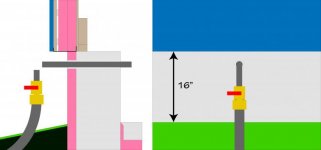
I am running the pipe above grade. When I wrote "foundation wall" I really should have written "stem wall" which is above grade. Here are my two options - two diagrams attached.

In either case, I need to provide a bracket of sorts to brace the pipe, and run a #6 to my ground rod.
 

Attachments

  • Foundation Penetration-02.jpg
    Foundation Penetration-02.jpg
    17.2 KB · Views: 43
  • Foundation Penetration-03.jpg
    Foundation Penetration-03.jpg
    17 KB · Views: 31
Last edited:
To avoid these ads, REGISTER NOW!
Top Bottom