To avoid these ads, REGISTER NOW!

Gauss Meters

GeoBruin

Well-known member
Joined
May 5, 2018
Messages
3,749
Take it easy on me as I'm just dipping my toe into this. I have a couple projects that require me to measure the strength of a magnetic field. I will need to be able to measure and compare the strength of permanent magnets and DC electromagnets. I have no need to document the absolute field strength at any specific distance, only to compare the strength at an arbitrary distance of my choosing.

That last bit hopefully opens up my options as I don't need a meter that has (for example) a really high high end, or is really sensitive on the low end, as I can vary the distance from the meter to my magnets at will, as long as I can measure both at the same distance.

I have a general working knowledge of electromagnetism and can likely calculate most of what I need once I have a measurement. I don't think I should have any issues comparing permanent magnet and DC electromagnet field strength (vs AC electromagnets) but if there any "gotcha's", I'd like to know about them.

Al that said, any advise or experience in selecting or using a meter is greatly appreciated. I would usually say budget is not an issue but knowing Garage Journal, someone here work in a laboratory and will tell me I need a meter capable of measuring the EM fluctuations of a pulsar in some far off galaxy, so let's say under $500 with a preference for value.

Thanks in advance.

-G
 
To avoid these ads, REGISTER NOW!
OP
G

GeoBruin

Well-known member
Joined
May 5, 2018
Messages
3,749
At work we measure residual magnetism on workpieces. We get our gauss meters from the R. B. Annie’s Company in Greencastle IN.
Excellent info. In my initial Googling I was coming up with lots of digital models but I don't need the max memory, data logging, etc. of a digital model and I'd much rather have something simple and we'll built.

May I ask, when checking for residual magnetism, at what distance from a part do you test? And what range model do you use (-10 to 10 Gauss, - 20 to 20, etc.)
 

minke

Well-known member
Joined
Dec 1, 2018
Messages
477
Location
fly over country
I don't want to make this more complicated than necessary. Also I am appallingly ignorant on this topic. Sounds like a bad start!

High school physics texts often have a photo of iron filings over paper over a bar magnet. It is obvious that the field in this case has directional properties. Unless whatever you are measuring has an isotropic field you need to measure field strength in at least one particular direction. That's my best gauss.
 
OP
G

GeoBruin

Well-known member
Joined
May 5, 2018
Messages
3,749
I don't want to make this more complicated than necessary. Also I am appallingly ignorant on this topic. Sounds like a bad start!

High school physics texts often have a photo of iron filings over paper over a bar magnet. It is obvious that the field in this case has directional properties. Unless whatever you are measuring has an isotropic field you need to measure field strength in at least one particular direction. That's my best gauss.
Yes, but again, I'm not after absolute measurements, just comparative measurements, so all I have to do is make sure the two magnets I'm comparing have their poles oriented the same direction and that my meter is placed in the same location relative to the direction of the respective magnetic field lines, (and that the measurements are taken at a consistent distance) and I should be able to compare the relative field strength.
 

Meursault74

Well-known member
Joined
Apr 1, 2019
Messages
22,053
Location
Southern California
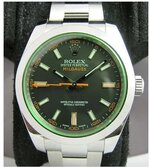
If I were going to spring for a Rolex, it would be a Sub or a deep sea diver. I'd be more than happy to take it off when working with strong magnets😁
I've worked in strong magnetic fields. Never measured it though. We have a set of titanium wrenches just for the tasks. I remember once when I couldn't find the right size in titanium, I took a regular one. Yeah, if flew out of my hand as I wasn't holding on to it that well.

I made it a habit to take off my watch (quartz) and leave my wallet (credit card magnetic strip) as well. The field would stop the quartz watch, then when I left the field it would start back up, but of course the time was wrong.

Even if I had a Millgauss, I wouldn't wear it for work.

If I could pick any Rolex for free though, it would be the Millgauss though. Supposedly they were originally marketed for Scientists back in the day and that's probably why I'm drawn to it. No real need for them now. I mean if I wanted to wear a watch in a magnetic field I'd just get a cheap digital one.
 
To avoid these ads, REGISTER NOW!

yhprum

Well-known member
Joined
Jul 27, 2006
Messages
1,396
Location
Brisbane Australia
Have used gauss meters to check magnetism in aircraft turbine engines after a lightning strike, which is very bad for roller and ball bearings.
 

cliffcharb

Well-known member
Joined
Nov 7, 2021
Messages
238
Location
North Port, Fl
we used gaussmeters during routine inspection of our eddy current rotors in a recycling plant. I might just have what you're looking for sitting on my desk collecting dust.
 
OP
G

GeoBruin

Well-known member
Joined
May 5, 2018
Messages
3,749
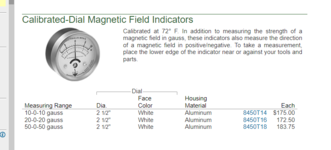
We get our gauss meters from McMaster Carr.
1683887329163.png
I hadn't thought about McMaster but I should have. That looks a lot like the R. B. Annis recommended above. I've since found those and the Magnaflux models show up often in searches.
 

jsaw

Well-known member
Joined
Oct 11, 2008
Messages
1,789
Location
Geneva, N.Y.
I have bot an inductive amp gage, and a short finder gave the magnetic field causes the need!e to move

1683946446266.png
 

MBfreak

MEMBER EMERITUS
Joined
Dec 10, 2010
Messages
2,301
Location
Linkoping , Sweden
There are integrated circuits available with sensor for magnetic field. Easy to make a rather accurate static and mains freq B meter.
Manufacturers publish application notes.
Also, many smart phones can be loaded with an downloadable app for the same.

Ola
 
OP
G

GeoBruin

Well-known member
Joined
May 5, 2018
Messages
3,749
There are integrated circuits available with sensor for magnetic field. Easy to make a rather accurate static and mains freq B meter.
Manufacturers publish application notes.
Also, many smart phones can be loaded with an downloadable app for the same.

Ola
It's funny you mention it but since I first posted here, I did discover a number of magnetometer apps for my phone. I've installed a couple and played around with them and they actually seem to work pretty well. Unfortunately the location on my phone where the sensor seems to be most sensitive is not convenient for repeatable measurements. Also, I'm a little leery of repeatedly and deliberately subjecting my phone to a strong magnetic field when I realize it's primary purpose is to detect the Earth's magnetic field which, from the perspective of my phone, is a very weak field.
 

Mr_Rich

Active member
Joined
Sep 25, 2010
Messages
30
Location
Illinois
Excellent info. In my initial Googling I was coming up with lots of digital models but I don't need the max memory, data logging, etc. of a digital model and I'd much rather have something simple and we'll built.

May I ask, when checking for residual magnetism, at what distance from a part do you test? And what range model do you use (-10 to 10 Gauss, - 20 to 20, etc.)
Sorry I didn’t see your question. Our process is influenced by magnetic fields as small as 1 gauss. We use +/-2 gauss meters directly on the workpiece. The company is R.B. Annis, stupid spellcheck
 
To avoid these ads, REGISTER NOW!
Top Bottom