threeputt
Well-known member
How can I tell if the generator I bought at a sale runs off propane or natural gas ? I know it runs off one of these fuels but don't know how to tell. Anyone know how I can check this. Thanks


Google the mixers model number. Then you may need an nozzle size.
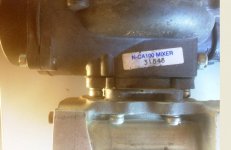
i guess what model generator is it, it should have something in the manual for it on how to identify the gas type , or call that manufacturer.I didn't see one but can look closer. The mixer is n-CA100 MIXER 31848 but not sure that will tell me anything.
So I really shouldn't worry about it being propane or natural gas ? I think it was on propane .
I tried that and could not come up with much. I went ahead and started it on propane. It seemed to run good but I only ran it for like a minute. I would assume it is set up for propane if it ran good ???
Now that you have started it, the next step is a load test.
My "load bank" is 6 porcelain lamp sockets wired in parallel. I test my generator with my ARC Welder.
+1. Many jets have a number stamped on them. The carb IPL should list both and tell what size jets. If they are not marked check the orfice size with a set of numbered drill bits(shank end).its just the size of the jet, a ten dollar piece
YesNo markings on the regulator?
This is a commercial generator with a 3.0 GM engine. GS25 TAYLOR GENERATOR 120/240 voltHow many hp on the generators engine?? A 20lbs grill bottle is going to be to small for many generators as it will have to fast of a withdraw rate. If you remove to much gas to fast the liquid can’t boil to a gas fast enough. A 33lbs or 40lbs tank would be big enough for most 10-12 hp generators or hook two 20lbs together.
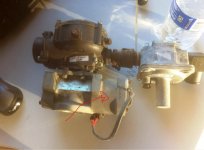
Here is what it looks like
Not sure what the part I have the red line on is called ? Its got an electrical wiring plug in on it.
Today I started it using a tank that came off a forklift. Not sure how much was in tank but it ran on forklift.
I laid the tank on floor horizontal like it bolted on forklift. It don't idle every good. Hunting I think would be the term. Not sure about the tank I used. Should I have just used a propane tank from a cooker ?
As seem in one of these pictures there is a spring someone zip tied to this part. Not sure why but someone meant not to lose it.
Maybe someone can explain exactly what I got by these pictures and which propane tank I need to use. THANKS
This is a commercial generator with a 3.0 GM engine. GS25 TAYLOR GENERATOR 120/240 volt
Generator model number is BC 184E
I was told it was last run in 2009
https://www.taylorpowergenerators.com/brochures/DS_GS Models General Brochure.pdf
I called the company. They told me to put the spring back in regulator and run it off natural gas if I could. I do have that option. The tech also said if I wanted to run it off propane it had to be vapor and a large tank like people use for home heat would be what I have to use. Something like a 250 gallon.
Did he tell me right ?
Thanks for this information. Written where I can understand it.Yes, without a vaporizer you need a large tank. 250 gallon is a starting place. I thought originally we were talking about a small aircooled engine generator. Forklifts and such have a vaporizer that uses engine coolant heat to turn the liquid to a gas. A large tank has enough surface area to do so. Also most lp lines off the tank are only sized for 250,000 BTu’s per hour heat rate which would be about 2 gallon per hour. A 25kw Generator is going to burn around 4 gallon per hour at full load or approx 400,000 btus. That means at least 1” diameter line if you stay under 75’ length or 1 1/4 if longer.
Seeing that your engine didn’t have a vaporizer I highly doubt it was run on lp and will need tuning.
Natural gas if available would be ideal and much cheaper to run. The only advantage to lp is if the natural gas line get disabled which is pretty rare for the most part but does happen in earthquakes or major floods if the compression facility is inundated. Remember natural gas will need probably even large pipes for the supply line.

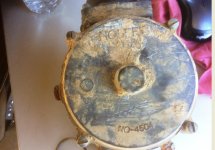
That is a regulator to control the gas pressure. "Typical" NG pressure is 7" WC or water column and is about .25 psi.
Typical LP pressures are 11" WC (.40 psi) but there are more variations but it's recommended to stay under 14".
Also LP is nearly twice as dense (amount of btu per volume) compared to NG.
It's my assumption, as I have never used or read the manual on that regulator, one of the major changes switching between fuel is the regulator setting and are doing so by different weight springs. The stronger the spring the higher the pressure will be past the regulator.
Some regulators are adjustable, some are not
The spring would go under the cap in the middle of the regulator. There is probably a screw disk to make small adjustments. Turn in to raise, out to lower. You would hook a manometer to measure the WC past the regulator. The spring change out would give you gross adjustments when switching between fuels and would be under the screw disk.
Thanks again for this very useful information. Not sure if I will mess with the manometer when I connect it to natural gas. I may try it if I find the time. Thanks for that link. It should run just fine. I hope I never need this generator but I will have it if I do.That is a regulator to control the gas pressure. "Typical" NG pressure is 7" WC or water column and is about .25 psi.
Typical LP pressures are 11" WC (.40 psi) but there are more variations but it's recommended to stay under 14".
Also LP is nearly twice as dense (amount of btu per volume) compared to NG.
It's my assumption, as I have never used or read the manual on that regulator, one of the major changes switching between fuel is the regulator setting and are doing so by different weight springs. The stronger the spring the higher the pressure will be past the regulator.
Some regulators are adjustable, some are not
The spring would go under the cap in the middle of the regulator. There is probably a screw disk to make small adjustments. Turn in to raise, out to lower. You would hook a manometer to measure the WC past the regulator. The spring change out would give you gross adjustments when switching between fuels and would be under the screw disk.
That is a regulator to control the gas pressure. "Typical" NG pressure is 7" WC or water column and is about .25 psi.
Typical LP pressures are 11" WC (.40 psi) but there are more variations but it's recommended to stay under 14".
Also LP is nearly twice as dense (amount of btu per volume) compared to NG.
It's my assumption, as I have never used or read the manual on that specific regulator, one of the major changes switching between fuel is the regulator setting and are doing so by different weight springs. The stronger the spring the higher the pressure will be past the regulator.
Some regulators are adjustable, some are not
The spring would go under the cap in the middle of the regulator. There is probably a screw disk to make small adjustments. Turn in to raise, out to lower. You would hook a manometer to measure the WC past the regulator. The spring change out would give you gross adjustments when switching between fuels and would be under the screw disk.
I could not find much in the way of es401 other than it is a modified rv-52-3/4 regulator and discontinued. How modded I don't know. But for an rv52 an orange spring is 4-8" WC, a blue one 5-12" WC and a plated one is 3-6.

![IMG_2007[1].jpg](/forum/data/attachments/944/944529-54db7069e9f18e4aa4d79087909426c9.jpg)