We use brake cleaner as a starting fluid, FYI.
No one has touched on this, but brake cleaners typically should not be set on fire.
Very bad suggestion in place of starting fluid.


We use brake cleaner as a starting fluid, FYI.
Not at all. Both are highly flammable, ether being even more so than acetone (non-chlorinated brake cleaner). Which is probably why it's used in starting fluid. But acetone is an acceptable fuel to be used as a starting fluid as well. As far as which is which is "safer" in the shop? One certainly might argue that would be acetone (non-chlorinated brake cleaner).No one has touched on this, but brake cleaners typically should not be set on fire.
Very bad suggestion in place of starting fluid.
I assumed we all knew that chlorinated BC is considered non-flammable, and wouldn't suffice for this use.
Wrong. In fact, burning ether and heptane could cause more health risk than burning acetone. But the health risk is small in both cases.BTW, the fumes off burning brake cleaner (the flammable one) are particularly dangerous and can cause some serious health issues very quickly.
Given a choice, carb spray is a much safer alternative.
@drmarkr so the phosgene gas as a result of welding parts cleaned with brake cleaner is a myth?
Either way, I'm not chancing it. YMMV
That's chlorinated, and we're NOT talking about that! Chlorinated is not flammable....that is one of the actual reasons it was produced/sold......the fact that it's "considered" non flammable.
I'm done, thanksWe use brake cleaner as a starting fluid, FYI. Works fine. Your purpose is to establish that the reason the engine isn't running is a fuel delivery problem. If some brake cleaner will allow the engine to run for a few seconds then it's unlikely you have valve train issues.
Lots of great suggestions. Not mentioned, but how about exhaust, is it clear.
When you choke it and crank you can tell it's wanting to catch and fire up but instead some very light puffs of white smoke.
You have to realize that at least half the folks here don't know what a distributor is, let alone the fact that it has a cap !Ive had a carbon trail on a distributor cap cause a backfire out the throttle body. No cap on this thing though.
this. a small engine with compression, timing & spark will start on gas sprayed into the carb. ether & other starting fluids can be a recipe for disasterAll this about starting fluid, brake cleaner, etc. Just squirt a bit of gas in the carb


Lots of great suggestions. Not mentioned, but how about exhaust, is it clear.
0.008 for exhaust and 0.006 for intake.
My point I think was mostly missed, I'm just wondering if valve lash being out could cause these symptoms.
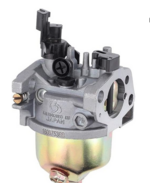
Looks near identical to the carb on my ryobi inverter generator. I had the same issue with the black "jet" on top. That is the one that usually turns out to be the issue. I swear I have to clean the carb about once a year or the thing surges/ jumps around RPM even with no load. I really suggest some ether to see if you can get it to fire. At the very least fuel sprayed straight into the intake. If it ran good when put up, I really thing this is a fuel issue...Early last year the first.. or maybe second time we lost power and needed it, it did not want to idle correctly. It was hunting a bit, so I ended up giving her a bit of choke to even it out. That time we were without power for about 3 days so it ran a bit rich for that entire time.
A week or so afterwards I tore the carb down and couldn't find anything wrong.. until I pulled what I thought was a black plastic plug which turned out to be another port. It's held in place (essentially) by the idle screw's formed plastic cup washer.
After cleaning that it was back to normal. Alas that guy was clear this time.
Sounds to me, the idle port in the carb was partially blocked starving the engine resulting in it running lean. By closing the choke, you restricted the air flow bringing the mixture back into proper air:gas ratio.Early last year the first.. or maybe second time we lost power and needed it, it did not want to idle correctly. It was hunting a bit, so I ended up giving her a bit of choke to even it out. That time we were without power for about 3 days so it ran a bit rich for that entire time.
A week or so afterwards I tore the carb down and couldn't find anything wrong.. until I pulled what I thought was a black plastic plug which turned out to be another port. It's held in place (essentially) by the idle screw's formed plastic cup washer.
After cleaning that it was back to normal. Alas that guy was clear this time.
Yup.Sounds to me, the idle port in the carb was partially blocked starving the engine resulting in it running lean. By closing the choke, you restricted the air flow bringing the mixture back into proper air:gas ratio.
This is a very typical symptom of being stored improperly with fuel remaining and breaking down in the carb.
decompression is on the exhaust valve , won't affect the intake valvesounds like a valve lash issue or decompression feature issue
Yes. Thank you. May shortcut this, I may check the obvious first, before the great list is started. Gas....I didn't watch that, (10 minutes) but a list of his "reasons" could have been posted and a man could read that in about 2 seconds. You tube is my least favorite source of everything. Anyway, this would be my small engine list:
- Compression:
- Engine threw a rod
- Valve stuck open
- Valve train failure/adjustment
- Blown head gasket
- Cam timing
- Holed piston
- Spark
- ignition module failure (assuming here one piece does it all
- Ignition timing (sheared pin)
- "Bad" spark plug
- Ignition defeated (whatever shutdown switches/components exist, could be many)
- Fuel
- Out of gas
- Fuel valve closed
- Water
- Fuel filter stopped up
- Carb needle and seat problem
- Carb fuel passages stopped up
- Fuel shutoff solenoid exists and off
I forgot.decompression is on the exhaust valve , won't affect the intake valve
You don't buy a case or two every fall like I do?You'll forgive me for asking this but.. since the nearest place that sells starter fluid is a 40 minute round trip, I need to make sure. The idea of using starting fluid is to eliminate the possibility of bad gas or a stifled fuel supply (clogged filter, host) right?
We've established that the gas is new, there is no supply issue as the line is new and fuel is reaching the cylinder.
There are a number of very different formulations of brake cleaner, some of which can permanently **** up your lungs if you breathe the fumes from burning it. Best not to use brake cleaner.I have that same generator. It's on carb #2 and I'm much better about storage than you are.
I know you think the carb is good, but I'd see if it'll fire on starter fluid... I know people are saying "brake clean" works - but didn't they just reformulate all that stuff to something more eco-friendly?
I gave up on cleaning the carb. Tried a few times. Bought a "generic" carb off Amazon with reviews that said it worked great out of the box on that particular generator.
And I stopped storing it with ANY fuel in it. Drain the bowl too.
It's possible it's not fuel delivery, watching the thread...
As someone with lung damage from an uninformed professional mechanic spraying a running engine with brake clean and wafting phosgene gas into my bay, **** you and your "old wives tales" ********. There's not one in ten car guys out there that knows not to burn chlorinated brake clean, much less why. You made a strong recommendation for "brake clean" with no mention of chlorinated or non-chlorinated. Use something that is intended to be safe around a running engine.Wrong. In fact, burning ether and heptane could cause more health risk than burning acetone. But the health risk is small in both cases.
NOW, the flammability risk is significant in BOTH, and as I already noted, it is GREATER in starting fluid! (Heptane and ether) Non-chlorinated brake cleaner (acetone!) is actually less flammable than the former.
And to hopefully make this clear....no one suggested using CHLORINATED BRAKE CLEANER as a starting fluid! It says right on the can that it's non-flammable, which is essentially the truth.
Re: carb cleaner. Methanol, toluene and.....wait for it..... acetone. Yep, it's also an acceptable alternative, and of course is essentially just as flammable at starter fluid or brake cleaner. Bottom line? They all will work just fine, and with very, very similar flammability or health risk profiles.
This place can just be rife with wives tales and long-standing "shop dogma".
Ooof. How are they "car guys" then?There's not one in ten car guys out there that knows not to burn chlorinated brake clean, much less why.
As someone with lung damage from an uninformed professional mechanic spraying a running engine with brake clean and wafting phosgene gas into my bay, **** you and your "old wives tales" ********. There's not one in ten car guys out there that knows not to burn chlorinated brake clean, much less why. You made a strong recommendation for "brake clean" with no mention of chlorinated or non-chlorinated. Use something that is intended to be safe around a running engine.