To avoid these ads, REGISTER NOW!

Generic rust removal solution

To avoid these ads, REGISTER NOW!

PlanB

Well-known member
Joined
Jul 21, 2022
Messages
263
Location
Saskatchewan
I never made it past 2nd year physical chemistry but GLDA seems alot like EDTA (thanks google)
 

Muzzer

New member
Joined
Sep 1, 2023
Messages
4
There's clearly a lot of BS and snake oil in Eavpo-Rust. When you do a bit of digging, it soon becomes clear that metal cleaning derusters are a fairly well understood subject. The patents that have been granted (and hence published) explain the underlying chemistry pretty nicely. Typically there's a lot of NaOH plus some or all of Na4 EDTA, sodium gluconate (or similar chelating agent), surfactants, hydrocarbon (kerosene for instance) etc. For hand-friendly cleaners, you'd obviously want to avoid strong alkali content ie cut back on the NaOH. Either way, I suspect that doesn't actually leave much leeway for E-R to claim by way of a patent.

The fact that E-R is claimed to be patent pending (and has been for many years) but without any visible actual application or granted patent emerging suggests to me either that the application was refused or they never planned to take to through to begin with. Besides, a published patent would reveal the formulation, which I suspect would be disappointingly mundane and allow every man and his dog to make their own. There's nothing stopping non-commercial exploitation of published patents, so the home shop community would be very happy to see the actual breakdown and there would be nothing they could do.

So they have almost certainly decided to reply on their marketing profile and these pretend patent applications to exploit their market position, while keeping their precious "trade secret" under wraps.

For my own home brew, I will focus on a mixture of sodium gluconate, Na4 EDTA, some industrial degreasant (takes care of the solvents and surfactants) and some warmth. To moderate the pH, I will add citric acid, which is another chelating agent. I don't imagine that will put E-R out of business but will save me a few beer tokens. This should work on other metals than just iron/steel.
 

yhprum

Well-known member
Joined
Jul 27, 2006
Messages
1,379
Location
Brisbane Australia
I found this on YT awhile ago and have been itching for and excuse to try making my own, so following with interest.
I have done molasses, vinegar, and phosphoric acid methods too. It works well but I hate the black residue cleanup.

 
To avoid these ads, REGISTER NOW!

dkmc

Well-known member
Joined
Jan 20, 2008
Messages
948
Location
NYS--Upstate in the corn fields
I found this on YT awhile ago and have been itching for and excuse to try making my own, so following with interest.
I have done molasses, vinegar, and phosphoric acid methods too. It works well but I hate the black residue cleanup.

Interesting! Even better, read the comments
 
Last edited:

Muzzer

New member
Joined
Sep 1, 2023
Messages
4
I managed to procure some raw materials for my attempt at a pH-neutral derusting solution, so was able to give this a shot this weekend.

I obtained 1kg each of tetrasodium EDTA, sodium gluconate and citric acid. The solubility of these is pretty high but most commercial products seem to contain around 5% by weight of the chelating agent. Besides, this isn't giveaway cheap when you buy it like me from an industrial chemical supplier and I'm at the experimenting stage, so don't want to blow the lot on my first outing.

20230923_161546.jpg

For test pieces, I found a nicely rusted mild steel faceplate that I made in my teens and had spent 20+ years in an outside shed. My mother in law's garage also had a large cast iron vise that was wonderfully rusted. And I found a brass bar that was heavily tarnished after years of handling. Game on.
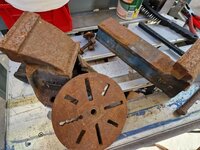
20230923_155443.jpg

I started with 2 litres of warm water and added 100g each of the EDTA and gluconate, then used some universal indicator paper to neutralise the pH with citric acid. I added 10ml or so of dish washing liquid to provide some surfactant action. Then in with the test pieces.
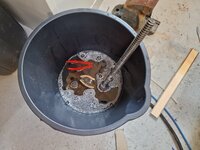
20230923_163118.jpg

I came back next day after ~20h to check up on progress. The faceplate didn't look startlingly good but I found simply brushing it with a paint brush loosened the surface crud, leaving the faceplate remarkably clear of rust. I wasn't expecting such an improvement and it didn't look as if I could improve it any further, so out it came.

20230924_120119.jpg

20230924_120123.jpg

There is some residual rust in the slots but this is simply where I didn't get the paint brush in. Apart from the fact that this is a rust remover, not a miracle metal polishing product, this is about as good as I might have hoped.

The brass bar lost a lot of its tarnish, although I'm fairly certain it has some form of lacquer or varnish protection, so some of the surface was unaffected. Either way, it's worth bearing in mind that these solutions are good for other materials than iron and steel. It would probably polish up nicely now.

20230924_201356.jpg

As for the cast iron vise parts and the vise handle, the rust there was much heavier and although initial results seemed fairly underwhelming, the surface rust came off pretty quickly with a sanding pad and only a little effort. There is some rust left but I'm expecting that will be gone after another 5h or so.

20230925_111454.jpg

Due to the shallowness of the liquid in my bucket, I was only able to immerse 1-2" of the samples, hence only the jaws were treated here.
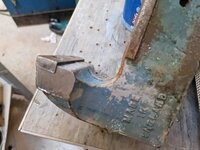
20230925_111750.jpg

20230925_111801.jpg

Not a bad result then. I will report back when the vise handle has come out again but I'm already pretty pleased with the results.

In terms of the cost, this works out about 1/3 of the cost of EvapoRust, despite having bought the chemicals from an industrial supplier. Over here in the UK, EvapoRust is about £35 for 5 litres (£7 per litre) and this stuff has come in at ~£2 per litre.

I've not attempted to do a scientific side-by-side comparison here but on the face of it, this looks fairly encouraging. If I get really carried away, I may attempt to do a direct comparison with EvapoRust.

Hope this is of interest!
 

autobon7

Well-known member
Joined
Oct 27, 2010
Messages
730

Electrolysis.....surprised this has not been mentioned yet. My preferred method by far.​


Muzzer

New member
Joined
Sep 1, 2023
Messages
4
I would expect heat and ultrasonic excitation would speed up the process but it would make a fine mess of the bath so if I'm in a hurry I might go that route, otherwise the passage of time is a simpler compromise. For small parts, you can put them in sealed containers to contain the mess but these parts would only just fit in my bath.

As I understand it, electrolysis would act rather like acid ie you'd really want to stop it when the rust is gone, otherwise you could dissolve the part - and I assume that would also apply to any clean / unrusty surfaces. On some of these parts, there is little or no rust in places to begin with. In which case, wouldn't they become eroded before the rust had gone? I work away from home during most of the week, so leaving stuff in the bucket is low risk and seems to promise good results. Once the rust has been gobbled, the process simply stops. There are some interesting examples of parts that have been left in acid too long.
 
To avoid these ads, REGISTER NOW!
Top Bottom
