To avoid these ads, REGISTER NOW!

Getting gravel foundation level

brass89

Well-known member
Joined
Sep 15, 2014
Messages
240
Hello all.. trying to get my pad set up for my shed. If I understand correctly, topsoil (loose stuff and any vegetation) comes up to get to something firm. In my case it's mostly clay. The site for my shed isn't as level as I'd like it to be.

Was hoping to create a 4x4 border and do around 6" of gravel to bring the front slightly above grade. So I'm faithfully plugging away, removing soft stuff and see that by the time I reach the front edge where the door will be (high side of natural grade), I'm gonna be around a foot or so deep - maybe more.

What are my options? Can I put a layer of concrete blocks to take up some of that space before putting the gravel down? Backfill with dirt and compact with a machine? If it's over a foot deep at the front, grade to bottom, should I stair step it (similar to a house footing)?
 
To avoid these ads, REGISTER NOW!

wnstwolf

Well-known member
Joined
Nov 7, 2007
Messages
837
Location
New York and PA
How big is the shed? Not sure where you are but crusher run or modified stone concrete dust mix is a great sub base. Soon tubes and a front step could work too depending on size of shed
 

LB-1911

ALLIANCE MEMBER
Joined
Sep 24, 2011
Messages
5,742
Location
Northwestern Il.
Prepping for a Concrete slab ?

Cut of OP's previous post in another thread -

Hi all. Planning on an 8x12 shed/workshop. The original plan was gravel under solid 8x16x4 blocks to support pressure treated 4x4 skids 12ft long. 2x6 pressure treated 16" o.c. with 3/4 pressure treated ply. I have a tool chest currently in storage that would be much more convenient if it could find a home in this shed. I'm not so confident that 2x6's spanning 4ft are sturdy enough. Some sheds use just 2 skids, some use 3 - has anyone ever used a 4th offset?
 

GS-Louie

Well-known member
Joined
Dec 10, 2013
Messages
135
Tamp down the ground where your shed will go. Get some garden steps in the largest size you can find, at least 12"X 12". Set your concrete blocks or bricks on the steps as needed to reach your desired height. Then use shims to level out the shed. You need a step at each corner and the middle, or more depending on the size of the shed. I have a 12 X 16 shed. It has about 6 ea 4 X 6 timbers the length of the shed (16'). Then there are 3 ea 6 X 6, if I remember right, these are set on the steps. It has been about 10 years since the shed was put in and it is in good shape. I parked my John Deere tractor in it, about 1100 lbs.

Lou
 

9GUY9

Well-known member
Joined
Oct 12, 2009
Messages
248
Location
Mankato, MN
Class 7 (recycled concrete) looks like gravel, and packs down rock hard. Its also very cheap, $7 a ton here.

Clay is a pretty solid base, just remove the vegetation and any loamy black dirt. Then get a min of 4" of packed rock down. If you have to fill the front that much, I would probably do as others have recommended and incorporate premade concrete steps. Or slope it back a ways so you have a ramp leading to the door.
 
OP
B

brass89

Well-known member
Joined
Sep 15, 2014
Messages
240
Sorry, yes LB-1911 is correct. I'm planning for an 8x12 shed so the area I'm preparing is 10x14 to give a foot extra around the perimeter of the shed. The ground naturally slopes from the front to the back of the shed site (and of the shed once its up). The slope from the high point of the yard to the front of the shed/base is much more gradual. From the beginning of the pad site and further back the slope increases some. As a rough estimate, along the length of the pad front to back (14' span) it's dropping around an inch a foot.

If it matters, I'm in the midwest near st louis. Frequent rain in spring/fall, anywhere from 4-8" (sometimes 12") of standing snow in winter. The particular land out here doesn't have much in the way of topsoil. For instance this summer I rented a couple of tractors to clear out some livestock pens and just below the hay/manure it quickly turned to straight clay. I dealt with caliche in the southwest before which is a type of clay but not like this stuff. This clay is moist and after a few runs over it with the tractors (a compact j.d. 40hp and a bobcat 80hp with tracks) both sunk to the axles. In another part of the yard I attempted to dig 'through' the clay trying to remove it hoping to get to something beneath it and no dice. Ended up with a trench 3ft deep and underneath was just more clay. No telling how deep this stuff is.

I'd like to avoid a concrete pad if at all possible. I did come across a suggestion to use some sort of lime to counteract the clay moving (for concrete) - would this also apply to other fills like pavers/gravel? Or is it strictly for concrete?

If I build a retaining wall/box for the pad using 4x4's with 3' rebar anchoring it and 8" spikes guessing I'll have 4 rows. Might need to incorporate deadmen along the middle. That still leaves 12"+ deep 'box' to fill in.

For gravel I have around 6t of 1" minus with fines (the guy who delivered it said it's what they use for roadbase here). I asked for 3/4 minus or crusher run and that's what he said they had/use. That should get me around 6" compacted for that size foundation. Just not sure what to use for the other 6" of fill needed. I do have some dirt but wasn't sure if that could be put in first and compacted before the 6" gravel (to bring the gravel to grade). The plan was to use 8x4x16 solid caps/pavers on the gravel, 4 rows across along the 12ft length to place 4 - 4x4x12's. The 4x4 skids would be slightly above grade, with 2x6 joists on top of that and 3/4 ply on top of that. So the floor would be around 10" above grade, then use a ramp. There's a tree stump directly in front of the planned foundation that i'll cut off at the ground and the ramp should be directly over top of it with no problem.

Should I use fill, compact, add gravel and compact with 8x4x16 concrete blocks on that? or should I lay down concrete blocks directly on the clay and stack them up like piers and put gravel around them? I'm not sure how many blocks high I can go before it becomes unstable. The only stacking I've heard of are on grade pads where people have a fairly flat ground level place to start, they pack gravel and set those cap blocks on top using the 4" thick and adding an 8x16x2" on top if it needs a couple inches to level it.

Right now if I start laying concrete blocks (4" thick 8x16's or 12x12's) I'll have 3-4 blocks high stacked directly on the clay arranged like piers - say 4 evenly spaced the 12ft length, by 4 rows (4 skids across the 8' width spanning the full 12' length) so - 16 'piers' of those concrete blocks 3 to 4 high. Would these 'piers' or stacks of blocks be left bare (ie, no fill surrounding them)? Would filling in around them do anything for stability or just be for looks?

Wnstwolf mentioned using sonotubes which I'd also considered. The clay is tough to dig through (to get a good 2-3ft deep in order to get below the frost line). Also considering the heavy clay I wasn't sure how sonotubes would fair in regards to frost heave. Best I can figure my frost depth is around 20" or so for this area (can't find anything specific but that seems to apply to st louis).

I don't know if any of this info helps, I'll try to get pictures up tomorrow if that will make things more clear. Trying to keep cost down where I can, I do have the gravel on site - just not familiar with building on clay and there's so many conflicting sources of info out there it can be confusing (ie some say clay's a good solid base, others say it's prone to sinking). I'm not as concerned with looks, that I can work around. Just something that won't have a new build sinking in a year. Obviously I need to do more than just slap a couple skids on the ground, but at the same time I'm not trying to drill 5ft deep and put in bigfoot pads for an 8x12 shed lol.
 
To avoid these ads, REGISTER NOW!
OP
B

brass89

Well-known member
Joined
Sep 15, 2014
Messages
240
I've noticed a few members here have done something similar, used a timber retaining wall to hold backfill and then gravel for the base of their shed. Is there any general consensus as to how deep of a perimeter trench to make? I tried searching, most of what I'm getting are one sided retaining walls (like along a hillside on a property) rather than a 3-4 sided 'box' meant to hold material.

I'm pretty sure there needs to be gravel, at least a couple inches beneath the treated 4x4's used for the wall. Do I need room for say 2" gravel and a 4x4 completely below grade as a starter row?
 

RickP

Well-known member
Joined
Jan 15, 2013
Messages
1,550
Location
Annapolis, MD
I've noticed a few members here have done something similar, used a timber retaining wall to hold backfill and then gravel for the base of their shed. Is there any general consensus as to how deep of a perimeter trench to make? I tried searching, most of what I'm getting are one sided retaining walls (like along a hillside on a property) rather than a 3-4 sided 'box' meant to hold material.

I'm pretty sure there needs to be gravel, at least a couple inches beneath the treated 4x4's used for the wall. Do I need room for say 2" gravel and a 4x4 completely below grade as a starter row?

You could definitely build a box -- I have plans for a shed that used 6x6s as a perimeter wall to hold in a bed of gravel. You could probably use 4x4s instead, if yours are not load bearing. Just make sure to drill vertical holes and drive rebar into the ground to keep the 4x4s from spreading. My plans were for load bearing walls, so they used 2x10s on their sides under the 6x6s as footers.

- Rick
 
OP
B

brass89

Well-known member
Joined
Sep 15, 2014
Messages
240
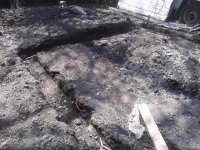
Hey guys, thanks for the input. I went ahead and jumped into it, hopefully I got it right. I think I did. Dug a trench (as wide as my square head shovel) similar to a footing for a slab, going a few inches below grade at the lowest point. Figured on 2" gravel in the bed of the trench/footing, plus 3.5" (4x4 treated)..and every time the trench reached the depth of 2 4x4's (7") I stair stepped it up..that way there's roughly 1 4x4 below grade plus the gravel beneath.

Not sure where I went wrong, managed to correct as I went. Had planned on being only 3 4x4's deep along one side and ended up 4 deep. Oh well. By the time I got the gravel in the bed of the trenches level, I was closer to 3-4" deep worth of gravel.

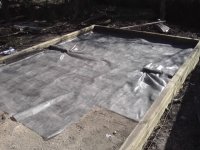
Got my 4x4's laid out, overlapping to create offsets so seams between 2 pieces didn't align vertically (staggered), the wall is only 5 4x4's deep in one small section, 3-4 deep in most areas so tiebacks/deadmen were probably overkill but figured it couldn't hurt. Sank rebar in the corners and every 4ft along the wall no less than 18" into the ground (in addition to the height of the 4x4's) so most pieces were around 32" long. Nailed each layer with galv 6" ring shanked spikes every 8-10".

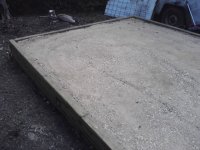
Rented a 17" plate packer, packed the dirt - laid landscape fabric, then 2 layers of gravel packing each layer. About 7-8" gravel total. Thankfully the tops of the 4x4 walls ended up dead on level along each wall and diagonally across the corners. (yes, I ran a bit short on landscape fabric - wasn't going back to the store, just wanted to get it done. good enough lol)
 

Attachments

  • P09-26-14_13-17.jpg
    P09-26-14_13-17.jpg
    140 KB · Views: 44
  • P09-29-14_12-41[1].jpg
    P09-29-14_12-41[1].jpg
    132.2 KB · Views: 41
  • P09-29-14_14-42.jpg
    P09-29-14_14-42.jpg
    133.6 KB · Views: 43
  • P09-30-14_17-30.jpg
    P09-30-14_17-30.jpg
    129.1 KB · Views: 46
OP
B

brass89

Well-known member
Joined
Sep 15, 2014
Messages
240
Thanks Rick - I was pleased with it, and glad I went with stuff that had fines in it rather than clean. Was a little concerned with it being 1" minus vs 3/4" minus like most folks use. That's all I had avail, but after running the plate packer over it it's almost like concrete. Had a few heavy rains since, washed a little of the dust down that came up after packing but still solid and no pooling water so it's draining well.
 
To avoid these ads, REGISTER NOW!
Top Bottom