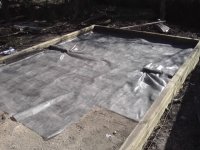
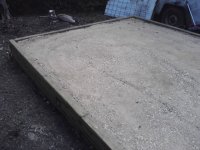
Sorry, yes LB-1911 is correct. I'm planning for an 8x12 shed so the area I'm preparing is 10x14 to give a foot extra around the perimeter of the shed. The ground naturally slopes from the front to the back of the shed site (and of the shed once its up). The slope from the high point of the yard to the front of the shed/base is much more gradual. From the beginning of the pad site and further back the slope increases some. As a rough estimate, along the length of the pad front to back (14' span) it's dropping around an inch a foot.
If it matters, I'm in the midwest near st louis. Frequent rain in spring/fall, anywhere from 4-8" (sometimes 12") of standing snow in winter. The particular land out here doesn't have much in the way of topsoil. For instance this summer I rented a couple of tractors to clear out some livestock pens and just below the hay/manure it quickly turned to straight clay. I dealt with caliche in the southwest before which is a type of clay but not like this stuff. This clay is moist and after a few runs over it with the tractors (a compact j.d. 40hp and a bobcat 80hp with tracks) both sunk to the axles. In another part of the yard I attempted to dig 'through' the clay trying to remove it hoping to get to something beneath it and no dice. Ended up with a trench 3ft deep and underneath was just more clay. No telling how deep this stuff is.
I'd like to avoid a concrete pad if at all possible. I did come across a suggestion to use some sort of lime to counteract the clay moving (for concrete) - would this also apply to other fills like pavers/gravel? Or is it strictly for concrete?
If I build a retaining wall/box for the pad using 4x4's with 3' rebar anchoring it and 8" spikes guessing I'll have 4 rows. Might need to incorporate deadmen along the middle. That still leaves 12"+ deep 'box' to fill in.
For gravel I have around 6t of 1" minus with fines (the guy who delivered it said it's what they use for roadbase here). I asked for 3/4 minus or crusher run and that's what he said they had/use. That should get me around 6" compacted for that size foundation. Just not sure what to use for the other 6" of fill needed. I do have some dirt but wasn't sure if that could be put in first and compacted before the 6" gravel (to bring the gravel to grade). The plan was to use 8x4x16 solid caps/pavers on the gravel, 4 rows across along the 12ft length to place 4 - 4x4x12's. The 4x4 skids would be slightly above grade, with 2x6 joists on top of that and 3/4 ply on top of that. So the floor would be around 10" above grade, then use a ramp. There's a tree stump directly in front of the planned foundation that i'll cut off at the ground and the ramp should be directly over top of it with no problem.
Should I use fill, compact, add gravel and compact with 8x4x16 concrete blocks on that? or should I lay down concrete blocks directly on the clay and stack them up like piers and put gravel around them? I'm not sure how many blocks high I can go before it becomes unstable. The only stacking I've heard of are on grade pads where people have a fairly flat ground level place to start, they pack gravel and set those cap blocks on top using the 4" thick and adding an 8x16x2" on top if it needs a couple inches to level it.
Right now if I start laying concrete blocks (4" thick 8x16's or 12x12's) I'll have 3-4 blocks high stacked directly on the clay arranged like piers - say 4 evenly spaced the 12ft length, by 4 rows (4 skids across the 8' width spanning the full 12' length) so - 16 'piers' of those concrete blocks 3 to 4 high. Would these 'piers' or stacks of blocks be left bare (ie, no fill surrounding them)? Would filling in around them do anything for stability or just be for looks?
Wnstwolf mentioned using sonotubes which I'd also considered. The clay is tough to dig through (to get a good 2-3ft deep in order to get below the frost line). Also considering the heavy clay I wasn't sure how sonotubes would fair in regards to frost heave. Best I can figure my frost depth is around 20" or so for this area (can't find anything specific but that seems to apply to st louis).
I don't know if any of this info helps, I'll try to get pictures up tomorrow if that will make things more clear. Trying to keep cost down where I can, I do have the gravel on site - just not familiar with building on clay and there's so many conflicting sources of info out there it can be confusing (ie some say clay's a good solid base, others say it's prone to sinking). I'm not as concerned with looks, that I can work around. Just something that won't have a new build sinking in a year. Obviously I need to do more than just slap a couple skids on the ground, but at the same time I'm not trying to drill 5ft deep and put in bigfoot pads for an 8x12 shed lol.


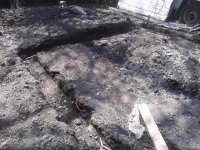
![P09-29-14_12-41[1].jpg](/forum/data/attachments/283/283104-af6d81779e1c8f7d5b9761f1c1aa4f42.jpg)