To avoid these ads, REGISTER NOW!

GFI breaker tripping

thammel

Well-known member
Joined
Oct 3, 2005
Messages
2,259
Location
Maryland
I have a circuit which powers the outside receptacles and lights in one room. Previously, the room with the lights had a GFCI receptacle to which the outside receptacles were connected. Every time an O/S current drain was too large, or a ground fault was detected, that receptacle would trip; problem is that it was behind some furniture and was a pain. So I thought I'd just put the entire circuit on a GFCI breaker (square d QO) and replace the GFCI receptacle with a normal one. Sounds good, right? The darn breaker has been tripping for no apparent reason. Any ideas why? Faulty breaker?

Thanks for your comments and experiences!
Tom
 
To avoid these ads, REGISTER NOW!

Sonorous

Well-known member
Joined
Aug 10, 2013
Messages
102
Location
Ottawa/Outaouais/MTL Canada
I have a circuit which powers the outside receptacles and lights in one room. Previously, the room with the lights had a GFCI receptacle to which the outside receptacles were connected. Every time an O/S current drain was too large, or a ground fault was detected, that receptacle would trip; problem is that it was behind some furniture and was a pain. So I thought I'd just put the entire circuit on a GFCI breaker (square d QO) and replace the GFCI receptacle with a normal one. Sounds good, right? The darn breaker has been tripping for no apparent reason. Any ideas why? Faulty breaker?

Thanks for your comments and experiences!
Tom

I'm not sure what you mean by "O/S current drain", but I'd just to some basic troubleshooting. It sounds like it's only outside receptacles and the inside light. I'd try to start from the 'busiest' part of the circuit to make sure nothing else is sharing the neutral line on the load side. After that just inspect each receptacle/box. If you pull the first one and everything is okay, you'll know it is either that receptacle or one of them upstream.
 

justsam

Well-known member
Joined
Aug 20, 2010
Messages
1,271
Location
Penngrove, California
Every time an O/S current drain was too large, or a ground fault was detected, that receptacle would trip
Thanks for your comments and experiences!
Tom

Large current drain, assuming it is less than breaker rating, will not cause a GFI breaker to trip. It only looks for line and neutral currents to be equal.

Double check your new install to make sure there is no ground to neutral short.

Does it trip right away or only when devices are plugged in?
 

Rookie2

Well-known member
Joined
Feb 27, 2013
Messages
1,925
Location
Western Pa.
I would eliminate one receptacle or light at a time until you find the cause of tripping. It could be a lamp cord, a skinned wire inside a metal box or a staple driven too hard over romex and cutting into the insulation. I had an old trouble light that when i stepped on the cord it would trip the GFCI !
 

Sonorous

Well-known member
Joined
Aug 10, 2013
Messages
102
Location
Ottawa/Outaouais/MTL Canada
I would eliminate one receptacle or light at a time until you find the cause of tripping. It could be a lamp cord, a skinned wire inside a metal box or a staple driven too hard over romex and cutting into the insulation. I had an old trouble light that when i stepped on the cord it would trip the GFCI !

See the extension cord thread. You're lucky it shorted to ground and not neutral!
 
To avoid these ads, REGISTER NOW!

Rookie2

Well-known member
Joined
Feb 27, 2013
Messages
1,925
Location
Western Pa.
no. i think the current can 'leak ' to the concrete floor. any path other than neutral will trip it.
 

landyacht

Well-known member
Joined
Mar 26, 2011
Messages
71
Location
Langley BC
My guess is one of the plugs in the room has the ground (bare) wire resting against the neutral screws on the side of the outlet which will trip it right away. Or the breaker might be connected to the wrong neutral
 

Sonorous

Well-known member
Joined
Aug 10, 2013
Messages
102
Location
Ottawa/Outaouais/MTL Canada
no. i think the current can 'leak ' to the concrete floor. any path other than neutral will trip it.

"Short" was a poor word choice. I agree any path other than the neutral going back to that GFCI will trip it, but the remaining options are the ground conductor and 'real' ground.

Grounded devices are meant to send any leaking current back through through the low resistance ground path to trip the GFCI right away. Without a ground wire, your metal trouble light could still become energized and would remain so until it found a path to ground, whether you or something else with sufficiently low resistance.

The GFCI is meant to trip above 6 mA but not below 4 mA. At 120v, 5 mA means a maximum cumulative resistance of 24000 ohms, or 0.024 megohms. That's orders of magnitude below the resistance that insulated cables should have, no matter how old old.

To put that in perspective, one centimetre (under half an inch) of tap water would range from 1500 ohms to 50000 ohms(0.0015 to 0.05 megohms) in resistance. So you're into the range of dunking a grounded extension cord into a bucket of water, with current flowing the short distance from hot to ground, to have the GFCI trip. In other words, the insulation would have to be seriously defective (i.e. cracked, or open in some manner) to leak even that amount of current to ground.

Usually if an ungrounded wire/cord is causing the GFCI to trip, it's because there are gashes in the cord and it's sitting on wet conductive ground/concrete or actually submerged to provide the necessary resistive leakage. There's just too much resistance if the insulated conductors are in tact. Of course at the plug and receptacle, the bare metal is much more vulnerable to leaking, but we're talking about the cord itself here.

So I guess what I'm saying is that if the insulation was bad enough to leak that much current anywhere, there's a good chance the insulation on the other conductors was in similar shape and would present a much lower resistance path to ground than a dry concrete floor.

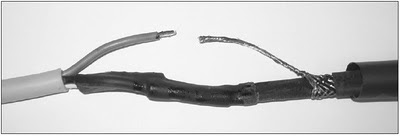
An example of the above is a heating cable for the plastic well pipe that was tripping the GFCI. A backhoe had compromised the insulation at some point and the heating cable would trip intermittently if the ground was hooked up. See the pic.
gfst-1_5.jpg


Even though the pipe went down to a metal well casing deep into the ground, the resistance of the water was too great to cause the trip without the ground. Even then it was only trip sometimes. The solution was to open of the heat shrink between the heating cable and plug cord because the water was working its way up to the **** connectors, which was leading to more current leaking. Once that was dried out the problems went away, which also reminds us that for nuisance tripping the aggregate leakage is what matters. Minimizing the potential sources for leakage (i.e. fewer connections, fewer devices) will usually help.
 

Zeke

Well-known member
Joined
Aug 13, 2009
Messages
17,176
Location
Long Beach CA, the sewer by the sea.
Getting back on track, the OP said the GFCI trips occasionally when it encountered a fault andd he wrongly suspected the outside current was too much for the GFCI iteslf. The answer is of course to move the GFCI from inside behind furniture and to the first outside device in the circuit. That won't solve any problems except the thing being hard to get to.

After that the circuit needs to be gone through thoroughly to determine what is causing the problem. Moisture comes to my mind. I don't see the need to use a GFCI breaker but the OP already purchased it thinking he could solve a problem with a new band aid.

If there is more info to go on we could help more.
 

G_P

Well-known member
Joined
Jul 11, 2010
Messages
7,135
Location
Central CT
I had this same problem. Turns out the seals on the cover for an outside outlet had dried out and crumbled. If wind blew rain onto the outlet it would sometimes cause the GFCI to trip. I put new covers on the outside outlets and have not had one single trip since.
 
OP
T

thammel

Well-known member
Joined
Oct 3, 2005
Messages
2,259
Location
Maryland
To simplify things, I'm going back to a regular breaker and GFI receptacles outside. That is much more practical. If a breaker trips, it is easily reset at the outside source. Thanks for all your comments!
Tom
 
To avoid these ads, REGISTER NOW!
Top Bottom