no. i think the current can 'leak ' to the concrete floor. any path other than neutral will trip it.
"Short" was a poor word choice. I agree any path other than the neutral going back to that GFCI will trip it, but the remaining options are the ground conductor and 'real' ground.
Grounded devices are meant to send any leaking current back through through the low resistance ground path to trip the GFCI right away. Without a ground wire, your metal trouble light could still become energized and would remain so until it found a path to ground, whether you or something else with sufficiently low resistance.
The GFCI is meant to trip above 6 mA but not below 4 mA. At 120v, 5 mA means a maximum cumulative resistance of 24000 ohms, or 0.024 megohms. That's orders of magnitude below the resistance that insulated cables should have, no matter how old old.
To put that in perspective, one centimetre (under half an inch) of tap water would range from 1500 ohms to 50000 ohms(0.0015 to 0.05 megohms) in resistance. So you're into the range of dunking a grounded extension cord into a bucket of water, with current flowing the short distance from hot to ground, to have the GFCI trip. In other words, the insulation would have to be
seriously defective (i.e. cracked, or open in some manner) to leak even that amount of current to ground.
Usually if an ungrounded wire/cord is causing the GFCI to trip, it's because there are gashes in the cord and it's sitting on wet conductive ground/concrete or actually submerged to provide the necessary resistive leakage. There's just too much resistance if the insulated conductors are in tact. Of course at the plug and receptacle, the bare metal is much more vulnerable to leaking, but we're talking about the cord itself here.
So I guess what I'm saying is that if the insulation was bad enough to leak that much current anywhere, there's a good chance the insulation on the other conductors was in similar shape and would present a much lower resistance path to ground than a dry concrete floor.
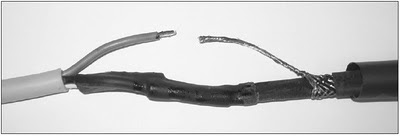
An example of the above is a heating cable for the plastic well pipe that was tripping the GFCI. A backhoe had compromised the insulation at some point and the heating cable would trip intermittently
if the ground was hooked up. See the pic.
Even though the pipe went down to a metal well casing deep into the ground, the resistance of the water was too great to cause the trip without the ground. Even then it was only trip sometimes. The solution was to open of the heat shrink between the heating cable and plug cord because the water was working its way up to the **** connectors, which was leading to more current leaking. Once that was dried out the problems went away, which also reminds us that for nuisance tripping the aggregate leakage is what matters. Minimizing the potential sources for leakage (i.e. fewer connections, fewer devices) will usually help.