here is the info that Chrislehr linked to
Acquisition by Hydrometals
In 1968 Lawton Shurtleff agreed to sell Thorsen Manufacturing to Hydrometals, Inc., an industrial conglomerate. The intended acquisition was noted in the August 15, 1968 issue of The New York Times. The transaction was structured as a stock swap and appears to have closed in early 1969, based on the information in an SEC News Digest from April 14, 1969, which notes that Hydrometals had filed to register securities for a secondary offering. Thorsen continued in operation as a division of Hydrometals, with Shurtleff remaining as the CEO until 1977.
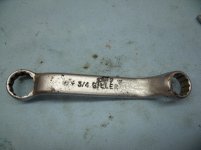
Giller Tool
Hydrometals had previously acquired the Giller Tool Corporation of Dallas in 1963, with the acquisition noted in the November 15, 1963 issue of The New York Times. Giller appears to have operated primarily as a defense contractor, and the February 19, 1966 issue of The New York Times notes that the Giller division of Hydrometals had received $1.9 million in new defense contracts. After the 1969 acquisition of Thorsen, Hydrometals reorganized its subsidiaries to make Giller Tool an operating division of Thorsen Manufacturing.
It's not known whether Giller Tool had its own manufacturing facilities or made use of contract manufacturers; however, as a division of Thorsen, Giller would have had access to Thorsen's manufacturing equipment. This helps resolve a long-running mystery concerning the close resemblance of many Giller-marked tools with the corresponding Thorsen model.
Later History
In 1977 Hydrometals was acquired by Wallace Murray, another industrial conglomerate. In the late 1970s Thorsen moved its headquarters to Dallas, Texas and built a large manufacturing facility there, and somewhere along the way the corporate name changed to the Thorsen Tool Company. During this period the company appears to have devoted more resources to tool engineering, as the only known tool patents assigned to Thorsen were filed in the early 1980s. There was also a resurgence of interest in trademarks, with a number of applications being filed around this time.
Some time later Thorsen appears to have run into financial trouble, and the new factory was sold, possibly to National Hand Tool. The Thorsen operations (possibly just the name and trademarks) were eventually acquired by Elgin National, originally a manufacturer of watches. Elgin also owned GC Electronics, a maker of supplies and tools for the electronics industry, and at some point GC Electronics and Thorsen Tool were merged to form GC Thorsen, Inc. as a subsidiary of Elgin.
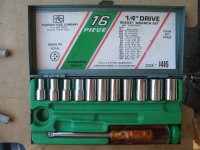
A 1995 catalog from GC Thorsen lists the address of Thorsen Tool as 1801 Morgan Street in Rockford, Illinois, and notes that Thorsen had been providing tools since 1926, with more than 2,000 tools in their current product line. The catalog offers sockets and drive tools in 1/4, 3/8, and 1/2-drive, plus a variety of wrenches, pliers, screwdrivers, air tools, and some specialty tools. The catalog illustrations show highly polished chrome finishes, with knurled handles on ratchets and raised panels on the wrenches. However, by this time Thorsen is believed to have sourced most (if not all) of their tools from other manufacturers.
In 1995 GC Thorsen was purchased from Elgin National by Katy Industries. (As Katy is a public company, numerous records of this transaction are reported online.) Under Katy the Thorsen Tool operations were separated from GC Electronics, and an annual report for 2000 listed Thorsen Tool as a value-added distributor, with tools sourced primarily from Asia. In 2001 Thorsen was acquired by Olympia Group, a distributor of hand tools and related products.

 I'll be keeping it here in the toolbox for quite a while.