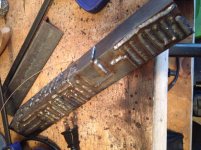
I also was getting a lot of pop corn starts which once held a second would turn into the bacon sizzle sound so I could run my bead. Is this normal when you first start the bead? I had to lower my wire feed settings down to about 28 from the suggested 40. A little strange?
flux core seemed to be easier - perhaps more forgiving with the settings to get a good bead running.
Seemed to be getting more slag build up inside the tip of my gun compared to the flux. Am I holding it too close? If I pull away the arc kind of loses its "bacon".
Also - do you guys still have to clean your beads when doing the Gas MIG vs. flux? I know with flux I always took a wire wheel on a drill to clean up the beads after and they looked shiny and great. I thought with gas I wouldnt have to do that. Its certainly LESS dirty but to get it to shine nice it still needs to be wire wheeled in my experience so far.
thanks for the info
re: popcorn starts
Probably because you are trying to initiate the arc on top of that mill scale on the hot rolled steel.

Clean the mill scale off before welding.
(yes, some welding processes can 'tolerate' various amounts of non-metal. Flux/slag processes can usually tolerate the most crud. SMAW, aka stick welding, with certain electrodes can tolerate the most crud/****. Some FCAW wires can tolerate a bit of crud, GMAW aka MIG can tolerate a bit less (usually, again depending on the exact wire chemistry as an S6 wire has a bit more silicon deoxidizers in it than say an S2 wire and can usually tolerate a bit more mill scale). GTAW aka TIG can tolerate the least amount, usually almost none, of crud.)
But you
ALWAYS get a better weld if you are welding on clean shiny metal. Sometimes you can get OK results with some crud on the metal (SMAW), but you always get better weld results if you are welding on clean shiny metal.
Some FCAW wires are 'easy' to set parameter-wise. Some (industrial type) FCAW wires can be very-very picky about the welding parameters (voltage and amperage/WFS and CTWD aka 'stick-out').
GMAW with solid wire is usually 'cleaner' than FCAW (because there is no real slag and smoke 'shield' to deal with). The shield in GMAW is the shield gas (clean), while the shield in FCAW is the 'smoke' from the flux core burning off.
But yes, even 'decent' GMAW weld beads usually need at least a little bit of clean up with a wire wheel (on an angle grinder). The 'power' of an angle grinder is leaps-and-bounds above what you can usually do with a 3/8" drill. Something to do with the wires (or grinding wheel or flap disk, etc) spinning at around 10,000+ rpm (typical speed of a 4-1/2" angle grinder) versus maybe around 2000 rpm for a 3/8" drill.
re: starting the gas flow and wire feed
When I am first setting up to do some MIG welds, I'll purge the gas lines for a few seconds to make sure I have actual shield gas. To not be wasting wire while doing that (my machines don't have an actual "purge" mode, some machines do), I either just turn down the WFS dial as low as it goes or just pop open the drive roller arm temporarily and then trigger the gun to let some gas flow (a few seconds). Depending on just how much wire came out (some with the WFS turned all the way down versus none with the drive rollers disengaged), I either just snip the wire off or just back-wind the spool a little bit. A couple of inches of wire out of the 10,000+ inches of wire on a spool is pretty much nothing. A couple of feet (2-3, not 10!!) of wire spit out from the gun means I didn't pay attention and turn the WFS down all the way or disengage the drive rollers.
re: tip distance from the weld
For 'small' wires on 'small' machines (either solid wire GMAW in short circuit transfer mode, which is all the 'small' machines can typically do, or the usual NR-211MP small diameter FCAW wire in 0.035 diameter) the 'stick out' (aka CTWD or contact tip work distance) is supposed to be about 1/2" (3/8" to 5/8" is what the spec/parameter sheets usually say). RTFM for the machine and the wire and see what you are supposed to be using for the CTWD for the wire type and size and machine.
Although GMAW beads can certainly 'benefit' from at least a quick clean-up with a wire wheel (on an angle grinder
), they can and should look a bit cleaner and shinier than what your beads on that angle iron looked like. Which (from one picture, over the 'Net, etc) sort of says to me that your technique and/or parameters and/or setup need some more work and practice. Halfway 'decent' GMAW beads using C25 gas could (and should) be mostly shiny with a few 'glassy' (often kind of amber looking) silicon islands here and there (from the silicon deoxidizer in the wire electrode doing its job and combining with any 'oxides' like mill scale during the weld process and turning into little glassy silicon dioxide 'islands').
That dull grey look on your beads sort of says to me that the shielding gas wasn't there long enough (the shielding gas should be a 'blanket' or gas puddle/bubble around the weld puddle and also around the still hot weld bead) or pulled in some air (and thus nitrogen and oxygen) because of gun/work piece angle or position or a draft/breeze, etc. Technique and/or set up (gas flow rate, more is not always better and in fact too high of a gas flow rate can actually pull in air via the venture effect).
Porosity in the weld bead with GMAW usually means you really have a major shielding gas issue, but the dull grey oxidized look means that shielding gas 'things' can still be improved upon, at least a little bit.


 .
. did I real just type that?