To avoid these ads, REGISTER NOW!

Gosiger Drill Press and Sheldon Lathe

bigcreek

Well-known member
Joined
May 11, 2013
Messages
387
Location
Idaho
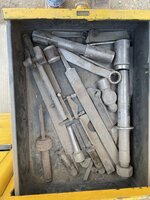
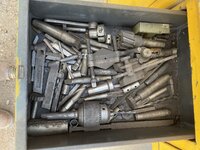
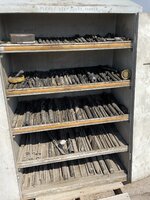
I just bought this drill press and lathe from a forest service shop. The drill press had to be around 9' tall and came with a cabinet of drill bits. It came with a big machinest vice and some hold down clamps. I already dumped it off at an auction as I dont need another drill press, but I did keep the vice and hold down clamps. But out of curiosity have you heard of the brand Gosiger from Dayton, OH? The drill press also said Edmund machinery company. I was curious as to its age if anyone knows approximately what decade it might be from. The press and lathe sold together as one lot hence why I bought the press although it was the lathe I was after. I know literally nothing about lathes but two of my best friends are machinests so I will pick their brains and Id like to take a couple classes at the local trade school on how to use a lathe. I took a tour of the CWI facility in Nampa, ID and he told me they start students out on the manual lathes then into cnc. Im not interested in the cnc but for a long time Ive wanted to learn how to use a lathe so here I go. The lathe is a Sheldon brand. Is it any good? 56" bed length. The guys at the forest service told me it worked just fine when retired. I have no clue what the stuff is in these drawers either.. There is a tag on it that says rebuilt by Sugita with 1953 on the bottom of tag. Dont know if thats the year it was built or year it was rebuilt but dang thats pretty old. Is a machine like this a decent one to learn on? I am going to have to put a VFD on it as it is a 3 phase and I do happen to have a spare 5HP VFD sitting on the shelf so that works out. FYI I paid $1100 for all of it. I figured I can get a few hundred + for the drill press and bits and maybe Ill only be into the lathe no more than $800 after the drill press sells. Does it even look like the lathe is completelathe 112.JPG? I really dont know what a lathe like this would be worth because I looked on Craigslist and prices were all over the board. The other drawer also is full of stuff but I couldnt attach an 11th picture.
 

Attachments

  • lathe 129.JPG
    lathe 129.JPG
    376.1 KB · Views: 78
  • lathe 127.JPG
    lathe 127.JPG
    384.4 KB · Views: 75
  • lathe 126.JPG
    lathe 126.JPG
    405 KB · Views: 73
  • lathe 125.JPG
    lathe 125.JPG
    437.1 KB · Views: 82
  • lathe 119.JPG
    lathe 119.JPG
    486.1 KB · Views: 114
  • lathe 116.JPG
    lathe 116.JPG
    435.7 KB · Views: 118
  • lathe 109.JPG
    lathe 109.JPG
    397.2 KB · Views: 119
  • lathe 113.JPG
    lathe 113.JPG
    395.3 KB · Views: 87
To avoid these ads, REGISTER NOW!

larry_g

Well-known member
Joined
Apr 28, 2007
Messages
16,893
Location
oregon

The above link is to what I believe your lathe is. The single handle on the quick change is a clue to the early lathe. That said I have two Sheldon lathes and they are a good lathe. Mine are a bit newer than yours but the last lathe that I will need.

And a 'you ****' for the deal.

lg
no neat sig line
 

rustyzman

Well-known member
Joined
May 7, 2015
Messages
772
Location
Chicagoland
I have a Walking Stick WS-46P 11"x46" Sheldon I converted to a 16 speed belt pulley E drive many years ago. Mine is the newer stand model from 1957 with the two lever tumbler. They are very nicely made lathes. Though the beds are not hardened, they have good mass and are fairly stout for their size. Even my old worn one can still make very accurate parts with diligence and patience. I have used it many times to make inspection and assembly fixtures for work on some very tight tolerance components.

That wrench in the sixth picture looks like a Sheldon wrench made for the tailstock clamp bolt. The picture also has what might be a square box end wrench for the carriage lock and threading dial clamping bolt.

Nice sized chuck on there as well.

Most of the old ones I believe are a 2.25"-8tpi threaded spindle nose. Mine is. Common size in case you want to get faceplates or alternate chucks.

That looks like an E style drive of either 8 or 16 speeds depending on if the motor and countershaft main pulleys have two Vee's or just one. It is a nice design and sturdy.

Clean it up, lube it all and enjoy it!
 
OP
B

bigcreek

Well-known member
Joined
May 11, 2013
Messages
387
Location
Idaho
The drill press is an Edlund. Gosiger is a machinery dealer.
Thank you for the inf
I have a Walking Stick WS-46P 11"x46" Sheldon I converted to a 16 speed belt pulley E drive many years ago. Mine is the newer stand model from 1957 with the two lever tumbler. They are very nicely made lathes. Though the beds are not hardened, they have good mass and are fairly stout for their size. Even my old worn one can still make very accurate parts with diligence and patience. I have used it many times to make inspection and assembly fixtures for work on some very tight tolerance components.

That wrench in the sixth picture looks like a Sheldon wrench made for the tailstock clamp bolt. The picture also has what might be a square box end wrench for the carriage lock and threading dial clamping bolt.

Nice sized chuck on there as well.

Most of the old ones I believe are a 2.25"-8tpi threaded spindle nose. Mine is. Common size in case you want to get faceplates or alternate chucks.

That looks like an E style drive of either 8 or 16 speeds depending on if the motor and countershaft main pulleys have two Vee's or just one. It is a nice design and sturdy.

Clean it up, lube it all and enjoy it!
That is great to hear. Glad it is a quality machine. Pretty much everything built back then was high quality but I feel good about the purchase. I didnt know what I was or wasnt getting with a lathe when I bought it so sounds like I did ok. Thank you.
 

Aaron_W

Well-known member
Joined
Feb 6, 2018
Messages
2,931
Location
Northern California
I'm not very familiar with Sheldon, but it seems to be a respected brand.

From the photos it looks complete, but no way to tell if it is any good without an in person inspection, and test cuts. Could be like new or completely worn out, but unless it is shot $800 is a great deal for a decent lathe that size. Even if the lathe is scrap you've still probably got $800 in parts and tooling there.
 

slowtwitch73

Well-known member
Joined
Apr 18, 2019
Messages
5,876
Location
Hellgate
^^^ what he says.

When buying tools that were stored with horse tack, you gotta wonder if if it was rode hard and put away wet!
 

RoninB4

Well-known member
Joined
Jul 22, 2020
Messages
3,610
Location
Under My House
I worked for Sheldon lathe in the 80's when they went bankrupt. Sheldon isn't a Monarch but they made a respectable manual lathe for decades. Is yours good enough? That would depend upon what you want to do with it. If it's making precision components for scientific instruments then this isn't a good choice. If it's repair to farm equipment, single point threading, occasional bushing/shaft fabricating, and polishing of said components then it should do just fine for general work like that. It's not stout enough for peeling a 1/4" DOC (depth of cut) in one pass but if could take 1/8" DOC if you're careful. I'd say you got a solid first time lathe for low cost and will offer the obligatory "You ****" as a congratulations. :beer:

Some things to check- Carefully examine all the gears for damage, particularly the back/bull gears used for low speeds. Too often these were used to "lock" the spindle when loosening/changing the chuck. If damaged, it may be expensive to replace/repair. All gears should be cleaned (in assembly is ok) to remove grit/swarf/chips from the internals. Flush all fluid compartments and replace the fluids per the manual. Upon start-up go through ALL the speeds noting excessive noise, heat, and vibration. The bed-way should also be cleaned and wiped down with a THIN film of oil, way oil is best to use. Remove the tail-stock and clean the underside, spindle, and oil both. Inspect the rack, cross feed, and saddle. Clean/oil all moving surfaces. Cleaning and re-oiling is important but total dis-assembly of the apron/headstock is a big job and not really required before you determine if the lathe is worth the trouble or not. Just clean and oil everything you can easily get to at this point.

If the bearings are shot or the bed is worn out then you'll have to decide whether to just run as-is or sell it. Plenty of worn-out lathes still making parts, just need to learn different techniques of tricking the machine into accuracy.

Other tooling- You may want to keep some of those drills from the DP you have (impressively large DP I'd want and can't keep). Some of those drills may help you with lathe jobs IF they'll fit in the tail stock. Large drills are expensive to purchase and don't bring much on the resale. So you may want to keep some for yourself, measure all of them (some have the size stamped on the drill itself) and report back. Perhaps some of us can suggest what to keep or not. You also have what looks like a few barrel laps. Those would be good for making a close fitting bushing fit a shaft. I'd keep them but I know what to do with them, they may sit for a few years before you'll need them. If you have to sell the DP (too bad) I'd just sell the bare machine and keep anything else you got in the purchased lot. Identify what it all is and whether you'll need it before letting it go for pennies on the dollar to replace it.

OT- I've still got a new, original Buck 4 jaw chuck that used to come with a Sheldon. As we shut down the company for bankruptcy just before Christmas a lot of things were being cleared out and thrown away. One of those original chucks went home with me and I've never used it. Must be from 1982 or so.
 
Last edited:

rustyzman

Well-known member
Joined
May 7, 2015
Messages
772
Location
Chicagoland
I worked for Sheldon lathe in the 80's when they went bankrupt. Sheldon isn't a Monarch but they made a respectable manual lathe for decades. Is yours good enough? That would depend upon what you want to do with it. If it's making precision components for scientific instruments then this isn't a good choice. If it's repair to farm equipment, single point threading, occasional bushing/shaft fabricating, and polishing of said components then it should do just fine for general work like that. It's not stout enough for peeling a 1/4" DOC (depth of cut) in one pass but if could take 1/8" DOC if you're careful. I'd say you got a solid first time lathe for low cost and will offer the obligatory "You ****" as a congratulations. :beer:

Some things to check- Carefully examine all the gears for damage, particularly the back/bull gears used for low speeds. Too often these were used to "lock" the spindle when loosening/changing the chuck. If damaged, it may be expensive to replace/repair. All gears should be cleaned (in assembly is ok) to remove grit/swarf/chips from the internals. Flush all fluid compartments and replace the fluids per the manual. Upon start-up go through ALL the speeds noting excessive noise, heat, and vibration. The bed-way should also be cleaned and wiped down with a THIN film of oil, way oil is best to use. Remove the tail-stock and clean the underside, spindle, and oil both. Inspect the rack, cross feed, and saddle. Clean/oil all moving surfaces. Cleaning and re-oiling is important but total dis-assembly of the apron/headstock is a big job and not really required before you determine if the lathe is worth the trouble or not. Just clean and oil everything you can easily get to at this point.

If the bearings are shot or the bed is worn out then you'll have to decide whether to just run as-is or sell it. Plenty of worn-out lathes still making parts, just need to learn different techniques of tricking the machine into accuracy.

Other tooling- You may want to keep some of those drills from the DP you have (impressively large DP I'd want and can't keep). Some of those drills may help you with lathe jobs IF they'll fit in the tail stock. Large drills are expensive to purchase and don't bring much on the resale. So you may want to keep some for yourself, measure all of them (some have the size stamped on the drill itself) and report back. Perhaps some of us can suggest what to keep or not. You also have what looks like a few barrel laps. Those would be good for making a close fitting bushing fit a shaft. I'd keep them but I know what to do with them, they may sit for a few years before you'll need them. If you have to sell the DP (too bad) I'd just sell the bare machine and keep anything else you got in the purchased lot. Identify what it all is and whether you'll need it before letting it go for pennies on the dollar to replace it.

OT- I've still got a new, original Buck 4 jaw chuck that used to come with a Sheldon. As we shut down the company for bankruptcy just before Christmas a lot of things were being cleared out and thrown away. One of those original chucks went home with me and I've never used it. Must be from 1982 or so.
Very Cool and good info.
I used to pass by the old Sheldon factory a lot when I was doing fire inspections for a few years.
Was John Knox there when you were? He was my go to for Sheldon info when I first got mine, as we were only a few blocks from each other. Great guy, really helpful.

That 4 jaw would be awesome. I have a nice Bison three jaw, a cobbled up smaller 4 jaw and an really nice old aftermarket 5c collet closer for mine.

Great point on locking up the back gear to remove the threaded chuck. Don't do it. Many have, and those gears can break quite easily.
Be sure to fully lube the back gear shaft and the spindle sleeve bearing if you are using the back gear too. Lube it each day you use the back gear as It will gall and fail if you do not. Get a copy of the manual for the machine.

I don't know if the older units had the Fiber gear on the leadscrew drivetrain, but it is a weak point as well and can fail if the load on the leadscrew is too high or a the machine has a crash when threading. I know that there is a seller on ebay making 3d printed replacements, but I am not sure if they are any good.

Couple download links http://vintagemachinery.org/pubs/detail.aspx?id=17056


MBfreak

MEMBER EMERITUS
Joined
Dec 10, 2010
Messages
2,301
Location
Linkoping , Sweden
The Edlund drill press is a monster and many machine shops in Sweden had them them. Very expensiv nowadays. Better than the already very good ARBOGA drill presses.
I love the stand for the lathe. Left side angled. For what reason??

Ola
 

RoninB4

Well-known member
Joined
Jul 22, 2020
Messages
3,610
Location
Under My House
Very Cool and good info.
I used to pass by the old Sheldon factory a lot when I was doing fire inspections for a few years.
Was John Knox there when you were? He was my go to for Sheldon info when I first got mine, as we were only a few blocks from each other. Great guy, really helpful.
Somewhat OT- I believe John was there for the bitter end. I hired in at the satellite toolroom that was behind Klein Tool (Across from Bell & Howell on Lehigh) and when it was "consolidated" (bought by Acme Cleveland) we packed up everything and moved to the Knox Ave. main plant behind Houston Foods.

The company was trying to move forward into the future (NC machinery was the future) by designing a tape reader mill and a large slant bed lathe. A lot of cash and man hours went into development of those two machines but the economy wasn't robust back then and nobody bought them. So Sheldon loaded up and went to the IMTS (International Machine Tool Show) at McCormick Place where they were sure some buyers would step up, none or not enough did. The prototypes were brought back to Knox Ave. and slowly dismantled, disappearing one assembly group at a time.

We in the tool room dept. were handed rush orders on somewhat complex parts for Acme Cleveland while the lathe builders filled the last orders. It almost seemed like those rushed parts were another reason to justify closing the doors because the parts sat on the shipping dock for a week after the due date. The official last day was about two weeks before Christmas......the union had secured us a raise at Thanksgiving. John Knox may have been one of the few engineers that tried really hard to keep the company alive but too little too late in a technology they were slow to adapt and unfamiliar with. I doubt John took the closing any better than we did. I liked working there and was sorry to see yet another example of the Machine Tool Builders of America go down that way. The years/decades that followed were not kind to manufacturing either.
 
Last edited:

rustyzman

Well-known member
Joined
May 7, 2015
Messages
772
Location
Chicagoland
The Edlund drill press is a monster and many machine shops in Sweden had them them. Very expensiv nowadays. Better than the already very good ARBOGA drill presses.
I love the stand for the lathe. Left side angled. For what reason??

Ola
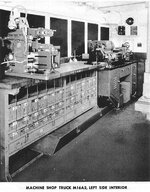
As I understand it, that cabinet was a design of WWII. The angled section was clearance for the rear wheel well of the truck mounted mobile machine shop. Someone mentioned once that one side of the lathe bed on the truck mounted ones was a releasable swivel joint that was loosened when driving so as not to torque the machine bed on rough roads. Never saw it myself though.
machine shop (1).jpg
 
Last edited:

rustyzman

Well-known member
Joined
May 7, 2015
Messages
772
Location
Chicagoland
Somewhat OT- I believe John was there for the bitter end. I hired in at the satellite toolroom that was behind Klein Tool (Across from Bell & Howell on Lehigh) and when it was "consolidated" (bought by Acme Cleveland) we packed up everything and moved to the Knox Ave. main plant behind Houston Foods.

The company was trying to move forward into the future (NC machinery was the future) by designing a tape reader mill and a large slant bed lathe. A lot of cash and man hours went into development of those two machines but the economy wasn't robust back then and nobody bought them. So Sheldon loaded up and went to the IMTS (International Machine Tool Show) at McCormick Place where they were sure some buyers would step up, none or not enough did. The prototypes were brought back to Knox Ave. and slowly dismantled, disappearing one assembly group at a time.

We in the tool room dept. were handed rush orders on somewhat complex parts for Acme Cleveland while the lathe builders filled the last orders. It almost seemed like those rushed parts were another reason to justify closing the doors because the parts sat on the shipping dock for a week after the due date. The official last day was about two weeks before Christmas......the union had secured us a raise at Thanksgiving. John Knox may have been one of the few engineers that tried really hard to keep the company alive but too little too late in a technology they were slow to adapt and unfamiliar with. I doubt John took the closing any better than we did. I liked working there and was sorry to see yet another example of the Machine Tool Builders of America go down that way. The years/decades that followed were not kind to manufacturing either.
Thanks for the info RoninB4. It is good to get the history down on paper from first hand accounts. I did non know they built those prototypes, its shame it did not pan out. The transition to NC was a tough one for many USA builders for sure. So many great iron builders in the day, but the electronic age was not an easy learning curve. The early NC machines at my old boss' company, before they went into FANUC controls, were plagued by a lot of reliability problems.
 
OP
B

bigcreek

Well-known member
Joined
May 11, 2013
Messages
387
Location
Idaho
Alot of very interesting information here on these two tools, I appreciate you all chiming in.
 
OP
B

bigcreek

Well-known member
Joined
May 11, 2013
Messages
387
Location
Idaho
I worked for Sheldon lathe in the 80's when they went bankrupt. Sheldon isn't a Monarch but they made a respectable manual lathe for decades. Is yours good enough? That would depend upon what you want to do with it. If it's making precision components for scientific instruments then this isn't a good choice. If it's repair to farm equipment, single point threading, occasional bushing/shaft fabricating, and polishing of said components then it should do just fine for general work like that. It's not stout enough for peeling a 1/4" DOC (depth of cut) in one pass but if could take 1/8" DOC if you're careful. I'd say you got a solid first time lathe for low cost and will offer the obligatory "You ****" as a congratulations. :beer:

Some things to check- Carefully examine all the gears for damage, particularly the back/bull gears used for low speeds. Too often these were used to "lock" the spindle when loosening/changing the chuck. If damaged, it may be expensive to replace/repair. All gears should be cleaned (in assembly is ok) to remove grit/swarf/chips from the internals. Flush all fluid compartments and replace the fluids per the manual. Upon start-up go through ALL the speeds noting excessive noise, heat, and vibration. The bed-way should also be cleaned and wiped down with a THIN film of oil, way oil is best to use. Remove the tail-stock and clean the underside, spindle, and oil both. Inspect the rack, cross feed, and saddle. Clean/oil all moving surfaces. Cleaning and re-oiling is important but total dis-assembly of the apron/headstock is a big job and not really required before you determine if the lathe is worth the trouble or not. Just clean and oil everything you can easily get to at this point.

If the bearings are shot or the bed is worn out then you'll have to decide whether to just run as-is or sell it. Plenty of worn-out lathes still making parts, just need to learn different techniques of tricking the machine into accuracy.

Other tooling- You may want to keep some of those drills from the DP you have (impressively large DP I'd want and can't keep). Some of those drills may help you with lathe jobs IF they'll fit in the tail stock. Large drills are expensive to purchase and don't bring much on the resale. So you may want to keep some for yourself, measure all of them (some have the size stamped on the drill itself) and report back. Perhaps some of us can suggest what to keep or not. You also have what looks like a few barrel laps. Those would be good for making a close fitting bushing fit a shaft. I'd keep them but I know what to do with them, they may sit for a few years before you'll need them. If you have to sell the DP (too bad) I'd just sell the bare machine and keep anything else you got in the purchased lot. Identify what it all is and whether you'll need it before letting it go for pennies on the dollar to replace it.

OT- I've still got a new, original Buck 4 jaw chuck that used to come with a Sheldon. As we shut down the company for bankruptcy just before Christmas a lot of things were being cleared out and thrown away. One of those original chucks went home with me and I've never used it. Must be from 1982 or so.
Well as for the drill press and drill bits I already took them to the auction. The bigger bits were pushing 2" in size. There were some real big ones in there. Well to me they were big. Are those drill bits with the flat shank made to this day or is that a thing of the past? I ask because I tried looking them up online and couldnt find bits with flat shanks like these ones are.
 

rustyzman

Well-known member
Joined
May 7, 2015
Messages
772
Location
Chicagoland
Well as for the drill press and drill bits I already took them to the auction. The bigger bits were pushing 2" in size. There were some real big ones in there. Well to me they were big. Are those drill bits with the flat shank made to this day or is that a thing of the past? I ask because I tried looking them up online and couldnt find bits with flat shanks like these ones are.
The ones in the cabinet in your picture are Morse Taper shank bits. They still make those, and the shanks are different sizes (no.1, 2, 3, 4, 5) for different size spindles. They make adapters as well. Google Morse Taper Drill and you will find them.

They allow you to use the bit mounted directly to the spindle without a chuck. The flat at the end aligns the bit in the spindle (like a key) and provides a protrusion for a taper key to engage, to knock the bit out when you want to change it. That is what the oval slot in the drill press spindle is for. They hold bits very positively.
 
To avoid these ads, REGISTER NOW!

RoninB4

Well-known member
Joined
Jul 22, 2020
Messages
3,610
Location
Under My House
. The transition to NC was a tough one for many USA builders for sure. So many great iron builders in the day, but the electronic age was not an easy learning curve. The early NC machines at my old boss' company, before they went into FANUC controls, were plagued by a lot of reliability problems.
I worked with some of the early tape readers, one by White-Westinghouse had an early "bubble memory" and would sometimes get up and head to the bunk house for no explainable reason. It broke several cutters and ruined a few graphite electrodes being cut, not a cheap scrap loss. Very scary when that happened.
 
Last edited:

RoninB4

Well-known member
Joined
Jul 22, 2020
Messages
3,610
Location
Under My House
Well as for the drill press and drill bits I already took them to the auction. The bigger bits were pushing 2" in size. There were some real big ones in there. Well to me they were big. Are those drill bits with the flat shank made to this day or is that a thing of the past? I ask because I tried looking them up online and couldnt find bits with flat shanks like these ones are.
As posted above, they are still being made and much preferred (at least by me) for not needing a chuck in the tail stock and the tang (flat part) provided a positive lock against rotation when the drill lip was grabbed by the material. The drills may have been large but that doesn't mean you had to go from zero to full size in one shot. Matter of fact it's not a good idea to try drilling a 2" hole in one shot unless it's with a radial drill press or similar stout equipment. Drilling in the lathe is often done in steps, larger each time to avoid problems encountered with using large drills. The large drills could even have been used on wood or plastic without too much concern. If they're already gone then it's a moot point but perhaps in the future you might ask someone before tossing items that could help you later. Hope you'll report back later when you're evaluating the lathe, good luck.
 
OP
B

bigcreek

Well-known member
Joined
May 11, 2013
Messages
387
Location
Idaho
Well not all is lost. I am actually thinking of buying it back now. Yes I would be out the buyers premium fee but that wouldnt be too awful bad. I may go talk to them and see about taking it off the auction early and giving them an inconvenience fee. Because Ive wanted a larger drill press for years due to mine not having enough umph on certain projects. This may be overkill but Id rather have it be bigger rather than smaller. Ill keep my smaller drill press and this Edlund if I decide to and dump what is now my biggest drill press which is a Jet. I just talked to a friend who says they have an Edlund at work that he talked highly of. So Ill be honest here. My wife hates my auction habits. However auctions is how I have accumulated over the years a large shop full of very nice metal working equipment for cheap. In my shop I have around half a million dollars worth of equipment if I bought it brand new. However buying it on the auction allowed me to get it for a tiny fraction of new. I couldnt justify buying new. No way. Except my cnc plasma tables, welders, plasma cutters Ive bought new, everything else I bought used. But my wife bless her heart just doesnt quite understand sometimes how spending the money to acquire "another" tool is going to help me long run. BTW I do metal work for a living, I just dont know anything about lathes, yet. So directly after picking up my drill press I dumped it off at another auction that I figure it would do well at. I watch the auctions close so I know what does well or better anyway at what auctions. I dumped it off so soon because I didnt want to pull into the driveway with that approximately 9' tall yellow machine sticking up off my flatbed just screaming to my wife "look what your husband just dragged home". Then Id have to hear about it and didnt feel like hearing about it. When I took the trip to town my wife asked so what you doing today? I said Im going to the powder coater, steel place, and auction to drop something off before quickly changing the subject before she could ask if I was picking anything up from said auction. What I didnt tell her is I was also going to pick up a lathe and drill press from forest service which I won at auction. I knew I could hide the lathe as it was on front of trailer and my gooseneck trailer would hide the little lathe but theres no way of hiding that drill press until getting it in the shop which I was positive I couldnt do without getting caught. So now you know the whole story. She is a great woman by the way dont get me wrong there. She just doesnt quite get my like for auctions and "the deal". On a side note alot of stuff I have bought over the years I was able to resell some of what I bought at a much higher price thereby either fully or partially paying for what I wanted to keep. I got an Uni-Hydro ironworker and a Jet 1018 bandsaw and a OTC 50 ton press for literally free because they came with a bunch of other equipment which after selling what i didnt want I had made my money back and kept these items out of that lot. And now you know my life story. :) Keeping secrets from your spouse not good for a healthy relationship? Probably not but if this is the only thing I try to keep on the low down from my wife Ill let myself slide a time or two lol.
 

RoninB4

Well-known member
Joined
Jul 22, 2020
Messages
3,610
Location
Under My House
Well not all is lost. I am actually thinking of buying it back now.
I'm probably the last one that should be giving advice on whether a machine should be purchased for the home shop or not. I've got several machines in the basement that I've only used a few times. However.....I don't think you're likely to find another drill press like that one any time soon. If you think you'll need it then it's a good buy. It won't do well for tapping 10-32's but if you're welding/fabricating/repairing any type of Ag-Con machinery I can see it giving your shop capability that a lesser DP would struggle with. Larger drills will mean greater danger of shattering under excessive or hand feed but I expect there's machine feeds on this DP. Securing the work to the table shouldn't be new to you if you're familiar with metal working, a big DP like that can snag-n-toss a heavy work piece and not slow down. Do you know how to sharpen large drills? I've run several large radial drill press on the job but never had an Edlund. I'm openly envious, congratulations on the re-acquisition.
 

rustyzman

Well-known member
Joined
May 7, 2015
Messages
772
Location
Chicagoland
Agreed that if have room for the Edlund and a need for a large drill press, keep it. If you drill large holes just the drill bits are worth having. I have had access to a nice geared head ARBOGA, as well as several different variable speed Clausings and Powermatics. That Edlund is in a class beyond those. Like RoninB4 said, the danger level is higher for sure, but it is a serious, rigid drill press that will likely not say no to whatever you throw at it.

I have passed up a few big drill presses because I had no room for them and/or they were just plain taller than my garage ceiling. If I could have made it work, I know for a fact that I could have used them over the years and they would have made jobs easier.
 

Packard V8

Well-known member
Joined
Mar 16, 2009
Messages
7,380
Location
Spokane, WA
Since the Edlund is so similar to the Avey, I made the mistaken assumption the Edlund was of Scandanavian manufacture; not so.

Edlund made heavy-duty drill presses and related metal-working machinery in Cortland, NY. Many of their machines were intended for production work. The company was in business before World War II; they apparently did contract manufacturing for drop-hammer maker C. C. Bradley & Son, Inc. In 1949 the two businesses merged, becoming the Bradley-Edlund Corp. In 1952 Bradley-Edlund was acquired by Precision Castings Co., of Fayetteville, NY. After a year or so, Bradley-Edlund had become the Edlund Division of Precision Castings Co. In 1963 the Edlund Division was acquired by Monarch Machine Tool Co., and became the Edlund Division of Monarch.

jack vines
 
OP
B

bigcreek

Well-known member
Joined
May 11, 2013
Messages
387
Location
Idaho
Well gosh guys after hearing all you had to say Ive decided to go back and get that press. I just didnt realize what I had. I really appreciate all the comments and input from you'all.
 

Aaron_W

Well-known member
Joined
Feb 6, 2018
Messages
2,931
Location
Northern California
Thanks for the info RoninB4. It is good to get the history down on paper from first hand accounts. I did non know they built those prototypes, its shame it did not pan out. The transition to NC was a tough one for many USA builders for sure. So many great iron builders in the day, but the electronic age was not an easy learning curve. The early NC machines at my old boss' company, before they went into FANUC controls, were plagued by a lot of reliability problems.

I read an interesting book on this subject

When the machine stopped: A cautionary tale from industrial America
Author Max Holland

It is primarily about the Bergmaster Corp, a machine tool company that specialized in turret drills but much of the book features the changes following the take over by Houdaille Industries and eventual failure in the 80s.
Houdaille acquired several American tool companies in the 1960s and 70s including Logan and Powermatic. Although its focus is on one brand it details the issues faced by many US machine tool companies and their response to changing industrial needs and overseas competition, mostly Japan and Taiwan in the 1970s-80s.

I'd recommend it to anyone interested in the subject. Not hard to find an inexpensive used copy on ebay, Abe books etc.

 
OP
B

bigcreek

Well-known member
Joined
May 11, 2013
Messages
387
Location
Idaho
That Edlund weighs in the area of 3500-4000 pounds. It’s easy to split right there at the 4 bolts above where the table is. Should you split it for hauling home, there is a counterweight for the drilling column traveling support within the upper column. It’s about a 40-50 pound lead block hanging from a chain.
Dang it sounds like you really know this DP inside and out. I would just haul it upright by running two tight chains across the bottom on both sides of the vertical post then ratchet strapping the heck out of the top. And I have forklifts to unload so Id just keep it in one piece. It will easily fit under any overpass through my route and in the shop door I need to get it under. Thanks for that info though.
 

tool_scrounge

Well-known member
Joined
Jul 20, 2010
Messages
4,211
Location
Southern California
I read an interesting book on this subject

When the machine stopped: A cautionary tale from industrial America
Author Max Holland

It is primarily about the Bergmaster Corp, a machine tool company that specialized in turret drills but much of the book features the changes following the take over by Houdaille Industries and eventual failure in the 80s.
Houdaille acquired several American tool companies in the 1960s and 70s including Logan and Powermatic. Although its focus is on one brand it details the issues faced by many US machine tool companies and their response to changing industrial needs and overseas competition, mostly Japan and Taiwan in the 1970s-80s.

I'd recommend it to anyone interested in the subject. Not hard to find an inexpensive used copy on ebay, Abe books etc.

Great book and pretty accurate from my limited experience. The Los Angeles made Bergmasters were very well built tight tolerance tools. The Powermatic metal bandsaws i have been dealing with lately of that vintage are best described as “some assembly required” or “tolerances? We do not need any stinking tolerances!”. How they thought Powermatic could make Bergmasters is beyond me.
 

cvairwerks

Well-known member
Joined
Aug 12, 2016
Messages
7,249
Location
Within hearing distance of Texas Motor Speedway
Don't know them very well, but do have one that is waiting on restoration. I had to split mine due to the height and where things are being stored.
If you are going to use a forklift to pick it up, take that cage **** off the top and the front cover. The cover is cast steel and is quite heavy. Take it off and put it somewhere safe for the move. Use straps around the arms on the upper casting to pick it up by. The table section will cause it to be a bit front heavy, but with some careful arrangement of your straps, it should lift ok. Don't lift or secure it by the table as you will destroy the elevating screw.
 
Last edited:

bctexas

Well-known member
Joined
Sep 6, 2015
Messages
671
Location
Aubrey, TX
Here are a couple interesting pages on buying old lathes. "How to buy a lathe" is about inspecting a used lathe before purchase. "In praise of klunkers" is about using a lathe with some wear, and still being able to make decent parts. I started out with a 9 inch South Bend from 1936 that had a lot of wear. With a bit of practice, I was able to make some useful stuff with it. It was also lots of fun and fulfilled a bucket list item of learning to run a lathe.


Enjoy!
 
To avoid these ads, REGISTER NOW!
Top Bottom