To avoid these ads, REGISTER NOW!

Green residue in electrolysis?

MikeH

Well-known member
Joined
Aug 8, 2018
Messages
62
Location
Milwaukee, WI
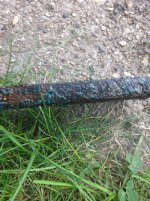
I'm setting up an electrolysis tank for de-rusting some old tools and stuff. First time through, on a test run, I ended up with some sort of green snot looking residue on the sacrificial anode. It was just a piece of junk steel. I cleaned most of the rust off of it (but didn't bother getting it perfect. The work piece was a trowel for spreading thinset for tile or whatnot. I don't know exactly what kind of steel it is, but it was rusting, so I guess it was safe. It has a plastic handle, which I'm given to understand doesn't matter.

Is it normal to end up with green crud? Safe? Far less important (although interesting) what is it? Green makes me think copper, but I don't think there's any copper in the tank.
 

Attachments

  • IMG_2223.jpg
    IMG_2223.jpg
    151.4 KB · Views: 42
  • IMG_2222.jpg
    IMG_2222.jpg
    152.8 KB · Views: 42
To avoid these ads, REGISTER NOW!

doublearon98

Well-known member
Joined
Oct 7, 2017
Messages
676
Location
Hamton, Arkansas
Hmm interesting. At first I thought copper but that appears to be a jelly type substance. Maybe something that was on the tool

Sent from my SM-G930V using Tapatalk
 
OP
M

MikeH

Well-known member
Joined
Aug 8, 2018
Messages
62
Location
Milwaukee, WI
Jelly is so much nicer a phrase than snot looking! Yeah I thought the same. It isn't actually sticky--I wiped it off and it is sort of pasty, like the powdery rust that is the result I expected. I just can't come up with anything on the tool that should have done that. The plastic should have been totally unaffected, right?
 

Username already in use

Well-known member
Joined
Sep 4, 2015
Messages
2,177
Location
Ohio
I don't know exactly what kind of steel it is, but it was rusting, so I guess it was safe.
It's really only safe to use electrolysis on plain steel or other unplated items. If there is chrome, copper, or other plating on the item being de-rusted, you're creating a toxic waste bath. For plated tools, something like evaporust seems to work well and it's 'safe' for the environment.

There's an all you could ever want to know thread on here somewhere about electrolysis with some good 'do's and don't's'. It's a long read, but is full of great information. Link to that thread is HERE.

As for the green goo in your tank, paint maybe? :dunno:
 
To avoid these ads, REGISTER NOW!
OP
M

MikeH

Well-known member
Joined
Aug 8, 2018
Messages
62
Location
Milwaukee, WI
Thanks for the link. I've read most of that thread before, but will probably review it again. I did know that stainless and plated were out of bounds, which is why I selected the tool I did. As far as I can tell it isn't plated, although it is possible that it once was. Definitely not stainless. All I really meant was that I didn't know the exact composition of the steel.

Probably what I'll do, unless I hear anything about what the green is, will be to try to clean something (something I want to clean this time!) and use several different anodes. That should tell me if it has something to do with this anode.

It's really only safe to use electrolysis on plain steel or other unplated items. If there is chrome, copper, or other plating on the item being de-rusted, you're creating a toxic waste bath. For plated tools, something like evaporust seems to work well and it's 'safe' for the environment.

There's an all you could ever want to know thread on here somewhere about electrolysis with some good 'do's and don't's'. It's a long read, but is full of great information. Link to that thread is HERE.

As for the green goo in your tank, paint maybe? :dunno:
 
To avoid these ads, REGISTER NOW!
Top Bottom