To avoid these ads, REGISTER NOW!

Homemade electrolysis. What do you use?

texasfiremedic

Well-known member
Joined
Oct 5, 2013
Messages
396
Location
Canton. TX
Wanting to build a homemade electrolysis tub at the house. What are the components you use. What is your best cleaning solutions that you have found? Also what the combination is best for rust, grease, grim .....
 
To avoid these ads, REGISTER NOW!

Mavawreck

Well-known member
Joined
Jan 30, 2011
Messages
1,835
Location
Durham NC
I made mine out of a plastic tub. Cut a piece of chicken wire and bent it into a rectangle to follow the profile of the tub. Weaved sections of cut bar into the wire. I had a section of mullions I took off a patio door that I set on top and hung whatever I was cleaning off it with wire. Washing soda and water for a mix, didn't take much washing soda. I use an older battery charger.

I copied this guy;

http://antique-engines.com/electrol.asp
 

drivesitfar

Well-known member
Joined
Oct 23, 2013
Messages
35,997
Location
Pacific Northwest
it's at the top of my project list of to do's also. here are a few pictures and i'll grab a parts list from my notes if someone else doesn't have them handy to post.

i'm planning on using the big plastic black storage container they sell at Costco with the yellow lid for the tank. I have plenty of rebar and wire for the electrodes and an old battery charger for the power. some spa chemicals and i'll get the name when I find my notes or I hear it works with baking soda or also without anything.

I hope others add posts with pictures too because nothing better than shiny steel other than steel cooking ready to become something shiny.
 

Attachments

  • Prentiss 58 Wrenchguy Josh4.jpg
    Prentiss 58 Wrenchguy Josh4.jpg
    72.5 KB · Views: 1,815
  • Prentiss 58 Wrenchguy Josh1.jpg
    Prentiss 58 Wrenchguy Josh1.jpg
    67.5 KB · Views: 1,757
OP
T

texasfiremedic

Well-known member
Joined
Oct 5, 2013
Messages
396
Location
Canton. TX
Thank you all so far. I was thing about using a couple of pipe stands to keep the piece off the bottom. Has any body used a old porcelain tub? Big and have a couple of them laying around. Old feed and water troughs. I was just wondering how the porcelain would hold up?
 

drivesitfar

Well-known member
Joined
Oct 23, 2013
Messages
35,997
Location
Pacific Northwest
just a guess until the experts chime in, but I probably wouldn't do any Electrolysis in any type of metal tub. under the porcelain is cast iron usually isn't it?

some have used bricks and other non metal objects to hold their projects off the bottom unless you are going to power up those pipes then might be an option.

i'm hearing using graphite pieces instead of steel for the electrodes might make less of a mess, but haven't heard from anybody that has fired one up yet. others use fairly thin steel pieces they wrap around the edge of the tub instead of rebar or hunks of steel.
 

jkwilson

Well-known member
Joined
Dec 5, 2012
Messages
758
Location
SW Indiana
Plastic trash cans and totes are my go to choices. For large stuff, you can use blocks, bricks or boards to make a pit and line it with a tarp.
 
OP
T

texasfiremedic

Well-known member
Joined
Oct 5, 2013
Messages
396
Location
Canton. TX
Yep that is cast iron under that porcelain. The porcelain is non-conductive is it not? I was just think nothing to throw away afterward. Just pour out and wash out and put it out by the barn for later use.

QUESTION: Since you are DC current does it matter what you use for a tub? since the current is going from pole to pole. Is this because of stray current?
 
OP
T

texasfiremedic

Well-known member
Joined
Oct 5, 2013
Messages
396
Location
Canton. TX
Sorry I think faster than I type. Sentences don't always come out straight. Also lack of proof reading.

I was just think of nothing to throw away afterward.
 

drivesitfar

Well-known member
Joined
Oct 23, 2013
Messages
35,997
Location
Pacific Northwest
nice idea on the mess clean up, but even if the porcelain would work for a bit the lit up steel might work a hole through it to the cast iron and then i'm not sure what would happen.

sounds like plastic containers or the pit idea are much better ideas and maybe use the tubs for molasses and vinegar soaking methods that also remove rust.
 

Nowater

Well-known member
Joined
Nov 29, 2011
Messages
744
Location
Southwest Florida
I used a SlimJim brand tall garbage can to de-rust my handsaws. You may find them at restaurant supply houses. I suggest framing the top with a few 2 by 4's to keep it from bowing out too much. I added washing soda as an electrolyte and used an old piece of rebar for the sacrificial iron. Avoid using stainless steel in place of the iron because of the chromium content, as it is poison.

The old style battery chargers worked with this process. If you have an old battery, try that hooked up to a newer charger as well, if you have one of the new charger types.

My handsaws came out free of rust, but were black and needed to be scrubbed with some scotch brite pads and WD-40. By the way, in my neck of the woods, old hand saws are available at garage sales for a dollar or two since they are no longer as widely used as used to be. The *** bolts are worth that! My last purchase was a Disston, for $1.00. The blade was kinked and if I can't straighten it, I will cut it up for card scrapers. I have not made that decision yet. I have yet to see any type of dovetail or fine carpentry saw for sale at any garage sale.

Times change. It seems like it is no longer socially acceptable to work with one's hands.
 

zkling

Well-known member
Joined
Jan 23, 2007
Messages
16,939
My setup is a 55? gal, one of those white plastic barrels, a guy a few streets over works at a food and flavor place. I cut the top off but left the thick rim for structure. Drilled a series of holes around the perimeter of the top. Then found a few sheets of ~1/8" mild steel, ripped them to ~6" wide x height of the tank and welded bolts to the top edge. That way I can hang the plates through the holes drilled eariler yet keep the part surrounded 360°. Use the back side of the bolts (outside of tank) to wire the plates up.

For a power supply I use a custom built unit out of old computer power supplies. Depending on how I arrange the connectors it will put out between 5 and 25amps at ~10-24volts IIRC.

I've always used washing soda (sodium carbonate) and tap water for the solution. I've heard of people adding other chemicals to increase performance but I have not done that yet. Once I added a bit of dish soap thinking it would make the parts cleaner. Unfortunately all I succeeded in doing was just creating a foamy nasty mess.

How well does this process work on grease and paint?

Grease is a no no as it will make the bath nastier, paint will be lifted and or loosened. I give everything a good rise off before going into the tank.
 

Fretters

Well-known member
Joined
Jan 25, 2014
Messages
4,217
Location
South Yorkshire, England
In my experience, it works best on rust. If the paint is flaking, it will pull it off but may leave some areas. Longest I ran anything was around 8hrs though.

That's about right. Some types of paint will literally flake off in the vat, whilst others seem to resist at all costs. I've found applying a little brake fluid or paint stripper several hours before popping something in the vat helps for paint.

Regarding grease, you're better off trying to remove that beforehand. White spirit, (mineral spirit), or paraffin, (kerosene), which is my favourite degreaser.

Don't use a metallic container btw, even if it is enamelled. It only needs one pin ***** in the enamel and it will start to corrode at a rate of knots from there on in. Tested it out last year with a metallic container. It only managed a few days before it tripped out the relay I'd put on it for the specific purpose of disconnecting the supply if there was leakage.

I personally use Sodium Bicarbonate for the solution. Sodium Carbonate seems to be the most recommended option though. Both work fine. About one tablespoon to a gallon of water is all you need. You don't need to chuck shedloads of current at the process either. You'll just degrade your anodes more quickly for little to no gain. Even with large stuff, 1.5A is ample. I normally vary current between 500mA to 1.5A max.
 
Last edited:

drivesitfar

Well-known member
Joined
Oct 23, 2013
Messages
35,997
Location
Pacific Northwest
I've heard rust and paint are usually what gets removed nicely to expose the raw steel when finished.

thanks for the tips on cleaning the grease off before the dunk. do you use a solvent tub or just a little simple green because I can use either?

any pictures to share for all us to enjoy your Electrolysis tanks in action????

please post on this thread.:thumbup:
 

Fretters

Well-known member
Joined
Jan 25, 2014
Messages
4,217
Location
South Yorkshire, England
I've heard rust and paint are usually what gets removed nicely to expose the raw steel when finished.

thanks for the tips on cleaning the grease off before the dunk. do you use a solvent tub or just a little simple green because I can use either?

any pictures to share for all us to enjoy your Electrolysis tanks in action????

please post on this thread.:thumbup:

I just take the pieces outside and scrub them down with paraffin before popping them in the vat if they're greasy. Paraffin is readily available and quite cheap, and it truly does work wonders for softening even solidified grease.

The only photo's I've got of vats are these. The first one is the metal container I tried last year. Started into self destruct mode within days. It's now used as a plant pot for a tree. :D

1338733849electrolysis_vat1.jpg

1338733849electrolysis_vat2.jpg


This little one is still in use.

1304081933electrolysis_vat_connected.jpg


These are some test pieces which were done in that vat above.

1304081321hammerhead_undone2.jpg

1304081301hammerhead_undone1.jpg

1304081322spanner_undone.jpg


1304081300hammerhead_done2.jpg

1304081300hammerhead_done1.jpg

1304096989spanner_done.jpg


That vat gets used for little pieces and the basket, shown below, which is well worth making something similar if you do lots of nuts, bolts etc. Far easier than stringing them all onto a wire. Only made this the other month to test whether it would work, and it does work a treat. So much easier for really small bits. Neg lead goes to the copper handle and then the parts are just chucked in the basket and immersed in the vat. It ain't pretty but it works. :D

1385589671parts_basket3.jpg

1385589659parts_basket2.jpg

1385589658parts_basket1.jpg
 
Last edited:
To avoid these ads, REGISTER NOW!
OP
T

texasfiremedic

Well-known member
Joined
Oct 5, 2013
Messages
396
Location
Canton. TX
Did not think of a plastic 55 gallon drum. Cut the top out and your in business with 360 anodes. Great idea. That just skipped my mind. (The switch is on but the light just flickers) :Sleep:
I don't mean caked on grease but the stuff that takes cleaner or diesel and heavy scrub brush. Just mostly clean.
 

zkling

Well-known member
Joined
Jan 23, 2007
Messages
16,939
Did not think of a plastic 55 gallon drum. Cut the top out and your in business with 360 anodes. Great idea. That just skipped my mind. (The switch is on but the light just flickers) :Sleep:
I don't mean caked on grease but the stuff that takes cleaner or diesel and heavy scrub brush. Just mostly clean.

I initially tried the trash can then a rubber maid container but both flexed too much when full of water. The white (food grade I think they are) barrels are very sturdy and have a clean look to them. If you do it, make sure to cut inside the top lip. On the barrel I have the top is very thick plastic and the outer most lip/rim adds to the structural integrity of the tank. I just drilled a few holes around the perimeter and connected the dots with a jig saw. Then filed the remnants smooth with an aggressive rasp.

I clean everything new to me weather it will be going into the tank or not with warm water and dawn dish soap. Cuts the grease real well, kills germs and is environmentally friendly. :thumbup:
 

drivesitfar

Well-known member
Joined
Oct 23, 2013
Messages
35,997
Location
Pacific Northwest
Fretters: you have awesome pictures again. now i'm on the search for some little metal baskets for the little stuff like sockets, nuts and bolts and so on.

also just learned to do a good grease and crud cleaning so the E process can find the steel.

Cheers
 

Voi

Well-known member
Joined
Oct 10, 2010
Messages
5,138
Location
Western South Dakota
The old style battery chargers worked with this process. If you have an old battery, try that hooked up to a newer charger as well, if you have one of the new charger types.

I have neither. Is it worth my time to search out an older style charger or are the new style with a battery in the loop just as good?

I have a very old grinder pedestal that I don't believe a sand blasting wand can get up into completely so I'm going to try electrolysis but don't have any sort of suitable power source at the moment.

I quoted Nowater but anyone can chime in with an opinion.
 

Fretters

Well-known member
Joined
Jan 25, 2014
Messages
4,217
Location
South Yorkshire, England
See if you can get hold of an old desktop/tower computer power supply. There should be shedloads of those knocking about, with the rate people upgrade their computers. They have a 12V output, and you should be able to get one for either next to nowt else nowt.


Fretters: you have awesome pictures again.

Most people tend to call me a bit of a sad git for taking so many photo's. :D I always think a photo is far more descriptive than words though, and is also a good backup against a shonky memory.


now i'm on the search for some little metal baskets for the little stuff like sockets, nuts and bolts and so on.

It'll definitely make the process just that little bit easier. Winding things onto a wire can become tedious after the umpteenth time of doing it, and you can do more little bits at once with a basket.


also just learned to do a good grease and crud cleaning so the E process can find the steel.

It definitely pays to spend that extra few minutes doing it at the offset. It's not a glorious task, but it saves time in the long run and the solution doesn't get as manky.
 
Last edited:

drivesitfar

Well-known member
Joined
Oct 23, 2013
Messages
35,997
Location
Pacific Northwest
NOWT. love those old English words. :thumbup::thumbup::thumbup:

great idea with the CPU and how would you hook one up?

i'm planning on using an old battery charger that is on wheels that I almost sold now that the kids are all grown and don't need their cars jumped any longer.

wait a minute you added a bunch of "old English" words so i'll comment on those later.
 
Last edited:

zkling

Well-known member
Joined
Jan 23, 2007
Messages
16,939
great idea with the CPU and how would you hook one up?

Depends on which one you get. Computer power supplies, particularly modern ones have multiple outputs both in voltage and amps. So you can make a selectable output power supply, hence the comments in my 1st post. Only thing you have to watch out for is some of them require a load to be sensed otherwise they will limit the output or fry themselves internally.

If you really want to kick it up a notch get an old transformer DC stick welder. Just have to watch the duty cycle, but most of the old transformer machines have a few taps where they can go 100% usually around 80amps.

Another thing I will bring up is you need to watch and keep a mind on current density when doing this process.
 
Last edited:

drivesitfar

Well-known member
Joined
Oct 23, 2013
Messages
35,997
Location
Pacific Northwest
If you really want to kick it up a notch get an old transformer DC stick welder. Just have to watch the duty cycle, but most of the old transformer machines have a few taps where they can go 100% usually around 80amps.

Another thing I will bring up is you need to watch and keep a mind on current density when doing this process.

are you talking current density on the CPU or the DC welder? how would you monitor that? if the part in the tub starts melting or if the lights in the neighborhood dim?
 

zkling

Well-known member
Joined
Jan 23, 2007
Messages
16,939
are you talking current density on the CPU or the DC welder? how would you monitor that? if the part in the tub starts melting or if the lights in the neighborhood dim?

Current density on the part to be cleaned and your anodes (amps per in^2) another reason why I like to use flat plate over say rebar shaped. You can monitor the current in the tank while running through a meter, and you can adjust it via power supply or by changing the resistance of the solution (water to soda ratio).

It's a trade off between cleaning time, how much heat your bath can dissipate, power supply capability and delicate-ness of the part to be cleaned. Obviously the larger the part (surface area wise) the more amps needed to keep up a reasonable current density.
 

Fretters

Well-known member
Joined
Jan 25, 2014
Messages
4,217
Location
South Yorkshire, England
are you talking current density on the CPU or the DC welder? how would you monitor that? if the part in the tub starts melting or if the lights in the neighborhood dim?

You can't really monitor the current draw unless the supply has an ammeter else you hook one up. It won't really matter if your setup is drawing more current than it needs for the process. All you'll note is excess bubbling and the anodes will corrode more quickly. You can remove some anodes to decrease current consumption.

If you try to aim for the sweet spot of having the occasional bubble rising to the surface of the solution from the piece, that's a good eyeball way of gauging the process. If it's bubbling away like mad, you're just wasting power.

If you want full control over the process, a variable bench top power supply with current limiting is the way to go, though it's not something you'll find just knocking about anywhere.
 

drivesitfar

Well-known member
Joined
Oct 23, 2013
Messages
35,997
Location
Pacific Northwest
my battery charger that is on wheels has a few settings and 2 for steady power at 6v and 12v. I guess I could try to find a meter and monitor or can you tell by the bubbling?

i'm guessing i'll use the 6 volt setting for the vises under 50 pounds and the 12 volt one for the bigger ones that weigh more than that?

thanks for bearing with my questions and really appreciate your knowledge. also some leave it on over night or for days and since I won't have it where I live should I turn it off at night or what is the risk?
 

EOC_Jason

Well-known member
Joined
Jun 25, 2012
Messages
11,388
Location
Bentonville, AR
I used a large plastic bin I found collecting dust in the back of the shop. Cut up a scrap piece of rebar and wire-wheeled them clean. Used some wire scraps to tie them together. Got the Arm & Hammer washing soda at the grocery store. Finally a 3-5 amp battery charger worked great.... Mix and let cook...
 

Attachments

  • P1020953 (Large).jpg
    P1020953 (Large).jpg
    146.3 KB · Views: 499
  • P1020954 (Large).jpg
    P1020954 (Large).jpg
    143 KB · Views: 474
  • P1020955 (Large).jpg
    P1020955 (Large).jpg
    151 KB · Views: 450
  • P1020959 (Large).jpg
    P1020959 (Large).jpg
    143 KB · Views: 558

Fretters

Well-known member
Joined
Jan 25, 2014
Messages
4,217
Location
South Yorkshire, England
Stick with the 12V setting for everything.

Regarding the risk of leaving it running, provided your connections are sound and nothing is close enough to accidentally short out in the tank, it should be fine left unattended. I leave mine running overnight down the bottom of the garden when I'm derusting. If you have the vat inside, just make sure there's adequate ventilation to remove the gasses, (oxygen and hydrogen), produced, and obviously don't seal the container. :D
 

Mustang51js

Well-known member
Joined
Jan 24, 2014
Messages
1,734
Location
Haskell nj
it's at the top of my project list of to do's also. here are a few pictures and i'll grab a parts list from my notes if someone else doesn't have them handy to post.

i'm planning on using the big plastic black storage container they sell at Costco with the yellow lid for the tank. I have plenty of rebar and wire for the electrodes and an old battery charger for the power. some spa chemicals and i'll get the name when I find my notes or I hear it works with baking soda or also without anything.

I hope others add posts with pictures too because nothing better than shiny steel other than steel cooking ready to become something shiny.

Is it me or does that look unsafe, haha, looks like it works well

Edit,I don't know how to get the pics to show
 

drivesitfar

Well-known member
Joined
Oct 23, 2013
Messages
35,997
Location
Pacific Northwest
I'm going to get the stuff together and maybe get some water bubbling this week. what I don't have already i'll hope the rest are easily found and not just "knocking about".

thanks again for another quality one and for the valued information.

Jason: great pics and description of the process

mustang: just saw your post. are you on a laptop or cell phone? I have issues posting pics from my cell, but on laptop I use either the paperclip attach feature that GJ gives you in the icons above where you are writing or I use www.photobucket.com which is a good free photo storage that I copy and past the image to my written post. good luck and ask more questions if you need help still
 
Last edited:

zkling

Well-known member
Joined
Jan 23, 2007
Messages
16,939
Just one thing to reiterate that another member brought up. Keep everything in the bath plain carbon steel or iron. Nothing plated, galvanized or the like. It will contaminate the bath and produce a nasty by product waste solution. This includes keeping in mind how you have your electrical connections setup.

Is it me or does that look unsafe, haha, looks like it works well

Edit,I don't know how to get the pics to show
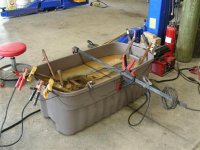
It doesn't look "unsafe" to me at all, but you can see the issue I was talking about. Rubbermaid style storage containers, while water tight really weren't designed to contain the pressure when full of water. Hence you see in the pics they put a clamp across the longer container to prevent it from bowing drastically. Jason's black container a few post up is much more stout and thus can hold full of water with minimal distortion.
 
Last edited:

drivesitfar

Well-known member
Joined
Oct 23, 2013
Messages
35,997
Location
Pacific Northwest
that reminds me of another product I was thinking of dunking in the tank. old chrome wrenches, socket and such where the chrome is flaking off.

good or bad idea to put in the E tank? or just use the wire brushes on the grinders to clean them up?
 
To avoid these ads, REGISTER NOW!
Top Bottom