To avoid these ads, REGISTER NOW!

Grounding a Portable Generator

jacric2005

Well-known member
Joined
Dec 21, 2018
Messages
114
Location
Lane County, Oregon
Got the Duramax 10000/12000. The manual says to ground it with a ground rod which I will do. But the guy at the hardware store said he’d never heard of having to ground a portable generator that way. I will have it on an interlock switch for backup power to the house. I plan to call the company about it too. Any comments or experience with this?


Sent from my iPhone using Garage Journal
 
To avoid these ads, REGISTER NOW!

DTE

Well-known member
Joined
Jul 13, 2013
Messages
996
Location
North Carolina
I have a ONAN and it has a lug on it to put a ground wire in. I use a piece of copper clamped to a rod I drive in the ground.
 

nadogail

Well-known member
Joined
Jan 23, 2009
Messages
32,032
Location
Coronado, CA
The guy at the hardware store just demonstrated his ignorance. Just because he has never seen a job done right; does not make him an authority.
 

kd3pc

Well-known member
Joined
Aug 10, 2013
Messages
3,630
Location
Northern Neck
not so fast...the guidance from OSHA may side with the store person...read for your self and decide..
 

Attachments

  • grounding_port_generator-1.pdf
    24 KB · Views: 126

chaosracing

Well-known member
Joined
Nov 14, 2015
Messages
585
Location
Kutztown, Pa
I have never seen or heard of anyone grounding a portable generator, however thats not to say it can not be done. I have a Generac 7500 watt portable that I back feed through my main panel when I have lost power. But my unit has the 4 prong 22v outlet on it, so in theory its grounded through that when hooked into my house. It does have a ground lug on it as well.
Now if you go by the OSHA pdf that kd3pc posted, backfeeding without the transfer switch is also a no no, but I kill the main breaker and never allow power from my generator to go through the panel into the main service wire and back onto the grid.

I am thinking that the grounding of the portable generator is needed if you are using it to power a permanent campsite, mobile home, etc where there is no electrical service provided. Then you would need to ground it for sure.
 

wyliesdiesels

Well-known member
Joined
Aug 14, 2012
Messages
20,067
Location
Modesto, CA
The ground lug on a generator is for connecting to the EGC going to the transfer switch or disconnect.

What do you think a ground rod will do for a generator?

Lets backup and ask what a grounding electrode is for and where is it required?

Its for lightening and required on all buildings.

Is a generator a building?

So again i ask what will a grounding electrode do for a generator?

Also, since its a portable generator, make sure to remove the neutral to ground bond since you will be using to provide power to a house which already has a neutral to ground bond.
 

chaosracing

Well-known member
Joined
Nov 14, 2015
Messages
585
Location
Kutztown, Pa
The ground lug on a generator is for connecting to the EGC going to the transfer switch or disconnect.

What do you think a ground rod will do for a generator?

Lets backup and ask what a grounding electrode is for and where is it required?

Its for lightening and required on all buildings.

Is a generator a building?

So again i ask what will a grounding electrode do for a generator?

Also, since its a portable generator, make sure to remove the neutral to ground bond since you will be using to provide power to a house which already has a neutral to ground bond.


If you think that a ground rod on a building is only for lightning, you do not have a understanding of electrical systems and how they work.
 

wyliesdiesels

Well-known member
Joined
Aug 14, 2012
Messages
20,067
Location
Modesto, CA
If you think that a ground rod on a building is only for lightning, you do not have a understanding of electrical systems and how they work.

oh i can make a list. primary reason is for lightening suppression.

But none of the purposes has any function for a generator connected to a building.
 
OP
J

jacric2005

Well-known member
Joined
Dec 21, 2018
Messages
114
Location
Lane County, Oregon
First off - I AM NOT AN ELECTRICIAN. I know enough to follow the manual and instructions. As for electrical, my expertise only goes as far as changing a light fixture and changing an outlet or switch. But I'm confident if I follow the instructions and use common sense, I will safely use the generator as millions of people do every day.

I just got off the phone with Duromax tech support. He said definitely ground it when it's used through the interlock switch on the main panel. He said galvanized ground rod is OK and it should be a minimum of 12 inches in the ground. As I said in an earlier post, the manual says to ground it. He suggested putting a surge protector between the gen power and the sensitive things - computer, TV, phone, etc.

My brother has a 3500 of another brand and the manual says nothing about grounding, so that contributed to my confusion - something not too hard to do.

For use in the field, Duromax tech support said grounding is a good idea but not mandatory, as some more sensitive tools may not recognize the generator (open ground??). I purchased a lot of ground rod, so I'll permanently mount one where the generator will be used most of the time and put one with a mallet in the travel box.

I respect you all that are way advanced in your knowledge of electricity. I plan to read more so I understand better.

By the way, Duromax tech support seems pretty good. But, the manual is not as up to date as it could be - example: remove the brightly colored one piece orange engine support, when in reality it was two red engine supports. You are left to conclude, OK those are the only brightly colored things so that must be the ones to remove.
 

Attachments

  • IMG_1981 edit.jpg
    IMG_1981 edit.jpg
    99.8 KB · Views: 40

alfredeneuman

Well-known member
Joined
Mar 3, 2011
Messages
4,590
Location
Fullerton, CA
:bounce:
NEC 250
Rod and Pipe Electrodes. The electrode shall be installed such that at least 2.44 m (8 ft) of length is in contact with the soil.
 

checkthisout

Well-known member
Joined
Sep 5, 2008
Messages
5,232
Got the Duramax 10000/12000. The manual says to ground it with a ground rod which I will do. But the guy at the hardware store said he’d never heard of having to ground a portable generator that way. I will have it on an interlock switch for backup power to the house. I plan to call the company about it too. Any comments or experience with this?


Sent from my iPhone using Garage Journal

No need to ground it if it's getting ground through it's connection to the house.

It needs to be in contact with the ground when used stand alone to run tools, say on a job site. GFCI (at least in our state) is also required.

If it's on wheels that isolate it from the ground then it's supposed to be grounded through a rod.
 

ant.foste

Well-known member
Joined
Aug 14, 2016
Messages
403
Location
Maryland
The ground lug on a generator is for connecting to the EGC going to the transfer switch or disconnect.

What do you think a ground rod will do for a generator?

Lets backup and ask what a grounding electrode is for and where is it required?

Its for lightening and required on all buildings.

Is a generator a building?

So again i ask what will a grounding electrode do for a generator?

Also, since its a portable generator, make sure to remove the neutral to ground bond since you will be using to provide power to a house which already has a neutral to ground bond.

Exactly correct.
 

ant.foste

Well-known member
Joined
Aug 14, 2016
Messages
403
Location
Maryland
No need to ground it if it's getting ground through it's connection to the house.

It needs to be in contact with the ground when used stand alone to run tools, say on a job site. GFCI (at least in our state) is also required.

If it's on wheels that isolate it from the ground then it's supposed to be grounded through a rod.

Contact with "the ground" is not required, for any reason. Nor is a ground rod required because of any isolation from earth created by tires.

You are correct though that GFI's are required.
 

ant.foste

Well-known member
Joined
Aug 14, 2016
Messages
403
Location
Maryland
I am thinking that the grounding of the portable generator is needed if you are using it to power a permanent campsite, mobile home, etc where there is no electrical service provided. Then you would need to ground it for sure.

No, you would not.
 

WaterBoyz

Well-known member
Joined
Nov 16, 2015
Messages
368
Location
Northern VA
I'm about to set up my 9000/7250 portable to be permanent with the connection to the main panel using an interlock arrangement. I will be contacting my County building inspection department to get clarification as related to the grounding arrangement.

This is what the manual for the unit says as related to grounding:

The Generator must be properly grounded before use. Have the unit grounded by a qualified electrician if you are not qualified to do so.

To ground the Generator, connect a #6 AWG grounding wire (not included) from the Grounding Terminal on the Control Panel to a grounding rod (not included) that has been driven at least 24 inches deep into the earth. The grounding rod must be an earth-driven copper or brass rod (electrode) which can adequately ground the Generator.

There is a permanent conductor between the portable generator stator winding and the frame.

Warning! GFCI receptacles will not protect from electric shock if the generator is not grounded.

Notice: This generator is not intended to power sensitive electronic equipment without the addition of an appropriate line conditioner and surge protector (both not included). Sensitive electronic equipment includes, but is not limited to, audio/video equipment, some television sets, computers and printers. Sensitive electronic equipment should be operated on approved inverter-type generators or pure sine wave generators.
 

checkthisout

Well-known member
Joined
Sep 5, 2008
Messages
5,232
Contact with "the ground" is not required, for any reason. Nor is a ground rod required because of any isolation from earth created by tires.

You are correct though that GFI's are required.

Yes I just made that part up.
 
To avoid these ads, REGISTER NOW!

checkthisout

Well-known member
Joined
Sep 5, 2008
Messages
5,232
The caveat here is "manufacturers instructions" are the default if the generator will NOT be grounded through the system it's connecting to.

So a 24" ground rod would be considered ok if the manual says so.
 

sberry

Banned
Joined
Jun 18, 2005
Messages
35,747
Location
Brethren, Michigan
The part about the gfci is not clear at best. Onlist purpose of a rod here is to reduce some step potential between the genset and the earth you are standing on.
 

sberry

Banned
Joined
Jun 18, 2005
Messages
35,747
Location
Brethren, Michigan
That's why I said,,, not clear. In the event of a fault with the unit the gfci does nothing, if there is a fault with it the rod doesn't do anything either. If there was a leak in a circuit to the ground a gfci would work, doesn't need the rod.
 

coleman10

Well-known member
Joined
Nov 12, 2012
Messages
871
Location
Fort Lauderdale, FL
I hate to resurrect an old thread, but this topic has my head spinning.

I am getting ready to install a transfer switch that will be fed by a portable generator in times of emergency (such a power outage from a hurricane - I live in South Florida).

I just found this on OSHA's site:


If the portable generator is providing electric power to a structure by connection via a transfer switch to a structure (home, office, shop, trailer, or similar) it must be connected to a grounding electrode system, such as a driven ground rod. The transfer switch must be approved for the use and installed in accordance with the manufacturer’s installation instructions by a qualified electrician.


Sounds like I need a grounding rod, even though there will be a ground wire hooked up to the transfer switch and panel. I asked the generator support guys and they said a grounding rod was not required because the generator is grounded to the frame. That didn't make sense to me. According to OSHA, you don't need to ground the generator if appliances are being fed directly from cords corrected to the generator. There is a grounding terminal on the generator. If, according to support, you don't need to ground it when connected to the house, then what's the purpose of the grounding terminal? I don't think the support guy knows what he's talking about.

I assume I should follow what OSHA is stating. Some friends of mine think I'm nuts for wanting to go through the trouble of grounding this thing, but my motto is there's no substitute for safety.
 

sberry

Banned
Joined
Jun 18, 2005
Messages
35,747
Location
Brethren, Michigan
I don't see as how fundamentally it would hurt anything. Its more a matter of how much good its gonna do. It would help if lightning struck it but I can see the concept of putting it at the same step potential as the ground its, you standing sitting on???
As long as thre is a system wire, 4th wire between it and premise ground both stakes would be at the same potential. I got to wonder about the 12 and 24 inch stakes too.
On portables I believe there is a wattage limit etc along the way involved with this.
 
Last edited:

mm08822

Well-known member
Joined
Jan 13, 2012
Messages
6,043
Location
NJ
NEC 250.34 (A) says a separate grounding electrode is not needed. OSHA copied NEC and ad-libbed in a few spots - didn't help to make it clearer.

As long as you use a 4-wire cord between gen and power inlet box, the ground of the gen (including the frame) will be connected to the permanent grounding electrode system of the dwelling via the bonding screw in the main panel.
 

mm08822

Well-known member
Joined
Jan 13, 2012
Messages
6,043
Location
NJ
I don't see as how fundamentally it would hurt anything. Its more a matter of how much good its gonna do. It would help if lightning struck it but I can see the concept of putting it at the same step potential as the ground its, you standing sitting on???
As long as thre is a system wire, 4th wire between it and premise ground both stakes would be at the same potential. I got to wonder about the 12 and 24 inch stakes too.
On portables I believe there is a wattage limit etc along the way involved with this.

They would work if everybody p*ssed on them 2x/day.
 

larry4406

Well-known member
Joined
Jan 27, 2006
Messages
19,547
Location
Northern Virginia
NEC 250.34 (A) says a separate grounding electrode is not needed. OSHA copied NEC and ad-libbed in a few spots - didn't help to make it clearer.

As long as you use a 4-wire cord between gen and power inlet box, the ground of the gen (including the frame) will be connected to the permanent grounding electrode system of the dwelling via the bonding screw in the main panel.

My generator had the neutral and ground bonded from the factory. I found the jumper and installed a switch to make or break this bond. This allows me to 4-wire feed to the house or use as a separate portable with bond. Learned this right here on GJ!
 

mm08822

Well-known member
Joined
Jan 13, 2012
Messages
6,043
Location
NJ
My generator had the neutral and ground bonded from the factory. I found the jumper and installed a switch to make or break this bond. This allows me to 4-wire feed to the house or use as a separate portable with bond. Learned this right here on GJ!

Yes, the safer way to run the gen with a PIB into a bonded service is breaking the neut/grd bond in the gen. Problem is many gens are used both ways - as stand-alone portables also.
Remember to check the switch position!
 

theoldwizard1

Well-known member
Joined
Feb 22, 2011
Messages
43,245
Location
SE MI
Also, since its a portable generator, make sure to remove the neutral to ground bond since you will be using to provide power to a house which already has a neutral to ground bond.

This seems t be an issue with portable generators and certain appliances.

Most (some ? all?) portable generators are not bonded. The ground is "floating". This is fine if you are going through a properly wired transfer switch.

However, small portable generators are often used with extension cords to power various "appliances" during a power outage. A furnace is not meant to be powered via an extension cord, but if it is 10F and the power is out, you can be damn sure many DIYers will rigs something up (hopefully not a "suicide cord"). Most (many? all?) modern furnace will not run because they can not "see" aground.

Simple solution

img_312091_1_226bf3304929cc5109f10b8f76448b6c.jpg
 

coleman10

Well-known member
Joined
Nov 12, 2012
Messages
871
Location
Fort Lauderdale, FL
My generator had the neutral and ground bonded from the factory. I found the jumper and installed a switch to make or break this bond. This allows me to 4-wire feed to the house or use as a separate portable with bond. Learned this right here on GJ!


Okay, time for me to learn something. Can you please explain the purpose of doing this and in what applications it would be broken? It sounds as though if you're connected to the house that the bond should be broken. ?? I believe mine is bonded to the frame and the only time this will ever be run is when it's connected to the house.
 

coleman10

Well-known member
Joined
Nov 12, 2012
Messages
871
Location
Fort Lauderdale, FL
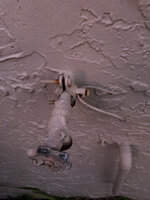
I also noticed that there is a bonding clamp on the hose bib (not the main shut off) where I'd put the generator. There's even a piece of wire still attached. Someone in the past must have had a generator there. Can that be used to ground the generator?

6819c93aef0922dc6cebd6cba0d718ac.jpg
 
Last edited:

larry4406

Well-known member
Joined
Jan 27, 2006
Messages
19,547
Location
Northern Virginia
Okay, time for me to learn something. Can you please explain the purpose of doing this and in what applications it would be broken? It sounds as though if you're connected to the house that the bond should be broken. ?? I believe mine is bonded to the frame and the only time this will ever be run is when it's connected to the house.

I’m no sparkie but will try.

You want neutral and ground connected at only one point. This occurs at your main panel.

When the generator is connected to the house, you want to keep the neutral and ground separate. Just like a 4-way feed to a detached structure.

In my case, my portable generator (stand-alone) had the neutral and ground connected (bonded). This is fine if not connected to a house.

When connecting a generator such as mine to a house then the neutral and ground bond at the generator needs to be broken. My switch does this.
 

coleman10

Well-known member
Joined
Nov 12, 2012
Messages
871
Location
Fort Lauderdale, FL
I’m no sparkie but will try.


You want neutral and ground connected at only one point. This occurs at your main panel.


When the generator is connected to the house, you want to keep the neutral and ground separate. Just like a 4-way feed to a detached structure.


In my case, my portable generator (stand-alone) had the neutral and ground connected (bonded). This is fine if not connected to a house.


When connecting a generator such as mine to a house then the neutral and ground bond at the generator needs to be broken. My switch does this.


Makes perfect sense. Thanks!

Always amazed how much I learn this this little community.
 

coleman10

Well-known member
Joined
Nov 12, 2012
Messages
871
Location
Fort Lauderdale, FL
I’m no sparkie but will try.

You want neutral and ground connected at only one point. This occurs at your main panel.

When the generator is connected to the house, you want to keep the neutral and ground separate. Just like a 4-way feed to a detached structure.

In my case, my portable generator (stand-alone) had the neutral and ground connected (bonded). This is fine if not connected to a house.

When connecting a generator such as mine to a house then the neutral and ground bond at the generator needs to be broken. My switch does this.

Larry, what kind of switch should I purchase for this just in case I find that they two are bonded?

Edit: Just saw this on the schematics: "Grounding System (AC):Neutral Bonded to Frame"

Guess that means I should break that when connected to the house.

Thanks.
 
Last edited:

PRH44

Well-known member
Joined
Dec 25, 2009
Messages
563
Location
Indiana
Be advised if you should use a transfer switch that opens the neutral conductor. Your generator will then be considered a separately derived system. A separately derived system is required to be connected to the grounding electrode.
 

coleman10

Well-known member
Joined
Nov 12, 2012
Messages
871
Location
Fort Lauderdale, FL
Be advised if you should use a transfer switch that opens the neutral conductor. Your generator will then be considered a separately derived system. A separately derived system is required to be connected to the grounding electrode.


Thanks. I'll should receive the transfer switch within a couple weeks and will review the documentstion then. Hopefully the neutral is not open. I'd love to cross the chore of driving in a grounding rod off my list.
 
To avoid these ads, REGISTER NOW!
Top Bottom