To avoid these ads, REGISTER NOW!

Grounding a Portable Generator

coleman10

Well-known member
Joined
Nov 12, 2012
Messages
871
Location
Fort Lauderdale, FL
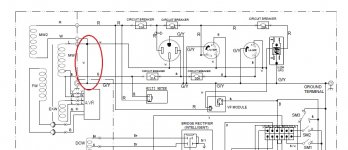
I believe I've located in the schematic where the neutral is jumped to the ground. I can take the panel off the generator in a couple weeks when I have some time and after the transfer switch is in and verify. Thankfully, we're done with hurricanes, at least for the moment. The transfer switch has a neutral wire that gets connected to the neutral bar in the panel, so I think I'm good with grounding when the generator is feeding the house through the transfer switch, just so long as I break the neutral away from the ground in the generator. I like the switch idea. Thanks, everyone.
 

Attachments

  • bondedneutral.jpg
    bondedneutral.jpg
    100.1 KB · Views: 27
To avoid these ads, REGISTER NOW!

Falcon67

Well-known member
Joined
Jun 11, 2009
Messages
18,371
Location
Merkel, TX
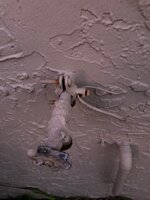
I also noticed that there is a bonding clamp on the hose bib (not the main shut off) where I'd put the generator. There's even a piece of wire still attached. Someone in the past must have had a generator there. Can that be used to ground the generator?

6819c93aef0922dc6cebd6cba0d718ac.jpg

That looks like a ground wire from a telephone demarc or a sat dish.
 

coleman10

Well-known member
Joined
Nov 12, 2012
Messages
871
Location
Fort Lauderdale, FL
On a related topic of transfer switch installation, what is proper for running the 10/4 from the transfer switch through a concrete block wall to a metal receptacle outside? I’m planning on recessing the switch into the wall so the wire will be inside the wall and only need to be run about a foot or so. Thinking PVC connected on both sides and grounding to the box should do it, no?

Thanks.
 

theoldwizard1

Well-known member
Joined
Feb 22, 2011
Messages
43,245
Location
SE MI
^^^^ First I assume you are referring to the generator power inlet on the outside of the building. (Male contacts)

You are inside of a wall cavity. NM-B is acceptable. It might be difficult to find a short length of 10/3 NM-B (they don't count the ground conductor except in portable cordage/extension cords).

THWN is easier to work with (bend) and that does need to be run inside some kind of conduit with both end properly affixed. The old school method was the ground wire was attached to the ground screw on the receptacle with enough excess wire to attach it to a screw on the metal housing.
 
To avoid these ads, REGISTER NOW!

coleman10

Well-known member
Joined
Nov 12, 2012
Messages
871
Location
Fort Lauderdale, FL
^^^^ First I assume you are referring to the generator power inlet on the outside of the building. (Male contacts)

You are inside of a wall cavity. NM-B is acceptable. It might be difficult to find a short length of 10/3 NM-B (they don't count the ground conductor except in portable cordage/extension cords).

THWN is easier to work with (bend) and that does need to be run inside some kind of conduit with both end properly affixed. The old school method was the ground wire was attached to the ground screw on the receptacle with enough excess wire to attach it to a screw on the metal housing.


Okay, so I think I bought the wrong type of wire. I bought SOOW, stranded. Is that acceptable for this application?
 

coleman10

Well-known member
Joined
Nov 12, 2012
Messages
871
Location
Fort Lauderdale, FL
Okay, so I think I bought the wrong type of wire. I bought SOOW, stranded. Is that acceptable for this application?


I think I found my answer - it cannot be used in this application.


Okay, just to clarify, NB-B would not require a conduit and THWN does, correct? I can order each by the foot and hopefully have it arrive by next weekend. I don’t mind if the install is pushed out a week, just want to make sure this is done correctly and safely.
Thanks.
 

PRH44

Well-known member
Joined
Dec 25, 2009
Messages
563
Location
Indiana
As stated in previous post if the the transfer switch has a solid neutral (not switched) and your house service is properly grounded with main bonding jumper installed. The generator will be grounded via the equipment ground in whatever four conductor wiring method you choose to connect it. The bonding jumper in your generator should be removed to prevent parallel neutral paths.

To further explain grounding, bonding:
It is paramount to understand that connecting your system neutral (via a main bonding jumper) to a grounding electrode ie underground metal water piping, ground rods, ground rings and ufer is to "EARTH" the system.
This brings the system ground and neutral to earth potential, theoretically zero. This prevents a difference in potential between the earth and the system neutral.there are specific requirements for electrodes in NEC part III of article 250
All other metal piping systems and all non current caring metal parts of your electrical system are to bonded to your system ground to prevent them from being energized.

Bonding: Connection to establish electrical continuity and conductivity.
Ground: Earth
Grounding: connecting to ground or to a conductive body that extends the ground

Be advised a ground rod is not meant to carry fault current and is incapable of caring enough fault current to trip an over current protective device.
The fault current travels from the fault through effectively grounded and bonded metallic components or the equipment ground conductor (EGC) back to the main bonding jumper then on to the neutral. At this point it travels back to source ie generator/transformer and creates enough current to facilitate the over current protective device.
 

coleman10

Well-known member
Joined
Nov 12, 2012
Messages
871
Location
Fort Lauderdale, FL
Been reading online about NM-B and conduits and when to use it or not use it and it seems like everyone has their own interpretation and can back it all up. Seems like there’s code and the common sense that the code doesn’t cover. I will start a new thread for that since I don’t want to muck up this topic.
 
To avoid these ads, REGISTER NOW!
Top Bottom