To avoid these ads, REGISTER NOW!

GTR Restoration and Build

BORING HOP YARD

Well-known member
Joined
Jan 13, 2007
Messages
1,101
Location
Boring Oregon
The first car I did I had a buddy who owned a body shop come over and show me how to get started. He said about 10 times to make sure your fit everything and that's what I did, everything except the hood latch. Went through body work, paint and into final assembly before I found out the core support was too tight across the top and pulled some of the point of the core support out, resulting in a hood latch that didn't have enough adjustment no matter what. So I hope you can learn from my error. I also find that the hole made by the screw helps to see if you got full penetration on you weld.
Sometimes I will drill out the screw hole to like 3/16, hammer and dolly to make sure both pieces are tight to each other then back up the hole with a piece of copper, brass or aluminum pushing it to the back of the weld. "weld wont stick"
Your going to learn so great skills as you move forward.
Think about installing all the screws, get everything perfect, it is a GTR you know :)
Then when it comes time to weld it up take you time, look at each screw hole for the best way to assure the metal is attached as good or better when it was spot welded.
Again take you time. When I first started, I think the first 5-6 took by far the longest, once I got the hang of it I was done in a matter of hours. Set your old core support up and practice welding on it to perfect your welders settings and your welding process.
Look forward to your progress.
Greg
 
To avoid these ads, REGISTER NOW!
OP
R

RLaCasse1

Well-known member
Joined
Mar 8, 2014
Messages
272
The first car I did I had a buddy who owned a body shop come over and show me how to get started. He said about 10 times to make sure your fit everything and that's what I did, everything except the hood latch. Went through body work, paint and into final assembly before I found out the core support was too tight across the top and pulled some of the point of the core support out, resulting in a hood latch that didn't have enough adjustment no matter what. So I hope you can learn from my error. I also find that the hole made by the screw helps to see if you got full penetration on you weld.
Sometimes I will drill out the screw hole to like 3/16, hammer and dolly to make sure both pieces are tight to each other then back up the hole with a piece of copper, brass or aluminum pushing it to the back of the weld. "weld wont stick"
Your going to learn so great skills as you move forward.
Think about installing all the screws, get everything perfect, it is a GTR you know :)
Then when it comes time to weld it up take you time, look at each screw hole for the best way to assure the metal is attached as good or better when it was spot welded.
Again take you time. When I first started, I think the first 5-6 took by far the longest, once I got the hang of it I was done in a matter of hours. Set your old core support up and practice welding on it to perfect your welders settings and your welding process.
Look forward to your progress.
Greg

Makes sense entirely.

What's your suggestion regarding how to spot weld the car?

1. Fill in all the holes on the chassis first, then repair the core support, then drill only necessary holes in the support to be spot welded?

2. Just fill all the holes in the chassis then weld the core support on using the holes in it already?
 
Last edited:

BORING HOP YARD

Well-known member
Joined
Jan 13, 2007
Messages
1,101
Location
Boring Oregon
I used my 110 volt Mig welder, my 220 welder has a hard time working in this thin of metal.
I use my 110 welder for about 99% of my metal work on auto body sheet metal.
My 110 is a miller cricket that I have had about 30 years, the new 110 welders will weld circles around it but it works great for body work. Do you have a mig welder?
If you need to buy one get a good one with a gas regulator otherwise you will have more work on the clean up side of the process. Flux core works good but it requires more on the clean up side
Most body shops use Mig welders in place of Spot welds.
Robert from MP&C has contributed some great information in the fabrication and Techniques on this web page called "Welding in patch panels", you want your mig welds that will replace the spot welds to look like Roberts to assure full penetration.
You also want the weld to sink a little below the surface after it cools.
Take some time and take a look at Roberts techniques, he is the Master.
I have asked Robert questions in the past and he has been nice enough to give my advice. I would also look at his grinding technique since your going to want to finish off the welds on the GTR. https://www.garagejournal.com/forum/showthread.php?t=53534
I'm more than happy to help any way that I can.
 
OP
R

RLaCasse1

Well-known member
Joined
Mar 8, 2014
Messages
272
I have TIG welder that I have been learning with.

Thanks for the link, I'll check it out.
 

BORING HOP YARD

Well-known member
Joined
Jan 13, 2007
Messages
1,101
Location
Boring Oregon
Sorry! I didn't read your response completely, NASCAR was on TV after 10 weeks.
At this point I'm assuming you may have some holes "the size of the spot face cutting tool in the GTR body or the new core support. it doesn't matter either way since both holes have to be filled in. Worse case you have let say a 1/4 in hole in the GTR body and a 1/4 hole in the new core support in a place a spot weld used to be. Here is how I would weld it. I would put a bolt I the hole with washers and tighten it down, then I would put some vice grip clamps around the area to make sure I held the two pieces of Sheetmetal tightly together. Then I would take a small flat block of aluminum and place directly behind the 1/4 inch hole and clamp it tight with the block on the side that will show when the car is done. The block side should be a better looking side after the welding and grinding. I would start welding on the edge of the sheetmetal around the hole slowly working the puddle to the middle of the hole until the hole is filled in.
Others will tell you to cut a 1/4 inch plug the same thickness and weld that into the hole.
As my friends tell me "its just metal" if it doesn't work grind it out and try again.
Use the old core support to dial everything in.
In theory both of the core supports are the same, after you fit it and clamp it , take a look and see if can see anything that has a big hole or gap. I would be looking at the root cause of that rather than trying to fill the hole or gap.
I was taught that every spot weld location needs to be rewelded on a job like this since its a unibody, the strength is in the welds.
I would also take a hammer and dolly to each Mig weld to stretch it back out, its not required but its a good muscle memory for when your repairing a panel as described by Robert.
Greg
 

casmurbax

Well-known member
Joined
Sep 25, 2012
Messages
2,758
Location
Wilton, NY
That makes sense, buy it repair it and drive it. It must have been great driving it on the Autobahn.

Looking forward to seeing the progress you make.

Thank you for sharing.
 
OP
R

RLaCasse1

Well-known member
Joined
Mar 8, 2014
Messages
272
Core Support Replacement

Was able to do quite a bit of work today on the car. Ground down all the spot welds I drilled out and also ground all the flanges where the core support mates to the chassis. So the prep work to get it welded in place is coming along fairly well.

Once everything was clean, I put the cores support on the chassis and used a couple self tapping screws (like Boring Hop Yard suggested) to hold it in place. Afterwards I put on all the front end parts to see how everything was fitting. Results:

Left_Initial Mock Up.jpg
Right_Initial Mock Up.jpg
Hood 1.jpg
Hood 2.jpg

There are still a couple things I will need to address before welding this support in place...

1) The gap between the bumper and the headlights/fender. The GTR actually has a pretty decent gap between the bumper and the headlights/fender. But the gap is consistent usually. In the photos you'll notice the gap under the headlights is very small, while the gap under the fender is much larger. The gap under the fender is partially because I didn't use a fastener to attach the bumper to the fender, I used a zip tie. Tomorrow I'll find the correct fastener and put in in, then lower the leading edge of the front brace to get the gap under the headlights correct.

2) The replacement core support does not fit quite the same as the old one, and it is sort of throwing me off. Though I do think the body lines aren't terrible, the core support actually sits completely different than the old one. The top rail sits in the exact same position; however, the flange below the headlight buckets that has to be spot welded to the chassis sits about 1/2 inch higher than the old one. Not sure I actually need to correct this, but it is throwing me off.

3) This cores support seems to be a bit narrower just in the area between the frame rails of the car. I actually used a ratchet strap attached to the tow hooks to pull the frame rails towards each other a tiny bit to get everything to fit better.

I'll take some pictures and post them tomorrow of the last two issues to hopefully get some thoughts on how to solve the problem, if they need to be solved at all.

After I get the gaps right and am comfortable with the position of the core support, I'll start attaching it more permanently to the car. Thinking on what has been provided in this thread, mainly by Boring Hop Yard, I'm thinking I"ll do the following:
1) Select the spots where I want to spot weld the core support on.
2) Each of those spots will have a self tapping screw put in it to hold the core support on.
3) Once all the screws are in place, I am going to mark the panel where the screw is located.
4) Remove all the screws and take off the core support.
5) Fill in all the holes on the chassis, except where the screws were.
6) Fill in all the holes on the core support, except where the screws were.
7) Put the cores support back on using all the screw holes to align it.
8) Start removing screws and spot welding where they are removed, using a copper backing plate to fill in the holes.

Thoughts?
 

NYBODYMAN

Well-known member
Joined
Sep 10, 2013
Messages
4,847
Location
NY
They could be bent down/up/side to side. Even a few millimeters will throw everything off. The typical tolerance is 2mm. Try to get a frame spec sheet and you can check the distance between the rails. IF you have a completely level surface, you can inflate the tires evenly and check the height from the ground.
 
OP
R

RLaCasse1

Well-known member
Joined
Mar 8, 2014
Messages
272
They could be bent down/up/side to side. Even a few millimeters will throw everything off. The typical tolerance is 2mm. Try to get a frame spec sheet and you can check the distance between the rails. IF you have a completely level surface, you can inflate the tires evenly and check the height from the ground.

I'll see if I can track a spec sheet down, that would be helpful.

As far as putting the car back on it's wheels, that won't be happening for a pretty long time. My garage floor is flat though, so I could level the car out and then measure from the floor up. However, it is the width between the frame rails that I am concerned about. I have friends with these cars, so I may need to go take some measurements.
 
OP
R

RLaCasse1

Well-known member
Joined
Mar 8, 2014
Messages
272
Take measurements on the used front clip you bought.

What are you suggesting I measure?

The front cut I bought was just the leading edge of the shock towers forward. So once I removed the core support it was all disassembled. The only remaining piece is the core support.
 
OP
R

RLaCasse1

Well-known member
Joined
Mar 8, 2014
Messages
272
Core Support Replacement

Was able to do more work today and the body fitment is looking pretty good. I really can't complain. I actually met up with a few buddies and took photos and notes off their GTRs to make sure I was on the right track. Realistically, the gaps and fitment on my car at the moment is equal to or better than the cars I was able to look at.

Regardless how well it looks, I am fighting one issue now. And it's the height of the core support flange under the headlights relative to the height of the flange on the chassis itself. In the picture below you can see the core support flange sits about 1/4 inch too high.

Core Support Height.jpg

And up close to really see the issue...

Core Support Height Upclose.jpg

I can move the core support any lower. If I do, all the gaps and fitment will get messed up. I also can't physically lower it as it is sitting perfectly on the frame rails and the upper part of the support is sitting flat on the upper rails. Pics below...

Frame Rail.jpg

Upper Rail.jpg

That really means the only way to remedy the flange height is to move the flange on the chassis up, but I'm hesitant to do so for several reasons. One, I didn't adjust anything on the chassis itself. So why would I have to move it up when I never moved it down. If anything, I would then be deforming the chassis in that area. And two, I can still spot weld the flanges as there is plenty of overlap.

Thoughts?
 
OP
R

RLaCasse1

Well-known member
Joined
Mar 8, 2014
Messages
272
Cowl Repair

As I contemplated the issues with the front core support, which I discuss in my previous post, I also began working on the driver (right) side cowl repair.

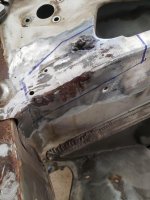
GTRs are notorious for the cowl rusting through as water becomes strapped between the metal cowl and the plastic cowl that sits on top. Below is a picture of said issue.

DS Cowl.jpg

I had to begin by removing the brace, the piece overlapping the cowl that butts up against the rusted out portion, shown in the previous image. Once removed you can see all of the damage. Unfortunately, the passenger (left) side is in just as bad of shape.

DS Cowl 2.jpg

Once removed, I cleaned it all up to see just how bad the area was and what would have to be replaced.

DS Cowl 3.jpg

At this point, I have to shape a piece of metal to patch the cowl with, the cowl is also two layers of metal. The first layer being the outer portion you see and the second layer being a small piece of 90 degree metal that runs the length of the cowl to strengthen the upper corner of it. Both layers will have to be replaced.

I am still learning and would consider my metal shaping/fab skills to be at the novice level. Even a small piece like this will probably take some time for me to form as I am "flying blind," in a sense.
 

NYBODYMAN

Well-known member
Joined
Sep 10, 2013
Messages
4,847
Location
NY
What are you suggesting I measure?

The front cut I bought was just the leading edge of the shock towers forward. So once I removed the core support it was all disassembled. The only remaining piece is the core support.

The cut (I call it a front clip) that you have should have the front of the frame rails attached, correct? If so, the front bumper reinforcement bar (aka re-bar) is usually bolted to the frame rail ends/horns. Using those bolt holes you can measure side to side and then compare to yours to see if your rails are off. Be sure to measure from the same spots on the holes. Without tram bars which I assume you don't have, you can put the bolts back in the holes and measure from the outside to outside portion of the bolt. Another measurement you would want to do when replacing a radiator support is the underhood measurements-generally from the back of the upper rail diagonally across to the front of the radiator support using the existing holes in the same manner described above.
 

BORING HOP YARD

Well-known member
Joined
Jan 13, 2007
Messages
1,101
Location
Boring Oregon
Great progress.
You could be looking at Nissans variation in their manufacturing stamping process.
At some point that front clip was "located" most likely in a fixture. I come from a aircraft manufacturing background. In aircraft you over build any holes or features used for locating into tooling to a higher tolerance to assure they are on location dimensionally to start with. Everything else has a general tolerance. So I would assume the front end has some hard locating points (front bumper mounts) and some location up top, These most likely are the locations you would compare measurements to the drawing.

Looking at your 1st picture it looks like its located up top but the flange of the inner fender is a little low. Going back to my variation concern. It could be variation in the stamping of the core support, the inner fender or both. So if it were me, I would check all of my hard location points, areas that have to be on location, front bumper and such.
I would then clamp the flange area with vice grips kind of tight, not super tight, then I would take my body hammer on the flange edge to see if I could coax the inner fender to go up. I would start at the point the flanges are lined up slowly working my way across from one end to the other (many small taps VS big hits with the hammer. I would be surprised if the flange you are concerned about is locating anything besides the back of the core support it appears to me its just sealing up the inner fender well. "based on the pictures"
I would also bet the factory tech just tapped these areas into locations to fit to themselves and not to tooling points.
Is the driver side the same way?
 
OP
R

RLaCasse1

Well-known member
Joined
Mar 8, 2014
Messages
272
The cut (I call it a front clip) that you have should have the front of the frame rails attached, correct? If so, the front bumper reinforcement bar (aka re-bar) is usually bolted to the frame rail ends/horns. Using those bolt holes you can measure side to side and then compare to yours to see if your rails are off. Be sure to measure from the same spots on the holes. Without tram bars which I assume you don't have, you can put the bolts back in the holes and measure from the outside to outside portion of the bolt. Another measurement you would want to do when replacing a radiator support is the underhood measurements-generally from the back of the upper rail diagonally across to the front of the radiator support using the existing holes in the same manner described above.

The issue I have with measuring the re-bar to get the frame rail width is that the rebar is extremely flexible. It has a springy effect to it and when not on the car the mounting points actually tend to spread apart.

Like you suggested previously, I am trying to track down a frame spec sheet, I think that would be particularly helpful here. However, since the car is relatively rare and new to the US, tracking down a sheet is proving difficult.

Great progress.
You could be looking at Nissans variation in their manufacturing stamping process.
At some point that front clip was "located" most likely in a fixture. I come from a aircraft manufacturing background. In aircraft you over build any holes or features used for locating into tooling to a higher tolerance to assure they are on location dimensionally to start with. Everything else has a general tolerance. So I would assume the front end has some hard locating points (front bumper mounts) and some location up top, These most likely are the locations you would compare measurements to the drawing.

Looking at your 1st picture it looks like its located up top but the flange of the inner fender is a little low. Going back to my variation concern. It could be variation in the stamping of the core support, the inner fender or both. So if it were me, I would check all of my hard location points, areas that have to be on location, front bumper and such.
I would then clamp the flange area with vice grips kind of tight, not super tight, then I would take my body hammer on the flange edge to see if I could coax the inner fender to go up. I would start at the point the flanges are lined up slowly working my way across from one end to the other (many small taps VS big hits with the hammer. I would be surprised if the flange you are concerned about is locating anything besides the back of the core support it appears to me its just sealing up the inner fender well. "based on the pictures"
I would also bet the factory tech just tapped these areas into locations to fit to themselves and not to tooling points.
Is the driver side the same way?

Yes, the driver side is the same exact way. So looking at hard location points... The core support flanges are sitting down on the inner fender. The only lifted areas I see in them are where I had to pry them a little to pop the spot welds loose after I cut them. Additionally, the core support has flanges that sit on top of the frame rails and those are sitting perfectly flush. So I can't lower the core support at all.

I can try to raise the flanges that are a bit low; however, like you said, the only purpose they serve is to locate how far away from the firewall the core support sits and to also seal up the area. They currently can do that just fine. So I see no real need to adjust them, but I may do so simply to have everything "right"


Here is a good example how you want your welds to look like, I know your going to Tig weld them but you want this amount of penetration and such.
https://www.jalopyjournal.com/forum/threads/55-210-wagon-progress.788490/page-35
scroll down about 14 pictures and see how Robert drilled out the holes to assure a good weld.

That was good info, thank you.

All of the metal I am replacing is measuring out to be around 1.03-1.05 mm thick, so off to find what appears to be 19 gauge steel.
 

BORING HOP YARD

Well-known member
Joined
Jan 13, 2007
Messages
1,101
Location
Boring Oregon
Let me throw this out for you to think about, lets pretend your thinking about buying this GTR. Lets also say you have replaced a front end on a GTR so you know how they looked from the factory. When you look at that area are you going to think "why didn't they finish off the area the way the factory did or are you going to think its no big whoop. For me it would make me look closer at the work to see if there was any other areas that not the same as the factory. It may not be noticeable when your done.
"If you want to try"
It looks like you could remove the screw, put a piece of strap metal to bridge the inner fender and the small horizontal portion of the core support. place one of the c clamp on the edge that needs to come up and the other end of the clamp pushing down on the strap. Watch the outside edges, they would most likely become flush first.
once they become flush, clamp tightly together and put a screw in the place the spot weld was, keep working your way to the center until its flush across. Small taps with a hammer will help move the metal flush in between the hard points you created by installing screws
Bottom line its our call, it looks like your very close.
 
To avoid these ads, REGISTER NOW!
OP
R

RLaCasse1

Well-known member
Joined
Mar 8, 2014
Messages
272
Let me throw this out for you to think about, lets pretend your thinking about buying this GTR. Lets also say you have replaced a front end on a GTR so you know how they looked from the factory. When you look at that area are you going to think "why didn't they finish off the area the way the factory did or are you going to think its no big whoop. For me it would make me look closer at the work to see if there was any other areas that not the same as the factory. It may not be noticeable when your done.
"If you want to try"
It looks like you could remove the screw, put a piece of strap metal to bridge the inner fender and the small horizontal portion of the core support. place one of the c clamp on the edge that needs to come up and the other end of the clamp pushing down on the strap. Watch the outside edges, they would most likely become flush first.
once they become flush, clamp tightly together and put a screw in the place the spot weld was, keep working your way to the center until its flush across. Small taps with a hammer will help move the metal flush in between the hard points you created by installing screws
Bottom line its our call, it looks like your very close.

I think I am definitely going to reattack it in an attempt to get it perfect. It does bother me the way it is right now.

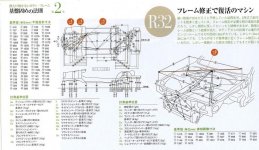
On the bright side, I found a spec sheet.However, it is in Japanese and it's not of the best quality. Hopefully I can get it translated and then decrypt the drawings. Spec sheet below:

Frame Spec Sheet 2.jpg
 

BORING HOP YARD

Well-known member
Joined
Jan 13, 2007
Messages
1,101
Location
Boring Oregon
That spec sheet has a lot of good data on it.
Nissan is giving you the dimensions between two points in MM.
Lets take a look at #2 the between the two hole center points should be 1659mm
This should be a fairly easy measurement. Some of the locations will be harder but you can do them in your garage,#15 would be harder since one of the locations is out in space meaning it has no feature to measure to. Its the center line of the car, its also giving you front to back location of the center line of the bumper holes.
It also shows that Nissan has no dimension for the area of concern we have be discussing, they should just be fit to each other.
One thing I did to help me measure these types of features. If the hole is threaded find a bolt and cut the head off, thread the headless bolt in and put the end of your tape on the bolt, measure to the center of the other hole. If you have a hole with no threads see if you can install a bolt from the underside put a nut on the bolt and put the end of your tape measure on it. Remember these dimension are center to center of holes. if you put a 6mm bolt in hole you need to subtract 3mm off your measured dimension to get the center of the hole, since in effect you measure the outside dimension of the hole the bolt was in. if you put a 6mm bolt in the two holes you measured "one on each end" you need to subtract 6mm from you dimensions, your measuring the two holes outside to outside and you need center to center.
I would get a tape measure that reads in MM to make it easy.
I would also measure the same feature at least three times until I got a repeatable result to assure you have the correct measurement.
You got this!
 
OP
R

RLaCasse1

Well-known member
Joined
Mar 8, 2014
Messages
272
It does have tons of useful information, hopefully I can get a translated version of it soon as that would help take out a lot of the ambiguity here.

For example, what measurement gives me the frame rail width? Is it #9? Maybe, but it doesn't really show a location for measurement points on the rails, unless it is just the inside of them like it appears to be in the drawing. But maybe my eyes are deceiving me.

In regards to measuring the center of the holes, I was gonna throw a bolt in my drill and grind it on the grinder to get a centered point. That way when I measure I can measure point to point on installed bolts.
 

BORING HOP YARD

Well-known member
Joined
Jan 13, 2007
Messages
1,101
Location
Boring Oregon
To help find #9 I would look for a flush hole at the top of the core support just off to the right as your standing in front of the car looking at the front end. You want to find what Nissan would call the (I hole feature) then swing the tape measure to the right in an ark down looking for the (J hole feature) should be 365mm from the I hole feature, it should be just above the bumper hole. J hole is flush with the core support and not like the bumper mounts that are 90deg to the core support. Same thing for the other side, from the I hole feature measure down and to the left in an arc to 455mm to find the other J hole feature. Once you have both J hole feature located you measure between the two J hole features to give you the #9 dimension which should be 740mm.
Don't be surprised if you have values that are close but not exact.

FWIW I did the same with grinding bolts to a point, I work alone in my shop 90% of the time and found its hard to hold on points of both bolts. First change I made to measuring outside of one hole to the center of the other hole. I put the end of the tape over the flat ground bolt, measured to the point and subtracted half of the bolt dia. that was ground flat. this gives you point to point dimension. It becomes difficult when you start measuring frames that are 14 feet long to hold the tape measure end by yourself.
 
OP
R

RLaCasse1

Well-known member
Joined
Mar 8, 2014
Messages
272
To help find #9 I would look for a flush hole at the top of the core support just off to the right as your standing in front of the car looking at the front end. You want to find what Nissan would call the (I hole feature) then swing the tape measure to the right in an ark down looking for the (J hole feature) should be 365mm from the I hole feature, it should be just above the bumper hole. J hole is flush with the core support and not like the bumper mounts that are 90deg to the core support. Same thing for the other side, from the I hole feature measure down and to the left in an arc to 455mm to find the other J hole feature. Once you have both J hole feature located you measure between the two J hole features to give you the #9 dimension which should be 740mm.
Don't be surprised if you have values that are close but not exact.

FWIW I did the same with grinding bolts to a point, I work alone in my shop 90% of the time and found its hard to hold on points of both bolts. First change I made to measuring outside of one hole to the center of the other hole. I put the end of the tape over the flat ground bolt, measured to the point and subtracted half of the bolt dia. that was ground flat. this gives you point to point dimension. It becomes difficult when you start measuring frames that are 14 feet long to hold the tape measure end by yourself.

What ended up being my go-to method was using a seamstress tape which I would hold in place using a welding magnet. The bolt idea was quickly discarded for exactly the same reason you mentioned.
 
OP
R

RLaCasse1

Well-known member
Joined
Mar 8, 2014
Messages
272
Verifying Original Frame Measurements

I was able to measure the front end, based on the Japanese spec sheet I had, and verified all the measurements were correct. I need a translated copy to be certain though as some of the text explains where reference points are, at least I believe. Using the spec sheet resulted in me moving the core support a few mm, afterwards I adjusted the inner fenders to match the core support flange a little better.

Core Right Final Position 2.jpg
Core Left Final Position 2.jpg

Though the inner fender protrudes a couple MM on each side, on the inside the bends are lined up perfectly. So I think I am happy with it at this point.

I meant to start test fitting all the front end parts today again since I moved the core support, but I ended up working on another car for someone.

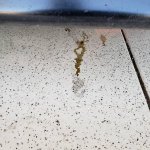
This is another R32 GTR, the owner has been having an issue with a very persistent oil leak. After sitting in my garage for 12 hours, it left a nice little trail of oil under it.

Ryan 12 hrs Sitting.jpg

So began the day by starting to tear the front end off the engine.

Ryan GTR.jpg

I ended up stripping everything off it to get to the cam seals, exhaust side was leaking for sure. Since I was in it this far I put a front main in it as well. Also replaced a missing oil pump bolt, not sure why someone chose to forego putting all the oil pump bolts in. Tons of cleaning up oil as well.

Stripped and cleaned
Ryan Stripped and Cleaned.jpg

Started reassembly, and now I'm just waiting on some parts before I can time it and put it all back together.
Ryan Waiting on Parts.jpg
 

BORING HOP YARD

Well-known member
Joined
Jan 13, 2007
Messages
1,101
Location
Boring Oregon
Looking good, like i said "you got this". When it comes to start welding, slow down and go for the best welds possible. I would highly recommend that you reweld every spot that had a spot weld. I would also recommend the once you weld take a hammer and dolly and ding on top of the weld to stretch it back out a little since the welds will be shrinking the point of the weld. I would also tap down the metal within about a 1/4 to 3/4 away from the weld over the top of the piece being welded to help keep the two pieces tight so each other. Your a good man for helping you another GTR that was slowly bleeding on the floor. Great work.
 
OP
R

RLaCasse1

Well-known member
Joined
Mar 8, 2014
Messages
272
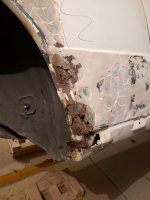
Last two weeks have been fairly busy, I'm back to work full-time again since my base is going back to normal ops. As such, I have not had much time in the garage. However, I was able to finally track down a right hand rear quarter panel. The one on the car is in pretty bad shape. The rear quarters are getting hard to find and more expensive as Nissan is not producing them outside their heritage program. It was at a dealership in Pennsylvania and I used Greyhound to ship it to Las Vegas. Unfortunately it go a little damaged along the way, but nothing serious. I think I can fix it all.

Quarter damage, this is just one shot of one small area.
20190302_193309.jpg
20190302_200955.jpg

New Quarter
Quarter.jpg

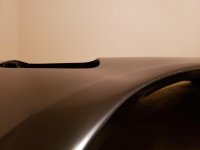
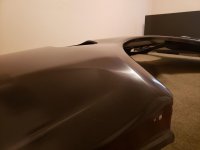
Damage to the quarter is one slightly pressed in area and then a small crease in the steel.
Damage 1.jpg
Damage 2.jpg
 

s14kev

Well-known member
Joined
Dec 12, 2008
Messages
245
There is an s14brent! Interestingly enough, I've owned both and S14 and an R32. Good work on persisting with that quarter panel. 15 years ago we would have scrapped that car and sold it as a front cut if it had that level of damage with how many were coming over from Japan.
 
OP
R

RLaCasse1

Well-known member
Joined
Mar 8, 2014
Messages
272
nice job! so wait, are you still in vegas?

Yes, at least for the time being. Late this year or early next year I will be moving on as I got picked up to be an officer and have to go to training for that.

There is an s14brent! Interestingly enough, I've owned both and S14 and an R32. Good work on persisting with that quarter panel. 15 years ago we would have scrapped that car and sold it as a front cut if it had that level of damage with how many were coming over from Japan.

True. This car would have been binned a decade ago. But now, worse cars will still pull a decent amount of money. I'm curious to see how their value will play out in the future.
 

BORING HOP YARD

Well-known member
Joined
Jan 13, 2007
Messages
1,101
Location
Boring Oregon
So what is the plan for the Qtr panel?
Are you thinking of replacing the whole Qtr or use it for patch panels.
How bad is the front of the Qtr panel at the bottom.
That's some nasty rust, I would bet your looking at some inner panel work as well.

My guess on the future $ values is R32 will be a higher dollar car, I don't see a rare car "to the United States" going down in value, and they have a good following.
Kind of like my dream car 70s bluebird coupe, their not going down in value only climbing. I understand that not all rare Nissan climb in value. I have a factory v6 S12 that now is a LS3 endurance race car but they have basically flat lined. I also have a 73 510 that is rare in the states because they only imported into Canada, It has a VG36 V6 Z32 brakes that is all bolt in, so someone could reverse everything if they wanted. The 510s have been going up in value as well.
 
OP
R

RLaCasse1

Well-known member
Joined
Mar 8, 2014
Messages
272
So what is the plan for the Qtr panel?
Are you thinking of replacing the whole Qtr or use it for patch panels.
How bad is the front of the Qtr panel at the bottom.
That's some nasty rust, I would bet your looking at some inner panel work as well.

My guess on the future $ values is R32 will be a higher dollar car, I don't see a rare car "to the United States" going down in value, and they have a good following.
Kind of like my dream car 70s bluebird coupe, their not going down in value only climbing. I understand that not all rare Nissan climb in value. I have a factory v6 S12 that now is a LS3 endurance race car but they have basically flat lined. I also have a 73 510 that is rare in the states because they only imported into Canada, It has a VG36 V6 Z32 brakes that is all bolt in, so someone could reverse everything if they wanted. The 510s have been going up in value as well.

I'd like to replace the whole quarter because there are so many issues with it. Not only is there rust in the lower areas, there is rust where the rear window sits and where the side window trim is. Replacing the whole thing would be ideal. A small portion of the inner fender will have to be repaired, from what I can see. And the inner wheel well may need some straightening as well. My intention is to remove the quarter, build wooden templates of the wheel well based on the other side which is pretty straight, and use them to correct the wheel well, then repair the inner fender, then put the new quarter on.
 

BORING HOP YARD

Well-known member
Joined
Jan 13, 2007
Messages
1,101
Location
Boring Oregon
Sounds like your thinking ahead of the game, good deal!.
If it were me I would make sure I had a screw in every spot weld and then remove one screw at a time weld up the spot and move on.
Remember make sure you hang the door and the trunk lid before you start welding, gaps need to be verified. Sorry if I sound redundant.
How are you doing with Tig welding a spot that looks like a spot weld?
 
OP
R

RLaCasse1

Well-known member
Joined
Mar 8, 2014
Messages
272
Well, it has been a hot minute since I have updated this thread. I'm all through my move and in training, now residing in Pensacola for the next year or so. I've mostly been just working on getting better at welding sheet metal, both **** joints and spot welds, as I'll eventually be welding in patch panels and probably a quarter panel. But that aside, some minor forward movement on the car has occurred, nothing significant but something is something.

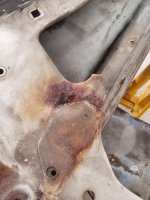
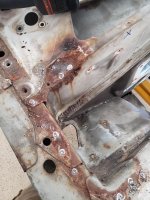
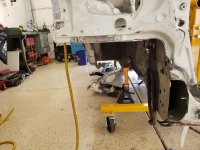
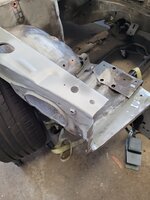
I began repairing the upper chassis rails on the front end of the car. Basically the rails the fenders bolt to and the core support will eventually be welded to. They had some damage from the spot weld cutters that were used to remove the old core support. For the most part it was just welding holes about an 1/8th in diameter and filling in cut marks from the cutters. It turned out to be a pain in the *** because the majority of the rails are two layers of steel and have some coating in between them. So once I started welding the welds would pop a bit. The other big part was cutting out a small section of the driver's side rail and putting a patch in place. Finished it all up with some weldable primer just to keep the Florida humidity from destroying the car.

This is what I started with on the driver's side, there was a bit of damage under the clamp that you can't see.
Front Right Upper Repair_Before.jpg

I cut this section out because the steel that was there was razor thin, you can see it was there in the pic above, but it mostly disintegrated once I cleaned the underside with a sander. Wish I had gotten a straighter cut on the back portion, but it still worked out.
Front Right Upper Repair_During 1.jpg

Here's a shot of it all welded in, came out pretty decent in my personal opinion. So did the area to the left of it that looks pretty mangled in the above picture.

Front Right Upper Repair_During 3.jpg

What's the saying? "A grinder and paint..." :) The only holes you see there are the two large holes which are factory features, and a tiny hole which is actually there to help locate the core support properly when I put it back on.

Front Right Upper Repair_After.jpg

The passenger side was much easier as I did not need to patch anything; however, it was more difficult trying to weld and seemed much more contaminated than the driver side due to the double layered steel issue I mentioned earlier. But, it turned out decent regardless.

Before.

Front Left Upper Repair_Before.jpg

During

Front Left Upper Repair_During.jpg

After. Once again, only the factory features and the small locating hole remain.

Front Left Upper Repair_After.jpg

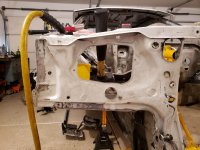
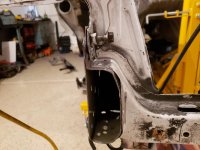
Next I'll work on repairing the two areas shown below and the core support. You can notice in the pictures below that the flanges and main frame rails all have holes/marks in them from having the core support removed. So I need to go throw and repair all of these. Fortunately all the steel in these areas is single layered and I can easily clean both sides and avoid contamination, I can also easily back these areas with copper.

Left Side Headlight Well_Before.jpg

Right Side Headlight Well_Before.jpg

Before the core support gets welded onto the chassis, I need to first address the cowl issues. I'll just show one side here, but both sides are equally damaged. Fortunately I bought some cuts from another car that are in decent condition, so I'll be grafting them onto the car.

DS Cowl 3.jpg

I'll hopefully get the core support and rest of the flanges/frame rails knocked out this week. It may be a couple weeks before the cowl issues get resolved. That's it for now.
 
OP
R

RLaCasse1

Well-known member
Joined
Mar 8, 2014
Messages
272
Got out of training a bit early today so I spent some time in the garage again working on the front end of the car and was able to get a bit done. Gotta say, welding vertically, even little welds like I was doing was not a fun time.

The following pics give an idea of what I was working on. The flanges the core support will be welded to and the main frame rails were the focus of the day. They weren't in horrible shape, but I did want to clean them up a bit and fix some holes and cut marks.
Left Side Headlight Well_Before.jpg
Right Side Headlight Well_Before.jpg

Driver Side Frame Rail_Before.jpg

And the after pics. I think everything turned out decent, but there are still a few things I'd like to clean up. I do need to get under the car and address the backside of the flanges, all I really need to do back there is grind out any metal from the penetration. They aren't perfect, but they don't have to be as they will have the core support mounted to them which will cover all the areas I have worked so far.


Passenger Head Light Well_After.jpg
Driver Side Headlight Well_After.jpg

I can get started on the core support tomorrow assuming my schedule doesn't prevent me from making it into the garage. That's all for now.
 

draco_1967

Well-known member
Joined
Jan 3, 2021
Messages
205
Location
Utah
Very cool project. Here is a quick and dirty photochop of the R32 that looks close to Katsura orange. You're doing awesome work!
 

Attachments

  • R32.png
    R32.png
    436.9 KB · Views: 53

FMB4

Well-known member
Joined
Jan 19, 2017
Messages
2,926
Definitely a super cool project. Lot's of sharp fab/work on your part as well.
 
Last edited:
OP
R

RLaCasse1

Well-known member
Joined
Mar 8, 2014
Messages
272
Welcome back! looks like your making some good progress.

I am, finally. It's been a while due to moving out of Las Vegas and getting to Pensacola, with all my training in between. But truth be told, I also did not get back into the garage as quickly as I could have out of sheer laziness.

Very cool project. Here is a quick and dirty photochop of the R32 that looks close to Katsura orange. You're doing awesome work!

Thank you. I appreciate that very much.

Definitely a super cool project. Lot's of sharp fab/work on your part as well.

Thank you, and sharp is probably an over statement, lol.
 
To avoid these ads, REGISTER NOW!
Top Bottom