To avoid these ads, REGISTER NOW!

GTR Restoration and Build

OP
R

RLaCasse1

Well-known member
Joined
Mar 8, 2014
Messages
272
I was able to get started on the actual core support today. I got the upper portion of the core support squared away. Unfortunately this was the easy part of the core support as it was accessible, so it's all uphill from here. But on the bright side, it sure was nice being able to weld on a flat surface today rather than vertically yesterday.

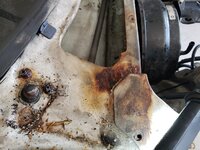
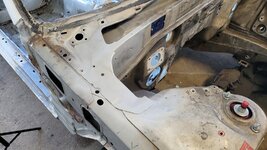
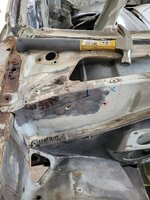
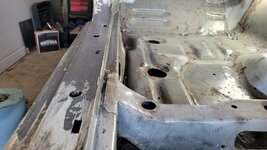
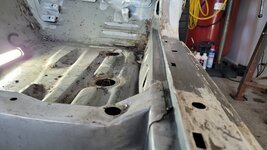
Here's a couple before pics of the areas I was addressing today. All the holes except two on each side had to be filled in. You can see them in the pictures, the hole with the black arrows (factory alignment hole) and the hole circled in blue (my alignment hole).

1. Core Support Left_Before.jpg
2. Core Support Right_Before.jpg

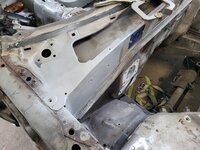
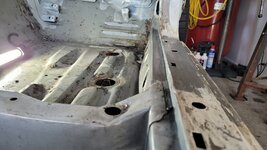
A couple of during shots. First shows the plugs I made with a cheap HF punch/die set. They worked out perfectly for all the holes. Second pic shows one side with all the plugs "tacked" in.

3. Core Support During.jpg
4. Core Support During.jpg

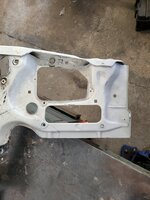
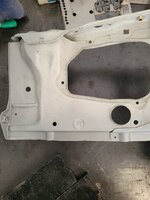
After shots. Not only do I need to work on my welding skills, I need to also work on my grinding/finishing skills as any imperfection is very visible. Like always, a light coat of weldable primer to keep the weather off the metal.

5. Core Support Left_After.jpg
6. Core Support RIght_AFter.jpg

Anyways, that's probably it for the next week or so as I'll be traveling over the holiday.
 
To avoid these ads, REGISTER NOW!

FMB4

Well-known member
Joined
Jan 19, 2017
Messages
2,926
@ RLaCasse1; Have good holiday weekend. And thank you for your service.

 
OP
R

RLaCasse1

Well-known member
Joined
Mar 8, 2014
Messages
272
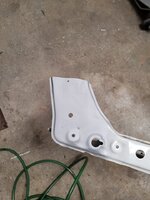
Progressed a bit more today with the core support and cleaning up the flanges on it. Below is a before pic of one end of it. Similar to the chassis, it was just a bunch of fix holes and cleaning it up.

9. Core Support Before.jpg

And after pictures.

8. Core Support Right_Finished2.jpg

7. Core Support Left_Finished2.jpg

I still have a bit more to go on cleaning up the core support. Unfortunately, some of what remains are areas that are awkward to get to with a TIG torch, so it should make for an entertaining day.
 
OP
R

RLaCasse1

Well-known member
Joined
Mar 8, 2014
Messages
272
Didn't realize it's been almost 2 months already. I'm working on two different things at this point: 1) Planning out how to keep the core support removable, and 2) repairing the cowl area (this is where I need suggestions).

This is the area to be repaired. It is outlined in blue sharpie. Also, there is an inner support running the length of the bend on the cowl on the underside (shown in the next pic) which will have to come out as well.

Cowl Damage.jpg

And here is a cutout of a cowl that will be going in. I wanted to show the underside of it so as I explain my current quandary it all makes sense.

Backside 1.jpg

So you can see on the underside of the cowl there is an additional support which runs along the bend in the cowl. This support is spot welded in all over the place. I'm currently trying to figure out how to retain this piece and have a few ideas.

1) I leave it in place as is, and just weld the patch in and make sure the weld actually penetrates both layers of steel simultaneously. The only real drawbacks I see here is it not penetrating and the contamination from rust/coating between the layers.

2) I remove the support from the patch panel first or recreate it as close as possible. This way I can put the support back in first, then add the cowl sheet metal on afterwards. The difficulty here is once everything is back in place it will be borderline impossible to spot weld the support and cowl back together.

3) Cut the cowl material back just a bit further than the support (think about a 1/2 gap between cowl patch and cowl panel) so I have access to weld the support, then weld in the gap on the cowl. Sorry if this does not make sense, I feel like I'm explaining it very poorly.

Thoughts?
 

Fix Until Broke

Well-known member
Joined
Feb 21, 2016
Messages
794
Location
SE Wisconsin
Combine #2 and #3

Remove the support from the patch panel by drilling the spot welds

Drill out the spot welds connecting the rusty cowl to the existing support

Remove the rusty cowl, leaving the existing support. If the existing support is rusty, remove the rusty part leaving a protrusion to weld to. Cut the patch panel support to the correct length and weld it to the existing support. Then weld in the patch panel.
 
OP
R

RLaCasse1

Well-known member
Joined
Mar 8, 2014
Messages
272
Combine #2 and #3

Remove the support from the patch panel by drilling the spot welds

Drill out the spot welds connecting the rusty cowl to the existing support

Remove the rusty cowl, leaving the existing support. If the existing support is rusty, remove the rusty part leaving a protrusion to weld to. Cut the patch panel support to the correct length and weld it to the existing support. Then weld in the patch panel.
Unfortunately the existing support is rusty and needs to be replaced, I can see that. Also, it is spot welded from the support side, so there is no way to actually see where the spot welds are on the cowl and it's impossible to get a drill behind the cowl even if I could see where the welds are.
 

Fix Until Broke

Well-known member
Joined
Feb 21, 2016
Messages
794
Location
SE Wisconsin
Ok, scratch that idea :)

What if you take idea #1 with a slight modification to insure penetration into both pieces?
If the support pieces **** up to each other nicely, grind back just the cowl pieces about 1 material thickness. **** the support together (or close) and you're left with a little valley to fill with the welder which will insure full penetration into all 4 pieces.

Super zoomed in cross section sketch below

Weld Idea.jpg
 
OP
R

RLaCasse1

Well-known member
Joined
Mar 8, 2014
Messages
272
Yesterday I began removing the top layer of steel from the cowl to replace it. I was thinking it would be a huge pain to get the spot welds holding the support to the cowl ground off, but it was easier than I expected. I just used a belt grinder and took my time grinding throw the cowl until the support was completely free. Fortunately, the support underneath was in much better shape than I had thought and cleaned up well enough.

20211029_134657.jpg

After cleaning up the support I worked on fitting up the patch panel, which went well for the most part. However, getting the gaps nearly non-existent was quite a pain, and necessary as I only have a TIG welder. Fortunately, it worked out fairly well and I was able to get the new piece buzzed in today.

20211030_131355.jpg

All that remains for this side is welding in a new cowl brace like the one shown below in the bottom left of the image. The brace just ties the cowl, upper chassis rails, and strut tower together.

20190129_135925.jpg

On to the passenger side next. Hopefully it goes smoothly. It is a bit more complex due to the shape of the what has to be replaced, but it is in a more welder friendly positions in my opinion.
 
OP
R

RLaCasse1

Well-known member
Joined
Mar 8, 2014
Messages
272
Unfortunately I did not take any photos of the process of repairing the passenger side cowl. Only a finished product photo. It's not 100% perfect, but at the end of the day, most of this area is covered with another brace that gets welded in. But overall, I think it turned out pretty well and learned a bit along the way.

Passenger Side.jpg

Next I will be moving on to finishing up the core support. I am trying to figure out how to keep the support removable as I think it would be convenient in the future whenever the drivetrain needs to come out, though I'm not completely decided yet. Additionally, it is time to move on to the rocker panels and floor boards.
 
OP
R

RLaCasse1

Well-known member
Joined
Mar 8, 2014
Messages
272
So after some contemplation I decided the core support will go back in to the car permanently, rather than making it removable. Once I put on the fenders, lights, crash bar, and bumper it was obvious a removable support was somewhat a pointless endeavor, or at least not as beneficial as I had imagined.

Anyways, took some time today to test fit all the body parts again before fitting the core in for its final time. Tomorrow I will zap it all in place permanently.

Final Fit.jpg

On another note, any good recommendations for chemical paint removers and rust removers? This cowl experience has convinced me that abrasive removal is an absolute no-no when dealing with steel this thing (22 gauge), so I'll be trying chemical strippers instead.
 

BORING HOP YARD

Well-known member
Joined
Jan 13, 2007
Messages
1,102
Location
Boring Oregon
The stripper that I use is no longer made. It has been replaced with a non-methylene chloride formula that I haven't tried yet
I have been using the original since the 80s. You have to take several precautions for yourself "PPE" as well as the car. "getting 100 % of the stripper naturalized, washed and removed is vital" stripper can hide in a seam and bleed out from the seam after final paint.
I also wash and dry the area to be worked so the stripper works faster not having to cut trough the oil. Apply stripper until your at the level of bare you want. Spray the stripper down with a strong degreaser and give it a scrub with a brush. I use a pressure washer to rinse it off making sure to hit the seams and any area that might hold stripper residue. Then I blow off the area with compressed air making sure I focus on seams and such. Sometimes I spray acetone around the seams to make sure and get all the stripper removed. Another stripping method I use is a portable propane touch to soften the paint and wire brush it off, just enough heat to soften the paint.
Nice progress!
 
OP
R

RLaCasse1

Well-known member
Joined
Mar 8, 2014
Messages
272
The stripper that I use is no longer made. It has been replaced with a non-methylene chloride formula that I haven't tried yet
I have been using the original since the 80s. You have to take several precautions for yourself "PPE" as well as the car. "getting 100 % of the stripper naturalized, washed and removed is vital" stripper can hide in a seam and bleed out from the seam after final paint.
I also wash and dry the area to be worked so the stripper works faster not having to cut trough the oil. Apply stripper until your at the level of bare you want. Spray the stripper down with a strong degreaser and give it a scrub with a brush. I use a pressure washer to rinse it off making sure to hit the seams and any area that might hold stripper residue. Then I blow off the area with compressed air making sure I focus on seams and such. Sometimes I spray acetone around the seams to make sure and get all the stripper removed. Another stripping method I use is a portable propane touch to soften the paint and wire brush it off, just enough heat to soften the paint.
Nice progress!

I've heard good things about Rust911 for rust, I'm currently trying out Loctite Naval Jelly which seems to work well on rust but not paint whatsoever.
 
OP
R

RLaCasse1

Well-known member
Joined
Mar 8, 2014
Messages
272
Today was an extremely frustrating day, TIG welding is not my friend. I'm able to TIG alright on a bench and metal that is 18 gauge or heavier. But just spot welding on vertical and upside down surfaces was extremely infuriating as I was having little to no success. I constantly had issues with the tungsten just immediately picking up the entire puddle and filler rod. Additionally, the outer layer of steel would constantly melt back making me have to "chase" the metal as I spot welded. I predict most of this happening and its something I actually tried to contend with over the weekend.

On Sunday I decided to go snag a cheap MIG welder from Harbor Freight. I figured a small welder with some flux core wire ought be good enough to spot weld, boy was I wrong. The Titanium flux core welder was a complete ************* and would not spot weld at all. I never actually made it to welding on the car as I couldn't get it to do a decent spot weld on the bench. Maybe it was the welder, maybe it was the wire, I have no idea. But what I do know now is that I'll never buy another and if you tell HF "I don't know if it's broken or just a *************" they will absolutely charge a restocking fee. :ROFLMAO:

So that brings us today where I decided to attempt to TIG the core into place. It went poorly, by noon I was losing my mind and had to just walk away before I started throwing things around my garage. I figured at this point my only option was to actually splurge a little for a decent MIG. So I hopped on FB Marketplace and found a Hobart Handler 140 which had only been used a few times before sitting around in a mobile mechanic's work trailer. So I went to see it, tested it out and ended up buying; I snagged a bottle of 75/25 on the way home as well. It only took a few moments to setup, even though I did have to switch the polarity and also fix the pressure unit thing inside where the previous owner left a fitting loose. But I gotta say, this thing welds beautifully, at least to me.

Hobart.jpg

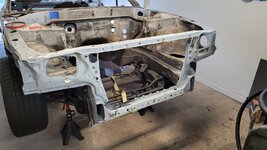
I was able to do about 75% of the total spot welds in about 20 minutes, whereas the other 25% had taken around four hours between the welding and constantly regrinding the tungsten. And finally the core support is fully welded in, I do have a few minor fixes I still need to make to some of the spot welds though. Also, as much as I'd love to try to fully finish the metal, I'm hesitant as it's so thin. So for the most part I'm just grinding down the bulk of the welds.


Core Support Complete.jpg

Like I said, I have some minor stuff to fix to have it 100% complete and I'll have that done tomorrow or the next day. After that, it is on to attempt fixing the pinch welds and rockers.
 

BORING HOP YARD

Well-known member
Joined
Jan 13, 2007
Messages
1,102
Location
Boring Oregon
I have used Rust911 when I'm soaking parts, I use two others when I'm doing a large part like a hood or a fender.
I prefer to use Rust Mort but it gets expensive, the concrete etch work great as well.
I wont use an acid without going through a complete process of neutralizing rinsing and drying, I have seen adhesion failures from acid left on the surface to dry.
Glad to see you get a Mig welder, they will fill a void in the shop when Tig is hard to perform. A shop needs both "my opinion".
I would also say any skill you master on both Mig and Tig will only make you a better welder.
"Warning" Down the road I would bet your next welder will allow you to weld thicker gauge, on a future project. I seen this play out before with my shop. I use the **** out of all my welders. I find Tig is the most frustrating and the most relaxing. My welder purchases went oxygen acetylene, 110 mig, 220 mig, Tig and plasma cutter in a span of 20 years.
Everything I see on your project looks very solid and well planned.
Robert of MP&C shop projects fame has talked about a mig wire that is easier to grind. The problem is its only available on large spools. He also talks about how to grind and finish those areas. Robert is a great guy and has answered many of my stupid questions in the past. If you find yourself with some spare time it would be worth the look. It has helped me understand what the metal is going through and that actions needed to correct without using a bunch of filler. Robert uses both Mig and Tig and well usually explain why he is using either one.
Anyway I'm enjoying your progress and its looking real good.
 
OP
R

RLaCasse1

Well-known member
Joined
Mar 8, 2014
Messages
272
I have used Rust911 when I'm soaking parts, I use two others when I'm doing a large part like a hood or a fender.
I prefer to use Rust Mort but it gets expensive, the concrete etch work great as well.
I wont use an acid without going through a complete process of neutralizing rinsing and drying, I have seen adhesion failures from acid left on the surface to dry.
Glad to see you get a Mig welder, they will fill a void in the shop when Tig is hard to perform. A shop needs both "my opinion".
I would also say any skill you master on both Mig and Tig will only make you a better welder.
"Warning" Down the road I would bet your next welder will allow you to weld thicker gauge, on a future project. I seen this play out before with my shop. I use the **** out of all my welders. I find Tig is the most frustrating and the most relaxing. My welder purchases went oxygen acetylene, 110 mig, 220 mig, Tig and plasma cutter in a span of 20 years.
Everything I see on your project looks very solid and well planned.
Robert of MP&C shop projects fame has talked about a mig wire that is easier to grind. The problem is its only available on large spools. He also talks about how to grind and finish those areas. Robert is a great guy and has answered many of my stupid questions in the past. If you find yourself with some spare time it would be worth the look. It has helped me understand what the metal is going through and that actions needed to correct without using a bunch of filler. Robert uses both Mig and Tig and well usually explain why he is using either one.
Anyway I'm enjoying your progress and its looking real good.

I appreciate all the tips.

I agree on the neutralizing any chemicals. The reason I was not too concerned with it is because I plan on having this car acid dipped anyways later on in the process of what I am doing here.

The little MIG is amazing. It's nothing special, but it works exponentially better for what I am doing when you factor in the positions and my personal skill level. So I'm glad to have it.

And yes, the MP&C thread is awesome. I keep going back to that one, reading his posts and trying to understand why he does what he does. There are some phenomenal people on this forum with incredible skills, which is why I chose to put this project on this forum versus a forum dedicated to the platform itself. Those forums don't necessarily have projects this in depth, they typically revolve around the "modification" aspect of the car. And the folks who are actually restoring these are not exactly documenting their restorations on forums, or so it seems.
 

Ohmthis

Well-known member
Joined
Jan 20, 2013
Messages
3,014
Location
Outside of Louisville KY
Great progress on the car. I second the fact that Robert is great to ask questions to. He is gracious in freely giving his knowledge and not making you feel like a *******. Thank you for your service!
 
OP
R

RLaCasse1

Well-known member
Joined
Mar 8, 2014
Messages
272
So.... big change here!

I've found that social media platforms kind of **** and are not the venue for chronicling this restoration. That being said, I opted to start a Youtube channel where I can upload videos. I am brand new to video editing, so there is definitely a learning curve associated with starting a channel. I hate being in front of a camera; however, my job for the last decade plus has been a lot of public speaking which will aid a bit in this endeavor. As of now, the video editing is very basic and to be completely honest, not the greatest. My first video is the result of several hours on my computer giving myself a crash course on editing. Also, some of the footage was taken with the intention of uploading it to social media versus creating a video. As for this thread....

I created this thread on this specific forum due to the overwhelming amount of expertise which resides here. I think it'd be short-sighted, or foolish, of me to just stop updating this thread. I plan to use this thread the same way that I have been, seeking advice and also providing updates. But the Youtube channel does provide the opportunity to go more in-depth as it is easier to quickly share more material. If you are interested in this type of channel, check it out. If you like what you see and want to support it, please subscribe and share with others who may be interested.

Quick basics of the channel, the name Motorwerk32 simply comes from always seeing performance/auto shops in Germany called "Motorwerk," the name just always appealed to me. The 32 is simply the chassis code for my GT-R (R32) and also a friends 300ZX (Z32) who may also be coming on board helping create these videos. From my Youtube About page: "This channel will chronicle the restoration and build of my R32 GT-R. I have a strong mechanical background, having wrenched on anything from Jeeps to Evo's and Caravans to GT-R's. That being said, fabrication and restoration are relatively new arena which I aim to conquer. What this is not! Youtube is not my full-time job, nor am I a mechanic, fabricator, or body man by trade. My shenanigans in the garage are simply me following my passion and now I am trying to share that with you. I will do my best to generate videos that are not only entertaining, but helpful to others who are seeking to restore, build, or modify their own."

Link: https://www.youtube.com/channel/UCf13sLLnZeWfaQTX0hzkHZg/featured

Logo 5.PNG
 
To avoid these ads, REGISTER NOW!
OP
R

RLaCasse1

Well-known member
Joined
Mar 8, 2014
Messages
272
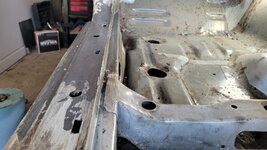
The next thing up on the car to be fixed is the inner sills, rockers, floorboard, and pinchweld on both sides of the car. I took a few minutes today to start cleaning up the area to get an idea of just how extensive the damage is and also brainstorm how I'll go about making this repair.

I ended up trying out some of the aircraft stripper Boring Hop Yard recommended, it worked decently to remove the bulk of the paint with a couple applications. Next up, I plan on using some naval jelly to remove any rust in the area. I'm trying to get rid of the bulk of the rust and paint so I can really see what is going on in the area.

The first four pictures are the passenger (left) side of the car and the last four are the driver (right) side of the car. You can see the amount of damage that has been done to the inner sill, rocker, and floorboard from improperly raising the car. GT-R's are well known for this particular damage and, unfortunately, my car is no exception.

The first image shows the damaged area inside the car once I cleaned it up a bit with some stripper. Unfortunately, it's somewhat difficult to clean between the sill and floorboard due to how the material is sandwiched together from the damage. Also, you can see right around the middle of the sill, where it meets the floor, the damage and subsequent water ingress was bad enough the inner sill actually rotted out (up close in second picture). As the floorboard and pinch weld were pushed up it also caused the inner sill to cave inwards toward the centerline of the car as shown in the third picture; the sill should be perfectly vertical. Finally, the fourth picture is a candid shot of the culprit of this damage. This is all the passenger side damage, the driver side damage pictures follow the same order.

Passenger Side:

20211106_164615.jpg
20211106_164618.jpg
20211106_164635.jpg
20211106_164702.jpg

Driver Side:

20211106_164735.jpg
20211106_164740.jpg
20211106_164748.jpg
20211106_164806.jpg

I have been considering how to go about fixing this particular issue and have a rough order of operations thought out. However, any helpful insight and advice would be greatly appreciated. Ops as follows:

1. Pull the pinch weld back down to its original position using a few body clamps (left pic) and some adjustable tension bolts (right pic). In order to actually get some pulling power the car will be set down onto two pieces of sturdy lumber, imagine a car sitting on a drive on lift. The tension bolts can get anchored to the lumber and pull the clamps directly downward. This is about the easiest way I can think of doing this in a small garage and even cheap tension bolts can hold 300+ pounds, so with 3-4 there's a potential for around half a ton of pulling force.
1636254652736.png1636254619523.png
2. Massage the inner sill back into place while it is being pulled down. Once everything is back in the correct place I can really clean things up and get rid of the remaining seam sealer and sound deadening.

3. Once cleaned up, assess what all will need to be replaced versus what can be further massaged into place. I know there are portions of the floorboard and rocker that need to be replaced as I don't think they will repair easily. The inner sill needs a minimum of a patch put in where it has rusted out, and this is assuming the inner sill will straighten out into its original form once pulled. If it won't, I'll likely have to cut it out, then recreate a portion of the inner sill. Difficult, but I believe doable with what I have in the garage.

That is the general gist of what I plan to be doing over the next few weeks.
 

BORING HOP YARD

Well-known member
Joined
Jan 13, 2007
Messages
1,102
Location
Boring Oregon
Well first good luck on your Youtube channel, I will make sure to check it out.
So the Datsun 510s have the same issue with the pinch welds being damaged.
Not sure if you have the room, I use a large slide hammer starting at one end and massaging it back and forth until its been pulled back into position. I made a clamp "that sucked" but it allowed me to fix the pinch weld. I tossed the clamp after finishing my 73 510 and decided to purchase a good clamp next time. I had purchased a 13lb slide hammer long ago for body work and you can move a fare amount of metal with it. My mentor showed me, he also welded on tabs in some areas that a clamp would not work. The tabs had a large hole in it so the hammer had a place to grab. Same process starting at one end and walking the metal back into position. He also gave me a book and told me to read it called "The key to Metal Bumping".
I have tried to grasp the metal working concept's but have found it difficult, it got better with experience for me.
Just wanted to share with your fan base a book that covers how to move metal.
I still have the copy I was given and the picture quality is not much better.
Hope this helps!


OP
R

RLaCasse1

Well-known member
Joined
Mar 8, 2014
Messages
272
Well first good luck on your Youtube channel, I will make sure to check it out.
So the Datsun 510s have the same issue with the pinch welds being damaged.
Not sure if you have the room, I use a large slide hammer starting at one end and massaging it back and forth until its been pulled back into position. I made a clamp "that sucked" but it allowed me to fix the pinch weld. I tossed the clamp after finishing my 73 510 and decided to purchase a good clamp next time. I had purchased a 13lb slide hammer long ago for body work and you can move a fare amount of metal with it. My mentor showed me, he also welded on tabs in some areas that a clamp would not work. The tabs had a large hole in it so the hammer had a place to grab. Same process starting at one end and walking the metal back into position. He also gave me a book and told me to read it called "The key to Metal Bumping".
I have tried to grasp the metal working concept's but have found it difficult, it got better with experience for me.
Just wanted to share with your fan base a book that covers how to move metal.
I still have the copy I was given and the picture quality is not much better.
Hope this helps!


Thank you for the book, I'll make sure to check it out. Any other suggestions on reading material?

Also, the slide hammer had been considered for about 10 seconds at one point but I dismissed the idea, perhaps too quickly. I could get the car back up onto the cribbing I built for it, but even then I will only have about 2 feet of space between the chassis and the floor. I didn't think that would give me sufficient much space to work with a slide hammer. Also, I'll be pulling three layers of steel simultaneously (floor board, inner sill, rocker). I had assumed it would be a struggle to get the momentum I need to move that much steel in such a confined space and awkward position. On the pro side, a slide hammer definitely simplifies the whole process. Perhaps I dismissed this idea too quickly.
 

Monza Harry

Well-known member
Joined
Dec 29, 2018
Messages
1,433
Location
Windsor ON
Thank you for the book, I'll make sure to check it out. Any other suggestions on reading material?

Also, the slide hammer had been considered for about 10 seconds at one point but I dismissed the idea, perhaps too quickly. I could get the car back up onto the cribbing I built for it, but even then I will only have about 2 feet of space between the chassis and the floor. I didn't think that would give me sufficient much space to work with a slide hammer. Also, I'll be pulling three layers of steel simultaneously (floor board, inner sill, rocker). I had assumed it would be a struggle to get the momentum I need to move that much steel in such a confined space and awkward position. On the pro side, a slide hammer definitely simplifies the whole process. Perhaps I dismissed this idea too quickly.
I have a store built Slide Hammer [probably a bit smaller than linked above] and a Shop Built one, the shop built one only has a ~14-16" shaft and a ~#5 slide but don't dismiss the lighter weight as the force created is 1/2MVsquared so the lighter weight will allow a higher speed on the hammer that coupled with your idea to add a constant PULL (turn-buckles (y) this will reduce some of the bounce and help concentrate your efforts) will move things along better than you might think. I have tapped a flange inside of a couple of holes with a little piece of brass, the key I found was patients as small taps will only stretch in a narrow band and lessen the distortion from going "Gung Ho!" with the BFH. Analyse what, when (Order of Operations), and where you want to move the steel, remember this is already stretched out of your desired finished shape, so I would try and remember to figure some shrinking into the plan. Good Luck! Harry
 

BORING HOP YARD

Well-known member
Joined
Jan 13, 2007
Messages
1,102
Location
Boring Oregon
I wonder if you only raised one side of the car at a time so your not pulling straight down and more of 45 deg angle to the floor.
Monza Harry has an excellent point about moving metal, he calls it "Gung Ho" we called it "rough it up and shoot em out.
In the case of the pinch weld I would take a straight edge and hold it up to the pinch weld to identify the start and stop of the damage I use a sharpie marker to mark it. Then I would start next to the line on the damaged side and slowly start taking some pulls on the slide hammer. Give it a good wack and see if anything moved use the straight edge to detect progress. No home runs just base hits and only take what it will give you, go down the line until you reach the other end of the damaged pinch weld. It might take you 5 - 6 passes up and down the damaged area to get it pulled out. When I first started I tried to pull out the damaged area at its deepest point but it has all the other metal around it trying to hold its damaged shape. By working across the area your getting the damaged metal furthest away from the deepest damaged area to relax and taking away its ability to hold the deep damaged that needs to come down so the pinch weld is level and straight. I would also run a torch lightly over the area above the rust just to get it to relax. you want it hot but not hot enough to burn the paint off, Propane torch would do it.
 
OP
R

RLaCasse1

Well-known member
Joined
Mar 8, 2014
Messages
272
I have a store built Slide Hammer [probably a bit smaller than linked above] and a Shop Built one, the shop built one only has a ~14-16" shaft and a ~#5 slide but don't dismiss the lighter weight as the force created is 1/2MVsquared so the lighter weight will allow a higher speed on the hammer that coupled with your idea to add a constant PULL (turn-buckles (y) this will reduce some of the bounce and help concentrate your efforts) will move things along better than you might think. I have tapped a flange inside of a couple of holes with a little piece of brass, the key I found was patients as small taps will only stretch in a narrow band and lessen the distortion from going "Gung Ho!" with the BFH. Analyse what, when (Order of Operations), and where you want to move the steel, remember this is already stretched out of your desired finished shape, so I would try and remember to figure some shrinking into the plan. Good Luck! Harry

I wonder if you only raised one side of the car at a time so your not pulling straight down and more of 45 deg angle to the floor.
Monza Harry has an excellent point about moving metal, he calls it "Gung Ho" we called it "rough it up and shoot em out.
In the case of the pinch weld I would take a straight edge and hold it up to the pinch weld to identify the start and stop of the damage I use a sharpie marker to mark it. Then I would start next to the line on the damaged side and slowly start taking some pulls on the slide hammer. Give it a good wack and see if anything moved use the straight edge to detect progress. No home runs just base hits and only take what it will give you, go down the line until you reach the other end of the damaged pinch weld. It might take you 5 - 6 passes up and down the damaged area to get it pulled out. When I first started I tried to pull out the damaged area at its deepest point but it has all the other metal around it trying to hold its damaged shape. By working across the area your getting the damaged metal furthest away from the deepest damaged area to relax and taking away its ability to hold the deep damaged that needs to come down so the pinch weld is level and straight. I would also run a torch lightly over the area above the rust just to get it to relax. you want it hot but not hot enough to burn the paint off, Propane torch would do it.

Thank you for the suggestions gents, it is very helpful advice. I agree entirely with "no home runs, just base hits" approach to this repair. I am going to give a slide hammer a shot, but I believe I'll have to be building one myself to make sure it is short enough to fit under the car. I don't want to put the car on it's side as I'm limited in space and can't really raise it up any higher than when it sits on its cribbing. Additionally, removing the cribbing on one side to tilt the car over makes me uneasy. The way she sits on her cribbing I have around 22" of space underneath the seam weld. So as long as I can get a slide hammer under it, I'll try that method before resorting to turnbuckles.

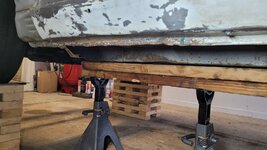
Over the last few two days I really haven't done much in the garage. I did get the car raised up onto its cribbing. I prefer cribbing over jackstands when I am going to be under the car or working on it as extensively as I will be here. The cribbing provides me with a sense of safety that jackstands do not. I actually built the cribbing around 2 years ago for this project specifically, though in that time frame I've also had a GMC 2500HD up on it. So I know it's sturdy enough and it gives me a lot of room underneath to move around.

Cribbing.jpg

Outside of that, I have been dabbling with my Youtube channel a bit. I am not experienced with video editing whatsoever, but it has been fun to put the videos together even if they are low quality. Hopefully as I continue making these my recording and editing skills will improve to the point the videos are actually entertaining and informative, at least that is the goal. If you're interested, here's a link to the channel and the first three videos I made.

Channel: https://www.youtube.com/channel/UCf13sLLnZeWfaQTX0hzkHZg


Monza Harry

Well-known member
Joined
Dec 29, 2018
Messages
1,433
Location
Windsor ON
I think the turnbuckles will help way more than you think. Take a piece of $#!+ bent steel and try straightening it with just a hammer on your bench/anvil, then with a couple of "C" clamps with modest clamp pressure watch how much less hammer action will be required for even faster results. The constant pressure will remove the wasted bounce (flex) energy. Harry
 
OP
R

RLaCasse1

Well-known member
Joined
Mar 8, 2014
Messages
272
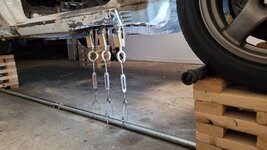
So spent some time in the garage today trying to put together a jig or "anchor" to pull the seam weld with. It's not the prettiest, but I think it will do the job, especially with the assistance of a slide hammer.

Each of these turnbuckles is rated at like 300 lbs or so, though I have zero intention of really pulling that hard on the car with this setup. Also, these body clamps are way more beefy than I had expected.

20211115_173105.jpg
 

cspcrx

Well-known member
Joined
May 2, 2014
Messages
608
Location
Phoenix, AZ
In for the results! The front jack points on the pinch welds are folded under on my CRX and have tried to come up with a way to pull them back to vertical. You have me thinking that what your doing may also work for that!
 

Steve_P

Well-known member
Joined
Sep 15, 2010
Messages
5,185
Very cool project.
I probably missed something, but if not, you really need to support the body on the frame rails for pulling, especially if you use a slide hammer; if not, the suspension will soak up much of the impact force.
 
OP
R

RLaCasse1

Well-known member
Joined
Mar 8, 2014
Messages
272
Very cool project.
I probably missed something, but if not, you really need to support the body on the frame rails for pulling, especially if you use a slide hammer; if not, the suspension will soak up much of the impact force.
Great point. This is something that I have thought about, and I have three reasons why I am not too terribly concerned with the suspension soaking up the force.
  1. The metal I am pulling is pretty thin, some of it is 22 gauge, so I'm not expecting it to require a ton of force anyways.
  2. The car is sitting on some really stiff coilovers which are also progressive coilovers, as in they are more resistant as they compress. So with the jig pulling the car down already, they will be even stiffer and resist the impact of hammering to an extent.
  3. If I find the suspension is working against me, I can easily take it out of the loop by using wood or steel to prevent any movement of the suspension.
That is my thinking anyways....

Well, it's been a couple weeks since my last post, so now is a good time to go ahead and update this thread. The last two weeks or so have been rather busy, not because of the GT-R, but because I made the silly decision to go and buy a truck that needed an engine in it. I started a thread on the truck over on the Ford-Trucks forum (Link: https://www.ford-trucks.com/forums/1680906-96-f-350-la-wawa-verde.html) if anyone is interested. Here's a portion of the first post I made....

"I just made what is arguably a poor financial decision and bought a 96 F-350, crew cab, dually. Unfortunately, it needed significant engine work, potentially an engine replacement, and had been sitting since 2005 sometime. Fortunately, I was able to talk the seller off his price quite a bit and also worked in him delivering the truck in the deal. Could have been better... but I ain't complaining. Anyways, here she is once she was delivered....

1_f2e1d636510913c819b010c2bafce4b27ac1ac86.jpg

Once it arrived, I got busy with figuring out what was wrong with the engine. The person I bought it from believe it had an issue with leaking coolant into the oil due to bad o-rings/seals on the oil cooler (at least he said); however, one climb underneath the truck proved it to be a much worse issue. Turns out it had tossed a rod, there was a significant ding in the oil pan where the rod had hit and the block had chunk knocked out of it. So began the process of pulling the engine and trying to find a replacement.

I ended up finding an engine about 4.5 hours from me, and since I had not truck, I had to rent a Dodge Ram from Enterprise to go pick it up. Gotta say, this engine moved this truck around on the highway; no quick stopping or swerving at all.
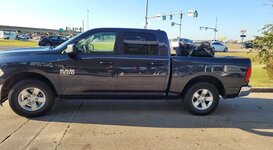
7_cc914342d5b492dc58e89acd78321987eec54a24.jpg

The engine did come out of a higher mileage truck that had rolled, so after I got it home, I went ahead and resealed it and freshened it up a bit. Once that was knocked out it was time to pull the old engine. Out with the old....

4_e23ac87a28d0bdd8054f13a45c6f849e2e800909.jpg

In with the new!!!! Well, new to the truck.
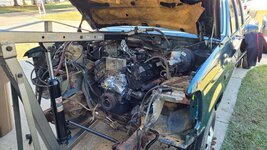
8_809ac10366de678323e94d9b3d909da9c3155aa6.jpg

At this point, I have 90% of it buttoned up. The only thing I am waiting on is a PCM and the core support bushings (right now I just have steel spacers to hold it in place), and a couple other odds and ends. Fingers crossed this pile starts after that. If it does, then I get to start working through all the other issues that likely exist from a decade and a half of sitting....... "

So the last two weeks have been hectic, as you can see, the GT-R had to come down off the cribbing so I could fit the engines for the truck into the garage. Space was TIGHT with those two in there.
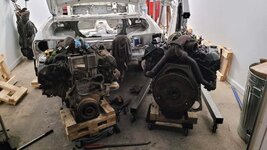
6_b106f58ba4a53a537e663d48747d50e5557334ff.jpg

And the garage proceeded to blow apart as I was digging out tools and not really cleaning things up as I went.

1638472632386.jpeg

Anyways, I spent some time yesterday getting things cleaned up so I could actually work in there today because I had a package come in with some stuff for the GT-R.

A bit over a year ago I cut the cowl top side braces off the car in preparation for repairing the cowl. The braces I cut off were rather damaged by the time they were off the car, so I wasn't going to be able to reuse them. In addition to that, Nissan does not produce and sell these braces anymore, so I had to find a set off another car. They arrived a few days ago and I was able to get them installed today. Below are some before and after pictures to give a good comparison.

1638473095535.jpeg

1638472847358.jpeg

1638473127983.jpeg

20211202_112511.jpg

There they are, welded on to the car, dressed up a bit, and with some primer over them to hopefully hold off the rust until this thing goes to an acid bath.

I'm hoping I'll get to the rocker panels in the next few weeks, but as of now, the truck is taking priority over the car.
 

tarmy

Well-known member
Joined
May 28, 2014
Messages
4,688
Location
Nor Cal
I think you need more on your plate…let’s throw Christmas in the middle of it!

Great thread OP…serious projects and effort…

oh, happy holidays And I hope the truck fires up…in a good way.
 
OP
R

RLaCasse1

Well-known member
Joined
Mar 8, 2014
Messages
272
Been a while since an update, so I figured it was time. I finally got around to pulling the seam under the car where the rocker, floorboards and inner sills join up near the jack point. GT-Rs are pretty notorious for damage in this area as they are really weak despite it being a jack point. Mine was no exception.

This is the driver's side seam, there is 1.5" of deflection from where the seam used to be, so it had been pushed up pretty severely. The picture below shows how much it was shoved up. Additionally, the inner rocker had bowed in about .5" due to the pressure of everything else being pushed up. Pretty easy to see in the second picture.

20190512_124840.jpg20211106_164748.jpg

It only took about 30 minutes or so to get everything back into what is nearly its original position. The seam pulled down nicely and I think the following repairs will be much simpler now that everything is back where it should be.... mostly!!! I was trying to avoid being too heavy handed and I think I did for the most part. Here's a shot of the seam once it was pulled, as well as the inner rocker.

20220221_164841.jpg
20220221_164834.jpg

Passenger side went just as smooth. When I started out, the seam was about 1" higher than it should be, so not as bad as the driver's side, but obviously pretty bad. The passenger side seam had been laid over (driver's side had not) and I had to straighten that out before I could put the clamps on and start pulling. The rocker had similar damage and had deflected about .5" as well. Before:

20211106_164702.jpg
20211106_164635.jpg

But like I said, it all returned to its original position... mostly!!!

20220221_164821.jpg
20220221_164814.jpg

I'm really pleased with the results, especially considering this is my first real adventure into restoring a car and doing metal work vs. just doing mechanical work. I was recommended the book Metal Bumping (author is Robert Sargent) in this thread, which I found very helpful. One of the concepts it mentioned was identifying direct vs. indirect damage. And once identified, fix the metal in the reverse order it was damage. So generally, far away indirect damage is repaired then you move towards the localized direct damage. I took that approach to pulling the seam and the process when much more smoothly than I had ever anticipated. It was a learning curve for me, but quite fun to say the least.

Anyways, the next part of this project is to pull the rockers off the car and get to work repair the damage on the floorboard, inner sill, and rockers themselves. I believe it will be much easier, now that everything is close to its original position. I thought this was a better approach than just removing metal, working everything individually, then putting it all back together. This way allows me to just focus on refining things individually.

Thanks for reading!!!
 

BORING HOP YARD

Well-known member
Joined
Jan 13, 2007
Messages
1,102
Location
Boring Oregon
I'm very happy to see the results, good job!
The "metal bumping" book is a great resource.
When I replace rockers I cut about 3/4 of an inch away from the spot welds with a cutting wheel, this give me a window to see inside the rocker while I drill out the spot welds. I find it easier to remove the outer rocker from the spot welds this way. It's hard to explain but I roll up the 3/4 inch strip that is left with a pair of needle nose vice grips after drilling the spot weld, going slow and only deep enough to remove the outer weld on the rocker. I usually get a snap when the weld lets go or it just rolls up.
Looking forward to seeing the next step.
Thanks for bringing us along.
 
OP
R

RLaCasse1

Well-known member
Joined
Mar 8, 2014
Messages
272
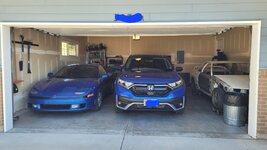
1.5 years already since I've touched this car. In that timeframe there was a cross-country move and the addition of a family. To say I've had more pressing priorities is an understatement. The car has been in storage this entire time and I finally brought it home over the weekend. Hopefully there is progress to come in the short future, but for now, she's sitting tight in a 2.5 car garage. :) I was worried she wouldn't fit with the wife's car and the VR-4 stuffed in there, but, just barely!
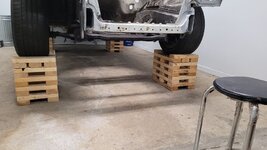
Sitting Tight.jpg

I hope to make some progress soon. Namely, stripping the car of anything that can't go through the stripping/acid-dipping process. There are only a few things, like badges, VIN place, and subframes. Once that is done, I'll build a small auto dolly so I can roll it around the garage easily and onto trailers.
 
OP
R

RLaCasse1

Well-known member
Joined
Mar 8, 2014
Messages
272
So, I'm back on the project, I stripped the car down in preparation for a chemical dipping. At this time, I just need to remove the front and rear subframes; however, I can't do that until I build a dolly for the car to sit on. For those of you with experience with car dollies, please advise me here. The dolly will be used to move the car around the garage and to load it on/off trailers when moving it from location to location.

I was considering building it out of 2"x2" / .25" wall square tubing; however, when looking at chassis dollies from vendors, they seem to be made with .106" wall (or around there). Would I be better off going to a 2.5"x2.5" / .125 wall square tube instead?

Obviously, I want it to be sturdy to be able to transport the car without issue. At the same time, I don't want to go wildly overboard with it.
 
To avoid these ads, REGISTER NOW!
Top Bottom