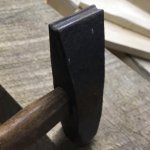
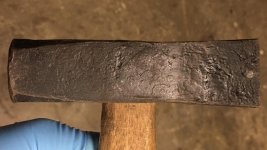
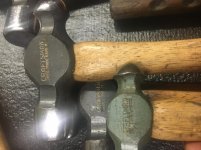
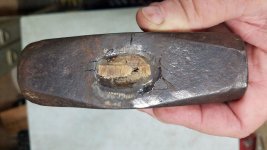
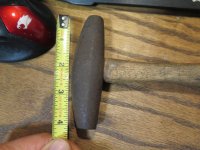
I bought a 3 lb. blacksmith hammer at a garage sale a couple of weeks ago. I bought it because it is a pattern that I have liked since I was a kid, way too many years ago! My grandfather had a lighter one of the same pattern, and I use it to this day. This one had been re-handled by someone who didn't know what they were doing. There was no wooden wedge, just a steel one, and there were big gaps where the handle fit into the head. The head was on upside down. The head itself was in good shape. It appears to have been well-used, but has not deformed, so I think it is of high quality. For $1.00 I felt it was worth a try.
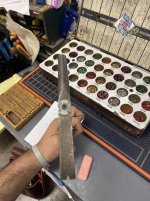
I was able to remove the head from the handle by clamping the handle in a vise with soft jaws and hitting the head with a dead blow hammer. It was that loose! I was able to work the steel wedge out of the handle without doing more damage. I then use a rasp the reshape the end of the handle to match the socket it the head as close a possible. Too much material had been removed from the front and back (long axis of the head) of the handle, so I decided to use epoxy to fill that and help hold the head on.
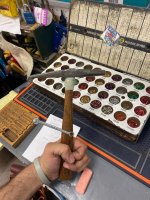
I bead-blasted the socket of the head, cleaned up the handle mating area, applied epoxy to the socket and inserted the handle. I drove in a new wooden wedge using a flat steel plate to transfer the blows over the entire top of the wedge. In spite of this, the wedge split. I think this is because the head of the handle was so damaged by the steel wedge that it resulted in uneven stresses when the wedge was driven home. The handle was quite tight, so I left it and used a toothpick to work epoxy into any voids. After the epoxy hardened, I sawed off the excess wooden wedge.
I just used it for the first time today, and it worked perfectly. I'm glad I saved a good hammer!
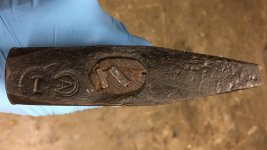
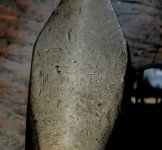
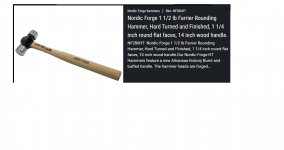
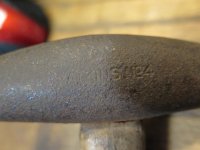
I can find no indentifying marking on the hammer head. I have seen other hammers with this form referred to as "Oregon" hammers, and that is where I live. I doubt my home state is the only place that used this design of head.