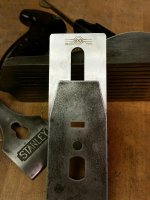
One painless way for a beginner to start is with a HF plane like this:
https://www.harborfreight.com/no-33-bench-plane-97544.html
Use a coupon and the drive away price is lunch money. And this is a nice #3 sized bench plane. Learn how to sharpen and adjust the blade. Use soft, knot free construction lumber for learning. First discovery is that you need a cabinetmakers bench with dogs to hold your project steady. Practice until you can pull a long, thin, full width shaving from a 24" section of a 2x4. Hint: your bench plane works better if you skew it 5-10 degrees.
You will know you have succeeded when you pull shavings like the ones in the pictures. Good luck.
Buy two of these.
Scrub plane first, then smoothing.
For this reason.
Unless you have (or want to invest in) a certified flat reference plate, go buy a large (12x12 or so, whatever you can find) flat porcelain tile at lowes or HD. This is good enough for the kind of work you're going to do.
Get several sheets of 3M sandpaper with 'wetordry' backing paper, from 80 up to 800 with as many grits as possible in between. Maybe 1200. Maybe 3000.
Get a dollar store bottle of cheapo windex or fill a spray bottle with distilled water (not 'purified water' as its not just pure water).
Wait for a rainy day. It's going to be a long boring day so you will want to bring a tv or laptop into the shop with you.
You need to flatten your plane's sole, so you have few or no machine marks except maybe very near to the centerline, and especially the sole around the mouth of the plane needs to be nice and flat and smooth. Once you do this with one, do the other. Go up the grits but spend way more time than you think is necessary at the lowest grit, that's where most of your true cleanup is going to come. When I flattened my HF #33, I used 4 sheets of 80 wet sanding and 1 sheet of all the others, and it's a mirror finish everywhere but for the center line.
The flatter the plane's sole is, the flatter your final results will be when planing. If the center is cupped up a little there's no harm, but you don't want too much away from flat. Think of your hand held power planer or your bench jointer. Your flat reference is everything.
To make the scrub plane you select whichever of the plane bodies has the wider mouth (or the one that needs to be filed to straighten if necessary), and maybe even want to make it wider still. Flatten them both first though because all else equal whichever sole you can get the mouth cleaner and smoother, choose the other for the scrub.
For the plane irons, basically you want to flatten the back the same as you do the soles above, but you want to do the bevels first. Look at the bevels, whichever is in worse shape set aside for the scrub blade. You can use the roller linked above and if you are going to get into chisels it's a good tool to have, same method with the flat plate and sandpaper to wet sand sharpen it, or you can get a machine like a Tormek or a 1x30 belt sander with a selection of belts and an angle guide like
this.
One of the two plane irons you are going to draw a curve (I chose a 4" radius soup can) and grind down that round profile. You will be left with only a partial bevel in the middle and have to put a new bevel on the curve edges. Not a bad idea to do a little rounding of the corners just in case one would grab something in the work piece and pull your plane and cause a nick in the blade.
Putting the bevel can be done on a bench grinder but I'm not good at setting the grinder's guides so I used it only to bluntly create the round edge. After I ground off the scrub plane's blade round I used the 1x30 with the above guide to create a new curved bevel and go up the grits to get it sharp. Just pick a spot and pivot around it an even number of times back and forth. 80 grit is fine for creating the bevel again, I did one with a lower grit but went through the same number of belts and took the same length of time either way. Believe it or not once you create the bevel on the rounded edge, it takes about the same length of time sitting in front of the machine that it takes for the smoothing plane by hand. I imagine it would take significantly longer to bevel the round edge by hand.
All the grinding and sanding you do with any power tool, you will want a tub of water to quench the blade as it starts to get too hot to hold the part thats just been worked; too much heat will ruin the hardness that comes from the temper, which results in it not holding its edge enough to be worthwhile.
My first HF #33 I did 100% on the flat plate for the sole, bevel & flat of the blade. Both blades were finished on the buffer wheel with black compound. I'm now working on a third one since a friend wants a scrub plane like mine.
I also made myself a denim strop block that I use to prolong the time between sharpening the blade. It's just a scrap of jeans glued to a 'flat' piece of pine. Stropping this way doesn't need any kind of real precision to it, since a leather strop is used without any solid piece backing it up. You just put a little white compound and go with the grain a few strokes then put it back on the plane and keep going. Much more convenient than getting the leather out every time. This doesn't last forever but it can give you a lot more use of the blade between sharpenings. I do the same with my chisels.
Total time invested in one smoothing plane and one scrub plane for me was about 6-8 hrs. I took my time and am meticulous in general. A lot of that time is something you'd only have to repeat if something bad happens like a nick in the blade or a chip in the plane's sole. If your plane sole starts to look nasty you probably do want to start down at 80 if simply cleaning it with whatever chemicals you use don't clean it; but you don't need to do all the work of removing machine marks again; wood is abrasive and you may have some much shallower scratches on it but these soles and irons are machined on a belt sander and that's the marks you're removing in the first steps.