I regularly use a handsaw, my chopsaw and circular saw are stored in a cupboard and for odd cuts its a damn sight easier just pulling out a handsaw than it is setting up for a power saw.
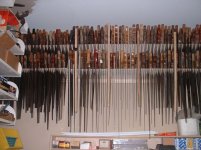
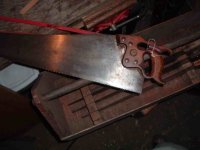
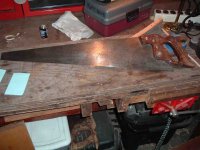
Yes, I keep a few lying around for just that reason. Aside from their convenience, I enjoy learning the ancient art of using them effectively and to slow the pace to get a sense for what I am actually doing. They tend to be more forgiving of mistakes, too. Tried all types of storage means and came up with a carry case I built for portable access. The pegboard plan works well in the garage, but heavy duty double pegs work the best, since I have had them slide off the single peg...that's a sound to remember. Hand saws are underrated, but probably for good reason. First off, one needs to find an old handsaw that has not been abused too much. Then, get it jointed , set and sharpened by a pro. I bought a "new" handsaw and it felt dumb, yes, no feed back from the blade. I had to say the cuts were impossible to get straight, too. The rubber grip on the handle made subtle shifts in position difficult, too. Back to old handsaws! I use a Disston D-95 (10 pt. x-cut) for clean, square cuts on large stock. Disston D-8 chisel tooth with finger hole for rips. The D-23 (10pt.) is for general use. Disston cabinet saw, D-12 (really old) for light work like mouldings and face frames. Keep a D-23 (5&1/2pt.) chisel tooth for smallish rip cuts. I keep an "unknown" brand 8pt. in my truck for use trimming lumber to fit in the truck bed. It never has been sharpened, has cut through wire nails (by mistake!) and lots of grunt work and it cuts 4x4's like butter. Wow, is all I can say. I think Atkins saws are fine examples of how to make a handsaw a professional tool, although I use Disston, mostly. If speed and production work is required; forget handsaws, but I like the minimal approach and there is much to gain by learning the required skill to use them. Compared to my Skil worm drive, they are quiet. I have learned about reading grains of wood, too, and notching is easy because the blade can cut blind flush to the stock, a nice feature. They are so light, too. If you find one at a GS or flea market, check for straightness as most old saws have been crimped from jamming the saw while pushing. They will be frustrating or at the best hard to use to full benefit. Stay away from pocked blades from rust corrosion. Fancy wood handles are a plus as those saws were usually the higher end in the food chain. That's a tall order, but if you find one that meets those standards, the rest is easy. I think the best storage solution for the saws' benefit is a closed cabinet, like the one posted above. I think that's my next project drawing my inspiration from those.
Great ideas. Thanks.